Bamacruiser98
Well-known member
- Joined
- May 1, 2024
- Messages
- 106

Fixed your thought above. As noted above, best place to have it made at the time.I’m curious to why a New York based company sold a rule would have a Germany marking
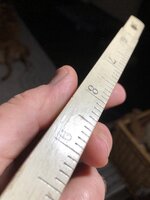
Hardwood coated with ivorine.Also what material do you think this is?
Hardwood coated with ivorine.
Or something similar. Their slide rules were made of mahogany coated in white celluloid.Probably nitrocellulose then.
Good point. Their immediate prewar, wartime, and immediate postwar slide rules were mahogany. At least according to two K&E collectors' sites, anyway. But my main point in reply to Brandon's decomposition of "ivorine" branding into celluloid was to note that K&E was famous for a similar coating on their slide rules.My K&E slide rule and my old man's are bamboo. My OM's is pre-WWII. Some older folding rules were boxwood.
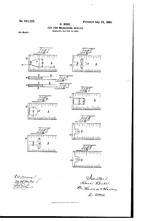
I am not sure what the "PAT'D / July 24, 1900" marking refers to. The same notice is in their 1904 catalogue, although by the 1913 catalogue, they were sufficed to say, simply, "Patented."
A review of the 1900 commissioner's report reveals that...
/ Keuffel & Esser had three (3) actions with the USPTO in 1900: a patent for a tape-reel (645,263 / issued March 13), a patent for a slide-rule (651,142 / issued June 5), and a trade-mark for the word "Paragon" when associated with mathematical and drawing instruments (35,513 / issued Dec 4). None of them match the pocket rule or date, obviously.
/ More troubling still, there were zero (0) patents issued for a folding, pocket, or any other type of rule on July 24, 1900. Several patents for rules in 1900, but none of them were issued on that date.
My first hunch when I have run into this before is it's a foreign patent, which might not be out of the question given the COO of the manufacturing, or the patent is not for the rule, but for something more peculiar, such as the metallic end pieces, or even the ivorine coating process.
More research required.
Speaking of the German mfgr, if I had to guess, I'd say that male figure with arms outspread flanked by the letters "C" and "B" is their logo.
The 1904 and 1931 catalogues are extolling the virtues of the surface for legibility and cleanliness.Gave it a light cleaning and the slicker surface surprised me.
Could be. As I said, my research was pointing to a foreign patent. A diagram and description would help. If so, a truly international product. German manufacturing for a US company based on a Canadian patent.
The 1904 and 1931 catalogues are extolling the virtues of the surface for legibility and cleanliness.

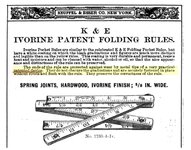
Maybe the C B stands for Conrad Bube?And partial solved mystery on the C & B. The B is clearly for Hans Bube.


Maybe the C B stands for Conrad Bube?
Category:Conrad Bube - Wikimedia Commons
commons.m.wikimedia.org
did you get a year on that ad?referring to this
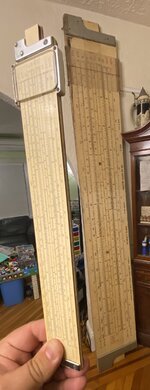
My personal collection of K+E slide rules are all mahogany, with one exception. My N105 is an 8' replica of my 4081-3. The 4081-3 Log-Log Duplex Decitrig is mahogany, but the N105 is redwood, an otherwise quite unusual choice for a slide rule, but for a classroom demonstrator it was probably selected for it's strength and comparatively light weight. I also doubt you could find enough examples of any wood other than a conifer with sufficiently straight grain to produce slightly over 8' slide rules.Or something similar. Their slide rules were made of mahogany coated in white celluloid.
More slide rules were made of bamboo than probably anything other than plastic (and plastic slide rules just plain ****). I know K+E used it a lot, though my own bamboo examples are Post and Lafayette. The perfectly straight grain of bamboo makes for a fantastic slide rule. Boxwood was certainly used for early slide rules, but went out of favor when white scales came into fashion, because boxwood doesn't take well to coatings, and it's grain just isn't quite up to the marking precision required on a slide rule.My K&E slide rule and my old man's are bamboo. My OM's is pre-WWII. Some older folding rules were boxwood.
My authoritative answer: I donno.
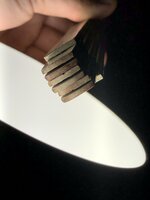
And on page two, there in parenthesis is the patent date of Feb 18 1902 for a folding wood rule, but I'm not finding that patent.That page actually includes the date of the patent in a parenthetical phrase just below the drawing of the rule.
And on page two, there in parenthesis is the patent date of Feb 18 1902 for a folding wood rule, but I'm not finding that patent.

I don’t guess there’s any way of knowing about how many of these were produced?Yup! I found a few other patents which got me the full name.