To avoid these ads, REGISTER NOW!

Keuffel and Esser folding rule?

Bamacruiser98

Well-known member
Joined
May 1, 2024
Messages
106
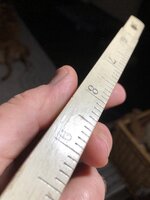
Elderly friend of mine gave me this rule today bc she knows I like old tools. I’m curious to why a New York made rule would have a Germany marking. Also what material do you think this is? IMG_6054.jpegIMG_6057.jpegIMG_6056.jpeg
 

Attachments

  • IMG_6055.jpeg
    IMG_6055.jpeg
    782.1 KB · Views: 13
  • IMG_6056.jpeg
    IMG_6056.jpeg
    718.9 KB · Views: 19
To avoid these ads, REGISTER NOW!

BrandonV

Well-known member
Joined
Jun 9, 2023
Messages
4,030
Location
Arizona
Keuffel & Esser were founded by German immigrants. Most old drafting tools I have are marked Germany.

I'm guessing they had it manufactured for them considering they probably knew quite a few people back at home.
 

minke

Well-known member
Joined
Dec 1, 2018
Messages
476
Location
fly over country
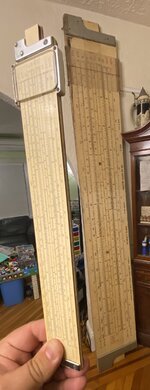
My K&E slide rule and my old man's are bamboo. My OM's is pre-WWII. Some older folding rules were boxwood.

My authoritative answer: I donno.
 

Private Lugnutz

Well-known member
Joined
Mar 30, 2012
Messages
30,595
Location
The Authentic Jersey Shore
I am not sure what the "PAT'D / July 24, 1900" marking refers to. The same notice is in their 1904 catalogue, although by the 1913 catalogue, they were sufficed to say, simply, "Patented."

A review of the 1900 commissioner's report reveals that...

/ Keuffel & Esser had three (3) actions with the USPTO in 1900: a patent for a tape-reel (645,263 / issued March 13), a patent for a slide-rule (651,142 / issued June 5), and a trade-mark for the word "Paragon" when associated with mathematical and drawing instruments (35,513 / issued Dec 4). None of them match the pocket rule or date, obviously.

/ More troubling still, there were zero (0) patents issued for a folding, pocket, or any other type of rule on July 24, 1900. Several patents for rules in 1900, but none of them were issued on that date.

My first hunch when I have run into this before is it's a foreign patent, which might not be out of the question given the COO of the manufacturing, or the patent is not for the rule, but for something more peculiar, such as the metallic end pieces, or even the ivorine coating process.

More research required.

Speaking of the German mfgr, if I had to guess, I'd say that male figure with arms outspread flanked by the letters "C" and "B" is their logo.
 

Private Lugnutz

Well-known member
Joined
Mar 30, 2012
Messages
30,595
Location
The Authentic Jersey Shore
My K&E slide rule and my old man's are bamboo. My OM's is pre-WWII. Some older folding rules were boxwood.
Good point. Their immediate prewar, wartime, and immediate postwar slide rules were mahogany. At least according to two K&E collectors' sites, anyway. But my main point in reply to Brandon's decomposition of "ivorine" branding into celluloid was to note that K&E was famous for a similar coating on their slide rules.
 
OP
B

Bamacruiser98

Well-known member
Joined
May 1, 2024
Messages
106
Here are a couple close up pics of the surface. Has a slicker surface than my stanley 86 which is ivory so I’m not sure on this. Gave it a light cleaning and the slicker surface surprised me.
 

Attachments

  • IMG_6059.jpeg
    IMG_6059.jpeg
    444.4 KB · Views: 15
  • IMG_6058.jpeg
    IMG_6058.jpeg
    485 KB · Views: 15

BrandonV

Well-known member
Joined
Jun 9, 2023
Messages
4,030
Location
Arizona
I am not sure what the "PAT'D / July 24, 1900" marking refers to. The same notice is in their 1904 catalogue, although by the 1913 catalogue, they were sufficed to say, simply, "Patented."

A review of the 1900 commissioner's report reveals that...

/ Keuffel & Esser had three (3) actions with the USPTO in 1900: a patent for a tape-reel (645,263 / issued March 13), a patent for a slide-rule (651,142 / issued June 5), and a trade-mark for the word "Paragon" when associated with mathematical and drawing instruments (35,513 / issued Dec 4). None of them match the pocket rule or date, obviously.

/ More troubling still, there were zero (0) patents issued for a folding, pocket, or any other type of rule on July 24, 1900. Several patents for rules in 1900, but none of them were issued on that date.

My first hunch when I have run into this before is it's a foreign patent, which might not be out of the question given the COO of the manufacturing, or the patent is not for the rule, but for something more peculiar, such as the metallic end pieces, or even the ivorine coating process.

More research required.

Speaking of the German mfgr, if I had to guess, I'd say that male figure with arms outspread flanked by the letters "C" and "B" is their logo.

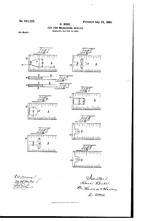
Is this not the patent? Canadian Patent Office website is currently down for maintenance.


Private Lugnutz

Well-known member
Joined
Mar 30, 2012
Messages
30,595
Location
The Authentic Jersey Shore
Could be. As I said, my research was pointing to a foreign patent. A diagram and description would help. If so, a truly international product. German manufacturing for a US company based on a Canadian patent.

Gave it a light cleaning and the slicker surface surprised me.
The 1904 and 1931 catalogues are extolling the virtues of the surface for legibility and cleanliness.
 

BrandonV

Well-known member
Joined
Jun 9, 2023
Messages
4,030
Location
Arizona
Could be. As I said, my research was pointing to a foreign patent. A diagram and description would help. If so, a truly international product. German manufacturing for a US company based on a Canadian patent.


The 1904 and 1931 catalogues are extolling the virtues of the surface for legibility and cleanliness.

Well looking closer it doesn't appear to be the right ruler despite the date.

1720752611541.png
 

Private Lugnutz

Well-known member
Joined
Mar 30, 2012
Messages
30,595
Location
The Authentic Jersey Shore
That leaves the second possibility, and there is some evidence to suggest that one of my examples, mentioned simply because there aren't too many components to the rule to begin with, might be right. It could be referring to this, which will be a little harder to find, especially since it wasn't assigned to K&E.

20240708_152730.jpg
 
To avoid these ads, REGISTER NOW!

Private Lugnutz

Well-known member
Joined
Mar 30, 2012
Messages
30,595
Location
The Authentic Jersey Shore
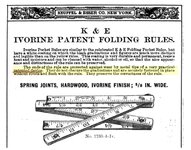
It's not an ad. It's an excerpt from page 195 of their 1913 catalog, which I provided a link to in post #4. The same description appears on page 199 of their 1909 catalog. Both can be found on IA/ITCL.

A similar description appears on page 1 of a 1904 special catalog called Instruments for Forest Work. That's the earliest and closest to 1900 K&E literature I can find. That page actually includes the date of the patent in a parenthetical phrase just below the drawing of the rule. A version of that catalog can also be found on IA/ITCL, but page 1 is missing.
 

rlitman

Well-known member
Joined
Oct 18, 2010
Messages
24,617
Location
Long Island
Or something similar. Their slide rules were made of mahogany coated in white celluloid.
My personal collection of K+E slide rules are all mahogany, with one exception. My N105 is an 8' replica of my 4081-3. The 4081-3 Log-Log Duplex Decitrig is mahogany, but the N105 is redwood, an otherwise quite unusual choice for a slide rule, but for a classroom demonstrator it was probably selected for it's strength and comparatively light weight. I also doubt you could find enough examples of any wood other than a conifer with sufficiently straight grain to produce slightly over 8' slide rules.
My K&E slide rule and my old man's are bamboo. My OM's is pre-WWII. Some older folding rules were boxwood.

My authoritative answer: I donno.
More slide rules were made of bamboo than probably anything other than plastic (and plastic slide rules just plain ****). I know K+E used it a lot, though my own bamboo examples are Post and Lafayette. The perfectly straight grain of bamboo makes for a fantastic slide rule. Boxwood was certainly used for early slide rules, but went out of favor when white scales came into fashion, because boxwood doesn't take well to coatings, and it's grain just isn't quite up to the marking precision required on a slide rule.
 

Attachments

  • IMG_0427.jpeg
    IMG_0427.jpeg
    363.3 KB · Views: 12

Private Lugnutz

Well-known member
Joined
Mar 30, 2012
Messages
30,595
Location
The Authentic Jersey Shore
You did not direct your question at me, but if by "these" you mean the folding pocket rule with the patented metallic ends and the ivorine finish, one data point to always consider in inquiries such as this is years of production.

We know it was made for at least 10 years, from 1904 through 1913, because it appears in both catalogs with the same description and P/N 1730-iv. The folding pocket rule with the same patented metallic ends but a standard yellow finish was P/N 1730. Note that in the 1921 catalog, they offered the 1730 and a 1740, which had a "white" finish. No fancy description of its properties other than better legibility. Without catalogs or ads from the intervening years (from 1914 to 1920), it's impossible to know exactly when they dropped the ivorine finish (1730-iv.) and replaced it with a white finish (1740). It might've been in production longer than 10 years, but no longer than 17 years.

That's a decent run.

I don't believe we've seen one pop up here before, but that's anecdotal, not statistically relevant. I think it's safe to call them uncommon, but rules are not one of K&E's prized collectibles, so it's hard to know how rare. They could be out there, just unreported, or lost to time and the garbage bin.

As for why it was dropped, we can only speculate, but probably cost related.

Using a 4 ft version as an example...

1904: 1730 = $.50 | 1730-iv = $.60
1909: 1730 = $.50 | 1730-iv. = $.60
1913: 1730 = $.38 | 1730-iv. = $.50

The 1921 and 1926 catalogs do not include prices, so we don't know the price of a 4ft 1740 ("white" finish), but I imagine it was the same or comparable to the yellow finish.
 

Private Lugnutz

Well-known member
Joined
Mar 30, 2012
Messages
30,595
Location
The Authentic Jersey Shore
Interestingly, they were still making one size (3 ft) of the narrow folding pocket rule with an "ivorine" finish in 1921. See here. And if you go one page back from there you will see the standard width (5/8") rules were "white" finish. I would read that to suggest that the standard width ivorine finish rules were probably not dropped in 1914 but phased out.

EDIT On the other hand, and going back to the OEM and COO (Germany), WWI almost certainly had an impact on K&E's arrangements with Conrad Bube. The war started in 1913, and even though the US did not enter it until 1917, Germany was subject to a severe blockade from 1914 to 1918, and strictly prohibited exports during that time. If K&E was still offering these rules after 1913, it was probably a different mfgr or made in-house. /EDIT
 
Last edited:
To avoid these ads, REGISTER NOW!
Top Bottom