Is it safe to assume that you have good capture efficiency/you're happy with the hood when you have a door/window open?
you can't connect the occupied space to the attic, it's "naughty". if you did want to do it you'd need a fire damper, probably one rated for hood use, which would be $$$. most of code around things is keeping the fire contained. as soon as you put in what I think you're talking about, you've functionally defeated all the fire ratings of your walls, ceilings, etc.
that aside, what is the goal again of the attic duct? to reduce airflow from the hood? why not just slow the fan down?
here's nothing wrong with putting in a damper to further restrict airflow. you won't hurt the fan, assuming it's not cooled by exhaust airflow (most non-remote/built-in fans are cooled by the hot exhaust from the stove). power draw goes DOWN when you restrict centrifugal fan airflow (not as much as slowing it down, but substantially).
assuming you wanted remote control of a damper, grab a 10" duct damper, and put a Honeywell DCA on it. something like a MS7503A2030. 24VAC/DC powered, and 0/2-10V or 4-20mA control. configure it for fail open. then you can throttle the fan down as low as you'd like.
that won't help your 100% flow situation, but it'll reduce your airflow to whatever you need it to be for single burner operation.
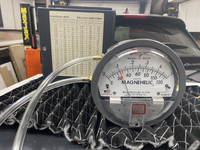
another thing to figure out is how much air you're actually moving at full fan speed. might need to borrow a flow hood to measure that. then you can get an idea of what you need for a makeup fan, instead of shooting in the dark and missing. there IS a fan that will work with your 8" passive duct/hole without redoing the siding, assuming you are up for spending $ and have room for the fan itself.
[/QUOTE]Agreed - however the 8" passive duct is already installed. Clearly I was given bad advise but it is what it is.
Regarding the shunt concept, the blower is remote and mounted on the roof exterior side. Thus the 10" duct and hood is under vacuum. The shunt would pull air from the attic space just like a roof mounted powered attic vent. The hood itself has a back draft damper at the hood itself. I assume you are thinking the ductwork has caught fire and the roof remote fan is not vacuuming the duct and therefore the flames from the duct fire go into the attic? To remedy this, the shunt could easily be ducted to a roof jack to blend in external air vs taking air from the attic space.
you can't connect the occupied space to the attic, it's "naughty". if you did want to do it you'd need a fire damper, probably one rated for hood use, which would be $$$. most of code around things is keeping the fire contained. as soon as you put in what I think you're talking about, you've functionally defeated all the fire ratings of your walls, ceilings, etc.
that aside, what is the goal again of the attic duct? to reduce airflow from the hood? why not just slow the fan down?
lol, not actually suggesting you use sterno. besides, you'd still need ventilation adequate for 130k BTU of sterno.The ship has sailed, its already in place, the kitchen is done, and we are not demoing the new kitchen to install an outdoor kitchen. Hey, I figured out if we never use it, it works great!
Rule of thumb on sizing hoods for gas units:
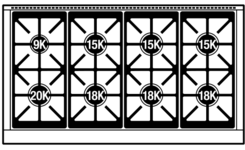
"To calculate the CFM for a gas stove, add the BTU ratings for all burners. Divide your total by 100 to figure the CFM you need." So in our case, all burners add to 128,000 btu so 1280 cfm would be the cfm recommended per this rule of thumb.
So we are in the right range. I guess we could have decided to cook on Sterno instead?
[/quote]
From the Wolf Ventilation Guide:
I am still annoyed that the Wolf hood controller only reduces voltage to around 70V. Thus the minimum fan speed is 70/120 (58%).
- CFM suggestions are based on the cooking appliance
output.- The chart below provides CFM suggestions
specific to the Wolf cooking appliance and ventilation
system used. To maximize airflow and performance,
specify a blower to match or exceed the CFM listed.- Additional CFM may be required for long duct runs (which we have)
- For the DF48850 dual fuel range and Pro Hood they recommend 1100 cfm.
- However, the 1100 cfm blower option is only for an in-line unit, not roof top. So no good.
- The remote roof top options are 900 (too small per Wolf), 1200, and 1500 cfm. Due to the long duct run, we chose the larger 1500 cfm.
So 1500 cfm *.58 = 870 cfm is the min which is still quite a bit. I would have thought the turn down would be broader range but no dice. Would have been nice for them to include the cfm range in their specs (min to max) vs just the max.
Still looking for clever, helpful, and minimally intrusive remediation options. I am following Denwood's science project.
here's nothing wrong with putting in a damper to further restrict airflow. you won't hurt the fan, assuming it's not cooled by exhaust airflow (most non-remote/built-in fans are cooled by the hot exhaust from the stove). power draw goes DOWN when you restrict centrifugal fan airflow (not as much as slowing it down, but substantially).
assuming you wanted remote control of a damper, grab a 10" duct damper, and put a Honeywell DCA on it. something like a MS7503A2030. 24VAC/DC powered, and 0/2-10V or 4-20mA control. configure it for fail open. then you can throttle the fan down as low as you'd like.
that won't help your 100% flow situation, but it'll reduce your airflow to whatever you need it to be for single burner operation.
another thing to figure out is how much air you're actually moving at full fan speed. might need to borrow a flow hood to measure that. then you can get an idea of what you need for a makeup fan, instead of shooting in the dark and missing. there IS a fan that will work with your 8" passive duct/hole without redoing the siding, assuming you are up for spending $ and have room for the fan itself.