To avoid these ads, REGISTER NOW!

Kitchen Makeup Air - Adding A Powered Makeup Air Fan to Passive System

Denwood

Well-known member
Joined
Sep 22, 2014
Messages
4,220
Location
Thunder Bay, Ontario, Canada
Fantech's silencers use non-flammable (not just acoustic foam stuffed inside) components, so you could certainly mix and match. The manufacturer (Electro) will likely give you a minimum downstream distance though...likely 3-6 feet from their heater.

I looked at a few different inline duct heater manufacturers common in the HRV world, but none of them come close to 1200 CFM. You are going to need some serious watts there depending on your design temp.
 
To avoid these ads, REGISTER NOW!
OP
L

larry4406

Well-known member
Joined
Jan 27, 2006
Messages
19,626
Location
Northern Virginia
Fantech's silencers use non-flammable (not just acoustic foam stuffed inside) components, so you could certainly mix and match. The manufacturer (Electro) will likely give you a minimum downstream distance though...likely 3-6 feet from their heater.

I looked at a few different inline duct heater manufacturers common in the HRV world, but none of them come close to 1200 CFM. You are going to need some serious watts there depending on your design temp.
Understood.

The Fantech folks put their silencer downstream of the fan and upstream of the heater. Their system is all modular which is nice.

The Electro Industries (EI) have everything all in one large box, so as you point out, if a silencer were deployed it would most likely have to be downstream of the EI boxed unit with adequate separation to the silencer.

Regarding heater sizing, I found this one chart on-line somewhere (can't remember), and I added lines for various KW heaters (10, 15, 20). IF the hood were to flow at its peak 1500 rating (doubtful), and were matched by the active makeup air unit, then a 10 KW heater would yield 30F temperature rise. This same 10 KW heater would yield almost 50F temperature rise at around 900 CFM (I think my minimum hood flow rate is around 870 cfm). Higher wattage heaters produce larger differential temperatures.
1670684691812.png

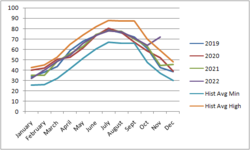
I obtained temperature data from Weather Undergound for the past several years and historic mins and maxes for my area (Sterling, Dulles Airport weather station), and plotted them in Excel. For the past 4 years, the minimum monthly average temperature has been above 30F, and the historic average min is 25.4F.

Using the 10 KW heater, at 30F temperature rise (max setting on range hood) and using the average min of 25.4F, the incoming makeup air would be 55.4F and at 50F rise (believed minimum hood setting), would be 75.4F. We set our thermostat at 68F in the winter, so this incoming air on the worst day would be somewhere between 55.4 and 75.4F which I think is acceptable.
1670685143551.png
The Electro Industries packaged units max out at 1200 cfm which might not be big enough for our installed hood (I have not measured its installed performance, its rated at 1500 cfm). Regardless, using their sizing chart and our local min average temperature of 25.4F, seems to indicate that the heater should be possibly as large as 20 kw at the upper flow and higher desired temp rise. Their chart seems to indicate that a 10 kw heater might not be large enough.
1670687345347.png

The Fantech heater sizing guidance seems odd to me. They have a chart dividing Northern America into zones. Based on this chart, it puts Virgina in Zone 6 cia the color scheme and claim that the average outside temperature in Virginia is -10 to 0 F which is a crock. If I use the 25.4F min average from the weather data for my actual area, then our location would correspond to their Zone 9. Again, I don't understand this chart.
1670687550277.png
Continuing with the Fantech literature, they have a heater sizing chart. If I am in Zone 9 based on the temperature data, then the 10 kw might be a bit undersized at the highest hood flows (small temp rise), but to upgrade to a 20KW heater, it appears would have to use the MUAS 2000 unit vs the MUAS 1600.
1670687895165.png

I need to see what size heat pack we have in our house heat pump for backup heat.

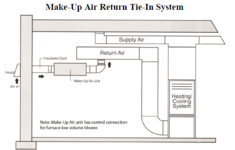
I wonder if its possible to use one of these packaged makeup air units to trigger the heat pack of the heat pump for tempering the makeup air? The Electro Industries installation schematics have an option for connecting the makeup air to the house return system and triggering the air handler fan to turn on when the makeup air system is running.
1670688923757.png

Still pondering....
 

dave*99

Well-known member
Joined
May 5, 2009
Messages
4,289
Location
Coastal NJ
Your last question about triggering the heating system is not too far away from my system detailed in post #32 on this thread.
A pressure switch in the vent hood duct triggers a damper on my make up air intake register and also triggers the fan in the HVAC system. The thermostat will sense the temperature drop and call for heat.
If your HVAC system can't keep up, you may be able to use the heat only unit from EI. No need to feed a blower into a blower.
 
OP
L

larry4406

Well-known member
Joined
Jan 27, 2006
Messages
19,626
Location
Northern Virginia
That was my conclusion - I have a 6 burner Wolf and a 600cfm hood. I told the appliance guy I don't have a wok and tend to make heat more than smoke. So 600cfm was adequate. It's a new house so makeup air was required. We have a very short run of 8 or 10" duct run into the return of the HVAC system. A pressure switch in the range hood duct triggers the damper in the makeup air duct and turns on the blower in the furnace. ------ Except it's not hooked up. The HVAC guy said everyone hates the hot,humid,damp,cold outside air coming in. But everything must be installed to pass the final inspection....... So I crack a window in the kitchen as needed.

But to the OP's questions, my range hood is programmable for it's max output. It can be set below the 600cfm max. Would it help to limit the range hood output to a lower output - commensurate with your cooking needs? Thereby lowering the makeup air needs to a more easily achievable value?

Your last question about triggering the heating system is not too far away from my system detailed in post #32 on this thread.
A pressure switch in the vent hood duct triggers a damper on my make up air intake register and also triggers the fan in the HVAC system. The thermostat will sense the temperature drop and call for heat.
If your HVAC system can't keep up, you may be able to use the heat only unit from EI. No need to feed a blower into a blower.
@dave*99

Thanks for sticking with me on this journey!

Your 600 cfm max is quite a bit less than mine. I believe mine is somewhere in the 870-1500 range min to max. I have not tested it. I think testing is needed.

Back on Post 27, I posted a chart from AirScape, which says your 10-12" passive system only flows in the 200 cfm range. For me to have a passive system, I would need a ~26" diameter duct or larger. Thus the need to have an active system.

Regarding "No need to feed a blower into a blower" I was just parroting what the EI manual indicated with the method of ducting their system to the HVAC return.

The manuals for EI and Fantech indicate that they don't run their heat units if the incoming air exceeds a set point (EI is 55F and Fantech is 60F). I would need to figure out how to enable the heat pump heat pack (and blower fan) upon pressure switch activation, but also run this thru a limit switch to drop out the heat pack if the incoming air were 55F/60F or more. I suspect there should also be a high limit switch to turn off the heat pack if air flow were low. The EI unit has a high temperature set point that appears adjustable (60-90F range).

Too much brain damage...
 

Denwood

Well-known member
Joined
Sep 22, 2014
Messages
4,220
Location
Thunder Bay, Ontario, Canada
The inline heaters I looked at did indeed have an air flow sensor as well as an adjustable thermostat, high temp cutoff snap switch, and a few other bits for reliability/safety. I would for sure look at a unit that has adjustable temp so that you adjust depending on your return location. I've found that about 65 F does the trick, but this is just 90 CFM dumped into our main living area. You can figure watts real quick by just looking at BTU/3.41 or (CFM x Delta T x 1.08) / 3.41

So (1000 CFM x 50 F x 1.08 ) / 3.41 = 15 834 watts . ~ 16kW to raise the temperature of 1000 CFM of air flow by 50 F. That's a lot of juice..over 60 amps at 220V. You may need to size your heater based on room on your panel!

If your thermostat for the the house HVAC is anywhere close to your kitchen, dumping cool air into the area will cause a problem as the rest of the house overheats.

It would be miles cheaper with respect to long term operating costs to look at an induction cook top. Then you'd be fine with a 200 CFM efficient hood. Just saying :) I know that's not your goal here.
 

dave*99

Well-known member
Joined
May 5, 2009
Messages
4,289
Location
Coastal NJ
@dave*99

Thanks for sticking with me on this journey!

Your 600 cfm max is quite a bit less than mine. I believe mine is somewhere in the 870-1500 range min to max. I have not tested it. I think testing is needed.

Back on Post 27, I posted a chart from AirScape, which says your 10-12" passive system only flows in the 200 cfm range. For me to have a passive system, I would need a ~26" diameter duct or larger. Thus the need to have an active system.

Regarding "No need to feed a blower into a blower" I was just parroting what the EI manual indicated with the method of ducting their system to the HVAC return.

The manuals for EI and Fantech indicate that they don't run their heat units if the incoming air exceeds a set point (EI is 55F and Fantech is 60F). I would need to figure out how to enable the heat pump heat pack (and blower fan) upon pressure switch activation, but also run this thru a limit switch to drop out the heat pack if the incoming air were 55F/60F or more. I suspect there should also be a high limit switch to turn off the heat pack if air flow were low. The EI unit has a high temperature set point that appears adjustable (60-90F range).

Too much brain damage...
Is my system passive? The blower in the furnace is 5’ away from a big duct headed directly outdoors. I bet when that opens most of the air hitting the heat exchanger is outside air. I suspect it’s not passive at all.
 

dave*99

Well-known member
Joined
May 5, 2009
Messages
4,289
Location
Coastal NJ
The inline heaters I looked at did indeed have an air flow sensor as well as an adjustable thermostat, high temp cutoff snap switch, and a few other bits for reliability/safety. I would for sure look at a unit that has adjustable temp so that you adjust depending on your return location. I've found that about 65 F does the trick, but this is just 90 CFM dumped into our main living area. You can figure watts real quick by just looking at BTU/3.41 or (CFM x Delta T x 1.08) / 3.41

So (1000 CFM x 50 F x 1.08 ) / 3.41 = 15 834 watts . ~ 16kW to raise the temperature of 1000 CFM of air flow by 50 F. That's a lot of juice..over 60 amps at 220V. You may need to size your heater based on room on your panel!

If your thermostat for the the house HVAC is anywhere close to your kitchen, dumping cool air into the area will cause a problem as the rest of the house overheats.

It would be miles cheaper with respect to long term operating costs to look at an induction cook top. Then you'd be fine with a 200 CFM efficient hood. Just saying :) I know that's not your goal here.
You have done a lot of good engineering on your system. Which I respect. But I don’t have or want an induction cooktop. I don’t like electric stoves either. I want a big gas flame I can see. Your hood flows a similar amount of air as my bathroom fan. Again, no disrespect. Just a different approach to cooking.
 

American Locomotive

Well-known member
Joined
Jan 8, 2017
Messages
11,016
Location
Rhode Island
So (1000 CFM x 50 F x 1.08 ) / 3.41 = 15 834 watts . ~ 16kW to raise the temperature of 1000 CFM of air flow by 50 F. That's a lot of juice..over 60 amps at 220V. You may need to size your heater based on room on your panel!
I mean not even counting fuel to run the stove, 16kw of make-up air would cost nearly 5 cents/minute to operate (10 cents/minute in my area). Would be close to $50-60/month in electricity just to use your vent hood if you cook every day.

In probably 2-3 years you'd spend enough on electricity to have just spent the extra money on a true mini commercial hood with integrated make-up air.
 

Denwood

Well-known member
Joined
Sep 22, 2014
Messages
4,220
Location
Thunder Bay, Ontario, Canada
You have done a lot of good engineering on your system. Which I respect. But I don’t have or want an induction cooktop. I don’t like electric stoves either. I want a big gas flame I can see. Your hood flows a similar amount of air as my bathroom fan. Again, no disrespect. Just a different approach to cooking.
No offense taken...I get it :)

There is a new metric out there with regard to kitchen exhausts, which appropriately focuses on extraction efficiency vs CFM. I've taken a look at quite a few exhaust hoods out there and been rather amazed at how poor the design is. They ****, but not in a good way. I suspect that's why a new measuring standard is evolving, particularly as the push to net zero housing is on. Keep in mind that the numbers I quote are actual measured at the hood. 120 CFM at the hood is plenty, and 160 CFM is overkill in my testing (smoke from wood chips in a pan).

Once you try an induction system, you'd look at a gas stove a bit differently I suspect. It's super fast, and regulates temperature very precisely. No carbon monoxide, no CO, no gas leaks, a super easy clean surface, super safe for kids. You do need to use quality cookware though. My litmus test has always been the ultimate Finn pancake (very thin) that I have always cooked used a favourite cast iron pan, seasoned over about 15 years of use. On induction, they are perfect every time. Setting 6, and cooked evenly edge to edge in the cast iron 14". In many areas of the world, gas appliances will be pretty to hard to buy..don't shoot me.

Very off topic, so I will return to the regularly scheduled program of Larry's make up air needs :)
 

dave*99

Well-known member
Joined
May 5, 2009
Messages
4,289
Location
Coastal NJ
I get your drift. In NYC I think they banned new restaurants using gas cooking. I don’t know where that will go. But I like to toss it around on the stove. I’m in my forever house. Built last year. If they don’t cut off the gas supply I’m a happy man.
 
OP
L

larry4406

Well-known member
Joined
Jan 27, 2006
Messages
19,626
Location
Northern Virginia
Is my system passive? The blower in the furnace is 5’ away from a big duct headed directly outdoors. I bet when that opens most of the air hitting the heat exchanger is outside air. I suspect it’s not passive at all.
But you said the HVAC fan is disconnected from the pressure switch and not forced to run when the pressure switch is enabled (hood on). Without fan assist, only the vacuum created internal to the home from the operating hood draws air thru the makeup air damper and duct.
 
OP
L

larry4406

Well-known member
Joined
Jan 27, 2006
Messages
19,626
Location
Northern Virginia
I mean not even counting fuel to run the stove, 16kw of make-up air would cost nearly 5 cents/minute to operate (10 cents/minute in my area). Would be close to $50-60/month in electricity just to use your vent hood if you cook every day.

In probably 2-3 years you'd spend enough on electricity to have just spent the extra money on a true mini commercial hood with integrated make-up air.
That ship has sailed.

The residential appliance market doesn't even address/acknowledge integrated make-up systems. Prior to this saga, it was unknown to me how commercial hoods address this. Again, it is moot at this point.

We could have saved all the money from the energy improvements and just have let the house leak like a sieve and then the hood would be happy. Happy hood while cooking, massive energy loss all the while not cooking.
 
To avoid these ads, REGISTER NOW!

dave*99

Well-known member
Joined
May 5, 2009
Messages
4,289
Location
Coastal NJ
But you said the HVAC fan is disconnected from the pressure switch and not forced to run when the pressure switch is enabled (hood on). Without fan assist, only the vacuum created internal to the home from the operating hood draws air thru the makeup air damper and duct.
As designed, the pressure switch turns on the blower in the furnace and opens the damper in the makeup air duct leading outdoors.

When operating, most of the air moving through the furnace will be coming from outdoors.

BUT. I did say it’s disconnected. Completely. Damper does not open at all. Blower in furnace is not triggered.
On advice from the HVAC company, it is disconnected as most of his customers did not like the results in the summer with the AC running.

I don’t have a fireplace. If I have a pressure deficit, I don’t notice it. On the rare occasion I run the hood full blast, I open a window in the kitchen. Mostly out of habit. I only need full blast when I burn the hell out of dinner.

It’s a 600 cfm hood in a new 3600 square foot house. As we learned, smaller houses with bigger hood sizes have greater requirements for functioning make up air systems.

My point is - my system (fully connected) may work for your situation.
 
Last edited:
OP
L

larry4406

Well-known member
Joined
Jan 27, 2006
Messages
19,626
Location
Northern Virginia
As designed, the pressure switch turns on the blower in the furnace and opens the damper in the makeup air duct leading outdoors.

When operating, most of the air moving through the furnace will be coming from outdoors.

BUT. I did say it’s disconnected. Completely. Damper does not open at all. Blower in furnace is not triggered.
On advice from the HVAC company, it is disconnected as most of his customers did not like the results in the summer with the AC running.

I don’t have a fireplace. If I have a pressure deficit, I don’t notice it. On the rare occasion I run the hood full blast, I open a window in the kitchen. Mostly out of habit. I only need full blast when I burn the hell out of dinner.

It’s a 600 cfm hood in a new 3600 square foot house. As we learned, smaller houses with bigger hood sizes have greater requirements for functioning make up air systems.

My point is - my system (fully connected) may work for your situation.
Understood.

Is your HVAC system a heat pump or gas furnace with AC?

I looked at the manual for our house heat pump. It is a 3 ton system. It has a 15 kw heat pack in it for emergency heat and the fan appears to be set at 1300 cfm in heat mode (not variable) to match the heat pack.

The manual says the 15 kw heat pack has a temperature rise of 37F @ 1200 cfm and 32F at 1400 cfm, so I am at 34.5F temperature rise at 1300 cfm.

I would need to figure out how to:
  • (1) Energize the blower in the air handler upon pressure switch activation
  • (2) Enable heat pack operation if the incoming makeup air temperature were below some threshold (say 55/60F)
  • (3) Provide some sort of high temp limit to drop out the heat pack
At low range hood speeds (I think around 870 cfm), the air handler would be blowing/sucking 1300 cfm. At high range hood speeds (doubtful it reaches its rating of 1500 cfm), the air handler would still be blowing/sucking 1300 cfm.

Still pondering...
 

dave*99

Well-known member
Joined
May 5, 2009
Messages
4,289
Location
Coastal NJ
I have a gas furnace and traditional AC system.
The vent system triggers the damper on the makeup air intake and the fan wire from the thermostat. Heat or cool would happen when the thermostat sees the room temperature changing.
I’d assume your system would know when to turn on the resistance heat as needed. No?
 
OP
L

larry4406

Well-known member
Joined
Jan 27, 2006
Messages
19,626
Location
Northern Virginia
I have a gas furnace and traditional AC system.
The vent system triggers the damper on the makeup air intake and the fan wire from the thermostat. Heat or cool would happen when the thermostat sees the room temperature changing.
I’d assume your system would know when to turn on the resistance heat as needed. No?
The resistance heat for the house heat pump I believe kicks in if there is more than a 2F differential between demand set point and actual (maybe its 5F, not sure). The thermostat is located in the center of the house on the first floor near the cold air return.

So if it were connected like yours, in winter, the entire house would be cooling down as the hood fan operates until such time that the thermostat senses the temperature drop, engages the heat pump for heat, and it it can't keep up, then it kicks on the heat pack as well.

The heat pump also goes thru a startup sequence. If the fan is in continuous run mode and there is a demand for heating or cooling, the fan shuts off, the startup sequence begins, and about 5-10 seconds later the fan is back on with whatever mode is being satisfied. So during this start up sequence, the range hood would not be provided with any makeup air IF the air handler in the HVAC system were the only fan.

My read of the Fantech and EI systems is they temper the incoming air immediately as it enters the home if it is less than the set point (55 or 60F) vs waiting for a global house drop and only then to react. They also say that many manufacturers set lower limits on the incoming air to the heat exchanger and that bringing cold outside air directly to the heat exchanger can damage them/void the warranty.
:dunno:

1670776269657.png
 

dave*99

Well-known member
Joined
May 5, 2009
Messages
4,289
Location
Coastal NJ
I feel your pain. The stuff in blue is probably a better explanation than what my HVAC guy said. And it's probably what led him to say leave it disconnected. Dumping humid outside air directly into my system would not be good. And cold winter air would not be any better.
 

yeldogt

Well-known member
Joined
Jan 2, 2012
Messages
18,184
Just mount one of these on the side of the house
 

Attachments

  • istockphoto-1184644547-612x612.jpg
    istockphoto-1184644547-612x612.jpg
    31.2 KB · Views: 2

yeldogt

Well-known member
Joined
Jan 2, 2012
Messages
18,184
It's not really advisable to dump unconditioned air into the return of your HVAC system as in the diagram you posted -- that's why having a system that uses a dehumidifier to inject the makeup into the supply is often shown.

The issue is still the same -- systems fighting each other.
 

Attachments

  • 1670688923757.png
    1670688923757.png
    137.3 KB · Views: 2
OP
L

larry4406

Well-known member
Joined
Jan 27, 2006
Messages
19,626
Location
Northern Virginia
It's not really advisable to dump unconditioned air into the return of your HVAC system as in the diagram you posted -- that's why having a system that uses a dehumidifier to inject the makeup into the supply is often shown.

The issue is still the same -- systems fighting each other.
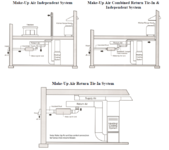
That diagram was one of 3 methods from the Electro Industries installation manual. For completeness, here are all 3 methods from their manual.

I have not yet seen a makeup air diagram with a dehumidifier and injection into the supply side of the HVAC system. Link?
1670783228561.png
 

u3b3rg33k

Well-known member
Joined
Dec 18, 2017
Messages
4,051
Fantech's silencers use non-flammable (not just acoustic foam stuffed inside) components, so you could certainly mix and match. The manufacturer (Electro) will likely give you a minimum downstream distance though...likely 3-6 feet from their heater.

I looked at a few different inline duct heater manufacturers common in the HRV world, but none of them come close to 1200 CFM. You are going to need some serious watts there depending on your design temp.
I think using direct electricity is a fools errand FWIW
Understood.

The Fantech folks put their silencer downstream of the fan and upstream of the heater. Their system is all modular which is nice.

The Electro Industries (EI) have everything all in one large box, so as you point out, if a silencer were deployed it would most likely have to be downstream of the EI boxed unit with adequate separation to the silencer.

Regarding heater sizing, I found this one chart on-line somewhere (can't remember), and I added lines for various KW heaters (10, 15, 20). IF the hood were to flow at its peak 1500 rating (doubtful), and were matched by the active makeup air unit, then a 10 KW heater would yield 30F temperature rise. This same 10 KW heater would yield almost 50F temperature rise at around 900 CFM (I think my minimum hood flow rate is around 870 cfm). Higher wattage heaters produce larger differential temperatures.
1670684691812.png

I obtained temperature data from Weather Undergound for the past several years and historic mins and maxes for my area (Sterling, Dulles Airport weather station), and plotted them in Excel. For the past 4 years, the minimum monthly average temperature has been above 30F, and the historic average min is 25.4F.

Using the 10 KW heater, at 30F temperature rise (max setting on range hood) and using the average min of 25.4F, the incoming makeup air would be 55.4F and at 50F rise (believed minimum hood setting), would be 75.4F. We set our thermostat at 68F in the winter, so this incoming air on the worst day would be somewhere between 55.4 and 75.4F which I think is acceptable.
1670685143551.png
The Electro Industries packaged units max out at 1200 cfm which might not be big enough for our installed hood (I have not measured its installed performance, its rated at 1500 cfm). Regardless, using their sizing chart and our local min average temperature of 25.4F, seems to indicate that the heater should be possibly as large as 20 kw at the upper flow and higher desired temp rise. Their chart seems to indicate that a 10 kw heater might not be large enough.
1670687345347.png

The Fantech heater sizing guidance seems odd to me. They have a chart dividing Northern America into zones. Based on this chart, it puts Virgina in Zone 6 cia the color scheme and claim that the average outside temperature in Virginia is -10 to 0 F which is a crock. If I use the 25.4F min average from the weather data for my actual area, then our location would correspond to their Zone 9. Again, I don't understand this chart.
1670687550277.png
Continuing with the Fantech literature, they have a heater sizing chart. If I am in Zone 9 based on the temperature data, then the 10 kw might be a bit undersized at the highest hood flows (small temp rise), but to upgrade to a 20KW heater, it appears would have to use the MUAS 2000 unit vs the MUAS 1600.
1670687895165.png

I need to see what size heat pack we have in our house heat pump for backup heat.

I wonder if its possible to use one of these packaged makeup air units to trigger the heat pack of the heat pump for tempering the makeup air? The Electro Industries installation schematics have an option for connecting the makeup air to the house return system and triggering the air handler fan to turn on when the makeup air system is running.
1670688923757.png

Still pondering....
FYI most economizers come out of the box with a MAT setpoint of 55F (mixed air temp)

Understood.

Is your HVAC system a heat pump or gas furnace with AC?

I looked at the manual for our house heat pump. It is a 3 ton system. It has a 15 kw heat pack in it for emergency heat and the fan appears to be set at 1300 cfm in heat mode (not variable) to match the heat pack.

The manual says the 15 kw heat pack has a temperature rise of 37F @ 1200 cfm and 32F at 1400 cfm, so I am at 34.5F temperature rise at 1300 cfm.

I would need to figure out how to:
  • (1) Energize the blower in the air handler upon pressure switch activation
  • (2) Enable heat pack operation if the incoming makeup air temperature were below some threshold (say 55/60F)
  • (3) Provide some sort of high temp limit to drop out the heat pack
At low range hood speeds (I think around 870 cfm), the air handler would be blowing/sucking 1300 cfm. At high range hood speeds (doubtful it reaches its rating of 1500 cfm), the air handler would still be blowing/sucking 1300 cfm.

Still pondering...
using the heat pump for this is a much smarter idea. or perhaps, give it its OWN heat pump?

another idea - how big is your water heater? if it's a gas fired tank system, you could get an external double wall/potable HX and pump and use it as a heat source to preheat your incoming air. I'm doing this but with a Rinnai combi boiler for a different purpose (500-800CFM of outdoor air)
The resistance heat for the house heat pump I believe kicks in if there is more than a 2F differential between demand set point and actual (maybe its 5F, not sure). The thermostat is located in the center of the house on the first floor near the cold air return.

So if it were connected like yours, in winter, the entire house would be cooling down as the hood fan operates until such time that the thermostat senses the temperature drop, engages the heat pump for heat, and it it can't keep up, then it kicks on the heat pack as well.

The heat pump also goes thru a startup sequence. If the fan is in continuous run mode and there is a demand for heating or cooling, the fan shuts off, the startup sequence begins, and about 5-10 seconds later the fan is back on with whatever mode is being satisfied. So during this start up sequence, the range hood would not be provided with any makeup air IF the air handler in the HVAC system were the only fan.

My read of the Fantech and EI systems is they temper the incoming air immediately as it enters the home if it is less than the set point (55 or 60F) vs waiting for a global house drop and only then to react. They also say that many manufacturers set lower limits on the incoming air to the heat exchanger and that bringing cold outside air directly to the heat exchanger can damage them/void the warranty.
:dunno:

1670776269657.png
you're gonna have all those problems anyways though. I have a 5 ton heat pump with NO AUX HEAT, that I use as a MAU, and the economizer handles the inlet air temp. it auto-mixes the return plenum air to 55F minimum.

maybe your system is zonable? you could have a makeup air thermostat, and that zone could dump/condition into your kitchen. then you don't bother the rest of the house as much, unless it's already running, in which case, well, no different than a big passive inlet.
 
OP
L

larry4406

Well-known member
Joined
Jan 27, 2006
Messages
19,626
Location
Northern Virginia
I think using direct electricity is a fools errand FWIW

FYI most economizers come out of the box with a MAT setpoint of 55F (mixed air temp)


using the heat pump for this is a much smarter idea. or perhaps, give it its OWN heat pump?

another idea - how big is your water heater? if it's a gas fired tank system, you could get an external double wall/potable HX and pump and use it as a heat source to preheat your incoming air. I'm doing this but with a Rinnai combi boiler for a different purpose (500-800CFM of outdoor air)

you're gonna have all those problems anyways though. I have a 5 ton heat pump with NO AUX HEAT, that I use as a MAU, and the economizer handles the inlet air temp. it auto-mixes the return plenum air to 55F minimum.

maybe your system is zonable? you could have a makeup air thermostat, and that zone could dump/condition into your kitchen. then you don't bother the rest of the house as much, unless it's already running, in which case, well, no different than a big passive inlet.
We have a hybrid heat pump water heater.

Our HVAC system is a single zone heat pump. Open to suggestions on possibly how to use a heat pump instead to temper the MUA.

How do you reduce/eliminate the lag of the heat pump MUA system when the range hood is turned on? For example, currently if someone in the house turns the range hood fan on without opening the casement window first, and our wood stove is running, we get a nice blast of wood smoke in the house! The rheostat/digital control for the hood would need to initiate the heat pump first, the heat pump determines if its heating or cooling and begin that mode of operation, then and only then does the range hood fan come on.
 

Denwood

Well-known member
Joined
Sep 22, 2014
Messages
4,220
Location
Thunder Bay, Ontario, Canada
I'm going out on a limb here, but I highly doubt any heat pump (water or heat source) is going to have the response time/temp delta to do what you're wanting here on precondition. You want the makeup air system on pretty much instantly with the range hood to prevent that wood smoke issue. If you do decide to incorporate your existing heat pump, there will for sure be lag in conditioning. Electric would the best way I would think to do this...but it will be at a cost as has been calculated.

I would think it might be more cost effective to add makeup air near the wood stove, using the wood stove itself to condition the air. Just a thought...
 
To avoid these ads, REGISTER NOW!
Top Bottom