To avoid these ads, REGISTER NOW!

Kitchen Makeup Air - Adding A Powered Makeup Air Fan to Passive System

Denwood

Well-known member
Joined
Sep 22, 2014
Messages
4,202
Location
Thunder Bay, Ontario, Canada
Well, in 2003, our home was blower door tested at a whopping 6.73 ACH. Zero insulation in the walls. I figure that's changed a lot since then with extensive renovation, spray foam etc. Has me pretty curious to do a retest.
 
To avoid these ads, REGISTER NOW!
OP
L

larry4406

Well-known member
Joined
Jan 27, 2006
Messages
19,560
Location
Northern Virginia
The 2018 IECC specifies a maximum air leakage rate of 3 ACH in the NJ Climate Zones.

Air Changes per Hour:

  • The number of times the full volume of air in the house flows out and is replaced with outdoor air flowing in during a one hour period.
  • Calculated by measuring the leakage rate (in cubic feet per minute - CFM) in the house with a blower door, converting it to cubic feet per hour, and dividing it by the house volume (in cubic feet).
  • ACH = (CFM x 60) / Volume

Here is the reference.

Do the math for your volume. A big house will leak enough - but still be required to have makeup air if the hood is over 400 CFM.
Go figure.....
Thanks. That was kind of my point that a big house built today with best practices, would leak enough such that even a ****** poorly performing makeup air system would allow the hood to still function properly.

The inspectors ask the hood size. When you tell them its greater than 400 cfm, then they start to inspect further. When they do, they look to see that the makeup air system is present, there is connected duct between the screened exterior wall cap and inlet plenum, that the wall cap has a screen but no flapper, that the motorized damper for the makeup air system opens and closes when the hood turns on/off, and that flapper on the range hood exhaust opens when the hood is running. The inspectors never question the max hood cfm nor the flow capacity of the makeup air duct. This has been my experience in 5 counties where I build in Northern VA and MD.

So lets run some numbers:

My basement is 1979 SF at 8'
My first floor is 2107 sf at 8".
So total volume of 32,688 ft^3.
Max allowable leakage of 1634.4 cfm at 3ACH for my house.

Since the kitchen hood at my house is rated 1500 cfm and we are clearly having issues even when turned down greatly, I assume this means the house is much tighter than 3ACH.

A recent McMansion I did has the following:
Basement - 3,646 sf @ 9'
First Floor - 3,660 sf @ 10'
Second Floor - 3,144 sf @ 9'
Attic - 824 sf @ 8'
So total volume of 104,302 ft^3
Max allowable leakage of 5,215.1 cfm at 3 ACH
Energy Star tested at 1.94 ACH50 (actual leakage 3,372 cfm?)
Kitchen hood max rating is 1300 cfm
Passive makeup air system with 8" line just like my house
No masonry fireplaces to back draft or stink
Three (3) vented propane gas fireplaces - potential for back drafting exists
Three (3) sealed combustion gas furnaces with intake and exhaust piping to outside
Two (2) Rinaii tankless water heaters with intake and exhaust piping to outside
Barometric fresh air system set to 114 cfm.
 
Last edited:
OP
L

larry4406

Well-known member
Joined
Jan 27, 2006
Messages
19,560
Location
Northern Virginia
How did that house get a certificate of occupancy with the 8" passive makeup air and a hood over 400 CFM?

Who is paying off the inspector?
Passive systems with interlocked makeup air dampers are legit in residential construction. No one paid off the inspector. It's just that, as I have learned, the passive systems clearly have their limited performance which few if any are aware of, obviously including the inspectors as well.

Mechanical inspector saw the makeup air system in place at the rough-in. At the final inspection, same inspector saw the motorized damper in the makeup air plenum open and close (interlocked) in response to hood operation, felt the incoming air thru the passive duct while hood was on, inspected the screened intake and witnessed the flapper exhaust wall cap open/close, and called it good.

Right or wrong, this is how it goes down with inspections in the 5 counties I build in (two different states) and has been like this ever since the makeup air requirement for hoods more than 400 cfm went into effect.

I have never paid these passive systems any mind as all has seemed proper. I even used the same 8" passive makeup air system at my house as that's what has been in play at the day job all these years.

The difference is my house is a fraction of the size of the McMansions I build, and I have a masonry fireplace that we use so it is soot laden and is clearly evident if there is a back draft. Your body doesn't tell you "Hey I feel like I am suddenly in a vacuum" when the hood is on so you are none the wiser if there is an issue. I also observed at my house that the spring loaded hinge on the fire rated door from the house to the garage is not strong enough to close and latch the door like normal while the hood was off. Most houses don't have the spring loaded hinge so would be unaware.

With my house, I have unfortunately found that the performance limitations of passive systems become more apparent as the house volume diminishes, as the tightness of the house increases, and the spread between the 401 CFM threshold and the actual hood size increases.

I would wager that most if not all of the makeup air systems out there "work" by nature of the inherent cumulative leakage of the house and the passive systems provide some meager effect in the low 100's of cfm's.

My prior 2001 built house had a 1200 cfm Thermador roof top mounted range hood exhaust via 10" duct. That house was built prior to the makeup air requirement. House had a wood burning fireplace, in retrospect was not sealed well (but typical for the period when it was built), and did not have a spring hinge on the door to the garage. Hood performance was excellent and we never had a fireplace soot smell. Clearly the leakage of the house provided the needed makeup air and we were none the wiser.
 
Last edited:
OP
L

larry4406

Well-known member
Joined
Jan 27, 2006
Messages
19,560
Location
Northern Virginia
I think that was Larry's point. That setup is code compliant.
Correct.
Even the passive makeup air?

I thought that was only good if the hood is 400 cfm or less.
Code says makeup air is required only if the hood is MORE than 400 cfm (ie 401 cfm is when makeup air systems are required.

You will find many hoods marketed at 390-400 cfm exactly for this reason to not trigger the makeup air requirement.

Edit - To be more clear, if your hood is lesser than "more than 400 cfm", you don't have to do anything. So 400 cfm and below, Code cares less.
 
Last edited:

danski0224

Well-known member
Joined
Jan 29, 2005
Messages
13,517
Location
Near Naperville, IL
Correct.

Code says makeup air is required only if the hood is MORE than 400 cfm (ie 401 cfm is when makeup air systems are required.

You will find many hoods marketed at 390-400 cfm exactly for this reason to not trigger the makeup air requirement.
That hood in the last example was given at 1300 cfm, which unless I'm exceptionally bad at math, is greater than 400 cfm.

Or am I missing something?
 

jar944

Well-known member
Joined
Jul 26, 2010
Messages
5,955
Location
Northern VA
That hood in the last example was given at 1300 cfm, which unless I'm exceptionally bad at math, is greater than 400 cfm.

Or am I missing something?

Less than 400 nothing is needed. More than 400 a passive hole is good enough, 401 to 450000 cfm makes no difference
 

Denwood

Well-known member
Joined
Sep 22, 2014
Messages
4,202
Location
Thunder Bay, Ontario, Canada
Larry, I think you’ve highlighted an issue that will require some code changes, likely triggered by open combustion devices.

My home has a condensing furnace, on demand hot water and non venting (condensing dryer). We do have a fireplace, but it uses outside air for combustion. So pulling negative pressure has no critical CO issues, just a potential back puffing fireplace if we open the door to load it (if exhaust fans are running). That issue could be resolved by just opening a nearby door when loading the fireplace. The kitchen exhaust fan is also lower flow.

Now apparently Minnesota has some very elaborate make up air requirements that likely reflect the above. Cold climate builds are quickly becoming tighter, but air requirements for combustion have also changed.

I’ve also more or less decided to bail on the makeup air via HRV concept. Here’s why. Below freezing, the Venmar I am working with uses an internal sensor (just one in the intake air stream) that has a specific recirc schedule to keep the core above freezing. Below -17C, it’s something like 10 min recirc, 30 exchange. So if I dynamically unbalance the HRV, (bring in a lot more cold air vs exhaust) the core will freeze up prematurely as the simple HRV control logic no doubt assumes balanced flow. In recirc, or with a frozen core, makeup air would be zero. In other words, if you live in a colder area, unbalancing won’t likely work with a typical heat exchange core. In a warmer climate however, I would do it.
 

yeldogt

Well-known member
Joined
Jan 2, 2012
Messages
18,184
My NJ place passed all the codes when it was redone for the second time I have owned it in 2015 ... it's fairly large.

The place in PA was a church .... so .. well -- you can imagine
 

yeldogt

Well-known member
Joined
Jan 2, 2012
Messages
18,184
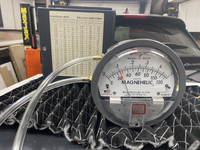
I'm using an old school magnahelic diff gauge for the house readings. High side tube ran outside (low/no wind during test), low inside the house. It's shown here on the mod'd HRV (fresh door ports) as I baseline flow vs pressure.

And ya, I need a stand for it...ha. It needs to be plumb/level for accuracy.

1666380529862.png
What's the model number ? how do you run the tubes ....one in and one out ?
 

dave*99

Well-known member
Joined
May 5, 2009
Messages
4,278
Location
Coastal NJ
See post 122.

1300 cfm.
What exactly are you questioning? A 1300 CFM hood will require a passive makeup air system that opens and closes with the turn on and off of the hood. That will meet code. Code does not actually require the system to "work well" It does not require a 1300 CFM forced makeup air system.
 

danski0224

Well-known member
Joined
Jan 29, 2005
Messages
13,517
Location
Near Naperville, IL
Exactly.

How did the house in question, as detailed in post 122, pass inspection?

I thought I asked a simple question after post 122, but maybe reading comprehension is poor... or my question was too complicated.
 

u3b3rg33k

Well-known member
Joined
Dec 18, 2017
Messages
4,048
I think the "oh it'll leak enough" is a cop out that should be reserved for fart fans. anything that moves 100s of CFMs should not be intentionally pulled through "leaks". otherwise you can make those leaks worse over time.
 
OP
L

larry4406

Well-known member
Joined
Jan 27, 2006
Messages
19,560
Location
Northern Virginia
That hood in the last example was given at 1300 cfm, which unless I'm exceptionally bad at math, is greater than 400 cfm.

Or am I missing something?
No. 1300 > 401 cfm so your reading comprehension is good.
Exactly.

How did the house in question, as detailed in post 122, pass inspection?

I thought I asked a simple question after post 122, but maybe reading comprehension is poor... or my question was too complicated.
You didn't read the next line after the the 1300 cfm statement.

I have since bolded it to make it more clear. That house (and mine) have a 8" passive makeup air system with mechanical interlocked damper.

So, you can have a system, it looks right, it changes state like its supposed to, but is otherwise worthless yet all is good in the world.
 

Denwood

Well-known member
Joined
Sep 22, 2014
Messages
4,202
Location
Thunder Bay, Ontario, Canada
What's the model number ? how do you run the tubes ....one in and one out ?
https://www.itm.com/product/dwyer-2301-magnehelic-pressure-gauge-0-5-0-0-5 (note the photo is incorrect, but part number/description is correct.

Model: Dwyer 2301

I just ordered 3/16" ID, 5/16" OD vinyl tubing to use with it. One length of tubing goes to high side port ****** on the gauge, the other to the low side ******. If you're measuring incorrectly the needle will bottom, so you just reverse the free end of the tubes. There are cheaper digital ones available via amazon, but I figured the analog version would be more accurate at the price point.
 
To avoid these ads, REGISTER NOW!

yeldogt

Well-known member
Joined
Jan 2, 2012
Messages
18,184
https://www.itm.com/product/dwyer-2301-magnehelic-pressure-gauge-0-5-0-0-5 (note the photo is incorrect, but part number/description is correct.

Model: Dwyer 2301

I just ordered 3/16" ID, 5/16" OD vinyl tubing to use with it. One length of tubing goes to high side port ****** on the gauge, the other to the low side ******. If you're measuring incorrectly the needle will bottom, so you just reverse the free end of the tubes. There are cheaper digital ones available via amazon, but I figured the analog version would be more accurate at the price point.
Thanks ...
 

u3b3rg33k

Well-known member
Joined
Dec 18, 2017
Messages
4,048
No. 1300 > 401 cfm so your reading comprehension is good.

You didn't read the next line after the the 1300 cfm statement.

I have since bolded it to make it more clear. That house (and mine) have a 8" passive makeup air system with mechanical interlocked damper.

So, you can have a system, it looks right, it changes state like its supposed to, but is otherwise worthless yet all is good in the world.
IIRC "at a minimum" a passive return is at least one size up from a supply duct, so your 8" should be a 12", maybe a 14", given the filter. Have you checked out the self-contained MAUs that I and others have mentioned? I think those are your best bet if you want to avoid the DIY/custom rabbit hole.
 
OP
L

larry4406

Well-known member
Joined
Jan 27, 2006
Messages
19,560
Location
Northern Virginia
IIRC "at a minimum" a passive return is at least one size up from a supply duct, so your 8" should be a 12", maybe a 14", given the filter. Have you checked out the self-contained MAUs that I and others have mentioned? I think those are your best bet if you want to avoid the DIY/custom rabbit hole.
Yes - I first mentioned the Fan Tech system way back on Post 25 & 29 which is what you suggested as well.

The Fan Tech system is the leading contender right now for me, $$$.
 

dave*99

Well-known member
Joined
May 5, 2009
Messages
4,278
Location
Coastal NJ
Thanks. That was kind of my point that a big house built today with best practices, would leak enough such that even a ****** poorly performing makeup air system would allow the hood to still function properly.

The inspectors ask the hood size. When you tell them its greater than 400 cfm, then they start to inspect further. When they do, they look to see that the makeup air system is present, there is connected duct between the screened exterior wall cap and inlet plenum, that the wall cap has a screen but no flapper, that the motorized damper for the makeup air system opens and closes when the hood turns on/off, and that flapper on the range hood exhaust opens when the hood is running. The inspectors never question the max hood cfm nor the flow capacity of the makeup air duct. This has been my experience in 5 counties where I build in Northern VA and MD.

So lets run some numbers:

My basement is 1979 SF at 8'
My first floor is 2107 sf at 8".
So total volume of 32,688 ft^3.
Max allowable leakage of 1634.4 cfm at 3ACH for my house.

Since the kitchen hood at my house is rated 1500 cfm and we are clearly having issues even when turned down greatly, I assume this means the house is much tighter than 3ACH.

A recent McMansion I did has the following:
Basement - 3,646 sf @ 9'
First Floor - 3,660 sf @ 10'
Second Floor - 3,144 sf @ 9'
Attic - 824 sf @ 8'
So total volume of 104,302 ft^3
Max allowable leakage of 5,215.1 cfm at 3 ACH
Energy Star tested at 1.94 ACH50 (actual leakage 3,372 cfm?)
Kitchen hood max rating is 1300 cfm
Passive makeup air system with 8" line just like my house
No masonry fireplaces to back draft or stink
Three (3) vented propane gas fireplaces - potential for back drafting exists
Three (3) sealed combustion gas furnaces with intake and exhaust piping to outside
Two (2) Rinaii tankless water heaters with intake and exhaust piping to outside
Barometric fresh air system set to 114 cfm.
I was looking at this calculation for your house and I see you included the volume of the basement. Just for discussion purposes - does it really count? Is is conditioned space? And you mentioned the attic in another house.

Wouldn't the volume for ACH calculations be only the volume of the conditioned space? My attic is ventilated - it may as well be considered outdoors.
 
OP
L

larry4406

Well-known member
Joined
Jan 27, 2006
Messages
19,560
Location
Northern Virginia
I was looking at this calculation for your house and I see you included the volume of the basement. Just for discussion purposes - does it really count? Is is conditioned space? And you mentioned the attic in another house.

Wouldn't the volume for ACH calculations be only the volume of the conditioned space? My attic is ventilated - it may as well be considered outdoors.
Good question - not sure I have the definitive answer.

It was my understanding that the volume is the conditioned space volume, as that is what is undergoing the air changes. To that end, an unfinished basement is conditioned and climatized but not a real living space per se.

In my case, our house has a single zone heat pump that heats the basement (unfinished) and the first floor so I included it all in the calc.

The other house from the day job I referenced has a finished attic with bedroom, playroom, and bathroom and thus why that volume was included as well. The finished attic space has its own Zone 4 heat pump.
 

dave*99

Well-known member
Joined
May 5, 2009
Messages
4,278
Location
Coastal NJ
Good question - not sure I have the definitive answer.

It was my understanding that the volume is the conditioned space volume, as that is what is undergoing the air changes. To that end, an unfinished basement is conditioned and climatized but not a real living space per se.

In my case, our house has a single zone heat pump that heats the basement (unfinished) and the first floor so I included it all in the calc.

The other house from the day job I referenced has a finished attic with bedroom, playroom, and bathroom and thus why that volume was included as well. The finished attic space has its own Zone 4 heat pump.
I see you used conditioned spaces and that does make sense.
 

Denwood

Well-known member
Joined
Sep 22, 2014
Messages
4,202
Location
Thunder Bay, Ontario, Canada
Figured I'd update this thread with a new finding. You can use this off the shelf Leviton 0-10V dimmer (ZS057-DOZ) to control any of the EC fans from Terrabloom, AC Infinity, Vivosun etc. It is paired with my Hubitat automaton hub (smarthings should work as well). What's super cool is that it can both power and control speed (via the extra two 0-10V control wires) for make up air, or in my case..for the HRV.

Leviton describes it as requiring an "Illumina RF" hub, but they don't mention anywhere that it's actually a standard Zigbee device so you can pair with a hub (Hubitat in my case) and control both on/off and set any speed you like from the hub. That's pretty cool!

My kitchen fan is already triggered by powering up the Induction Cook top ( https://www.garagejournal.com/forum...nline-ecm-fan-turbocharge-yer-exhaust.491330/ ) so I can now easily play with the HRV exhaust and intake speeds to add some make up air as required.

You could also wire this Leviton 0-10V dimmer to an inline EC exhaust fan (I'm using a 6" inline Terrabloom EC fan) to both power it up and ramp it's speed dynamically with power use by the cooktop...that's pretty cool too. This way you have full automation and full manual control if you want it. You'd just need to use it with the Aeotec Zwave Heavy Duty Appliance Smart Switch 240V. Full automation for the cooktop and exhaust fan dynamic speed control for about $200 bucks (if you're already using Hubitat, SmartThings etc.) :)

The Leviton physical device has 10 steps for speed, but the driver (via automation) allows you choose anywhere from 1-99 ...much finer control if you're using for example a larger 10" fan for makeup air etc. You could 100% then control/coordinate the exhaust fan and make up air fan with great precision.

IMG_8464.JPG

img_8462-jpg.1760265
 
Last edited:

yeldogt

Well-known member
Joined
Jan 2, 2012
Messages
18,184
Interesting .... I have the lutron versions for lighting in my new house ..... never gave it a thought for motor control.
 

Denwood

Well-known member
Joined
Sep 22, 2014
Messages
4,202
Location
Thunder Bay, Ontario, Canada
@larry4406 , we had our first fire (high efficiency fireplace with outside air supply) last night and I was 100% able to stop any back smoking into the room while loading the fire ... by ramping the HRV fresh air fan to max while loading. Unbalancing via the HRV is very much a viable strategy IMHO to deal with back drafting. That said, efficiency on the HRV/ERV is affected if you vary air flow:

Scenario 1 is an imbalance with about 40 CFM more stale (warm air) leaving the house vs fresh (cold) coming in. This predictably skews heat transfer to favour efficiency as more heat is added to the HRV core vs removed.

system running fresh at 40 CFM and stale at 70 CFM.jpg

Scenario 2 is an imbalance of about 40 CFM with more incoming (cold air) entering the house vs stale (warm) exhaust air leaving. This predictably skews heat transfer downwards as more heat is removed from the HRV core vs added.

system running fresh at 64 CFM and stale at 47 CFM.jpg

I don't see this as an issue at all if, although in very cold conditions scenario 2 would likely freeze up the core if run for a longer period.

The automation and independent speed control of the fans is working well with our kitchen exhaust hood. In that case if the kitchen exhaust system is triggered by the induction cook top, the HRV just ramps to max speed (both fans). In my case, that's about 75 CFM balanced air flow.

I'll probably just add a wireless trigger/button to run an imbalance scene so that when running the fireplace, I can skew the balance to fresh air.
 

Denwood

Well-known member
Joined
Sep 22, 2014
Messages
4,202
Location
Thunder Bay, Ontario, Canada
I replaced the HRV intake 4" fan with a 6" EC fan, also from Fantech. It's their cheaper EC fan, which as far as I'm concerned is 100% ok. The motor mount is plastic, and it does not have the connecting block as I've pictured for the S4 (more expensive fan).

Due to the construction of the core (basically coreplast), there is a quite a bit more resistance to flow on the fresh air side of the core. I've also added the MERV13 filter box, so again a bit more resistance. For this reason, the six inch fan (higher CFM) combined with the 4" fan (exhaust) is a near perfect match. I can get a balanced 100 CFM from the system now, fully ducted.

If you're planning on using the AC infinity fans (and controlling like I am, via the Leviton dimmer) then I'd highly recommend the less expensive fan:


1668538299419.png


The one gotcha, is that you'll need to cut off the USB-C type connector on this fan to expose the four wires. It does not have a connector block under the cover plate on the motor. The included Molex connector does not have pin 4 connected internally, which you need, so you can't use that for connections. If you cut the USB C plug on the end of the control cable off, you'll see the four wire colours:

AC Infinity Yellow to Leviton Violet
AC Infintity White to Leviton Grey
AC Infinity red and black not connected (just cap them off).

As far as I can tell, this fan is identical to the more expensive ones, but a cheaper case so is ideal if you're just ditching their controller for automation anyway. They sell these fans up to 8" in the EC flavours with airflow: 724 CFM | noise: 42 dBA |.
 
Last edited:

u3b3rg33k

Well-known member
Joined
Dec 18, 2017
Messages
4,048
I'm feeling lazy, so instead of checking spec sheets, what kind of static can those fans do? someone on here did a kitchen exhaust fan with what looked like an axial fan, and i've got a low opinion of most of this sort of thing (until proven otherwise):
1668580835043.png
 

PoorUB

Well-known member
Joined
Mar 29, 2021
Messages
11,701
Location
Fargo, ND
I'm feeling lazy, so instead of checking spec sheets, what kind of static can those fans do? someone on here did a kitchen exhaust fan with what looked like an axial fan, and i've got a low opinion of most of this sort of thing (until proven otherwise):
1668580835043.png
Pretty much none. They will assist air flow, but will not move much air on there own. Add any resistance to air flow, long ducts, air filers or and HRV heat exchanger and they drop of terribly, maybe .01 -.02 inches of water column.
 

Denwood

Well-known member
Joined
Sep 22, 2014
Messages
4,202
Location
Thunder Bay, Ontario, Canada
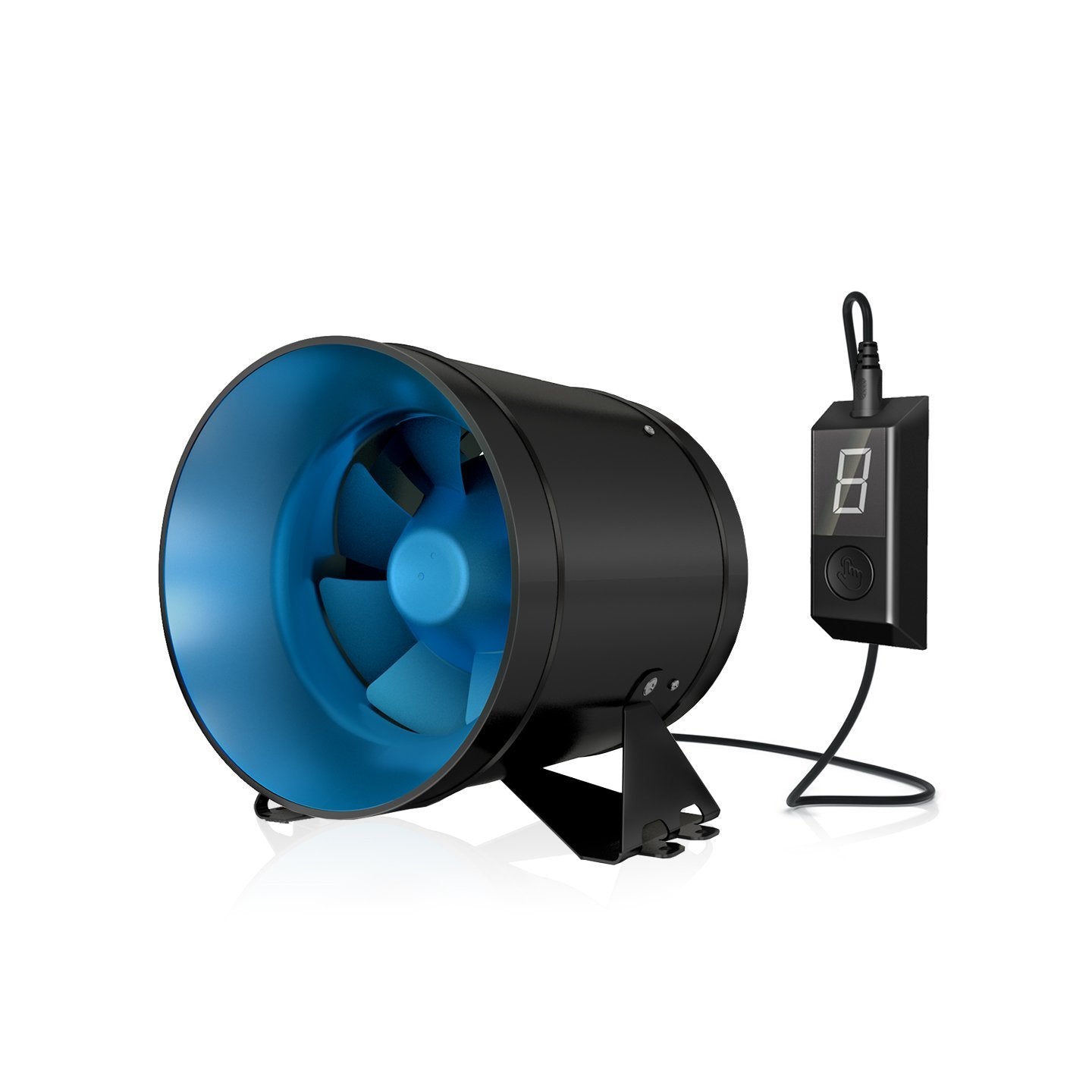
The AC Infinity and Terrabloom EC ducted "mixed flow" fans that I’m using actually do quite well with static pressure. This is the flow/pressure chart for the Terrabloom EC fan I used for our automated kitchen exhaust system. It uses 36 watts at full speed. I've measured it at 160 CFM actual and that's in a duct setup that drops from 6" to 5" to 4" duct with an exterior 4" insulated Broan Eco-Vent (total about 12 feet with a few elbows)...so quite restrictive. That model has a metal case so would pass code here for kitchen exhaust...


terrabloom-6-ec-inline-duct-fan-with-variable-speed-controller-ecmf-150-288-cfm-36w-635166_700x.jpg

terrabloom-6-ec-duct-fan-with-remote-speed-controller-288-cfm-36w-861630_700x.jpg

And with my HRV project, the 6" AC Infinity fan is on the high pressure side of the core, so at .13" w.g. (just measured across the heat exchanger core) has no problem moving 100 CFM through the system. That's full ducted with a fairly restrictive 4" fresh air intake, HRV core, internal filters, 14x14x4 filter box with MERV13 filter, and about 6" of custom duct muffler. It dumps into our main living area and is quiet enough with the duct muffler etc. so that no further sound treatments were needed.

These fans have plastic cases, so are ok for the HRV. I did not find a flow curve for the AC Ininity fans, but the 6" fan is rated at 352 CFM, and is quieter than the Terrabloom (6" rated at 288 CFM) as the fan blades/motor case is at least 2" larger OD. If you're looking for higher CFM with the least amount of noise, I suspect the AC infinity EC fans would be hard to beat. They rate the sound at a very low speed @ 34 db, but I'm easily less, at near full speed, by using a 6' long duct muffler.


For a whopping $100-130 for these EC fans, there is no comparison to the cheaper duct booster fans which IMHO are a complete waste of cash.
 
Last edited:

u3b3rg33k

Well-known member
Joined
Dec 18, 2017
Messages
4,048
well you sold me on price. I never meant to imply that the duct booster fans were any good, but I'm used to noise/price/tradeoffs (like delta muffin fans, or high static closed impeller fans).
 

Denwood

Well-known member
Joined
Sep 22, 2014
Messages
4,202
Location
Thunder Bay, Ontario, Canada
well you sold me on price. I never meant to imply that the duct booster fans were any good, but I'm used to noise/price/tradeoffs (like delta muffin fans, or high static closed impeller fans).
I have used the old school duct fans and they will move air at low static pressure....but they are noisy, and use a lot of power. I guess we can thank all the pot growers for the market in inexpensive EC fans...ha.
 

yeldogt

Well-known member
Joined
Jan 2, 2012
Messages
18,184
I have used the old school duct fans and they will move air at low static pressure....but they are noisy, and use a lot of power. I guess we can thank all the pot growers for the market in inexpensive EC fans...ha.
Years ago ... pre 1990 there was no other choice. They were better than nothing -- larger ducts required. I remember having to use 8" round at a minimum with those fans -- proper placement was required for sound.

The jet blade type is interesting .... any benefit over the axial? Why would you pick over the axial ? The great thing about the fantech units --- they pump it it out. I have used the 4" for basement rooms .... the 6" are better for longer distance.

My new build has a far flung bathroom that my guess will need a booster -- I made two potential spots for one but I'm still trying to figure out how to control it. I think a simple thermostat is enough.

For make up air standard fans seem to fail .... they don't have the ability to overcome much static.

noticed your post on GBA (assume that was you) .... wish there was more back and forth over there. It's all one sided and I never stay very long
 

Denwood

Well-known member
Joined
Sep 22, 2014
Messages
4,202
Location
Thunder Bay, Ontario, Canada
yes, that was me ...ha.

The reason I started experimenting with the mixed flow inline EC fans was primarily for efficiency, but now that I can control them via 0-10V and automation, I guess it's just availability at this point. They work well with static pressure...
 
OP
L

larry4406

Well-known member
Joined
Jan 27, 2006
Messages
19,560
Location
Northern Virginia
Well the kitchen passed final inspection with flawed passed makeup air system and all. Exactly what I expected.

I had streamers in place hanging from the ceiling grille and a ladder for him to see the mechanical damper was interlocked and visually see the incoming makeup air flow via the streamers flapping in the breeze, but he never even asked me to turn it on!

Regardless, I still need a permanent solution. We are using the nearby casement window method for now.

The large Fantech units (MUAS1200 and MUAS1600) are all listed as being on indefinite back order as are some of their inline heaters. Nice, real nice.

I recently stumbled upon a similar packaged makeup air system by Electro Industries (EI). Looks like a nice unit (no silencer though like Fantech's). Their largest is a 1200 cfm rated unit (our hood is rated 1500 cfm). These units appear to be in stock with options for 5 kw, 10 kw, and 15 kw heaters.

However, unlike the Fantech system which is insulated and can be installed in non-conditioned attic spaces, the Electro Industries cannot be installed in non-conditioned spaces. Their 1200 cfm unit requires 14" ducting which poses a challenge with the 2x10 16" o/c floor joists at the basement ceiling and the net 7'-8" basement ceiling height. These units use CT's like the Fantech ones.

Still thinking...
 
To avoid these ads, REGISTER NOW!
Top Bottom