To avoid these ads, REGISTER NOW!

Lake water pump issues

Rod N

Well-known member
Joined
Jul 21, 2011
Messages
835
Location
Keswick, Ontario
Hello Gents,
My house already had a pump for using lake water on the lawn when I bought it.
It has me a bit stumped.
When I first plugged it in it worked well. If I put a sprinkler on it, it would slowly lose pressure and then blow the breaker.
Now it does nothing.
Is priming the issue? The tank doesn't fill with water. I'm pumping about 100 ft with an 10 ft. rise.
Any tips?
Thanks
Rod
 

Attachments

  • IMG_4548.jpg
    IMG_4548.jpg
    146.9 KB · Views: 270
To avoid these ads, REGISTER NOW!

ejabour

Member
Joined
Jul 12, 2014
Messages
15
You may have a few issues but I do not think the pump not priming should cause the breaker to blow. You would think with little load it would draw less current.

An exception to that may be if the inlet is clogged. Do you have a strainer/screen on inlet in the lake?

Hello Gents,
My house already had a pump for using lake water on the lawn when I bought it.
It has me a bit stumped.
When I first plugged it in it worked well. If I put a sprinkler on it, it would slowly lose pressure and then blow the breaker.
Now it does nothing.
Is priming the issue? The tank doesn't fill with water. I'm pumping about 100 ft with an 10 ft. rise.
Any tips?
Thanks
Rod
 
OP
R

Rod N

Well-known member
Joined
Jul 21, 2011
Messages
835
Location
Keswick, Ontario
There is a strainer/screen on the end with a valve. It is clean and it is hanging under the dock a couple of inches off of the bottom of the lake.
There is a "T" junction in line just to the left of the pump. When I open it there isn't any suction.
 

Pluribus

Well-known member
Joined
Dec 16, 2012
Messages
2,143
Location
Skagit County, WA
Are you running just an inline pump directly to the sprinkler vs. a pump, pressure switch, and tank? My experience with a lake water source had a pressure tank, and we never had issues like you mention. If you're not using a pressure tank and limit switch, then I'm wondering if your pump capacity is far greater than the lines allow, and you're overloading the pump. Is the pump getting hot before it trips the breaker?

As ejabour mentioned, what's the pickup configuration? I'll add that getting the pickup off the bottom of the lake was something we did. Ours was at least a foot off the bottom, and about 3' under the surface of the water. It also had a pickup screen that wasn't overly restrictive.
 
OP
R

Rod N

Well-known member
Joined
Jul 21, 2011
Messages
835
Location
Keswick, Ontario
This setup had worked for years for the previous owner.
The pick up is nice and clean as it is hanging down and the lake is a hard bottom.
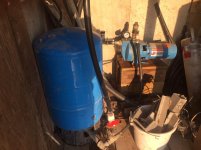
There is a tank, but like I said it was empty when I did have the system working. I don't see a pressure switch.
Close up of the pump.
 

Attachments

  • IMG_4551.jpg
    IMG_4551.jpg
    145.8 KB · Views: 230

Garageguy65

Well-known member
Joined
Apr 30, 2013
Messages
270
Location
Spokane WA
Hello Gents,
My house already had a pump for using lake water on the lawn when I bought it.
It has me a bit stumped.
When I first plugged it in it worked well. If I put a sprinkler on it, it would slowly lose pressure and then blow the breaker.
Now it does nothing.
Is priming the issue? The tank doesn't fill with water. I'm pumping about 100 ft with an 10 ft. rise.
Any tips?
Thanks
Rod

I have a swimming pool. So I am throwing some thoughts out here..

Assuming the inlet screens are clear

Are the seals on the pump cracked at all? That could be a reason for lost prime.
Check the poly pipe coming in for cracks. (The pic looks like poly pipe)

I just fixed my poly pipe on my pool. Had a 1.5” crack. That crack caused my pump to **** air and cavitation. Lost prime also. The crack was tiny and hairline.

See if you can pressure test that poly pipe line. Pool shops have a plug called a turbo plug. Rubber stopper with a air chuck built in.

You may have to put a abs barb fitting on each end to get a proper seal. Compress with air and see if it holds pressure.

I could be way off base here but that’s how I found the pressure loss in my pool.

Hope it helps
 

TLCObsession

Well-known member
Joined
Aug 30, 2011
Messages
328
Location
Bellingham, WA
I run the same kind of a setup for my house. Your pressure switch is the 'Square D' box on the back side of the pump. You do need to prime it.

I can't think of any reason the pump would blow the breaker unless its running continuously and getting hot or the motor is hooped.

There is a small pressure line into the switch. on that generation, it is likely plastic. It can get packed with sediment and the pump won't operate correctly.

Is the bladder in the pressure tank good?

I would start by bleeding the pressure down and taking the pressure switch apart. Then I would take thew pump apart - its a dead easy job and you can fin the manuals online. The problem should be obvious.
 
OP
R

Rod N

Well-known member
Joined
Jul 21, 2011
Messages
835
Location
Keswick, Ontario
Thanks TLC. Good info there.
No idea if the bladder is good.
Isn't it strange the tank does not fill with water?
Why did it work before without priming it?
How do you prime it?
I'll check the line to the pressure switch.
 

kbs2244

Well-known member
Joined
Nov 11, 2006
Messages
14,065
Your not getting water into the tank means the pump is running dry.
Running dry will increase the load until it pops the breaker.

If it still happens after priming then I am going with the sucking air via cracks in the inlet piping or a jammed pump impeller.

(You prime it by removing the plug from the tee on top of your pump and filling the whole system with water. It may take gallons and need "burping" while doing this. Go slow to allow any air to not get trapped.)
 
Last edited:

Milton Shaw

Well-known member
Joined
Feb 11, 2011
Messages
4,835
Sounds like the impeller in the pump is toast. Dry and overheated and blew the breaker. Does the inlet have a check valve in it. That would keep the pump from loosing its prime and having to run basically dry until it pumps water up. Another name for the check valve would be foot valve, I think you should get one to protect the new impeller you are going to have to get. Also check motor bearings to see if they over heat with just the motor running with out the new impeller. That type of pump uses a two/three part seal that is spring loaded and will burn up quickly if run dry so once the impeller is off check bearing and seals there.
 
Last edited:

u3b3rg33k

Well-known member
Joined
Dec 18, 2017
Messages
4,047
what's the pressure gauge read when it's running a sprinkler? filling the tank?

centrifugal pumps draw maximum current when moving maximum mass. as a standard 40/60psi system approaches 60psi, the amp draw decreases. if you close the outlet (or restrict it to minimal flow), amp draw will drop to a minimum value (depends on the motor). eventually this would overheat the pump half, but not the motor, if it has it's own cooling fan.
a bad bladder will cause the pump to short cycle, or cause the pressure switch to rapidly hammer on/off if it's completely dead.

aside from operational issues, if you trip the breaker over time, something is wrong with the pump/motor.
 

pcmeiners

Well-known member
Joined
Aug 13, 2009
Messages
7,848
Location
In the only town in Pennsylvania, Bloomsburg.
A 100ft line/10foot rise plus the friction losses in the sprinkler system would strain a normal shallow well pump. Can you disconnect the sprinkler system and allow the pump to free flow to see if it has anything to do with the sprinkler system.

Your intake at the pump intake should not be bushed down. I see you have 3 different sizes before it attaches to the lake feed pipe, that should not be.... this make more friction, more horse power wasted, higher amperage draw.

These pump require you to prime them, they do not usually self prime.


"Would the motor still run (it does) if the impeller was jammed?" Nope, but if the impeller is damaged in some way, just because the motor runs it means little. Take the main housing of the pump apart, the impeller should be visible. Very simple mechanical, you should not have an issue putting it back together. You might need a seal/gasket, but you can make one with silicone or other compounds from an auto parts store.

"centrifugal pumps draw maximum current when moving maximum mass. as a standard 40/60psi system approaches 60psi, the amp draw decreases. if you close the outlet (or restrict it to minimal flow), amp draw will drop to a minimum value (depends on the motor). eventually this would overheat the pump half, but not the motor, if it has it's own cooling fan."

correction..
as a standard 40/60psi system approaches 60psi, the amp draw increases.

if you close the outlet (or restrict it to minimal flow), amp draw will drop to a maximum value (depends on the motor).

eventually this would overheat the motor half, but not the pump.
Pump sections do not general overheat as their is a good quantity of water in the housing.
 
Last edited:
OP
R

Rod N

Well-known member
Joined
Jul 21, 2011
Messages
835
Location
Keswick, Ontario
When it worked. The gauge has never shown a reading with the pump on, but when I pulled the plug it did jump up a bit for a few seconds.
I've never heard the switch cycle in any way. Pump just runs. I rock the tank all the time when it did work and it was almost always empty.
 

NUTTSGT

Super Moderator
Staff member
Joined
Sep 14, 2009
Messages
50,864
Location
Northern Central Ohio
The tank should have an air bladder in it, so it won't be completely full.

Did you ever check the pressure on the tank with a gauge ?


Does anybody else have their gauge mounted in the same place as the OP ? My gauge is mounted on top of the "tee" on the output. I have a plug in the OP's gauge location and where I prime my pump if need be.
 

u3b3rg33k

Well-known member
Joined
Dec 18, 2017
Messages
4,047
A 100ft line/10foot rise plus the friction losses in the sprinkler system would strain a normal shallow well pump. Can you disconnect the sprinkler system and allow the pump to free flow to see if it has anything to do with the sprinkler system.

Your intake at the pump intake should not be bushed down. I see you have 3 different sizes before it attaches to the lake feed pipe, that should not be.... this make more friction, more horse power wasted, higher amperage draw.

These pump require you to prime them, l they do not usually self prime.


"Would the motor still run (it does) if the impeller was jammed?" Nope, but if the impeller is damaged in some way, just because the motor runs it means little. Take the main housing of the pump apart, the impeller should be visible. Very simple mechanical, you should not have an issue putting it back together. You might need a seal/gasket, but you can make one with silicone or other compounds from an auto parts store.

"centrifugal pumps draw maximum current when moving maximum mass. as a standard 40/60psi system approaches 60psi, the amp draw decreases. if you close the outlet (or restrict it to minimal flow), amp draw will drop to a minimum value (depends on the motor). eventually this would overheat the pump half, but not the motor, if it has it's own cooling fan."

correction..
as a standard 40/60psi system approaches 60psi, the amp draw increases.

if you close the outlet (or restrict it to minimal flow), amp draw will drop to a maximum value (depends on the motor).

eventually this would overheat the motor half, but not the pump.

Pump sections do not general overheat as their is a good quantity of water in the housing.

you are wrong.

centrifugal pump amp draw is based on work done. less work done (water moved), lower amp draw. you ARE correct if you're looking at any sort of positive displacement pump (roots blower, gear pump, etc).

a deep well pump will draw the most power when it produces the most flow.

ever put your hand over a vacuum cleaner hose and hear the motor speed up? the motor stops doing work, and is thus able to increase its RPM. this is the same reason standard furnace fans spin faster as the filter clogs up.

if you dead head a pump, eventually you will damage the pump itself, as the energy being wasted turns into heat, and can't be given up to new water flowing through the housing. the quantity of water in the pump housing is finite, and thus can be heated easily. just like in a tea kettle.

if you have a 1HP pump on and full of water, where does the energy go if you cap it off? the only place it can - itself. the pictured pump has a cooling fan, so the motor should be able to shed the 110W or so it wastes at full load. the 750W (less, because no work is being done) goes into the pump housing and can't leave.
it's the same mechanism a stationary bike uses to create resistance. those get hot.
 
Last edited:

u3b3rg33k

Well-known member
Joined
Dec 18, 2017
Messages
4,047
Hello Gents,
My house already had a pump for using lake water on the lawn when I bought it.
It has me a bit stumped.
When I first plugged it in it worked well. If I put a sprinkler on it, it would slowly lose pressure and then blow the breaker.
Now it does nothing.
Is priming the issue? The tank doesn't fill with water. I'm pumping about 100 ft with an 10 ft. rise.
Any tips?
Thanks
Rod

Here's my recommendations.
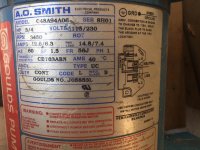
1. get us a picture of the motor plate, and tell us what voltage it's currently wired to run at.

2. get the pump down to a few feet above water level. fill it with water. see if it works. 100' of pipe is an unreasonable length of pipe to pull through.

3. if, after moving it down to 3' max suction, and 10' max total suction length, the pump still doesn't function after priming, or it still trips the breaker, make sure the breaker is the right size, and if it is, something is wrong with the pump (damaged bearings, bad capacitor, shorted winding, who knows) - repair/replace the pump.

4. if this is switched on for lawn watering, and off when done, then you don't need that pressure tank, and you don't need a pressure switch. install a 100 PSI relief valve on a 1/4" tap off the pump output. it will pump up to max head for the flow it's providing and your sprinkler will be strong. turn it on to start watering, turn it off to stop. easy life for the pump.


FYI, the pump will not self prime if it has to pump 100' worth of air into that pressure tank. it will only self prime if can discharge the air in the line to the atmosphere, and even then, 100' may be too much.
 
Last edited:

spudley

Well-known member
Joined
Dec 27, 2016
Messages
702
Location
Northeast Wisconsin
I had a similar issue. I found the foot valve had sand in it preventing it from closing and holding water which caused the pump to lose prime. After cleaning everything worked as before. Might check that before you get to far into the motor.
 
To avoid these ads, REGISTER NOW!

Muzzy

Well-known member
Joined
Jun 20, 2015
Messages
335
Location
Northeast PA
Pull it apart, check the impeller and seals. Since you have it apart, blow back the line to the lake with compressed air.
It wouldn't surprise me if the whole works is full of sand and crud.
 

NUTTSGT

Super Moderator
Staff member
Joined
Sep 14, 2009
Messages
50,864
Location
Northern Central Ohio
I'm not sure what is going on but this thread doesn't appear to be working properly.


EDIT: u3b3rg33k had made a post that was creating an error with the forum and this thread. I'm not sure what the forum doesn't like about his like or pop-out picture but it locks up the thread. Unfortunately, I had to delete his post due to this issue. :(
 
Last edited:

u3b3rg33k

Well-known member
Joined
Dec 18, 2017
Messages
4,047
i'll try again without the embed. also turned of auto parse links just to be safe, so you'll have to copy the link manually and paste it in a browser window.

this is to show that when you restrict a centrifugal pump/fan, the amp draw goes down. kill-a-watt set to amps.

https://drive.google.com/open?id=1vva3DM_1Dg6x7K7xVdAmolIoKzHYyJFC
 
Last edited:

kbs2244

Well-known member
Joined
Nov 11, 2006
Messages
14,065
What everybody seems to be forgetting is that this is a new problem in a previously working installation.

It is a fix problem, not a new installation problem.
 

gbrett

Well-known member
Joined
Oct 26, 2010
Messages
45
I would blow out the suction re-prime and try it. to set up a centrifugal pump properly the suction pipe should be larger than the fitting size in the pump and should be reduced with an eccentric reducer near the pump. The smaller pipe and concentric reducer cause turbulence and air bubbles at the pump intake. Since you were losing pressure I would suspect a blockage in the suction pipe or in the impeller or diffuser. Since you blew a breaker more likely to be the suction pipe. I have a pump that gets small rocks stuck in the impeller occasionally but that results in low pressure and low amp draw due to the impeller not moving water.
 

TractorJeff

Well-known member
Joined
Dec 8, 2013
Messages
3,309
Location
Elkhorn, WI
If I GOOGLE "Centrifugal Pump" - all the discussions and explanations state "DO NOT RESTRICT THE OUTPUT FLOW!" Only restrict the Inlet to vary the Output?
 

u3b3rg33k

Well-known member
Joined
Dec 18, 2017
Messages
4,047
If I GOOGLE "Centrifugal Pump" - all the discussions and explanations state "DO NOT RESTRICT THE OUTPUT FLOW!" Only restrict the Inlet to vary the Output?

if that were the case, they would all come with instructions not to mount them in a deep well, or to put hoses on the outlets, or to have any vertical lift.

basically, all of the cases you'd want to bother using a pump.
 

LS6 Tommy

Well-known member
Joined
Dec 27, 2013
Messages
26,162
Location
Northern NJ
centrifugal pumps draw maximum current when moving maximum mass. as a standard 40/60psi system approaches 60psi, the amp draw decreases. if you close the outlet (or restrict it to minimal flow), amp draw will drop to a minimum value (depends on the motor).

aside from operational issues, if you trip the breaker over time, something is wrong with the pump/motor.

"centrifugal pumps draw maximum current when moving maximum mass. as a standard 40/60psi system approaches 60psi, the amp draw decreases. if you close the outlet (or restrict it to minimal flow), amp draw will drop to a minimum value (depends on the motor). eventually this would overheat the pump half, but not the motor, if it has it's own cooling fan."

correction..
as a standard 40/60psi system approaches 60psi, the amp draw increases.

if you close the outlet (or restrict it to minimal flow), amp draw will drop to a maximum value (depends on the motor).

eventually this would overheat the motor half, but not the pump.
Pump sections do not general overheat as their is a good quantity of water in the housing.

Slight correction on your correction. You are correct about current draw increasing up to max flow. U3b3rg33k is correct about restriction. Current draw decreases when you block off either the inlet or the outlet of a centrifugal pump.

I don't really have any ideas for the OP other than loss of prime or air leaks.

Tommy
 
Last edited:

TractorJeff

Well-known member
Joined
Dec 8, 2013
Messages
3,309
Location
Elkhorn, WI
if that were the case, they would all come with instructions not to mount them in a deep well, or to put hoses on the outlets, or to have any vertical lift.

basically, all of the cases you'd want to bother using a pump.

I only asked is all, no need to take it personally.
I only asked to better understand......
 
OP
R

Rod N

Well-known member
Joined
Jul 21, 2011
Messages
835
Location
Keswick, Ontario
Thanks. I knew there would be some educated responses here.
Yes. Please note this is a fix to a pump that the previous owners used for years and worked for me for a couple of weeks before cacking.
BTW. If misunderstood. The pipe going into the lake is 20 ft long with a 3 foot drop and the water out pipe is 100 ft (maybe just 75 ft) with about a 10 ft. rise.
I will pull apart the pipe into the lake to make sure it is not clogged.
Do I actually pump air into the tank?
 

kbs2244

Well-known member
Joined
Nov 11, 2006
Messages
14,065
Do not worry about the tank.
The air pressure will take care of itself if you start getting water into it.

Get the pump going with the to the lawn outlet closed.
That will route the water into the tank.

The pressure switch will turn the pump off when the time comes.

Then you can open the lawn outlet, when the water level gets low enough the air pressure will go down and the switch will turn the pump back on.

And the cycle starts again.
 
OP
R

Rod N

Well-known member
Joined
Jul 21, 2011
Messages
835
Location
Keswick, Ontario
Well, now I'm really confused.
Checked foot valve again and all looked fine.
Plugged it in. Nothing.
Primed it by pouring water in the pipe attached to the pump, closed both outlets and plugged it in. After a couple of minutes the tank started to fill up. Let it run for 15 minutes and it would not shut off even though the tank felt like it was full.
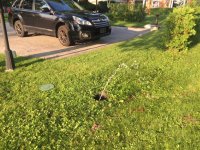
I opened up the valve to the lawn and water shot up 15 feet for 30 seconds until the tank was empty. Now it only shoots up 2 feet. Ran for an hour and nothing changed.
This thing has a mind of it's own. Maybe it's female.
 

Attachments

  • IMG_4568.jpg
    IMG_4568.jpg
    162.5 KB · Views: 87
  • IMG_4565.jpg
    IMG_4565.jpg
    151.1 KB · Views: 66
  • IMG_4566.jpg
    IMG_4566.jpg
    154.1 KB · Views: 90

zak77

Well-known member
Joined
Sep 18, 2014
Messages
1,351
Location
Monson, MA
Sounds to me like the impeller may be filled with sand/stone or possibly worn out. First check to see what the pressure is in that pressure tank with it empty. Next, what's the pressure switch set for? I think you mentioned the pressure gauge on the pump isnt working, replace it. Without any of this stuff verified and checked no one can help you without chasing ideas down an alley.

I've maintained and replaced a system similar to yours for 20 years, slightly smaller scale, so it's not my first rodeo fixing this stuff. It's simple but things need to work first in order to trouble shoot.
 
OP
R

Rod N

Well-known member
Joined
Jul 21, 2011
Messages
835
Location
Keswick, Ontario
Far enough Zak.
Everything has sat for a day and the tank is at 18 psi.
The pressure switch says it is good from 30 lbs. to 80 lbs. You adjust it by tightening the spring. I'm not sure where it is at as there isn't a dial. Would you just watch the prssure guage and adjust accordingly?
I pulled the pressure guage and it appears to work fine when I blow compressed air into it.
Do I just take the 4 bolts that join the motor to the pump to inspect the impeller?
Is it possible that it is just sucking air and I should re seal the connections between the pump and the lake?
Thanks again for your help.
 

zak77

Well-known member
Joined
Sep 18, 2014
Messages
1,351
Location
Monson, MA
To be sucking that much air, the leak would probably be obvious but i'm assuming you've inspected the line to ensure that's not the issue. And you said to checked the foot valve to ensure that's not the issue. Where does it draw in water? Hopefully not the lake bed but instead some kind of bucket with holes to keep out debri but let in plenty of water. So if you are certain that nothing is wrong from the pump back to the water source then i'd look at the pump.

So the pressure tank is sitting at 18psi with no water in it?? The pressure in the tank depends on the setting of the pressure switch, which most are set at 30/50. But you're saying that it can run for over an hour and not build to 50 psi. So it's either not enough water, the pump cant make that much pressure, or you have a massive leak and it's going somewhere. While doing any trouble shooting shut down any output valves after the pressure tank. IF you have a 30/50 setting, you want 28 psi in the pressure tank. If the switch is set to 20/40 then 18 is correct.

Yes, those 4 bolts should come off and you should get access to the impeller. I drew up a bunch of sand and small pebbles one year after i had to pull the foot valve and had to clean out the impeller, worked fine after that.
 

Buickspec6231

Well-known member
Joined
Jun 14, 2018
Messages
127
Location
CNY
Usually pressure switches are set to a 20lb differential from the factory. Example would be that a pump turns on when water pressure drops below 30psi and shuts off at 50psi. Most pressure switches have two spring loaded screws on them. A larger and taller screw adjusts your pressure. The smaller shorter screw adjusts the differential. The difference between a 30/50 switch and a 50/80 switch is only how the factory adjusted the screws before it got boxed up. Your pressure tank should have air in it. Again, common practice is to have 2-3 lbs less air pressure in your tank than the pressure switch is set to turn on. To check the air in the pressure tank, it needs to be completely drained of water. Sometimes the bladders leak and you can't drain the tank. If that happens its time for a new tank. You need to confirm that your pressure gauge is working before you can adjust any pressures/differentials. Also, before you start pulling your pump apart, I would disconnect the inlet line, put a pressure gauge and schrader valve on a T-fitting and add air pressure to the line and check to see if the air is leaking back at the foot valve. Lots of little things to check before you start pulling pumps apart.
 
Last edited:

kbs2244

Well-known member
Joined
Nov 11, 2006
Messages
14,065
It is time to open up the pump.
Be sure to check the jet to be sure it is very clean.

I had a pea sized stone make a fool of be one weekend.
I found it on the third disassembly.

Have you fooled with the pressure switch?
Rarely will they go to 80 lbs.
As said 30 lbs on and 50 lbs off is common.

The tank should not go to full of water.
The air in an empty tank should compress to apx 50 lbs at the half full mark.
Make sure you are starting with an empty tank.

And as said earlier, the pump needs some resistance.
If you have a valve between the pump and the tank close it half way until the system id cycling correctly.
 
Last edited:
To avoid these ads, REGISTER NOW!
Top Bottom