To avoid these ads, REGISTER NOW!

Latest fab. project - downhill racer

OP
J

Jeff Ivers

Well-known member
Joined
Apr 9, 2010
Messages
2,567
Location
Oklahoma
500 lbs, plus bumps, on an axle with the wheel mounted 6"+ outboard in a cantilever arrangement, is a bit tough on a 1/2" diameter axle.

As you have found out.

https://mechanicalc.com/reference/beam-analysis-1

Some quick numbers.

500 lbs, spread over 4 wheels, is 125 lbs at each wheel.

Add in some bump in the road and allowing for some non-uniform weight distribution, and let's run some numbers with 250 lbs at a wheel.

A 1/2" diameter shaft has a moment of inertia

https://mechanicalc.com/reference/cross-sections#moment-of-inertia

of I = pi * d^4/64

= 3.14 * (0.5)^4 / 64 = 0.003 in^4

Maximum bending stress = (bending moment) * (centroid distance) / (I)

The bending moment (aka torque) is the force * the lever arm distance, so in this case you have

250 lb * 6 inch = 1500 in-lb

The centroid distance is just the distance from the 'middle' of the beam (in this case the axle) to the outer 'skin'. Your circular axle is symmetrical, so the distance from the 'middle' to the 'skin' is just the axle diameter / 2 . Or just the axle radius.

0.5" / 2 = 0.25"

So the maximum bending stress for your 1/2" diameter shaft with 250 lbs force applied to a 6 inch cantilever length is

(1500 in-lb ) * (0.25") / (0.003 in^4) = 125,000 psi max bending stress

Which is more stress than plain steel or hardened 4140 steel can handle before actually deforming and bending. Which is why your axles bent.

You could try and get some 'stronger' 1/2" steel bars, but that is more $$$$.

You can shorten the cantilever length that the axle sticks out.

You can lower the forces.

Or you can just use a bigger diameter axle. Even if you have just the very end of the axle turned down to the 1/2" diameter to fit into your wheel bearings.

If you use a 1" diameter shaft and everything else stays the same, your bending stress changes from 125,000 psi to 15,000 psi.

(1500 in-lb) * (0.5 in) / (0.049 in^4) = 15,300 psi max bending stress

Which means plain mild steel can handle that and not permanently bend.

:beer:

Thank you for the detailed response. I really appreciate the help. I am unable to reduce the cantilever length because of the thickness of the wheel/disc brake hub combo. What type of steel would I have to spec in .5 inch diameter to be strong enough?
 
To avoid these ads, REGISTER NOW!

Heap64

Well-known member
Joined
Mar 17, 2006
Messages
135
Location
Illinois
Well, with both grandsons wanting to run the competition class, it looks like I need 2 cars for next year (and a way to get 2 cars on the trailer or a bigger trailer!)

downhill 2 - begin compon r.jpg
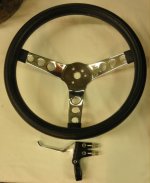
While researching bike parts, I stumbled across the brake lever shown in the picture. It actuates two brake cables at the same time. I think this might be just the ticket for a second car - switch to hand operated brakes so the car can more easily accommodate different drivers (me in the adult class and my grandson in the youth class - yes, I think it is time to get in on the fun). I found the steering wheel at a swap meet yesterday for $10. I think it cleaned up pretty good, but forgot to take a before pic.

For the new car, I want to use disk brakes and would like to use a steering rack.

So far, I have not found a suitable rack for less than $100. Anyone have any tips for me?

With regard to brakes. I am still researching this issue and having some difficulty figuring out what I need. From a failure avoidance perspective, I want to stick with a .5" axle. I also want to use 20" bike wheels, but they must accept sealed bearings that will fit the axle. Where do I find wheels or wheel hubs that will accommodate disk brakes - remember, on a retiree budget?

Any help appreciated.


What diameter is this steering wheel? Just curious. Nice project!
 
OP
J

Jeff Ivers

Well-known member
Joined
Apr 9, 2010
Messages
2,567
Location
Oklahoma
What diameter is this steering wheel? Just curious. Nice project!

That particular wheel is a 13". On Downhill 1, I used a 10" wheel and on my old fart cart, I used a 12". Interestingly, the 10 and 12 wheels are go-kart wheels and the 13 is an automotive wheel - the 3-hole mounting is a different bolt circle on go-kart vs car. It worked out well, because I wanted to use a quick-release hub on DH2 and I found it in a Racing catalog (car).
 
To avoid these ads, REGISTER NOW!
OP
J

Jeff Ivers

Well-known member
Joined
Apr 9, 2010
Messages
2,567
Location
Oklahoma
To recap a bit, the Sand Springs race for March of this year was cancelled. I took DH2, the newer car to Macon, GA in April for a race that I entered to get some test time on the car.

In order to enter that race, they required a handle to be added to the rear of the car for them to hold the car on the hill with. I found a nice aluminum handle in my scrap bin that filled the bill - sorry didn't remember to take a pic.

Following my experience there, I had to straighten the right front spindle, reinforce both front spindles, added a front bumper to protect the spindles.

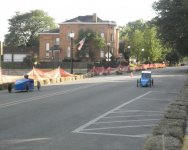
We then located a race to be held July 4 in Muscatine, IA. For this race, they required cars to have both front and rear tow hooks so they could do a daisy-chain tow. Both cars had been designed with front tow hooks, but no rear. I picked up a couple of 3/8 inch eye-bolts and installed them through the rear frame of each car. I was a bit concerned about this as I was unsure how many cars would be chained together and what weight would be applied to the car and how much the eyebolt would hold. Cars were limited to 500 pounds, including driver and were towed with the drivers in them. Thankfully they only hauled 4 cars at a time and the eyebolts held fine.

The next problem was how to get 2 cars to the race, 565 miles and 10 hours from my home.

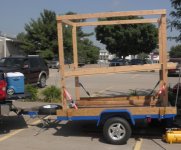
I have this 5x8 utility trailer that I restored a number of years ago that I use for all types of towing activities. Since I am kind of proud of it, I don't want to put additional holes in the sides or floor for attaching things. I had devised a runner setup that acted as guides for the downhill wheels that was attached to a cross piece that slipped into the channel instead of the front panel of the trailer. This worked well for hauling DH1.

After a bit of head scratching, I expanded on that rig to haul both cars.

Muscatine 3 r.jpg
This is what I came up with. The rear support for DH2 unbolts, allowing the ramp assembly to be lowered (after DH1, the lower cars, has been removed). Then DH2 can be rolled off the trailer. A come-a-long handles the raising and lowering chores for the upper ramp. I had wanted to come up with an assist for getting the car up the ramp, but it turned out to be an easy push for my daughter and I with my grandson waiting to drop a hook in the rear tow bolt to retain the car while the ramp was lifted.

Muscatine 31 r.jpg
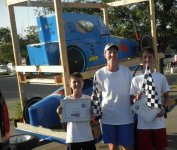
This is my grandsons in their final race.
Muscatine 36 r.jpg
A happy ending for grandad although the older grandson was disappointed to not end up number one. If we continue racing, I know the DH2 can be the winner.
 

rixtrix1

Well-known member
Joined
Aug 25, 2013
Messages
3,010
Location
Chandler, AZ (from west NE)
I know this is an old thread, but if you are still into this, may I offer some suggestions based on 5 years of Soap Box Derby construction( Late 1960's designs with pivoting straight axle front steering and wood framing.) Your top canopy and flat back end only create more drag, not streamlining. The pic of the red car with the bent and broken off wheels is probably the best design for low drag based on total frontal and surface area alone. As I had to make my cars bodies larger to account for a 10" change in my height over those 5 years, my cars slowed considerably. We would also take these same cars to the top of a 450' tall hill on a highway and with cars behind us to keep traffic away would coast to the next county road 3 miles down the hill, achieving speeds in excess of 80mph. Dumb-yes. Dangerous- definitely. Did we care- hell no. All cars weighed the same and used the same wheels, axles and steering design. All my cars had sprung, floating axles which enabled me to outrun most of the others as it handled bumps and undulations better by allowing the wheels to roll over obstructions instead of hitting them with the full weight of the car .

Bottom line: width x height of the body give a rough estimate of the brick you're trying to push through the air; streamlining comes from round, pointy ends- NO vertical surfaces except sides.
 
To avoid these ads, REGISTER NOW!
Top Bottom