y'sguy
Well-known member
True! they should go higher.


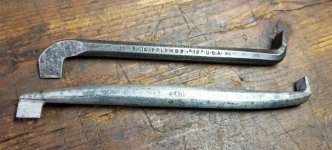
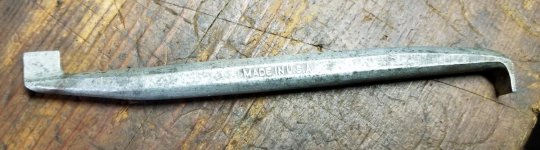
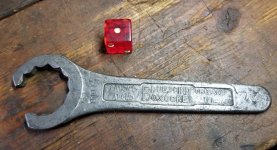
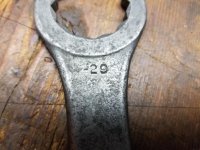
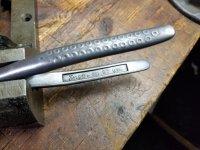
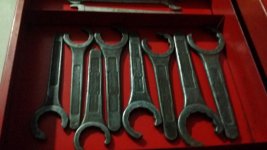
Those are neat wrenches. There is a vendor at a once/year flea that has some. I think he is asking $20per. If you want me to pick them up let me know.Flea find from this morning. Early (1929, to be exact) Blue-Point Chicago 940 (1-1/4") water pump wrench. I think this is my third of these. This is how we do it. Come back and see me when I'm 80 and maybe I'll have the whole set. Or maybe not. [emoji38]
Those are neat wrenches. There is a vendor at a once/year flea that has some. I think he is asking $20per. If you want me to pick them up let me know.
Looking for the following Plomb Pebbles Wrench 3061

Hi,
Sort of off topic-?
I searched around but did not find any answers, although I can't believe there is no thread for this question.
I've been looking around for a set or two of Snap-on metric sockets that might match my general target of 1940s-1950s tools, etc.
I'm not against something newer as I feel the Flank Drive are probably better tools practically speaking.
I have found a few sets that seem to have patent numbers on them but no date codes. These were flank drive sockets though.
What is the window for these? 1960s through the 1980s? 70s - 80s?
If I find a set with patent numbers and dark bands is it possible they could be from anywhere within a 20 year gap? Or is there some way to narrow that down? What is the oldest flank drive metric sockets?
Thanks for any clues or help.
The metric socks show up in the 38 cat.. ones from the 30s-50s are very hard to find. I think the black bands are like early 70s.
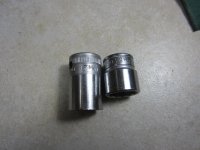
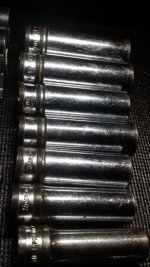
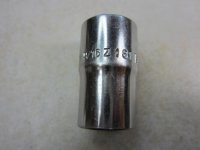
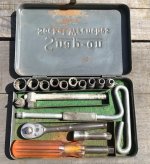
the pic on the left. 38-to about 49 (date code 49)
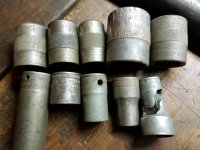
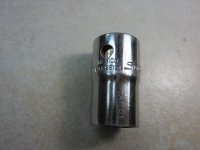
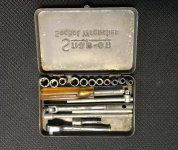
pic on the right 50-thru probably the 60s. not sure as to the 60s (date code 51)


I could be way off but according to TESS snap on filed a trade mark of Flank drive in 1980 but it appears that the first use may have been much earlier that that back in 1967.Hi,
Sort of off topic-?
I searched around but did not find any answers, although I can't believe there is no thread for this question.
I've been looking around for a set or two of Snap-on metric sockets that might match my general target of 1940s-1950s tools, etc.
I'm not against something newer as I feel the Flank Drive are probably better tools practically speaking.
I have found a few sets that seem to have patent numbers on them but no date codes. These were flank drive sockets though.
What is the window for these? 1960s through the 1980s? 70s - 80s?
If I find a set with patent numbers and dark bands is it possible they could be from anywhere within a 20 year gap? Or is there some way to narrow that down? What is the oldest flank drive metric sockets?
Thanks for any clues or help.
[emoji481]
Immediate pre-war and wartime Snap-on sockets look, generally speaking, like the metric socket snapmom posted (but not chromed, of course). There are slight variations that can be chalked up to slight variations in tooling/dies, but they all have that simple vertical spaced knurling. Sometimes the knurling is raised, sometimes it is recessed. Sometimes it is framed with two grooves, sometimes one groove, sometimes no groove. Sometimes it is shorter. Sometime the entire base is recessed, and sometimes it is flush with the body of the socket.You say that one style is 38-49.
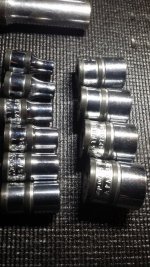
Here it starts to look like the step might be between 1947 and 1948.
I honestly never looked this close before because it's hard to read in real life and I was always a little disappointed in missing parts and replacements. I never saw the 1947 date code clearly until tonight taking a picture for you. So it never occurred to me that this might not be a replacement but simply a transitional set that illustrates the step between two different generations.
Am I reading this right?
Anyone got any examples of 1945 or 1946 date codes?
Thankfully, with Snap-on, the variations become academic for the most part, because of the date codes. Not so with Walden, Bonney, and many other mfgrs, where the close study of construction differences is often vital for determining production date.
1945


I have what I consider a strong explanation for the preponderance of double and triple date codes in the late 1920's and early 1930's: the Great Depression. As unsold stock was carried over from year to year, they had to date code stamp it again, and again, if necessary, because of the 1-year guarantee they were offering at that time. And it is an explanation that has some complementary backing from the 50th anniversary stakeholder pamphlet, "The Snap-on Story," which talks about how they almost went under at that time.
That wouldn't explain a double 1954 and 1955 stamp, however. With a lifetime guarantee on most items, it wouldn't matter when it was produced. If you bought a piece in 1955 that was actually made and stamped in 1954, machts nichts.