To avoid these ads, REGISTER NOW!

Let's Share Non-Obvious Tool Tricks

oldschoolcraft

Well-known member
Joined
Dec 31, 2017
Messages
1,829
Location
Bay Area, California
I was hanging out with a woodworker friend of mine a few years ago, and the topic of tape measures came up, and I commented that I noticed tape measures have a wobble on the metal lip that is on the end of the measuring tape that sticks out of the tape measure body. And I asked him about the concern that the wobble would introduce an error into the measurement.

I've only ever had to use tape measures to measure rough estimates. How many feet is the backyard to run sprinkler pipe. Hanging the TV at a proper height. Nothing that + or - a full inch would really matter. But in woodworking, obviously you need to get to down to 1/16" or smaller, and that little wobble at the end clip might mess it up. And I'm not a stupid person, and I've used tools for various purposes for over 20 years at this point in my adult life. But never did any woodworking.

He explained that the wobble is intentional and precise, to be the dimension of the end metal clip itself, because the end metal clip has thickness to it. The 6' micro tape measure I have here has a 0.04" thick metal lip on the end.

The purpose of the wobble is that if you are going to hook the lip over the top of something and pull traction on the tape measure, you want that lip to wobble outward, so that the measurement tape gains an extra 0.04" (in this case) to account for the thickness of the lip itself. And if you are pushing the tape measure end into something, you want that lip to wobble inwards, so that it doesnt inappropriately add its 0.04" width to the measurement.

I'm probably the only idiot here who didn't know that, but the point of this thread is for people to share other similar tricks that might be non-obvious when it comes to the tools we use. And maybe as an informal poll mechanism, if someone posts a trick you learned something from, "like" that post and we can see which tricks were the least well known to people here.
 
To avoid these ads, REGISTER NOW!
OP
O

oldschoolcraft

Well-known member
Joined
Dec 31, 2017
Messages
1,829
Location
Bay Area, California
I assumed that everybody that used a tape measure knew that. :)
I didn't! Tape measures are so common, they come in every $20 chinesium 6-piece starter tool kit. I bet most of the tape measure owning public has no idea about this end wobble. Though I bet 99% of Garage Journal members know it, we're not representative of the general public.

I think with calipers, I did immediately learn there was several ways to use it to measure something by the person who first showed me a caliper in person, who was a hobbyist machinist. My first pair was an old of his that he gifted me. I'm sure there's a lot of people who bought calipers off Amazon and thought that the only way to use them was to squeeze the tips around something and would have their mind blown.
 

darkzero

Well-known member
Joined
Oct 20, 2011
Messages
3,315
Location
SoCal
Speaking of calipers, I've owned digital Mitus for years before I became a hobby macheenist. I'll never consider myself a real machinist so I spell it that way.

Most people know the tail end has a rod that can be used as a depth gauge. But many people don't know that the front end can be used as a depth gauge also. It's wide so obviously can't be used for measuring hole depth but for a lip it can be easier due to the larger surface area (but can also more prone to error depending on surface irregularities).
 

OccupantRJ

Well-known member
Joined
May 15, 2009
Messages
10,933
Location
Eastern North Carolina
When the wide head end of the caliper is used it is called a step measurement. The four normal uses are inside, outside, depth, and step. The step measure is very useful for setting a distance from an edge to scribe a mark. Blueing the surface or blacking with a felt tip marker beforehand, then using an Exacto knife to scribe with gives a very good line less affected by the thickness of the scribe. When I see a video where the tips of the caliper are used as a marking gage from an edge to scribe a line, I immediately dismiss that person as an ignorant hack who should not be handling anything more precise than a sledge hammer.
 

MushCreek

Well-known member
Joined
Jan 14, 2015
Messages
9,743
Location
Upstate South Carolina
One handy trick with digital calipers is measuring hole spacing. Measure the inside of a hole, and zero the calipers. Then measure from inside of one hole to another (they have to be the same size) to get the hole spacing.
 

no704

Well-known member
Joined
Apr 27, 2016
Messages
5,207
Used to work at a UL certified lab. Among the many silly things we had to have calibration certified yearly were two Lufkin tape measures. Not sure what that cost, but had to be more than the cost of them. Had to have two so we had one when the other was at the calibration “lab”.
 

bobg03

Well-known member
Joined
Aug 29, 2020
Messages
3,420
Location
conway sc
My brother is an accomplished woodworker and his go to measuring device is a folding ruler with the brass slide whenever he is building something, it's always on him. I don't think he uses a tape measure unless he's laying out a deck or something similar.
 

darkzero

Well-known member
Joined
Oct 20, 2011
Messages
3,315
Location
SoCal
When the wide head end of the caliper is used it is called a step measurement.
That's a better word I was looking for. Was late when I posted & was brain dead. Lip came to mind, I knew wasn't a good description but was too tired to think. Lol
 

cgrutt

Well-known member
Joined
Mar 4, 2016
Messages
8,166
Similar to the 1/16 adjustment for push/pull measurements the case of tape measure is usually marked with its width so it can be added for measurements in between two points, for example two walls. Push tape into wall one and run body flat against wall two read measurement on tape and add the case width for overall measurement.

But did you know a tape measure can tell you how old you are (unless you're too old LOL). Pull tape to current year, 2024 would be 124" fold tape in half and place tab at 124. Now read back to the year you were born, say 2005 the year my son was born (105" on tape measure). Now read the marking folded against the 105, in this case 19", so he will be 19 in 2024. Works to early 1960s if you were born before that I guess they figure you're too old to be using a tape measure LOL...
 

Leaflessshadetree

Well-known member
Joined
Aug 1, 2013
Messages
7,144
Location
Don't ask.
To make equal divisions measure diagonally with the tape at a measurement that divides easily by the number of divisions.
Place a nail in the claw of a hammer with the head of the nail against the handle (or base of the head of the hammer). You can start the nail with a swing of the hammer (leaving one hand free).
 

d.mcfarland

Well-known member
Joined
Jun 18, 2012
Messages
6,564
Location
Western PA
To make equal divisions measure diagonally with the tape at a measurement that divides easily by the number of divisions.
Place a nail in the claw of a hammer with the head of the nail against the handle (or base of the head of the hammer). You can start the nail with a swing of the hammer (leaving one hand free).

Almost every modern framing hammer has a magnetic nail starter built into the normal pounding end.
 

dutchgray

Well-known member
Joined
Sep 28, 2014
Messages
6,461
Location
Dorset. England.
When the wide head end of the caliper is used it is called a step measurement. The four normal uses are inside, outside, depth, and step. The step measure is very useful for setting a distance from an edge to scribe a mark. Blueing the surface or blacking with a felt tip marker beforehand, then using an Exacto knife to scribe with gives a very good line less affected by the thickness of the scribe. When I see a video where the tips of the caliper are used as a marking gage from an edge to scribe a line, I immediately dismiss that person as an ignorant hack who should not be handling anything more precise than a sledge hammer.
I do have a pair of Mitutoyo 6" calipers I use for scribing lines, someone else dropped them and broke the tip off one of the jaws so they were already ruined as a measuring instrument.
 

Junkdrawer Dog

Well-known member
Joined
Jan 14, 2019
Messages
1,460
Location
LV NV
Used to work at a UL certified lab. Among the many silly things we had to have calibration certified yearly were two Lufkin tape measures. Not sure what that cost, but had to be more than the cost of them. Had to have two so we had one when the other was at the calibration “lab”.
Been there, done that. At my last job I had to measure steel billets ranging from 17 feet to 20 feet long. The tolerance on length was +/- 2 inches. Every 3 months I had to send my company supplied and serialized FAT MAX tape measure to the lab to be "calibrated".
 

Kasal

Well-known member
Joined
Nov 21, 2017
Messages
731
Location
Galicia, España
A few years ago a fellow electrician taught me the "proper" way to use scissors. I've done it like that since then.
Screenshot_20240511_102835_Google.jpg
It involves resting one part on the palm of your hand, this way you use more force and don't hurt your fingers.
 

uart

Well-known member
Joined
Nov 17, 2011
Messages
1,226
Location
Australia
Here's another useful tape measure tip, to find your favorite tool.


1. Measure the length of anything close at hand to the nearest cm (or to the nearest inch if you prefer).
2. Multiply this number of cm (or inches) by 9 to get a new number.
3. Add up all the digits of the number in step 2 to get another new number.
4. If necessary, repeat step 3 (adding all the digits from the previous step) until you get a single digit number.
5. Go through the alphabet, where "a" is 1, "b" is 2 and so on, until you get to the letter corresponding to your final number.
6. Think of your favorite tool that starts with that letter.

I bet you chose Impact Driver or Impact Wrench
 
Last edited:
To avoid these ads, REGISTER NOW!

guitarbutt

Well-known member
Joined
Sep 29, 2017
Messages
237
If you don't have a square and need a line on a board: measure and mark two spots or more, then turn the tape measure over (blade concave facing up), line the marks up, and draw a line connecting them
 

DGersic

Well-known member
Joined
Mar 12, 2017
Messages
6,265
Location
DeKalb, IL
If you cannot get the thread to start properly especially on fine threads, rotate the item in the opposite way it threads on and when you feel it click then it should start on properly, works on all threads , try it

I do this on all threads. Especially so if I‘m putting a screw back in to a hole in wood.
 

KSJeff

Well-known member
Joined
Dec 19, 2011
Messages
759
Location
Andover, Kansas
I didn't know that dimensional lumber (except for marked wall studs) were all cut long. I expected a 12' stick of treated 2x4 to be 12' long. They varied from 12'1/2 to 12'2". I was going crazy trying to square a shed base and finally measure the wood. Had no idea.
 

seber

Well-known member
Joined
May 31, 2016
Messages
4,190
Location
Deep East Tx.
I didn't know that dimensional lumber (except for marked wall studs) were all cut long. I expected a 12' stick of treated 2x4 to be 12' long. They varied from 12'1/2 to 12'2". I was going crazy trying to square a shed base and finally measure the wood. Had no idea.
I don't know where you get your lumber but I've never had that happen. That would really get bad if you were buying stud length lumber.
 

txvwnut

Well-known member
Joined
Jan 1, 2015
Messages
7,588
Location
Bedford, Texas
Most people know the tail end has a rod that can be used as a depth gauge. But many people don't know that the front end can be used as a depth gauge also. It's wide so obviously can't be used for measuring hole depth but for a lip it can be easier due to the larger surface area (but can also more prone to error depending on surface irregularities).
This only works on calipers that have both jaws that sit flush to the end. I have a set of Helios calipers that the sliding jaw is radiused and does not sit flush with the end of the static jaw.
 

Beerhippie

Well-known member
Joined
Oct 13, 2023
Messages
9,641
Location
Far NE Oregon
My brother is an accomplished woodworker and his go to measuring device is a folding ruler with the brass slide whenever he is building something, it's always on him. I don't think he uses a tape measure unless he's laying out a deck or something similar.
A folder with slide (extension rule, per Starrett) has been my number-one tool for many carpentry jobs for decades. I learned to use it when I was doing a lot of stain-grade trim work. I don't measure with it so much as transfer with it.

53622379275_176b5d101b_b.jpg
 

dscheidt

Well-known member
Joined
Apr 26, 2017
Messages
2,880
I don't know where you get your lumber but I've never had that happen. That would really get bad if you were buying stud length lumber.
lumber sold as dimensional length (8', 12', etc) has a length tolerance of -0/+3 inches, and anything longer than 8' is commonly + 1 or 2". Stuff sold as precision trimmed (like studs cut to length to allow for the plates) have tighter tolerances (it's something like +/- 1/16 on 25% of a bunk, with the rest being +/-0), because the reason it's used is to save the time of cutting it to length.
 

bonneyman

Well-known member
Joined
Apr 22, 2010
Messages
8,757
Location
Desert SW
Don't forget "girly" stuff. Alot of products made for the ladies serve purposes in the shop.

Emory boards - for sanding electrical contacts and sanding small areas
Nail polish - for securing screws that seem to vibrate loose
Nail polish remover - contains acetone but is thick so stays put
Seamstress seam ripper - good for stripping insulation off of small wire bundles like stat wire
Seamstress button puller - great for reaching into tight spots and grabbing wires, like stat wire buried in the wall
Blackhead remover - used for reassembling ratchet springs
Cuticle shaper - for scraping small parts
Wood manicure sticks - for soft plastic cleaning
Tweezers with built-in magnifying glass - perfect for holding and placing tiny screws.

Pampered Chef makes nice cleaning brushes and scrappers, and I've used Rubbermaid snap-lid containers for years.
 
Last edited:

Beerhippie

Well-known member
Joined
Oct 13, 2023
Messages
9,641
Location
Far NE Oregon
Don't forget "girly" stuff. Alot of products made for the ladies serve purposes in the shop.

Emory boards - for sanding electrical contacts and sanding small areas
Nail polish - for securing screws that seem to vibrate loose
Nail polish remover - contains acetone but is thick so stays put
Seamstress seam ripper - good for stripping insulation off of small wire bundles like stat wire
Blackhead remover - used for reassembling ratchet springs
Cuticle shaper - for scraping small parts

I'll add more once I go out to my shop and check my tiny tools bin.
I'll add to that theme:

Diamond Deb fingernail file: First affordable diamond file I ever bought. Very thin for easy access to things you probably shouldn't be filing on. Makes a great hook file, too.

Sally Hansen Hard As Nails Clear Nail Hardener: Best varnish ever for insulation repair, etc. Pretty good glue for fixing runs in fabric car seat covers and such. Great head cement for fly tying. Doesn't turn yellow in sunlight. And it's still sold!
 

bonneyman

Well-known member
Joined
Apr 22, 2010
Messages
8,757
Location
Desert SW
My only concern with a diamond tool would be to wear gloves and discard them right after use. I can't imagine any residual diamond dust getting in my eye or something.
 

Beerhippie

Well-known member
Joined
Oct 13, 2023
Messages
9,641
Location
Far NE Oregon
My only concern with a diamond tool would be to wear gloves and discard them right after use. I can't imagine any residual diamond dust getting in my eye or something.
I've been using diamond sharpening stones for several decades--and the Diamond Deb for longer--and have never encountered that problem.
 

Beerhippie

Well-known member
Joined
Oct 13, 2023
Messages
9,641
Location
Far NE Oregon
I have a similar old ESEE 4 with same scales. EXCELLENT knife!! Good taste :cool:
It was for a friend, in exchange for this:

53719954270_3a0c802618_b.jpg

I thought it would be an easy job, as it still had the Ontario factory bevels and no blade damage. Nope. The factory bevels were what I put on a shovel--over 30 degrees per side. I re-profiled it to 23 DPS and honed to 2,200 grit, then finished on a bench strop. He got his money's worth out of that Mechanic's Pal!
 

Captain Spaulding

Well-known member
Joined
Feb 13, 2017
Messages
741
Location
Southern Indiana
Used to work at a UL certified lab. Among the many silly things we had to have calibration certified yearly were two Lufkin tape measures. Not sure what that cost, but had to be more than the cost of them. Had to have two so we had one when the other was at the calibration “lab”.
I had a 6” machinist’s rule that I had to have “calibrated”. It was used with a measuring microscope in an environment where we couldn’t put a moving measurement device or control the exact distance to the item being measured. Drove me crazy I had to send it in every 6 months for them to attach a sticker with the same error values every time.
 

Beerhippie

Well-known member
Joined
Oct 13, 2023
Messages
9,641
Location
Far NE Oregon
I had a 6” machinist’s rule that I had to have “calibrated”. It was used with a measuring microscope in an environment where we couldn’t put a moving measurement device or control the exact distance to the item being measured. Drove me crazy I had to send it in every 6 months for them to attach a sticker with the same error values every time.
Wait a minute--don't machinist's rules have an adjustment screw for calibration?
 

MushCreek

Well-known member
Joined
Jan 14, 2015
Messages
9,743
Location
Upstate South Carolina
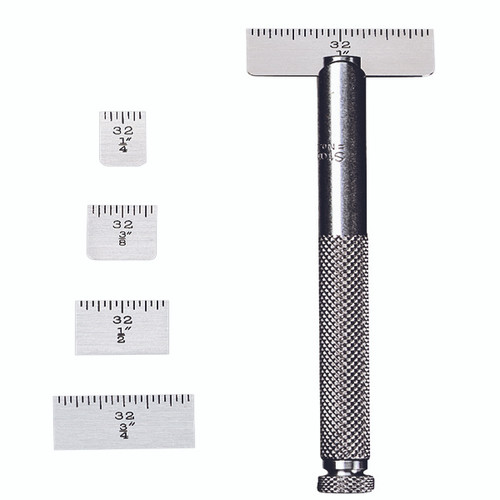
I bought several cheap flexible 6" scales and cut them into shorter pieces. Handy for measuring in tight spaces where a 6" scale won't fit. You can clamp them in an Xacto knife handle for more reach. Starrett makes a set, but $$$.

 
To avoid these ads, REGISTER NOW!
Top Bottom