moab11
Well-known member
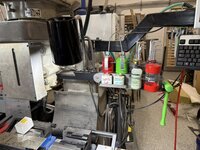
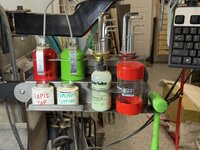
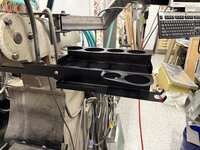
That looks like a great idea to store some of your most used tool holders! Close at hand, and then also gives you a handy spot to put extras when not needed as you work through a project.

yeah, I think a combination of the two is probably perfect. If I had maybe 5 or 6 on the top lip of the splash guard that should be enough for just about anything I'm machining as I'm machining and then be able to put them away when I'm done.That looks like a great idea to store some of your most used tool holders! Close at hand, and then also gives you a handy spot to put extras when not needed as you work through a project.
I think I get what you’re saying but not sure. Share pics when you can…I can’t find a picture and I’m working out of state. I have swing away tables on each end of my 1340. It’s just an angled square tubing arm that registers on a pin with a table top that has a central pin in it as well. I use them for all of my pertinent tooling and parts when I’m working. They lift off and store away when not needed. My friends call them the dentist tables.!
I think I get what you’re saying but not sure. Share pics when you can…
way less complicated that the ones I made. Hm...wonder if they'd be strong enough for the larger CA tool holders on a 10* angle sitting above the lathe (thinking about them being 3d printed and not in 6061 machined)?
Pin gage just helps you take a measurement that's otherwise difficult to measure. In this case, a pin is unimportant because we have the ability to model and we know the angle (defined in the Aloris CA spec). Here's an examle:Dumb question time....
If you use pin gauges to measure the width of the dovetail, why wouldn't one use round pins to hold the tool holders?


In fact -Dumb question time....
If you use pin gauges to measure the width of the dovetail, why wouldn't one use round pins to hold the tool holders?

Daaaayum!Today's lunchtime activity - Knee Mill Organizer
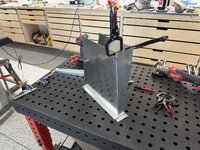
Had a few backwards moments bending it up that caused me to make a couple of the parts again but I got there.
Three pieces to get this thing to come together.
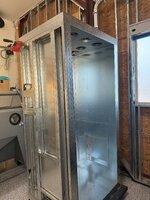
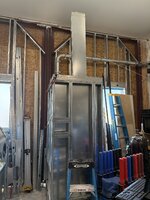
Working on getting the insulation in the oven which gives me a lot of time to contemplate 2 things:Oven build reminds me of a place I worked at that made temperature ovens for crystal oscillator testing. Made everything in-house, circuit boards, software, full machine shop. They had to be within 1 degree C anywhere/everywhere in oven, which is no easy task, from -40 C to 150 C. Used nitrogen or compressor cooling, electric heat. The amount of mass in the oven affected things too. It was interesting work, I did a bit of everything.

Oh come on LS, everyone know you need to create a vacuum furnace duhhhhWorking on getting the insulation in the oven which gives me a lot of time to contemplate 2
in regards to #1....how does one design an oven to be within one degree C anywhere/everywhere? You teased maybe the most important and relevant information of my current (big) project. I'm focused on ensuring that I have sufficient circulation but I'm gonna bet there's something I'm missing....
Multiple sensors?...share.

I use a convection oven as my powder coat oven. It behaves very well. I see you've got fans in the top of yours. So long as you distribute the output airflow all over the bottom, you should have a pretty consistent temperature, and not need a lot of complexity.Working on getting the insulation in the oven which gives me a lot of time to contemplate 2 things:
in regards to #1....how does one design an oven to be within one degree C anywhere/everywhere? You teased maybe the most important and relevant information of my current (big) project. I'm focused on ensuring that I have sufficient circulation but I'm gonna bet there's something I'm missing....
- Things people have said to me that I didn't grok in the moment.
- Other projects that I wanna do
Multiple sensors?...share.
think I've somehow created enough complexity regardless...I use a convection oven as my powder coat oven. It behaves very well. I see you've got fans in the top of yours. So long as you distribute the output airflow all over the bottom, you should have a pretty consistent temperature, and not need a lot of complexity.








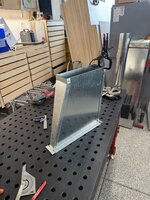

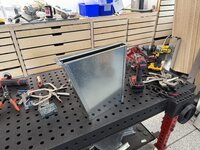


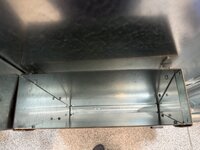


I had that conversation with my boss a few days ago. That’s something we both agree on!Oh, how do I get there from here! Love the challenge, then the result....
Oh, how do I get there from here! Love the challenge, then the result....
Done right, it can be magic.I had that conversation with my boss a few days ago. That’s something we both agree on!


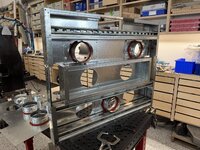
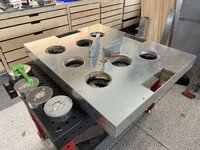
Thank you. I got the fans and ducts sealed, temp wired, and gave them a go. Recirculating into the element boxes and everything 16ga should be a game changer for even heating and recovery.That powder coat oven looks fantastic.
You could probably sell these when you are done with the prototype unit.
Excellent fab!
It was a progression of designs and techniques. Ovens started small, 1 cu ft being able to test 10s of oscillators. Then medium size, larger and larger with capacities in the hundreds. Yes the ovens had circulation fans. Multiple sensors, up to 8 or 16 temp channels. Good door seals, wire seals. Don't put stuff in the corners. One of the major hurdles was the control scheme. Controlling undershoot/overshoot without being too slow. Test time is money, have to test hot and cold and someplace in the middle. We used a PID control loop. Took a long time to tune it. Calibration was not fun. Cooling with liquid nitrogen was very fast, compressor systems much slower. Differences in mass were hard to deal with, how many racks installed.in regards to #1....how does one design an oven to be within one degree C anywhere/everywhere? You teased maybe the most important and relevant information of my current (big) project. I'm focused on ensuring that I have sufficient circulation but I'm gonna bet there's something I'm missing....
Multiple sensors?...share.
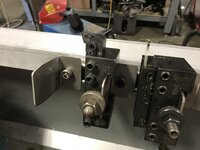
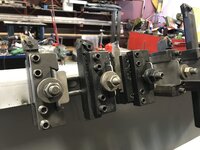

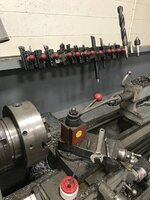
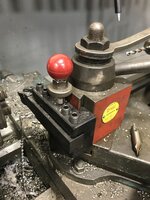
Yah, saw this a ways back. It’s WAY less complicated. I could make dozens in a hour verses the days it took with a dovetail cutter I paid more than a hundred for….Y’all are overthinking the lathe toolholder parts…
A simple piece of stainless bent that fits in the dovetail works perfectly and requires no machining, 3D printing or any special tools.
You can obviously CNC cut them for convenience and consistency, but you could do this with a cutoff wheel on a grinder if you wanted to.
I have mine attached to a piece of uni-strut so it’s adjustable and modular.
I saw this trick years ago on Tom Lipton’s blog and made my own.
A few years later I saw him add knobs to the toolholders and it’s a game changer. Super duper handy. Highly recommend.
The machined blocks are cool, but a lot of extra work haha.


Boring would be ok on lower RPM/bigger diameter stuff but yeah, you’d be wearing some of itWorks great, makes one heck of a mess on a manual lathe haha.
I used a Hougen mag drill coolant pump, I just put the quick connects on it so I could easily swap it around.
Since getting the Mazak I tend to not use the LeBlond for boring jobs that need coolant.

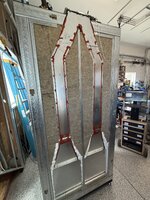


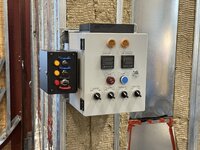
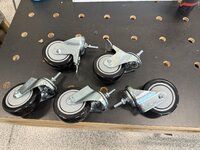
Didn’t you guys’s moms teach you not to play with your stool?For an upcoming project. Any guesses? Should be easy…
