To avoid these ads, REGISTER NOW!

Looking For Specialty Hook Wrench

Rstark18

Well-known member
Joined
Mar 28, 2013
Messages
75
Location
Los Angeles
I'm hoping someone can help me find a tool that would make some of my jobs easier.
I need a hook spanner/hook wrench with pins that engage on opposite sides. It needs to fit a barrel of about 1.5"
So The barrel has 4 receiving holes that are 90deg apart. I only need to engage two of these holes to unthread/thread the barrel.
I normally use a standard hook spanner but in some circumstances the ape that worked on the equipment previously torqued down the barrel far too much. THe barrel is made of nickel plated brass and is very soft. If too tight the single pin spanner deforms the receiving hole.
I've only come across one tool that is close to what I need but it is very expensive for the apparent quality. ( https://www.grainger.com/product/FACOM-Precision-Adjustable-Pin-Spanner-36U003 ).
Any other suggestion besides the above tool?
 
To avoid these ads, REGISTER NOW!

4xdog

Well-known member
Joined
Aug 18, 2012
Messages
5,601
Location
Santa Fe, NM
Park Tool (a well-known producer of bicycle tools) makes a pin spanner that might work for you. Ten bucks.

SPA-1_002.jpg


Edit: Ah, I see you're looking for a side pin spanner, not a face pin spanner... That Park tool is obviously for pin holes on the face of the target.
 
Last edited:

eejack

Well-known member
Joined
May 18, 2021
Messages
166
Location
the garden state
As an odd thought, you might be able to modify a C clamp to the task. Set an appropriately sized pin on the static end and grind down the moving end to a point. Not pretty and not a shiny new tool but...
 
OP
R

Rstark18

Well-known member
Joined
Mar 28, 2013
Messages
75
Location
Los Angeles
Thanks for the suggestion but I don’t have a way to fabricate the tool. I did think about adding pins to an adjustable wrench but again I don’t want to fabricate.
 

KnurledNut

Well-known member
Joined
Jan 28, 2011
Messages
8,104
Location
n/a
Last edited:
OP
R

Rstark18

Well-known member
Joined
Mar 28, 2013
Messages
75
Location
Los Angeles
That is something to consider especially the Hozan BB tool. My concern with that is getting the pins round so that they don't chew up the part.
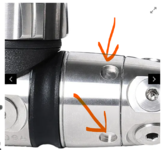
FYI here is an example of the part in question.
 

Attachments

  • Screenshot 2021-05-30 122624.png
    Screenshot 2021-05-30 122624.png
    397.6 KB · Views: 60

darkzero

Well-known member
Joined
Oct 20, 2011
Messages
3,317
Location
SoCal
That is something to consider especially the Hozan BB tool. My concern with that is getting the pins round so that they don't chew up the part.
FYI here is an example of the part in question.

My first thought seeing the pic was just a common single pin spanner but after reading your original post now I understand why you want a wrench with 2 pins from opposing sides.

Here's a thought, how about making some new vise jaws. Drill a hole & press in a dowel pin on each jaw. Then bolt the jaws in place of the original jaws. I suppose you might be able to make the same thing as jaw pads/inserts but my thinking is it's better to have them secured to the vise so you don't have to clamp down on the part tight & risk slipping.

Or you can make something like this which should be pretty easy also.

TFPS R5701 RADIAL PIN SPANNER 02175 1K.jpg
 

510ebl

Well-known member
Joined
Jan 20, 2015
Messages
518
Location
Southern New Jersey
Thanks for the suggestion but I don’t have a way to fabricate the tool. I did think about adding pins to an adjustable wrench but again I don’t want to fabricate.
I realize you don’t want to fabricate, but an adjustable wrench could be cross drilled and roll pins installed with nothing but a drill, drill bit and hammer. Welding/heavier fabrication may not be necessary. Forgive me if this is exactly what you DON’T want to get into.

What is the required diameter of the pins to engage the holes in the part in the image you posted?
 

510ebl

Well-known member
Joined
Jan 20, 2015
Messages
518
Location
Southern New Jersey
Is this a purpose built tool for the job? I don’t know anything about scuba gear, but it looks similar to your application.

 
To avoid these ads, REGISTER NOW!

mikegt4

Well-known member
Joined
Sep 12, 2005
Messages
3,265
Location
sw ohio
Pick your poison.
 

Al Borland

Well-known member
Joined
Jan 20, 2016
Messages
1,598
There ARE single-size fixed wrenches designed for this. (Pin Spanners) They look like a box wrench with a half-moon opening and pins sticking in.
And it's an excuse to buy a NEW TOOL!!!!!!!
Garage Journal Peer Pressure!!!
Get them NOW!!!
 
OP
R

Rstark18

Well-known member
Joined
Mar 28, 2013
Messages
75
Location
Los Angeles
My first thought seeing the pic was just a common single pin spanner but after reading your original post now I understand why you want a wrench with 2 pins from opposing sides.

Here's a thought, how about making some new vise jaws. Drill a hole & press in a dowel pin on each jaw. Then bolt the jaws in place of the original jaws. I suppose you might be able to make the same thing as jaw pads/inserts but my thinking is it's better to have them secured to the vise so you don't have to clamp down on the part tight & risk slipping.

Or you can make something like this which should be pretty easy also.

TFPS R5701 RADIAL PIN SPANNER 02175 1K.jpg
I like the idea of modifying an setting the pins in the vice jaws.
Question. The image you posted. What tool is that? It looks perfect for the job

What is the required diameter of the pins to engage the holes in the part in the image you posted?
It is 1.5“
Is this a purpose built tool for the job? I don’t know anything about scuba gear, but it looks similar to your application.
This is exactly what that tool is for and I already have that. The problem with that tool is that the lockdown screws are made from soft nylon. Under normal circumstances it works fine but when the body is over torqued it shreds the nylon ends.

Pick your poison.
I’ve already searched McMaster and haven’t found anything.

There ARE single-size fixed wrenches designed for this. (Pin Spanners)
I already have fixed single pin spanned specifically for this purpose. This is what I normally use. The problem with the single pin is that it loads too much pressure on the one receiving hole and will deform the hole. Distrusting the force across two holes will lessen the chance of deforming the hole.
 

Hiball

Well-known member
Joined
Apr 30, 2009
Messages
14,027
Location
Missery
I bet a fixed or adjustable “Pin” wrench would work as long as the Pin fits the Hole solid and isn’t undersized, Unless it’s damaged. What is the diameter of the Holes? How deep are they? They appear to be fairly shallow.
 
Last edited:

darkzero

Well-known member
Joined
Oct 20, 2011
Messages
3,317
Location
SoCal
Question. The image you posted. What tool is that? It looks perfect for the job
I'm not sure exactly, I think it's for dirt bike shocks. But it might be too big for your needs & it's expensive. Just found it on google to show as an example to make but I think you said you rather not make a tool? It's a simple design & easy to make though if you have the proper tools.

 
OP
R

Rstark18

Well-known member
Joined
Mar 28, 2013
Messages
75
Location
Los Angeles
I bet a fixed or adjustable “Pin” wrench would work as long as the Pin fits the Hole solid and isn’t undersized. What is the diameter of the Holes? How deep are they? They appear to be fairly shallow.
The pin in a single pin wrench for the diameter of the body (1.5”) is always too small. The pins are usually around 2-3mm and the receiving holes are about 5mm And a depth of 1.5mm.
Again based on 20 years of working on these I can tell you when they are frozen, a single pin spanner deforms the receiving hole. i have a high quality specialty set of fixed single pin scanners just for this application which is what I always use.
 

Hiball

Well-known member
Joined
Apr 30, 2009
Messages
14,027
Location
Missery
The pin in a single pin wrench for the diameter of the body (1.5”) is always too small. The pins are usually around 2-3mm and the receiving holes are about 5mm And a depth of 1.5mm.
Again based on 20 years of working on these I can tell you when they are frozen on a single pin scanner deforms the receiving hole. i have a high quality specialty set of fixed single pin scanners just for this application which is what I always use.
1.5mm depth screams specialty tool to me, I own just about every pin/hook tool known to man including the Facom model you linked in the 1st post. If it’s deformed or the Pin you are using is too deep, I can see it damaging the holes and wanting to cam out.

How have you gotten them out in the past when “frozen”?
 
OP
R

Rstark18

Well-known member
Joined
Mar 28, 2013
Messages
75
Location
Los Angeles
1.5mm depth screams specialty tool to me, I own just about every pin/hook tool known to man including the Facom model you linked in the 1st post. If it’s deformed or the Pin you are using is too deep, I can see it damaging the holes and wanting to cam out.

How have you gotten them out in the past when “frozen”?
The specialty set I have is made just for this application and has shallow pins. On a standard service job it works perfectly.
Whenever I get a body in that that is frozen I add a leverage pipe to the scanner and can always get it off that way. This always results in some form of receiving hole deformation.
 

Hiball

Well-known member
Joined
Apr 30, 2009
Messages
14,027
Location
Missery
The specialty set I have is made just for this application and has shallow pins. On a standard service job it works perfectly.
Whenever I get a body in that that is frozen I add a leverage pipe to the scanner and can always get it off that way. This always results in some form of receiving hole deformation.
Gotcha.. Well due to the size and pin depth, I got nothing outside of maybe a strap wrench over some properly sized wooden dowels or similar material that are cut down.

Or maybe just a strap wrench?
 
Last edited:

510ebl

Well-known member
Joined
Jan 20, 2015
Messages
518
Location
Southern New Jersey
This is exactly what that tool is for and I already have that. The problem with that tool is that the lockdown screws are made from soft nylon. Under normal circumstances it works fine but when the body is over torqued it shreds the nylon ends.
Is the ring also nylon on the specialty tool? Could the lockdown screws be replaced with a threaded “bolt” with the end turned down to the diameter and depth you need? I’d wager if you had a new nylon lockdown screw (or whole tool) to take measurements from, someone here could make one from just about any material you could imagine. Maybe even replicate the “ring” for you in something that won’t mar the stainless/titanium part.

That said, I like the vise idea better...
 

joecon

Well-known member
Joined
Oct 4, 2010
Messages
679
what if you used tow of the hook type of spanners one forwards and one backwards, if you drilled a hole and put a bolt in to make it like a pair of pliers it would put the load on both holes and help stop the deformation of the hole.
 
OP
R

Rstark18

Well-known member
Joined
Mar 28, 2013
Messages
75
Location
Los Angeles
Thanks for all the suggestions. I figured out what I'm going to do.

I'm going to have two separate ways of doing this using extended tip set screws (dog tip).

First is similar to what @darkzero suggested using the vice. I'm going to remove the mounting bolt on one end of the vice jaws and use the holes to screw in the set screws. The vice I use (Heinrich Grip Master) to work on this equipment has through holes for the jaws which will make adjusting them in and out very easy.

For the second solution I'm going to use the specialty tool (that I already have and never use) and replace the soft nylon screws with extended tip set screws. I'll add a small knurled knob to the end of these to make adjusting quick.
 
To avoid these ads, REGISTER NOW!
Top Bottom