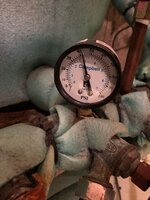
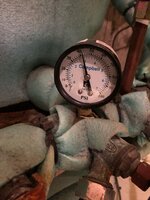
Generally, well water isn't too kind to components - various minerals can cause buildups and even plugs - the FIRST thing that can (and does) go wrong, is GAUGES. Before I spent much $$$ on your well, I would buy a new gauge like the one you have and replace the old one - you know what the existing one reads, after replacing it and there's no change, you're only out a few bucks - but at least you'll know more than you do now.
Once you know what's REALLY happening pressure-wise, you need to realize that your "pump guy" may not have realized what you asked about the diaphragm pressure setting - if he DID understand, I'd recommend getting a different "pump guy", because he BLEW it - pressure on the diaphragm ABSOLUTELY must be a few PSI LOWER than the pressure switch's cut-IN pressure, because if it's NOT, then the pump will NEVER TURN ON because the pressure switch thinks there's always enough water pressure so it doesn't NEED to turn on.
If your new gauge reads the same as the old one, and your pump is running constantly, I'm surprised the pump hasn't died yet - it'd be a REALLY good idea to figure this out SOONER than later.
Speaking of which, here's a vid for setting your pressure switch
Remember to ONLY use insulated tools for this, there's an
excellent chance you have bare metal wiring lugs with 240 volt across them...
And a basic well diagram
Notice at the very bottom of the well is the pump - typically the actual MOTOR is the bottom half of the pump (so it's more likely to be cooled) - the upper half of the pump is whatever impellers that pump has, stacked on the driven shaft - I've had wells that ran on a 3/4 horse pump (my existing one) but that well's only 60 feet deep - also had a well that was 280 feet deep, it had a 3 horse pump with 23 stacked impellers.
Just above the pump in the diagram, see the check valve - this is a one-way valve that keeps the pipe above it from draining out between cycles - usually called a "foot" valve. these can wear out and leak down (in fact, nearly every component in the system can fail)
If your gauge isn't lying to you, and the pump isn't shutting off, that could be a leak in the pipe that's ABOVE the water level - that could allow PART of the water that's being pumped to just dump back into the well casing - That could be the reason your pump isn't coming up to cut-off pressure, because
the entire system from pump to pressure tank has to be leak-proof or it can NOT build pressure. The bigger the leak, the less likely it'll come up to pressure.
Depending on what kind of pipe your well has, that "evil well water" I mentioned earlier could have caused the pipe itself to erode away - I replaced piping in one well that was galvanized - the ONLY parts of that piping I recognized as being galvanized, were the parts that were PROTECTED by the electrical tape that'd been used to fasten the pump wiring to the pipe - the rest of the pipe wasn't very far from collapsing and dropping pump and all into the well - I replaced all 60' of that with schedule 80 CPVC and a new bronze check valve - water tasted better after that too...
Hopefully the diagram I posted will help you in troubleshooting - remember, the more you learn about this the less likely your wallet will be calling you names :=)
HTH... Steve