

You are using an out of date browser. It may not display this or other websites correctly.
You should upgrade or use an alternative browser.
You should upgrade or use an alternative browser.
Low-yield well solutions?
- Thread starter racerboy
- Start date
Chapter21
Well-known member
The well fills the tank directly, then you have a second pump (basically just another well pump) and a pressure tank that feeds your house from the tank. You'll have to come up with some arrangement of float/level switches and timers so that the well pump turns on/off at a rate it can keep up with and then shuts down when full. It can be done for very low cost.Ok. That sounds like how mine is set up.
If I were to add a storage tank, it would go between the well and the pressure pump, correct?
The well fills the tank directly, then you have a second pump (basically just another well pump) and a pressure tank that feeds your house from the tank. You'll have to come up with some arrangement of float/level switches and timers so that the well pump turns on/off at a rate it can keep up with and then shuts down when full. It can be done for very low cost.
Thanks Chapter21
I found this post from another Internet forum and it sounds like the guy is trying to do the exact same thing: build a low-budget Well Manager.
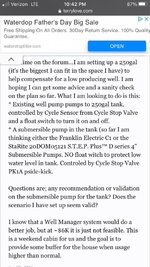
Sent from my iPhone using Tapatalk
Attachments
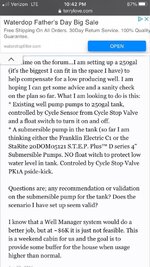
Chapter21
Well-known member
That looks about right. This sort of thing can be put together rather cheaply if you find the right parts. Some of the other systems might be more advanced about controlling pressure and other things but that isn't really helping the low water situation, just a fancier system.
As long as the well guy checks out the well/pump and you can get it flowing right again, even just a little bit of flow should make this usable. Then you shouldn't have to worry about anything except running out of water, but if that happens you would just need to wait.
As long as the well guy checks out the well/pump and you can get it flowing right again, even just a little bit of flow should make this usable. Then you shouldn't have to worry about anything except running out of water, but if that happens you would just need to wait.
I feel like the well guy sort of abandoned me. As soon as I told him that I lowered the pressure from 40/60 to 30/50 and that the well pump was now able to turn off, he thinks the equipment is fine, just that the water table is too low. He was supposed to call his digger about a new well but not sure that ever happened. The well digger I called was not the same one he uses, but that guy wasn’t really that helpful. Maybe I’m being a bit harsh, but he had no interest in coming out to scope things out. He basically told me to pick the spot I wanted a new well and as long as it was 100’ from my septic and a truck could get to it, he would drill it.
Adding a second (or bigger) pressure tank wouldn’t really help, right? I think my tank is 42 gal, according to my neighbor who replaced it for the previous owners.
With the pressure at 30/50, everything seems to be ‘normal’. We are being careful about not running the shower and the dishwasher and washing machine at same time, but we have not run out of water again. I’m assuming this is because the well is recovering at a fast enough rate for the pump to hit the 50 psi mark.
We are getting a lot of rain this weekend so hopefully that helps a bit as well.
Adding a second (or bigger) pressure tank wouldn’t really help, right? I think my tank is 42 gal, according to my neighbor who replaced it for the previous owners.
With the pressure at 30/50, everything seems to be ‘normal’. We are being careful about not running the shower and the dishwasher and washing machine at same time, but we have not run out of water again. I’m assuming this is because the well is recovering at a fast enough rate for the pump to hit the 50 psi mark.
We are getting a lot of rain this weekend so hopefully that helps a bit as well.
Chapter21
Well-known member
If it's working OK now I would not bother with the well guy then...just make sure the pump doesn't run dry (and probably install some sort of run dry protection) and does not keep running. You could easily add an extra tank on top of that with a solenoid valve that opens to fill a tank at recurring intervals you could set that do not run the well dry. (Say, 5 minutes every hour)
You could store more water using a bigger, or another pressure tank, but that is probably a much more expensive way to go about it, you only get to use about 25% of the tank capacity before you run out of pressure.
You could store more water using a bigger, or another pressure tank, but that is probably a much more expensive way to go about it, you only get to use about 25% of the tank capacity before you run out of pressure.
If it's working OK now I would not bother with the well guy then...just make sure the pump doesn't run dry (and probably install some sort of run dry protection) and does not keep running. You could easily add an extra tank on top of that with a solenoid valve that opens to fill a tank at recurring intervals you could set that do not run the well dry. (Say, 5 minutes every hour)
You could store more water using a bigger, or another pressure tank, but that is probably a much more expensive way to go about it, you only get to use about 25% of the tank capacity before you run out of pressure.
I like this idea. A couple of questions:
Is the PumpTech the type of device I would get to prevent the pump from pumping the well dry?
Any recommendations on a timed solenoid valve that I could install between the well and the storage tank?
Would I need a float switch in the storage tank to stop the solenoid from opening once that tank was full?
Would the second pump push the water from the storage tank to the pressure tank? If so, what size pump would I need? My initial thinking is to get something like a 200 gal storage tank and place it next to the pressure tank.
Sent from my iPhone using Tapatalk
American Locomotive
Well-known member
I feel like the well guy sort of abandoned me. As soon as I told him that I lowered the pressure from 40/60 to 30/50 and that the well pump was now able to turn off, he thinks the equipment is fine, just that the water table is too low. He was supposed to call his digger about a new well but not sure that ever happened. The well digger I called was not the same one he uses, but that guy wasn’t really that helpful. Maybe I’m being a bit harsh, but he had no interest in coming out to scope things out. He basically told me to pick the spot I wanted a new well and as long as it was 100’ from my septic and a truck could get to it, he would drill it.
Adding a second (or bigger) pressure tank wouldn’t really help, right? I think my tank is 42 gal, according to my neighbor who replaced it for the previous owners.
With the pressure at 30/50, everything seems to be ‘normal’. We are being careful about not running the shower and the dishwasher and washing machine at same time, but we have not run out of water again. I’m assuming this is because the well is recovering at a fast enough rate for the pump to hit the 50 psi mark.
We are getting a lot of rain this weekend so hopefully that helps a bit as well.
While this probably isn't what you want to hear - there really isn't much more the well drillers can do, IMO. There really isn't anything to "scope out" from the surface. Either they'd need detailed data from every single well around you to build an idea of the water table, or they'd have to contract a geo-technical firm to drill a bunch of test bore holes around your property.
If you got exact positions of all of your neighbors' wells, along with their static water level depths, plotted it all on a map - you might be able to make a more informed decision about where to place a new well.
Thanks Loco.
I can certainly create a map of where my neighbor’s wells are located. If you look at the below picture, the red X indicates where my other neighbor has a good well. From the yellow X to the red X is about 120’. The distance from my existing well to the yellow X is about 40’. I believe a well drilling truck could get into that gravel area, and maybe even a few feet back into the woods closer to that other well, and still have a relatively straight shot to my existing well my understanding is that if I drilled a new well, I would want to have it connect to the pipe that goes into my basement, as opposed to having to tear up my patio for a new line. Is that correct?

Sent from my iPhone using Tapatalk
I can certainly create a map of where my neighbor’s wells are located. If you look at the below picture, the red X indicates where my other neighbor has a good well. From the yellow X to the red X is about 120’. The distance from my existing well to the yellow X is about 40’. I believe a well drilling truck could get into that gravel area, and maybe even a few feet back into the woods closer to that other well, and still have a relatively straight shot to my existing well my understanding is that if I drilled a new well, I would want to have it connect to the pipe that goes into my basement, as opposed to having to tear up my patio for a new line. Is that correct?
Sent from my iPhone using Tapatalk
Attachments

jrsavoie
Well-known member
$10 a foot sounds cheap. I was guestmated $8000 for about 125 ft deep. My 65 ft 5" well was near $5000. 20 years ago.Not sure what part of Jersey you’re in, but in the NNJ/NYC metro wells run ~$10/ft. I’d suggest not trying to put anything hillbilly over on the health dept.
Sent from my iPhone using Tapatalk
jrsavoie
Well-known member
$10 a foot sounds cheap. I was guestmated $8000 for about 125 ft deep. My 65 ft 5" well was near $5000. 20 years agoNot sure what part of Jersey you’re in, but in the NNJ/NYC metro wells run ~$10/ft. I’d suggest not trying to put anything hillbilly over on the health dept.
Sent from my iPhone using Tapatalk
I haven't gone back through the thread. How deep is your well?Thanks Loco.
I can certainly create a map of where my neighbor’s wells are located. If you look at the below picture, the red X indicates where my other neighbor has a good well. From the yellow X to the red X is about 120’. The distance from my existing well to the yellow X is about 40’. I believe a well drilling truck could get into that gravel area, and maybe even a few feet back into the woods closer to that other well, and still have a relatively straight shot to my existing well my understanding is that if I drilled a new well, I would want to have it connect to the pipe that goes into my basement, as opposed to having to tear up my patio for a new line. Is that correct?
Sent from my iPhone using Tapatalk

What diameter?
Do you haveba submersible pump?
What elevation are you sucking from? Can you lower your pump or suction pipe?
What is the water level in your well?
Attachments

jrsavoie
Well-known member
The guy from California that recommended a storage tank for my issues, said he would use a 1500 gallon tank buried outside the house.I like this idea. A couple of questions:
Is the PumpTech the type of device I would get to prevent the pump from pumping the well dry?
Any recommendations on a timed solenoid valve that I could install between the well and the storage tank?
Would I need a float switch in the storage tank to stop the solenoid from opening once that tank was full?
Would the second pump push the water from the storage tank to the pressure tank? If so, what size pump would I need? My initial thinking is to get something like a 200 gal storage tank and place it next to the pressure tank.
Sent from my iPhone using Tapatalk
Last edited:
tez929rr
Well-known member
The 1500 gallon poly tanks are very reasonably priced.The guy from California that recommended a storage tank for my issues, said he would use a 1500 gallon tank.
jrsavoie
Well-known member
Yes they are. Sometimes they can be found used even cheaper.The 1500 gallon poly tanks are very reasonably priced.
$10 a foot sounds cheap. I was guestmated $8000 for about 125 ft deep. My 65 ft 5" well was near $5000. 20 years ago
I haven't gone back through the thread. How deep is your well?
What diameter?
Do you haveba submersible pump?
What elevation are you sucking from? Can you lower your pump or suction pipe?
What is the water level in your well?
My well is 500’ deep. I have a 1hp/7gpm submersible pump. The pump was replaced last June and the well was hydrofracked. According to the paperwork, the static level was 60’, but I think it is much deeper. After they hydrofracked it, it would take an ice cube about 7-8 sec. to hit water. Now it takes 12-14 sec. I had to adjust my 40/60 pressure switch down to 30/50 because the pump could no longer get to 60 psi and would just keep running. It seems to be working ok now, but I know I’m living on borrowed time. That’s why I’m looking at a store age tank solution and/or a new well. The driller quoted me $15 a foot just for the drilling (casing, piping, electrical is extra).
We got a lot of rain the last two days, so when I get home I’m going to try my ice cube test again to see if there is any improvement.
Sent from my iPhone using Tapatalk
The guy from California that recommended a storage tank for my issues, said he would use a 1500 gallon tank buried outside the house.
Any idea how far down it would have to be buried to avoid freezing?. We get plenty of days in the 0-10 degree (F) range in the winter. That’s why I was thinking of the tank in my basement (though 1500 gal sure sounds nice).
Sent from my iPhone using Tapatalk
65ranchero
Well-known member
It's a real thing!Spoke to PG today. Still no ETA on when well driller might be coming by for a discussion. I talked to my neighbor with the 2 wells. He told me that one of his wells is at 350’ and the other one is at 500’. He said neither of his wells are great producers but they are good enough. lol. He said he would send me the name of the outfit that drilled his second well. He also talked a little bit about the people who find water using a divining rod. I always though that was fictional. Do people really do this for a living?
Sent from my iPhone using Tapatalk

Sevenhills1952
Well-known member
We went to their convention about 35 years ago in Danville, Vermont. We were impressed. They had well drilling equipment there and these old guys would dowse, then say "right here" when dowsing stick (some used divining rods crossed) , then tell depth, gpm flow rate, etc. Drill to verify.
Pretty convincing. Some used a Y shaped willow branch, others two bent copper rods, some a pendulum. Seems bizarre but amazing.
There were classes we took at the convention also.
Sent from my SM-S205DL using Tapatalk
Pretty convincing. Some used a Y shaped willow branch, others two bent copper rods, some a pendulum. Seems bizarre but amazing.
There were classes we took at the convention also.
Sent from my SM-S205DL using Tapatalk
Chapter21
Well-known member
I'm not sure exactly what you need for run dry protection - I'm sure others can answer. I need to install the same on my well. I believe it senses a current change in the motor due to lack of water and then shuts it off. I don't know which valves are "good", but I just bought a 3/4" brass solenoid valve from Amazon, have not received it yet. A motorized ball valve would probably be more reliable but also about double the cost. You could probably just use a plain old sprinkler valve, they're only like $14.
I would definitely use an additional float switch at the top of your tank to turn off the well whenever the tank gets full. The second pump is the one that pumps water to the pressure tank, and will control your household pressure. This way your old pump does not have to produce high pressure and could potentially last longer. They sell external pumps for this type of system that **** water from your tank, or you can literally just use a normal submersible well pump submersed in your water tank. Check out the water pump section on Northern Tool.
Also keep in mind I won't be using my system for household use - just irrigation and outdoor cleaning. You might want to consider some kind of UV sterilizer after the water tank, in case anything bad ever starts to grow in your tank. Definitely make sure the tank is in a dark place and get a black one if you can.
I would definitely use an additional float switch at the top of your tank to turn off the well whenever the tank gets full. The second pump is the one that pumps water to the pressure tank, and will control your household pressure. This way your old pump does not have to produce high pressure and could potentially last longer. They sell external pumps for this type of system that **** water from your tank, or you can literally just use a normal submersible well pump submersed in your water tank. Check out the water pump section on Northern Tool.
Also keep in mind I won't be using my system for household use - just irrigation and outdoor cleaning. You might want to consider some kind of UV sterilizer after the water tank, in case anything bad ever starts to grow in your tank. Definitely make sure the tank is in a dark place and get a black one if you can.
jrsavoie
Well-known member
Since the tank would have a lot of flow, I could probably get by with 42". But why not just go the whole 4 ft?Any idea how far down it would have to be buried to avoid freezing?. We get plenty of days in the 0-10 degree (F) range in the winter. That’s why I was thinking of the tank in my basement (though 1500 gal sure sounds nice).
We get as cold as -20 F. I usually just bury everything 4 foot deep.
The other thing you have to watch out for, is the tank floating out of the ground - like an empty septic tank will do.. Just have to make sure it's full of water and it won't float.
Sent from my iPhone using Tapatalk
I’m going to start piecing together the parts I need to create this poor man’s well manager storage tank today. Time to do a little shopping on Amazon.
Regarding the actual storage tank, my first inclination is to put this in my basement. Should I still look for a black one? The reason I ask is that the ones that come with the real Well Manager system are translucent.
We got a lot of rain here in north NJ the past two days. I used an 18-gal bucket to collect rainwater from one of my downspouts of the garage and then used a small transfer pump to transfer it to the 65-gal tank I bought the other day. I was surprised how quickly that 18-gal bucket filled up. Got me thinking that I should capture rain water for watering the plants, washing cars, etc.
I also checked the well again using the ice cube method and the water is now between 6-7 seconds down. That’s basically the same level that it was at right after they hydrofracked last summer.
is there any reason to change the switch back to a 40/60 configuration or is it fine to leave it at the 30/50 setting?
Regarding the actual storage tank, my first inclination is to put this in my basement. Should I still look for a black one? The reason I ask is that the ones that come with the real Well Manager system are translucent.
We got a lot of rain here in north NJ the past two days. I used an 18-gal bucket to collect rainwater from one of my downspouts of the garage and then used a small transfer pump to transfer it to the 65-gal tank I bought the other day. I was surprised how quickly that 18-gal bucket filled up. Got me thinking that I should capture rain water for watering the plants, washing cars, etc.
I also checked the well again using the ice cube method and the water is now between 6-7 seconds down. That’s basically the same level that it was at right after they hydrofracked last summer.
is there any reason to change the switch back to a 40/60 configuration or is it fine to leave it at the 30/50 setting?
American Locomotive
Well-known member
6-7 seconds is 750+ feet. If you really want to know the height of the water, just get a ton of string with a heavy weight tied to it. Drop the string down until it doesn't go any further, and then mark the string with a marker right at ground level. Pull the string out, and wherever the string transitions from wet to dry will roughly be the water level. Then just measure that distance to the mark you made.
A bit of rain in a day is not going to make that much of a difference that quickly to a 500+ foot well. A shallow well? Sure. Definitely not a deep well. It takes a long time for water to percolate through the ground.
As far as dowsing goes? It's a bunch o' ****. It doesn't hold up to scientific scrutiny (as in, the "success rate" is not any better than random chance). It's easy to say "But we found water right where the dowser said we would, so it must work!" It's very convincing until you realize that you could have drilled anywhere in a 500 foot radius from where the dowser said to drill and still hit just as much water. Basically what it comes down to is that aquifers are usually huge, and that it's hard to not hit water when drilling down in most of the country.
The USGS actually published a whole report on dowsers. If they were any more reliable than random chance - the USGS would be employing them.
...and that's why so many of the well drillers you've called are just saying "just pick a spot I can get the truck into". Because in small areas like the size of your yard (unless your yard is 500 acres), it really doesn't matter. There aren't narrow veins of water flowing through the ground. If your well is really terrible, then a well drilled 40 feet to the north, south, east and west are likely to be just as terrible. Yes occasionally you get the short of the end the stick and you get a terrible well, while your neighbor right next door has an amazing well - but that's not super common.
A bit of rain in a day is not going to make that much of a difference that quickly to a 500+ foot well. A shallow well? Sure. Definitely not a deep well. It takes a long time for water to percolate through the ground.
As far as dowsing goes? It's a bunch o' ****. It doesn't hold up to scientific scrutiny (as in, the "success rate" is not any better than random chance). It's easy to say "But we found water right where the dowser said we would, so it must work!" It's very convincing until you realize that you could have drilled anywhere in a 500 foot radius from where the dowser said to drill and still hit just as much water. Basically what it comes down to is that aquifers are usually huge, and that it's hard to not hit water when drilling down in most of the country.
The USGS actually published a whole report on dowsers. If they were any more reliable than random chance - the USGS would be employing them.
...and that's why so many of the well drillers you've called are just saying "just pick a spot I can get the truck into". Because in small areas like the size of your yard (unless your yard is 500 acres), it really doesn't matter. There aren't narrow veins of water flowing through the ground. If your well is really terrible, then a well drilled 40 feet to the north, south, east and west are likely to be just as terrible. Yes occasionally you get the short of the end the stick and you get a terrible well, while your neighbor right next door has an amazing well - but that's not super common.
jrsavoie
Well-known member
You might consider installing a cistern. They work great. You can even run drainage tiles to them. Our Cistern was huge I filled it with clean rock. Seems it took more than a semi loadI’m going to start piecing together the parts I need to create this poor man’s well manager storage tank today. Time to do a little shopping on Amazon.
Regarding the actual storage tank, my first inclination is to put this in my basement. Should I still look for a black one? The reason I ask is that the ones that come with the real Well Manager system are translucent.
We got a lot of rain here in north NJ the past two days. I used an 18-gal bucket to collect rainwater from one of my downspouts of the garage and then used a small transfer pump to transfer it to the 65-gal tank I bought the other day. I was surprised how quickly that 18-gal bucket filled up. Got me thinking that I should capture rain water for watering the plants, washing cars, etc.
I also checked the well again using the ice cube method and the water is now between 6-7 seconds down. That’s basically the same level that it was at right after they hydrofracked last summer.
is there any reason to change the switch back to a 40/60 configuration or is it fine to leave it at the 30/50 setting?
ZRX61
Well-known member
Everyone I know with a well has at least one 5000gal tank. I know a couple of people who have 10 of those tanksThe yield on my well at home is terrible. I don’t know the specific gph, but it’s never been great.
I had the well hydrofracked last June. That seemed to help, but we ran out of water again today. I did run a little sprinkler (the kind that you attach to a hose) for about an hour today and that seemed to do me in. My pressures tank can’t seem to get above 32 psi. I turned off the pump to give the pump a break and let the well recover. My neighbor (who has two wells - one dedicated to his lawn sprinkler system) waters his lawn every day. I think we share the same aquifer and that probably compounds the issue.
Since I’ve been fighting this battle for about 5 years, I’d really like to find a longer-term solution. I don’t think spending another $2000 for Hydrofracking again makes a lot of sense since I only got a year out of it.
I read about a Well Manager system that holds 200+ gallons of water in a holding tank. It seems like it is specifically designed for low-yield wells. Does anybody here have any experience with that system?
I’m guessing my other choice is to drill a new well. My current well is 500’ deep, so I’m not sure if they can go any deeper. Interestingly enough, my other neighbors (not the guy who has two wells) have very productive wells, have never had any water shortage issues, abs their wells are less than 1/2 the depth of mine. I don’t know how they pick a spot to drill a well, but it seems like they missed the mark big time. Anyway, if I did get another well drilled, would both wells provide water to the house? Would they somehow be linked?
Are there any other solutions I might consider (besides moving)?
Thanks!
Sent from my iPhone using Tapatalk
ZRX61
Well-known member
Those are called Compounded tanksFor household use you definitely need to be a little more "clean" about it, they often use black plastic tanks for this so no light can get inside to grow things. Maybe even inside a shed if it is not underground. Using a UV light for disinfecting would not be a bad idea.
One of my rental houses has a big bored well for this reason, the hole is big enough for a person to get into, like a hand dug well, even though it isn't that old. The extra space acts as a big tank underground, and the water trickles through the concrete walls. I'm betting it was very expensive!
Chapter21
Well-known member
That's really weird. Normal people do not use that much water in an entire month. Or a year for that matter...Everyone I know with a well has at least one 5000gal tank. I know a couple of people who have 10 of those tanks
American Locomotive
Well-known member
A normal house with 3-4 people will use 5,000 gallons of water in 2 weeks.... The average household in the U.S. uses 70-100 gallons of water, per person, per day.That's really weird. Normal people do not use that much water in an entire month. Or a year for that matter...
Chapter21
Well-known member
And your point is? There is nothing what so ever that indicates the OP needs more than a few gallons of water. He is not on a farm, he is not running a business, he doesn't have a house full of children, and he isn't concerned about fire protection. He has also not indicated more than 2 humans here.A normal house with 3-4 people will use 5,000 gallons of water in 2 weeks.... The average household in the U.S. uses 70-100 gallons of water, per person, per day.
STOP arguing about stupid ****. A 5,000 gallon tank is excessive for most people/homes. The only time you would need that is if your well is sooo low flowing it takes days to fill or you have water trucked in. Otherwise only people doing not-normal things with water need a tank like that.
If you use that much water, great, have fun, but that isn't what this thread is about.
American Locomotive
Well-known member
My point is, in your post, you claimed that a normal person wouldn't use that much water in a year, let alone a month. That is wrong. The average American uses 70-100 gallons of water per day. A household with just two people will typically use 5,000 gallons in a little over three weeks. If you have a family of 4, you will use that much water in just 12 days. That's not people living on a farm, or running a business. That's just normal people living in a house.
If you live in a place with water scarcity, or have a poorly performing well, it may be a good idea for you to have a tank as large as 5,000 gallons to act as a buffer.
If you live in a place with water scarcity, or have a poorly performing well, it may be a good idea for you to have a tank as large as 5,000 gallons to act as a buffer.
lpakiz
Active member
One of the sneakier leaks in a house is the toilet.
Once a year or so, shut off the supply valve under the toilet tank just before you go to bed.
In the morning, lift off the cover (or just try to flush it) and check that it is full. If the tank leaked down even a little overnight, fix the leak.
To the folks who are wondering, when the well pumps up and shuts off, it should stay at that pressure for weeks if no one uses water.
Depending on where the shutoff valves(s) are in the basement, you might be able to isolate a leak by shutting off the valve in the basement. If pressure drops, there might be a leak in the foot valve, the well pipe from the pump to the pitless adaptor, or the buried line into the basement.
Another suggestion—if you leave your house for more than overnight, shut off the power to the well. If you blow a washing machine or dishwasher hose or ice cube maker line, your basement won’t be full of water when you get home. We also unplug the water heater and the water softene.
Once a year or so, shut off the supply valve under the toilet tank just before you go to bed.
In the morning, lift off the cover (or just try to flush it) and check that it is full. If the tank leaked down even a little overnight, fix the leak.
To the folks who are wondering, when the well pumps up and shuts off, it should stay at that pressure for weeks if no one uses water.
Depending on where the shutoff valves(s) are in the basement, you might be able to isolate a leak by shutting off the valve in the basement. If pressure drops, there might be a leak in the foot valve, the well pipe from the pump to the pitless adaptor, or the buried line into the basement.
Another suggestion—if you leave your house for more than overnight, shut off the power to the well. If you blow a washing machine or dishwasher hose or ice cube maker line, your basement won’t be full of water when you get home. We also unplug the water heater and the water softene.
manwithtools
ALLIANCE MEMBER
And your point is? There is nothing what so ever that indicates the OP needs more than a few gallons of water. He is not on a farm, he is not running a business, he doesn't have a house full of children, and he isn't concerned about fire protection. He has also not indicated more than 2 humans here.
STOP arguing about stupid ****. A 5,000 gallon tank is excessive for most people/homes. The only time you would need that is if your well is sooo low flowing it takes days to fill or you have water trucked in. Otherwise only people doing not-normal things with water need a tank like that.
If you use that much water, great, have fun, but that isn't what this thread is about.
My point is, in your post, you claimed that a normal person wouldn't use that much water in a year, let alone a month. That is wrong. The average American uses 70-100 gallons of water per day. A household with just two people will typically use 5,000 gallons in a little over three weeks. If you have a family of 4, you will use that much water in just 12 days. That's not people living on a farm, or running a business. That's just normal people living in a house.
If you live in a place with water scarcity, or have a poorly performing well, it may be a good idea for you to have a tank as large as 5,000 gallons to act as a buffer.
It's a location dependent thing. Every house within 20 miles of me that has a well, has a 5-10k gallon tank. In our area, wells are deep and fires are common. I've got a fire hydrant connection to my 10k tank. When the fire trucks come, they have at least a chance of saving my house with the contents of that tank. I've got a 900 foot deep well with a 5hp submersible pump. It needs to cycle optimally to prolong it's life, a booster pump provides the required water pressure for the house. That means the submersible runs when the tank level drops by 500 gallons and continues until that amount is replenished. This reduces the stop/start cycles and the resultant inrush current to run that big pump.
ZRX61
Well-known member
Fairly common in the desert.... & if the OP had a larger tank he wouldn't be running out of water every 15 minutes.STOP arguing about stupid ****. A 5,000 gallon tank is excessive for most people/homes. The only time you would need that is if your well is sooo low flowing it takes days to fill or you have water trucked in. Otherwise only people doing not-normal things with water need a tank like that.
If you use that much water, great, have fun, but that isn't what this thread is about.
jrsavoie
Well-known member
We talk about how we should have shut stuff off when we get home. Every once in a great while, we actually remember to shut stuff off before we leave.One of the sneakier leaks in a house is the toilet.
Once a year or so, shut off the supply valve under the toilet tank just before you go to bed.
In the morning, lift off the cover (or just try to flush it) and check that it is full. If the tank leaked down even a little overnight, fix the leak.
To the folks who are wondering, when the well pumps up and shuts off, it should stay at that pressure for weeks if no one uses water.
Depending on where the shutoff valves(s) are in the basement, you might be able to isolate a leak by shutting off the valve in the basement. If pressure drops, there might be a leak in the foot valve, the well pipe from the pump to the pitless adaptor, or the buried line into the basement.
Another suggestion—if you leave your house for more than overnight, shut off the power to the well. If you blow a washing machine or dishwasher hose or ice cube maker line, your basement won’t be full of water when you get home. We also unplug the water heater and the water softene.
I always wondered how the auto shut off valves worked. How do they know there is a leak?
tez929rr
Well-known member
Here is the tank storage yard at our local hardware store. 3000 gallons is the smallest that most people install. This market also includes people with rainwater collection who of course need even more storage.Fairly common in the desert.... & if the OP had a larger tank he wouldn't be running out of water every 15 minutes.
Attachments

jrsavoie
Well-known member
With our current well issues, I should dig up and revamp our old cistern. Or maybe bury a. New tank next to it and tie it in. The tiles still run to and from the cistern. I just filled it in with clean rock.Here is the tank storage yard at our local hardware store. 3000 gallons is the smallest that most people install. This market also includes people with rainwater collection who of course need even more storage.
dcg9381
Well-known member
I'm not sure exactly what you need for run dry protection - I'm sure others can answer. I need to install the same on my well. I believe it senses a current change in the motor due to lack of water and then shuts it off.
Also keep in mind I won't be using my system for household use - just irrigation and outdoor cleaning. You might want to consider some kind of UV sterilizer after the water tank, in case anything bad ever starts to grow in your tank. Definitely make sure the tank is in a dark place and get a black one if you can.
I use this one. I like it better than the others as it gets set for your particular pump and is pretty easily adjusted:

Cycle Sensor Pump Monitor – Cycle Stop Valves, Inc
Buy It! Interactive Animation General Information Specifications Wiring Diagram Installation Instructions Installation Video Troubleshooting
 cyclestopvalves.com
Realistically, this is all you'd need if you added a float switch when pumping into a tank. It has a programmable "restart" delay - you can set it as high as 300 minutes, which would allow this low-producing well to recover.
It'd pump until it goes dry, shut down, wait 300 minutes, then restart. You'd just need to have it "stop" when your tank float switch hits a certain level....
I also think for residential use (IE - no irrigation) a relatively small tank will work for the OP, maybe 500 gallons, with 400 or so usable.
jrsavoie
Well-known member
How deep is your pump? Can your pump be lowered?My well is 500’ deep. I have a 1hp/7gpm submersible pump. The pump was replaced last June and the well was hydrofracked. According to the paperwork, the static level was 60’, but I think it is much deeper. After they hydrofracked it, it would take an ice cube about 7-8 sec. to hit water. Now it takes 12-14 sec. I had to adjust my 40/60 pressure switch down to 30/50 because the pump could no longer get to 60 psi and would just keep running. It seems to be working ok now, but I know I’m living on borrowed time. That’s why I’m looking at a store age tank solution and/or a new well. The driller quoted me $15 a foot just for the drilling (casing, piping, electrical is extra).
We got a lot of rain the last two days, so when I get home I’m going to try my ice cube test again to see if there is any improvement.
Sent from my iPhone using Tapatalk
At the depth of your well, I wouldn't think rain would make much difference. On our 65 ft well, it makes a huge difference
Storage is comforting, easier on a well pump by reducing start stop cycles, probably cheaper over time, and good insurance. When they drilled and first tested my well it produced 30gpm for 90 minutes and they shut it down before it went dry. It is 520' deep. I put a 1.5 hp pump in it, and piped it uphill to a 2100 gallon storage buried concrete cistern. The pump kicks on every 4 to 6 weeks and the house is gravity fed. That is for an average of two flushes, one load of laundry per week, and 5 minute showers for one person.
Non house water comes from a spring plumbed to another 2100 gallon cistern. I have a pump and small pressure tank off this cistern. I can easily go through 1000 gallons in one watering session each day. I keep a pretty big green belt watered around the house. There is no fire protection district so I try to be as actively preventive as I can be without going nuts about it. Sprinklers are on timers. The days I do not water, the cistern overflow runs steadily.
I offer this info to point out that one can be either conservative or liberal with water usage. The OP needs to figure out what his needs, wants and desires are, determine where he can compromise, and go from there.
Non house water comes from a spring plumbed to another 2100 gallon cistern. I have a pump and small pressure tank off this cistern. I can easily go through 1000 gallons in one watering session each day. I keep a pretty big green belt watered around the house. There is no fire protection district so I try to be as actively preventive as I can be without going nuts about it. Sprinklers are on timers. The days I do not water, the cistern overflow runs steadily.
I offer this info to point out that one can be either conservative or liberal with water usage. The OP needs to figure out what his needs, wants and desires are, determine where he can compromise, and go from there.
I know I am really late to the party here, but I have some thoughts that may be helpful to people that stumble across this thread with similar issues. I have a lot of experience with low production wells from helping one of my family members and one of my neighbors too.
First I will address the question on keeping the well from running out of water and the pump from dry running. OP mentioned a pumptec. A pump tech is a pump protection device often recommended by well pump installers for low-producing wells. A pumptec is not a device specific to wells, rather it is a device for pumps that watches the electrical amperage going to the pump, and when it sees the amperage drastically change indicating a pump is dry running (in the case of the well, the well is pumped dry and the pump is dry running) then the pumptec will shut off the well pump for a predetermined wait time before allowing the pump to run again.
This is certainly better than a normal pressure switch or even one with a low pressure cut off, but it will still allow your well to run out of water, be overpumped, and even let your pump dry run until it shuts it off.
To keep a well healthy and keep the well yielding its best, you need to keep as much water in your well as you can while also pumping the water you need.
One of my family members had a low-yielding well at around 0.25-0.5 gallons per minute with two households on it. We researched our options and went with an Epp Well Solutions System, and I could not recommend it highly enough. With the system and enough water storage, my family member had enough water for both households and plenty for parties and such.
This system is far more advanced than a Well Manager. Rather than using timers that need to be set for how long it harvest and how long it waits to recharge, this system automatically harvests water from the well while using sensors to measure water available in the well. That data is processed through the control box that determines when to run the well pump. When the system sees the well beginning to run low on water the system automatically shuts itself off and waits for the aquifer to fill back up before pumping again. No more overpumping!
The system has a lot of great features such as a built-in 20 GPM booster pump with a constant pressure valve for plenty of water pressure at a lot of volume. They also come with a touchscreen that you can use to see how much water is in the tank(s), water usage over time, pressures from the sensors, and pump controls.
With such a smart system there is no need for large water storage containers. With water harvesting controlled by automatic processes, well yield is dramatically increased.
First I will address the question on keeping the well from running out of water and the pump from dry running. OP mentioned a pumptec. A pump tech is a pump protection device often recommended by well pump installers for low-producing wells. A pumptec is not a device specific to wells, rather it is a device for pumps that watches the electrical amperage going to the pump, and when it sees the amperage drastically change indicating a pump is dry running (in the case of the well, the well is pumped dry and the pump is dry running) then the pumptec will shut off the well pump for a predetermined wait time before allowing the pump to run again.
This is certainly better than a normal pressure switch or even one with a low pressure cut off, but it will still allow your well to run out of water, be overpumped, and even let your pump dry run until it shuts it off.
To keep a well healthy and keep the well yielding its best, you need to keep as much water in your well as you can while also pumping the water you need.
One of my family members had a low-yielding well at around 0.25-0.5 gallons per minute with two households on it. We researched our options and went with an Epp Well Solutions System, and I could not recommend it highly enough. With the system and enough water storage, my family member had enough water for both households and plenty for parties and such.
This system is far more advanced than a Well Manager. Rather than using timers that need to be set for how long it harvest and how long it waits to recharge, this system automatically harvests water from the well while using sensors to measure water available in the well. That data is processed through the control box that determines when to run the well pump. When the system sees the well beginning to run low on water the system automatically shuts itself off and waits for the aquifer to fill back up before pumping again. No more overpumping!
The system has a lot of great features such as a built-in 20 GPM booster pump with a constant pressure valve for plenty of water pressure at a lot of volume. They also come with a touchscreen that you can use to see how much water is in the tank(s), water usage over time, pressures from the sensors, and pump controls.
With such a smart system there is no need for large water storage containers. With water harvesting controlled by automatic processes, well yield is dramatically increased.
Pen & Wrench
Well-known member
This is probably a long shot, but have you considered contacting the New Jersey Water Association? Is there a "rural" or regional water system anywhere nearby that could hook you (and would probably have to be most of your neighbors) into their system? If enough people are having issues, you could also consider forming a water user district and starting a water system. It takes a few years to get something like that going, but if you did, you would likely have a much more dependable possibly more sanitary water source. Its a lot of work and it can take years to get a group of people on the same page, and I don't know if your area even warrants it, but it has helped a lot of people all over the country to get a better water source.