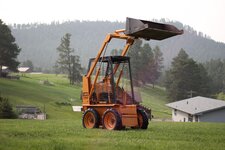
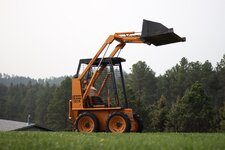
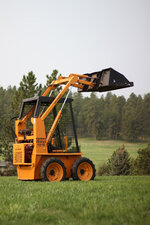
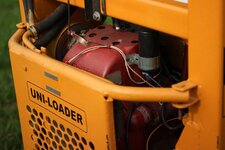
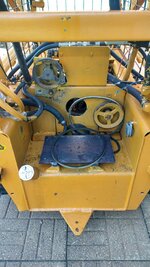
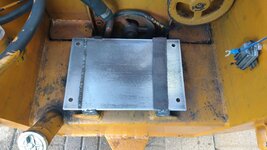
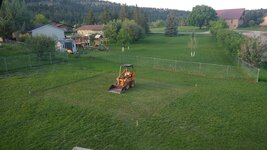
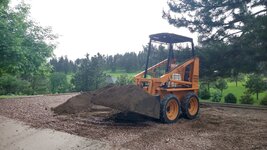
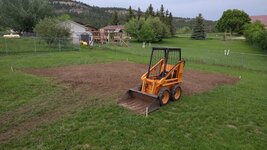
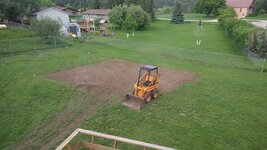
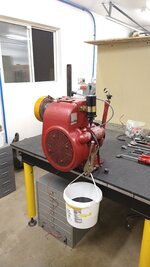
Here's where we left off, fully reassembled and ready for fresh oil after draining as much of the old junk as possible overnight.
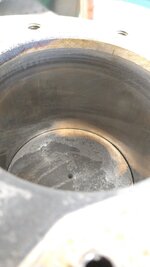
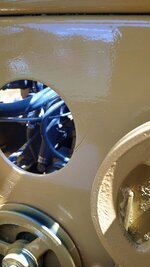
If you remember, I mentioned in the original overhaul post that there was "zero" clearance between the front of the crank pully and the bulkhead plate of the machine. That was caused by this abomination of a cobbled together, farmer welded triple pulley setup. In order to somewhat align the hydraulic pump pulleys to the crankshaft setup, the front pulley had to be pushed really far forward. This, combined with the predictable runout of the crank pulley, was causing a self clearancing scenario between the pulley and bulkhead, as shown here:
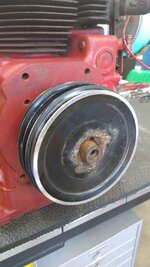
Certainly not ideal. The proper fix would be to fab up a new and proper crank pulley, but due to time constraints I decided to cheat and shave off approximately .09375" from the face of the pulley. I achieved this by rotating the engine with a cordless drill on the flywheel nut while sanding the face with an angle grinder, deburring with files when I was satisfied with the amount removed. The result after a spray bomb rebuild is at least functional and now the crank pulley and bulkhead are at a safe distance from one another.


At this point, it was finally time to prepare for a reunion of engine and machine. No photos of this, you'll have to use your imagination as I did my best to remain patient with a project that was taking me longer than anticipated. The unelaborate engine wiring harness was leaving some to be desired in terms of routing and protection, so I remedied that with some nice braided loom and zip ties in the hydraulic compartment, routing the wires more directly to their source of termination in a safe, easy to access fashion. This cleaned up the engine bay more than I was expecting and left me with my final task, which was installing the new fuel pump and reconfiguring the fuel lines.
The pump mounted nicely in the stock holes in the lower left side of the engine compartment, but rather than leave the mess of excess fuel hose and hook it up as it was, I brought it to a state that my obsession could comply with. This meant placing the fuel shutoff valve
behind the main fuel filter instead of the old position in front of the filter which made no sense to my mind. I also relocated the main filter and shutoff to the hydraulic compartment underneath the seat instead of crowding up right next to the engine with about 14" of excessive hose.
With the fuel and electrical system reconfigured, I wrestled the old Kohler back home into the spruced up engine bay, slipping the belts on the dieted crank pulley and fastening it to the plate I had cleaned up earlier. Electricity and fuel was supplied to the big red heart, and after reconnecting the battery I was ready to test out my work. Key inserted, I anxiously switched the ignition on. A proper clickety-clackety greeted me from the new fuel pump, and after a few seconds of priming the fuel system, I turned the key to the start position. I cranked for a few seconds with no signs of combustion. For a brief moment I cursed myself for what I was sure was some stupid mistake that would require hours more work on an already overschedule project, but skeptically I hit the key again. This time the un-muffled engine roared to life -
success! I walked around the back of the machine watching for leaks and anything out of the ordinary, thankfully finding nothing. The true test was now to see if I could push the throttle to max RPM and maintain a smooth running machine or if all of this work had been for nothing. Once again -
success! I thought anyway, it was tough to discern how smooth it was running without re installing the muffler. So I did just that, threw the muffler back on and started the engine back up. Indeed, my inclination of success once the exhaust decibels were toned down to a reasonable level was verified, so I then operated the hydraulics with no seat installed to verify that the hydraulic pump belts were tensioned sufficiently and not slipping. With that confirmed, I tossed the seat back in to properly make a test run, as both of my sons excitedly climbed into my lap to join me as the sun was setting over a fulfilling project's evening.
The test run resulted in a satisfying increase in power and functionality over the pre-overhaul machine status. Not a slight increase either as predictably, the ability to rev the engine out to full throttle effectively made the experience of operating a completely different machine. Feeling a healthy sense of accomplishment and exhaustion, I parked the 1816 for the night.

In conclusion, I can't be certain which variable or combination of variables was causing the misfire condition, but I'm glad to have it up to 100% now. I learned that as I've gotten older, more experienced, and my patience level raised, projects just go smoother. It really brings the enjoyment and reward out when you can bring a project to the finish line without overcoming unnecessary obstacles brought on by lack of patience and forethought.
Thanks for reading!