To avoid these ads, REGISTER NOW!

Metal Lathe. Looking for advice.

iSpark

Well-known member
Joined
Sep 12, 2015
Messages
283
Location
Coastal SC
Hi everyone.

I want to get involved with metal lathes, this will solely be a home use thing. I have no experience with these type of machines. The closest I've been to one was walking by it while picking up a head I had decked at the local machine shop.

What interests me, is the ability to fabricate metal parts or pieces for items that are damaged and/or missing, like you would if you were restoring things.
One day I would like to have a lathe and a mill.

Are there any lathes that would be a good "first timer" lathe, new or used?

I know this is probably a pretty vague question, not sure I have the knowledge to even ask the correct questions...lol, but any suggestions would be great.

Thanks
 
To avoid these ads, REGISTER NOW!

FuzzyTiger

Well-known member
Joined
Aug 17, 2020
Messages
429
Location
Canada
I'm curious to see what people respond with because I've always wanted a lathe and mill myself but I know next to nothing about them. Recommendations for lathes and mills seem to just come down to: "Get an older manual uber machine", "remortgage your house and get an uber modern CNC machine", or "go home". Cheaper new machines seem to be universally hated.

The part that bothers me about the first recommendation though is how is someone that isn't an expert with many years of experience supposed to evaluate the condition of a machine with literal inches of grime and decades of wear and tear. For someone that knows what they're doing, I'm sure this is the best value and right way to do things but for people that are still figuring things out it just seems reckless.
 

Daveco

Well-known member
Joined
Apr 8, 2010
Messages
348
Location
Texas
You don’t need to get it perfect the first time.
Try to find something that is a package deal, that includes tooling so you can start using it right away.
Once you have a machine and start using it, it will be much easier to understand what you really need. If you shopped smart, you can recover your initial costs when you sell the first machine to buy what you now know suits your needs.


Sent from my iPhone using Tapatalk
 

dogdog

Well-known member
Joined
Nov 15, 2011
Messages
12,711
Hi everyone.

I want to get involved with metal lathes, this will solely be a home use thing. I have no experience with these type of machines. The closest I've been to one was walking by it while picking up a head I had decked at the local machine shop.

What interests me, is the ability to fabricate metal parts or pieces for items that are damaged and/or missing, like you would if you were restoring things.
One day I would like to have a lathe and a mill.

Are there any lathes that would be a good "first timer" lathe, new or used?

I know this is probably a pretty vague question, not sure I have the knowledge to even ask the correct questions...lol, but any suggestions would be great.

Thanks

I would be careful about advise on looking on the old lathes.... unless you know what you are getting into... a lot of them might be good, but if you have lucky enough you might end up with the clapped out ones and end up spending more to get it working right... Especially be careful about those tools with the selling it as much if not more than new lathes because of the COO. Even if they offer some tooling. so at least compare the price of a similar size new to the one you would be buying...

other than that for small projects a lot of people are happy with the HF 7x12 or similar ones... And afaik people think the 7x10 version is too small...

Don't forget the tooling for one lathe might not be interchangeable for the other... so.

you can go visit some machinist specialty sites like practicalmachinist, or littlemachineshop they have few other precision small lathes they recommend.


Me... I am eyeing on these dependents but I don't have a good place for it. so.. eyeing for now. also don't forget factoring into toolings... they can run you a lot more dependents on what you are doing..

https://www.grizzly.com/products/grizzly-11-x-26-bench-lathe-w-gearbox/g9972z

https://www.grizzly.com/products/grizzly-10-x-22-benchtop-metal-lathe/g0602

https://www.grizzly.com/products/grizzly-12-x-36-gunsmithing-lathe-with-stand/g4003g

few instructional dvd videos that are good... if you can find on the web or buy them... the MIT series are free also very good.
 

JeepJohn62

Well-known member
Joined
Feb 25, 2019
Messages
157
Location
Alaska
The two companies that I like are Grizzly and Precision Matthew's. They both offer hobby workshop machines. Another good link is Little Machine Shop. These are all chinese or taiwan to my knowledge. I'm have not seen any US made hardware available in these hobby sizes.

Someone above asked what your intended use was with respect to size. Good question! If you are looking for general workshop usage then a 10" swing with a 24" to 36" bed is a common size.

You can turn aluminum and mild steel bars with these. Understand that the rigidity of these smaller machines can never match the mass and size of a large machine shop lathe.

John


Sent from my SM-A102U using The Garage Journal mobile app
 

Lost Pup

Well-known member
Joined
Apr 14, 2005
Messages
95
Location
Garage
I can speak from experience here.

My first and only lathe is a South Bend 10k. Books and YouTube saturation with a good bit of experimentation and allot of those “ what the f*** “ moments.

I found mine on Craigslist locally for $300. I learned, upgraded the motor to a VFD setup and 3 phase motor. Made quite a bit of tooling. Learned how to set it up properly for best results.

Find something local (cheap) you can manage and learn with.

I will dig up a few links on mine and post back.
 

dogdog

Well-known member
Joined
Nov 15, 2011
Messages
12,711

rsanter

Well-known member
Joined
Dec 22, 2007
Messages
18,510
Location
visalia ca
Start looking for a used machine.
You are more likly to find a deal that has tooling and stuff with the machine that way.
You will end up having more money n the tooling that the machine eventually.

Start looking locally and see what there is, if your area has few machines then you can start looking at new.
Getting a good vintage machine can be great but also some of the used Chinese machines can be a deal too
 

RoninB4

Well-known member
Joined
Jul 22, 2020
Messages
3,539
Location
Under My House
You really need to estimate how large your work will be, the level of precision you'll need, and whether you'll want to cut/chase threads. I know this is difficult to do if you've not run a lathe before but you must have some sort of "vision" of what you'll be working on. You can even rule out some work (auto driveshafts for example) and that will be useful for limiting the length of the lathe bed. If you rule out work pieces you can't lift by hand that will limit the swing of the lathe. How much room do you have for it to occupy? Do you have 3 phase power? What's your budget? Are you prepared to purchase the other equipment/instruments/tooling you'll want or need? For any tooling and/or repair parts are they still available? I think it's great that you want a lathe (toolmaker for 40 years here) but you still need to define some parameters BEFORE purchasing or you may get something that won't be a good purchase. Might as well get what you want for the money spent aye?
 

MushCreek

Well-known member
Joined
Jan 14, 2015
Messages
9,767
Location
Upstate South Carolina
One thing that's important is to try to find a lathe that is somewhat standard as far as the spindle goes. Despite having run lathes for 50 years, I bought the 'wrong' lathe for my home shop. It works OK, but has some limitations because it is an older Japanese machine. For one, the spindle nose (where you mount chucks) is a 56 x 3 mm thread. It turns out that you can't find chucks or mounting plates anywhere with that thread! I've googled and searched all over with no luck. I have a 3 jaw chuck and two backplates, so I can add a 4 jaw. The internal spindle taper doesn't seem to match any standard I can find, so I can't use collets. Lastly, the tool post is actually built in to the compound slide, so I can't mount a quick-change dovetail tool post like I'd like to have. Also, if I ever need parts for this lathe, I'll have to make them myself.

It's an OK lathe, and built hell-for-stout, but I'd replace it in a minute if I could find something more standard that I could afford. And that's the other problem- around here, lathes and mills are ridiculously expensive.

Older American machines can be good hobby machines, if they're not too badly worn out. Before you buy something, do some research to see if there's a support group that can give you advice. The abovementioned South Bend 10K has a big following, and you'll have more luck finding parts and accessories. As others have said, you need to think about what you want to make. Bear in mind that on a 7" lathe, you can't really do 7" parts, or anywhere close to that. An import 7" lathe would struggle with 3" aluminum.

Lastly, but most important- Lathes are DANGEROUS! Seriously, it's easy to get hurt by machine tools. Learn how to run one, follow ALL of the safety rules, wear your eye protection. Human flesh is no match for even the smallest lathes.
 

Jawn

Well-known member
Joined
Jul 29, 2011
Messages
3,596
Location
Stuck in traffic, GA
Recommendations for lathes and mills seem to just come down to: "Get an older manual uber machine", "remortgage your house and get an uber modern CNC machine", or "go home". Cheaper new machines seem to be universally hated.
I disagree... the better name imports (Grizzly, PM, etc) seem to at least be tolerated among the hobbyist circles. But don't dare mention one of them on Practical Machinist, you'll get run out of town on a rail.

The part that bothers me about the first recommendation though is how is someone that isn't an expert with many years of experience supposed to evaluate the condition of a machine with literal inches of grime and decades of wear and tear. For someone that knows what they're doing, I'm sure this is the best value and right way to do things but for people that are still figuring things out it just seems reckless.
That's kind of what I was up against... no experience, had never run a lathe before I bought mine. Not a whole lot of selection of used machines in this area either.

I ended up buying a Grizzly G0602 (10"x22", 1hp). Thinking back, I wish I'd held out for something in a 12" class with more power, more rigidity, and a power cross feed... but probably not enough to want to upgrade now. The G0602 is a capable hobbyist machine, in my opinion of limited experience. I've successfully turned anything from plastics to 41xx steel.
 
OP
I

iSpark

Well-known member
Joined
Sep 12, 2015
Messages
283
Location
Coastal SC
Great replies guys!
Some very good questions for me that I didn't think of.

Size.
Nothing large but I guess strength also lies in here too. I would like to be able to make bolts, screws, pins, rods, bushings and washers etc;.
For example, my dad has an old sugarcane mill that is missing a bolt and washer, and a couple of bolts are bent, I would like to make replacements that look and function as the originals did.

I'm assuming I wouldn't need anything bigger than what the old South Bend heavy 10 or 9 is.

YouTube I think is what is fueling my interests in lathes and eventually mills. I've been watching Mr. Pete, Keith Rucker, and Diresta for a few years now, and some others I just started watching.
I know videos don't replace actual hands learning and making your first screw-ups, but one thing it does, is feed the desire to learn and want to do more.

Power requirements, shouldn't be a problem. I can get 3 phase power installed from the utility provider, just the cost of that and an electrician is the only thing, but it is available.

Tooling, no clue. That's the result from not having the knowledge.

I wish I could visit with friends who have lathes, but none of my 3 friends have lathes.

thanks for the replies!
 

Jason280

Well-known member
Joined
Mar 4, 2012
Messages
3,164
If you can actually get 3 phase, it opens up a world of reasonably priced equipment.

That being said, you can always run it off a VFD or rotary phase converter, but you really need to decide on your budget....and double it. ;) Seriously, buy once cry once. Just realize that you will likely have more in tooling and set up equipment than you do the actual lathe itself.
 

alcorelli

Well-known member
Joined
Mar 15, 2019
Messages
366
Location
Westchester County, NY
South Bend Heavy Ten running 120v.
No issues with cutting anything so far.

Bridgeport mill running a step pulley 3 phase with a VFD running off of 220v

The VFD is a Westinghouse. It was 139 dollars. Easy to wire, plus it allows the addition of safety switches and other features.

It is nice to be able to say, "Yeah, I can make that", when someone needs something repaired.

Will probably add a VFD to the lathe at some point. The infinitely variable speeds and ability to easily add safety switches are definitely worth it.

Sent from my SM-G975U using Tapatalk
 

Ign

Well-known member
Joined
Jul 7, 2006
Messages
12,769
Location
Butte Peak ND
There's so many hobbyists out there that say, "That won't fit in my garage"....you can often get better deals on engine lathes.

It's one of those weird paradoxes in the market I'll never understand like 1/2 tons selling for more than 3/4 tons

If you're lucky enough to want what no one else does, you're in a great position as a buyer
 

MushCreek

Well-known member
Joined
Jan 14, 2015
Messages
9,767
Location
Upstate South Carolina
The first thing you'll need is a dovetail quick-change toolpost, likely an Aloris clone. The size will be determined by the size of the lathe, probably an AX or BX size for a smaller lathe. Get a set with a bunch of holders. That way, your most-used tools can stay in the holder and be on center and ready to go at all times. I much prefer insertable carbide tools for general turning and boring work. There are generic shapes such as triangular that are available dirt cheap, and will do most work. Some of the fancier proprietary inserts perform great; just make sure they are readily available. There's something to be said for keeping a handful of high speed steel bits on hand to make custom shaped tools, and it will expand your knowledge and skill set to learn how to grind them and sharpen them. Some new machinists don't really understand what the cutting edge is doing, and so don't know how to properly sharpen lathe bits and drill bits. Speaking of which- you'll want a big set of drill bits, again, depending upon what you wind up making. I have all of the wire drill, letter drills, and fractional drill up to 1/2", plus a set of reduced shank drills up to 1". You'll need taps appropriate to your work, too.

One thing a lathe is good at is cutting threads, especially on a non-standard part. I recently made a part for a 140 y/o park bench, and the threads weren't close to any standard size. I wanted to reuse the decorative nuts, so I had to cut threads to match. Single-point threading is fun, but takes practice to get good at. I have an insertable carbide threading tool, which makes it a joy to set up.

Other things include a drill chuck for the tailstock (keyless is nice), and a live center to go in the tailstock to support long, thin pieces. A three jaw chuck is pretty much the go-to for lathes, but they aren't always the best set-up. Collets are the most rigid and accurate for sizes up to an inch or so. 5C collets are the industry standard for smaller lathes; try to get a lathe set up for them. There are zillions of cheap import collets available in 5C that are perfectly fine for most work. A four jaw, independent chuck is the hot set-up for anything that isn't round, or for off-center work on a round part. They can also be tweaked into 'perfect' for round work, but it's a slow process. For any 4 jaw work in particular you will want a dial test indicator, and a holder that you can clamp onto the drill chuck in the tailstock. The quill clamp for my mill also works on my lathe, so I only need one. I use a cheap import one that reads to .0005", and it works fine for general purpose work. I also have an expensive name brand indicator that reads to .00005 (50 millionths) but that's way overkill, and not particularly handy in the home shop.

I've been running lathes since I was in high school, everything from production work to custom one-offs to ultra-accurate tooling components. The lathe is still my favorite shop tool. I've run everything from a 1901 beast to accurate Hardinge toolroom lathes to CNC chuckers. I'm happy to share my knowledge and experience.
 

IndyGarage

Well-known member
Joined
Apr 29, 2010
Messages
9,683
Location
Indy
For a first timer, I would look for a used South Bend or Atlas or other benchtop lathe coming from someone who used it in a hobby and has lots of tooling with it.

Have them show you some of the things they made with the lathe. Have them show you all the features.

You will probably not be able to buy what you will ultimately want the first time. Don't worry about that - it's like buying a motorcycle - you want something easy to use and you'll figure out what you want next.

The trick is to not buy the wrong thing - because it will turn you off and you will think a lathe is very difficult to use or not useful.
 
To avoid these ads, REGISTER NOW!

ezzzzzzz

Well-known member
Joined
Jan 25, 2012
Messages
359
My advice is to be aware and careful when you finally get something going. A lathe is probably the most dangerous machine in a shop. You're throwing the material into a fixed tool. Things can and have gone horribly wrong in a fraction of a second. The bigger the machine the more dangerous too. I remember a poster in one of the many machine shops at a navy yard I worked at. It showed a larger lathe, 15" or more, with a full scalp wrapped around a shaft in the chuck. I own a Grizzly 13x40 which is okay but far from great. I also have a bridgeport mill and other machines. The lathe, by far, garners my attention the most.
 

Downwindtracker 2

Well-known member
Joined
Jun 13, 2019
Messages
1,715
Location
BC
First off , you need a welder, mill and a lathe. It's surprising how often they get used. I'm not a fan of worn out equipment, it's highly frustrating to use. So when they say used American iron, those guys saying that are not machinists. And not only that, it requires a much greater level of skill. A sweet spot is the Taiwanese lathes from the '90s, referred to as generic Taiwanese. They are 10" , but mostly 12".the Very well regarded Grizzly G4003 is a 12" example. They are belt drive, with hardened ways, Even the rough ones like mine have perfect ways. Another thing to look for, two or three shafts on the front. If they drive off the lead screw they wear out the engagement. The down side to Taiwanese is electrics, I have 5 used Taiwanese machines, 4 have had electrical problems.
 

jonesg

Well-known member
Joined
Mar 15, 2010
Messages
1,698
Location
northern Maine/
Hi everyone.

I want to get involved with metal lathes, this will solely be a home use thing. I have no experience with these type of machines. The closest I've been to one was walking by it while picking up a head I had decked at the local machine shop.

What interests me, is the ability to fabricate metal parts or pieces for items that are damaged and/or missing, like you would if you were restoring things.
One day I would like to have a lathe and a mill.

Are there any lathes that would be a good "first timer" lathe, new or used?

I know this is probably a pretty vague question, not sure I have the knowledge to even ask the correct questions...lol, but any suggestions would be great.

Thanks

I'm not a machinist either, my first machine was a war dept 1944 south bend with 9 inch swing, 36 inch bed, complete with thread gearing, auto feed etc, $500.

I sold it and down scaled to a sherline lathe and mill for hobby work.
A cheapo HF chinese lathe would be ok to tinker with, accuracy be damned, I never measure anything anyway.
 

larry_g

Well-known member
Joined
Apr 28, 2007
Messages
16,877
Location
oregon
I started out close to where you are, perty ignorant. A 6" craftsman came my way and I learned a lot from that machine. Soon moved up to a 10" Logan and learned a bunch more. I'm now on lathes #6&7 or so and have machines that serve my purpose. So I bought and sold machines as my skills and needs grew. The sold machines were sold at a breakeven price and on a couple I made a good profit. It's sometimes worth it to buy a well equipped machine and strip out the tooling and sell the basic lathe to breakeven and get free tooling. Along the way I learned a lot and learned what to ask and to look for in tools.

So I suggest that you buy something and consider it a learning tool. Once you've had enough time you will understand if it meets your needs or not and what you need to look for in your next lathe.

lg
no neat sig line
 

MushCreek

Well-known member
Joined
Jan 14, 2015
Messages
9,767
Location
Upstate South Carolina
First off , you need a welder, mill and a lathe. It's surprising how often they get used. I'm not a fan of worn out equipment, it's highly frustrating to use. So when they say used American iron, those guys saying that are not machinists. And not only that, it requires a much greater level of skill. A sweet spot is the Taiwanese lathes from the '90s, referred to as generic Taiwanese. They are 10" , but mostly 12".the Very well regarded Grizzly G4003 is a 12" example. They are belt drive, with hardened ways, Even the rough ones like mine have perfect ways. Another thing to look for, two or three shafts on the front. If they drive off the lead screw they wear out the engagement. The down side to Taiwanese is electrics, I have 5 used Taiwanese machines, 4 have had electrical problems.

I'm a machinist; tool maker, actually, and I like old American iron, BUT- I know what I'm looking at, and know how to check a machine over for wear. My 1965 Bridgeport mill still has good original factory flaking! It must have been in a school or research facility to have so little wear. It's actually the tightest Bridgeport I've ever run.

I had an old LeBlond (WWII vintage), and we had to take .035" off of the bed ways to straighten it out. Yes, it was VERY worn. It was a decent machine when I got done with it, though.
 

dutchgray

Well-known member
Joined
Sep 28, 2014
Messages
6,467
Location
Dorset. England.
Buy the best condition lathe you can get, with the most tooling and a standard spindle type which you can get backplats for, that is the size and weight you can transport and do the work you want to do, stick to machines that are still made that you can get parts for, or are common enough that you can get used parts. I would avoid anything that was made before WW2 as that stuff is old fashioned and mostly worn out by now.

This is coming from someone who bought a rare lathe with a propriety spindle nose and no tooling, so have to make back plates myself and modify accessories from other lathes to fit, it was very cheap however and the base machine is decent, but most likely I will buy another slightly larger lathe that is a common one and have two of them.
 

Downwindtracker 2

Well-known member
Joined
Jun 13, 2019
Messages
1,715
Location
BC
I'm a millwright, I learned on a big Okuma. It had wear at the headstock end so it had been donated to the college for a tax write off.

My youngest son and i went together and bought a Chinese 250mmx 550mm (10x22) XIMA . There were two manufactures of 10x22 lathes, SEIG and XIMA, SEIG assembled lathes and XIMA fitted them. Accuracy costs money no matter where it comes from. XIMA lathes cost more money than the new Grizzly South Bends. BTW .We got lucky and paid a clearance price of $800 , but that was pretty bare, when we finished optioning it out , it was near $2000, To get a price point, XIMA had stripped it down. When my son moved out he took the lathe.

Now without a lathe I found a used mill/drill and a lathe for $1750. The mil/drill was a genuine Rong Fu RF-45, a square column gear head. I valued it at $1500. The lathe was a Taiwanese generic imported by Busy Bee (Canadian Grizzly) DF1224g . I have no clue who DF was. It's the same as the Grizzly G4003 Both were and are projects. The 12x24 has almost the same footprint as the 10x22. It's both easier to use and I'm able to make higher tolerance parts. Easily within 1/2 thou. On the other hand,I refer to the RF-45 as the Drama Queen. If the new lead screws and nuts don't take up the slop, I may have to learn how to scrape !
 

Hammer1963

Well-known member
Joined
Jan 2, 2011
Messages
2,048
Location
Kentucky
Here's the deal. I was a tool maker for many years. Yes the older US machines are built heavier because they were meant for daily use in tool shops. Now I own a 10" x 22" Grizzly GO62 lathe and a Harbor Freight 40939 vertical knee mill. Both due everything I ask of them. No, I cannot make huge parts in them and I cannot take huge cuts with them, but they work damn good for what I need. The mill is actually very precise and there are other brands that offer the same mill for a few bucks more that are finished a bit nicer and come with a few more feature. You can add those as you go. One more thing: when it comes to bench top lathes, the heavier the better. There are some that are appealing with variable speed, but are not nearly are sturdy as ones that use belt and pullies for speed change. I built a stand that resembles the stand on the Grizzly GO729 including the chip pan and I am happy as I can be!

Ask yourself this: do I want to spend time chasing down parts and rebuilding something old that I know little about. Probably not and not every town has old South Bend, Clausing lathes or Bridgeport 1 mills on Craigslist.

Read the reviews carefully. It's fairly easy to sort through the ******* comments and you'll find the favorable comments to be numerous on both of the machines I own. Good luck!
 
OP
I

iSpark

Well-known member
Joined
Sep 12, 2015
Messages
283
Location
Coastal SC
Thanks for the advice.
I have lots to learn.
One thing I have learned, metal lathes must not be too popular in the south, but holy ****, wood lathes on the other hand are a dime a dozen.

I did come across a local craigslist ad for a SB heavy 10 toolroom lathe. The guy may want more than it is worth though, he's asking $1500 and it has a non working feed clutch. Says it could be the shear pin.
I thought the feed clutch had a key that was "pinned" in the worm gear, maybe that is what he is referring too. I dunno.

I have not inquired about the lathe yet, he also has a SB drill press floor model for $500.
I should ask about a combo deal if I were to buy both.

Anywho, I have lots of reading to do and YT vids to watch.

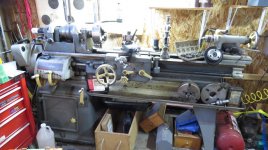
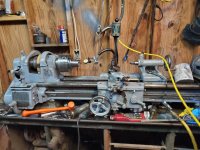
Here is a pic of the lathe and drill press.
 

Attachments

  • SB lathe.jpg
    SB lathe.jpg
    145.9 KB · Views: 91
  • SB drill press.jpg
    SB drill press.jpg
    68.7 KB · Views: 77

Aaron_W

Well-known member
Joined
Feb 6, 2018
Messages
2,902
Location
Northern California
I am not a machinist, I'm just a guy who has playing with machine tools in the basement for about 5 years now.

Since you really have no idea on where you want to go with this I'd suggest either a Chinese 9x20 or a 10x22. My reasoning is these are big enough to do some real work, but small enough that almost anybody can find a spot for it in the garage. The 9x20s weigh 250lbs so two big guys can move it, you might want an engine hoist for the 10x22, or get a couple of weight lifters from the gym to stop by and help. These are also cheap enough at $1500-2500 new, that if you just keep it for a few years until you know enough to actually have a dream lathe you aren't out a ton of money. Figure you can get 50-60% back by selling it.

The 7" and 8" mini-lathes are not bad, but really all they get you is small. A decent mini-lathe is going to cost you $1200+ (no the $600 Harbor Freight 7x10 is not a decent mini-lathe, at least not until you have put a lot of time, effort and money into it).

I started out with a tiny mini-lathe, a Sherline 3.5x17 and a whopping 35lbs. I love this little lathe for making model parts. It comes up short for making bigger things, but I use it more than any of the other machines.

Since then I've added a bunch of machines, most I bought used, most are 40+ years old USA iron but I had a little more experience by the point that I bought them. I also had met several far more experienced (real) machinists who could help me evaluate older used machines.

There are definitely some deals out there for used machines, but you do need to know what you are doing or you can end up buying scrap.

Again, I think the small 9" and 10" Chinese (or Taiwanese if you get lucky) machines are a pretty safe bet buying used as well. These machines are not likely to be found in ********* industrial use, at most maybe in a shop to do some light work. Most of these machines are sold to hobbyists, probably half get used a few times and then sit in a corner for a few years before they go up on CL during a garage clean up. The other ones get used by a more serious hobbyist who uses it for awhile, before learning enough to know what they really want. The result is they might be abused, but they probably won't be worn out. This is good, because wear is harder to detect, but abuse and neglect is pretty obvious even to the inexperienced. Parts are readily available for most of the machines. I have an Enco 9x20 made in the 90s that I picked up cheap. I was able to get all the parts I needed to fix it up, because it is still in production and sold under several different brands.

These lathes are by no means high end, and those that say a small Southbend, Logan or even Atlas is better, are not wrong. I would gladly swap my Enco for a nice Southbend 9A, but for somebody brand new I think these are a decent starting point to learn with.


Also agree with Downwindtracker, with a mill, lathe and welder it feels like you can do just about anything. I've had a lot of fun with mine.


Also be aware with a lathe, even a small one you will soon find you need a bandsaw and a bench grinder. The bandsaw to cut material (portaband works). You will want a bench grinder for grinding lathe tooling.

The book how to run a lathe is a classic and cheap, originally published by Southbend. Still in print, and available from a couple of publishers on Amazon for $5-10.
 
Last edited:

Aaron_W

Well-known member
Joined
Feb 6, 2018
Messages
2,902
Location
Northern California
Thanks for the advice.
I have lots to learn.
One thing I have learned, metal lathes must not be too popular in the south, but holy ****, wood lathes on the other hand are a dime a dozen.

I did come across a local craigslist ad for a SB heavy 10 toolroom lathe. The guy may want more than it is worth though, he's asking $1500 and it has a non working feed clutch. Says it could be the shear pin.
I thought the feed clutch had a key that was "pinned" in the worm gear, maybe that is what he is referring too. I dunno.

I have not inquired about the lathe yet, he also has a SB drill press floor model for $500.
I should ask about a combo deal if I were to buy both.

Anywho, I have lots of reading to do and YT vids to watch.

Here is a pic of the lathe and drill press.


This is the other issue with "old iron" do you want a machine you can use or a project? Both can be fun, but a project is more fun when you have working tools to fix it.

A Southbend Heavy 10 is a great small lathe, and $1500 isn't a bad price, if it really is a simple fix. Can you tell if that is really all that is wrong with it, can you fix it. If it really was just a simple thing to fix, why is he selling it broken, instead of fixing it himself and selling the lathe for another $500-1000? Could be a great deal, could be a boat anchor.
 

RoninB4

Well-known member
Joined
Jul 22, 2020
Messages
3,539
Location
Under My House
Would not advise getting anything that needs repairs or anything that has a proprietary/difficult-to-find spindle nose for mounting chucks/face-plate. A steady rest made for that machine is almost required too. Beware of a steady rest that isn't made for that machine, unscrupulous sellers will put a mis-matched one on for the unknowing buyer. Not opposed to the Chi-Wan lathes but the small ones have tiny handles that are clumsy for hands larger than a small woman. This can be dangerous when making threads and timing of disengagement is critical. Operate the levers. Are they easy to get to or do are you cramped into a certain position? You want clear access to all the hand levers while your attention is on the spinning chuck. A quick change gear box is much nicer than changing gear sets by hand. No tail stock is a deal breaker too. Read up on how to determine excessive wear on the lathe bed. Do your research on lathe operation, it's a dangerous machine. Start shopping now to help educate yourself on the market. Post questions here if we can help.
 

MushCreek

Well-known member
Joined
Jan 14, 2015
Messages
9,767
Location
Upstate South Carolina
Here in upstate SC, that SB would sell quickly. If it were closer, I'd check it out myself. But- I know how to fix them, and/or make new parts.

One thing to watch out for on old lathes, especially big ones is that they often don't have very high RPM. You need some revs to do small work. I recently looked at a big old beast that topped out at 600 RPM.
 

homebuilt burner

Well-known member
Joined
Dec 8, 2014
Messages
1,763
Location
central Wisconsin
I would suggest checking on a night class at the local technical college. I have not bought a lathe yet, but I have learned a lot about what size machines can do what. It also gave me some insight into what processes I would need.
 

2mJps

Well-known member
Joined
Feb 20, 2012
Messages
1,797
Location
north central Mo
I would suggest checking on a night class at the local technical college. I have not bought a lathe yet, but I have learned a lot about what size machines can do what. It also gave me some insight into what processes I would need.

This is some good advice i have 4 lathes now and learned every thing from the school of hard knocks. My first lathe was a atlas 10" it was a good lathe. I now have a very old SB 13" its about the right size. I also have 2 American 19"lathes. I love to build stuff and machine stuff i got into machine work to help make parts for prodjects but its like a small airplane owner told me if your in a hurry to get from point A to point B the plane isnt always the fastest or best way to get there.
 

justanengineer

Well-known member
Joined
Apr 5, 2011
Messages
7,722
Location
Motor City
For welding and machine work I am a big advocate for taking a trades course or two. You will learn more in 15 weeks than you would in five years otherwise, won’t pick up the usual bad habits, and have a good feel for what you want/need prior to investing and potentially wasting money otherwise.

As to machines, I’d say there’s both good and really bad advice above. Single horse and smaller motors are cheap to repower with $100 VFD if necessary so three phase is easy to handle for most machines you’ll consider. Tooling is similarly pretty simple bc all you need to start is a spindle chuck, tool post, HSS bit, drill chuck, and center for the tailstock. More is better but not necessary for quite awhile. Wear is also pretty irrelevant at this point. Regardless if you’re on a thoroughly worn out production machine or a super-precision toolroom lathe you’ll be a couple thou out from where you want to be for a few years. You’ll actually discover like most of the hobbyists teaching on YouTube (I know well or have met most of the “big names” so can make fun) that your measuring tools will start lying to you long before you hit the tolerance limits of a worn out machine. Moreover, only WW2 and earlier domestic machines and imports are really known for soft ways and massive wear, so unless you buy one of the two then wear shouldn’t be much of a consideration. The other reality of old arn vs new import is that both will need a thorough disassembly and adjustment before use so unless the old arn is broken then it’s no more of a project than the import.

My advice would be to take a class. Barring that, be patient and keep your eyes open for a deal within a few hundred miles. Keep in mind people need holiday money now and want their garages cleared before winter so while fall seasonal pickings may be slimmer than spring, prices should be better.


Sent from my iPhone using Tapatalk
 

tdkkart

Well-known member
Joined
Jun 17, 2006
Messages
6,887
Location
Eastern Iowa
You don’t need to get it perfect the first time.


Certainly not.
In the last 25 years I've had a 6" Atlas, moved up to a 12" Atlas that I basically built from pieces, a process that'll learn ya a lot about lathes, and then I got lucky enough to find a 12"x 36 Clausing local to me that was listed on Ebay but the guy selling it had barely knew it was a lathe so he didn't know how to describe it, let alone answer any questions.

It's a progressive disease, once you have one you'll always be looking for a better/different one, and just like anything else the toling will cost more than the machine.

Oh, did I mention I also bought an 11" Rockwell that I'm refurbing to sell??
 

Renegade1LI

Well-known member
Joined
Mar 11, 2018
Messages
4,948
Location
long island ny
I'll throw in my 2 cents as someone who just got their first lathe, I went with a Grizzly G4003G gunsmith lathe. After looking at a lot of nice old lathes that all needed work & tooling it just made sense to buy a new machine that came with a warranty & some basic tooling to get started.I thought it would be easier to set up & learn on something new that was hopefully within tolerances & working as it should. I have bought other machines from grizzly with good results & the few minor issues I had they corrected right a way. I have heard many good things about precission matthews also & you have the option of getting a taiwan built machine, either way going new if you can I feel saves time & headaches, plus you can put the spare time into the learning process.
 

dogdog

Well-known member
Joined
Nov 15, 2011
Messages
12,711
I'll throw in my 2 cents as someone who just got their first lathe, I went with a Grizzly G4003G gunsmith lathe. After looking at a lot of nice old lathes that all needed work & tooling it just made sense to buy a new machine that came with a warranty & some basic tooling to get started.I thought it would be easier to set up & learn on something new that was hopefully within tolerances & working as it should. I have bought other machines from grizzly with good results & the few minor issues I had they corrected right a way. I have heard many good things about precission matthews also & you have the option of getting a taiwan built machine, either way going new if you can I feel saves time & headaches, plus you can put the spare time into the learning process.

how big and how heavy is the 4003G ? was eyeing on it for a while, couldn't pull the trigger if I can't get it into my living room. 1 flight of stairs. was about to make a trip to their PA warehouse and of cause they closed that down the month before.
 

Renegade1LI

Well-known member
Joined
Mar 11, 2018
Messages
4,948
Location
long island ny
It's a good 1000 lbs, I built a wood gantry to set it on it's stands, it is very top heavy. Anything can be moved & set up, going up a flight of stairs may be tough, make sure the stairs can handle the weight etc. So far I like it, I'm no machinist but the few things I turned came out fine, right now the machine is way better than me.
 
To avoid these ads, REGISTER NOW!
Top Bottom