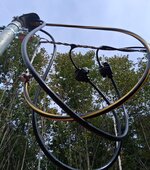
Something I learned after I did mine, face the weather head the opposite direction, so when the drop loop curls down/up its smoother.
Other then I guess he could have trimmed a bit, looks like every other install I've seen in ME or VT.
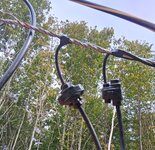
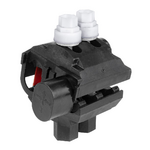
Are those split bolts or something else?
Alliant uses those dumb things around here too. No idea what their reasoning is. Cost 5x as much as a crimp and less reliable.
Cheaper tools?Got to be some reason
PoCo doesn't subscribe to NEC (you had to) and wires in free air can carry more current then wires on/in a building.This is just a noob question but, why was I required to use 2/0 aluminum when CMP's wire is obviously a lot smaller?
You're a numbers guy, right?Cheaper tools?
Expensive tools are lost and stolenYou're a numbers guy, right?
Seems the more expensive tool cost quickly gets recovered if the widget used on the cheaper tool costs more (x3 per install)
And they have reams of data that shows most services don't come close to drawing the installed capacity. Possibly the load calc could sway things but i doubt that info makes it to the lineman.PoCo doesn't subscribe to NEC (you had to) and wires in free air can carry more current then wires on/in a building.
Even the NEC allows higher ampacity for wires in open air. Better heat dissipation. The utility company uses different rules than the NEC anyway.This is just a noob question but, why was I required to use 2/0 aluminum when CMP's wire is obviously a lot smaller?
Cheaper tools?
When i bought my house, we upgraded from a 100A service to 200A. We've got 4/0 aluminum from the meter to the weatherhead, where it connects to 6AWG triplex. I asked about it when they hooked it back up, and the poco guy said they do the calculation by square footage, and since the house isn't changing size, the wire doesn't need to. I don't know know if telling them what the load is goign to be would hange that, or not. They do use bigger wire on new install and repairs, though.And they have reams of data that shows most services don't come close to drawing the installed capacity. Possibly the load calc could sway things but i doubt that info makes it to the lineman.
Idk.Ok, why would an electrician use split bolts on a service instead of a crimp?
Split bolts are usually what you see an owner do on their own stuff, because they don't have the tool for a crimp.
Yes we use compression type connectors.PoCo here uses crimp connectors and they use a battery powered hydraulic crimper... doubt those ever fail
Got to be some reason