To avoid these ads, REGISTER NOW!

Mini Mill and Lathe for small shop?

To avoid these ads, REGISTER NOW!

Bigblue&Goldie

Well-known member
Joined
Mar 12, 2009
Messages
10,679
Location
AZ
I had a Sieg X2 for a while. I bought from a guy that used it to make pinewood derby cars with his grandkids. For that application I think it was perfect. I thought it might be handy for minor gunsmithing projects, but in actuality I found very little use for it.

https://littlemachineshop.com/products/product_view.php?ProductID=4962&category=1387807683

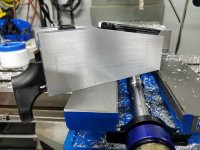
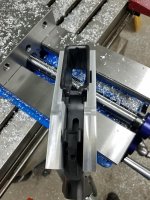
With the understanding that you're working with size constraints, I'd try to step it up as large as you can. My biggest complaint was how small the table was. It's really hard to get a good setup on an item that is almost as big as your table, if not bigger. To illustrate this, attached are pictures of some plates I made to hold lower receivers for milling operations in my Bridgeport. I don't see a mini mill being able to properly hold this.

With regards to a mini lathe, I don't see any real uses for gunsmithing. Maybe others can chime in, but I personally don't want a machine that can't do barrel work.

I could be wrong, but based on what I've read in these posts, most people that are happy with these machines aren't doing "gunsmithing" work. I do see how they'd be great for other hobbies, especially RC stuff.
 

Attachments

  • 20190609_185613.jpg
    20190609_185613.jpg
    104.5 KB · Views: 57
  • 20190609_185709.jpg
    20190609_185709.jpg
    124.3 KB · Views: 57
  • 20190609_185833.jpg
    20190609_185833.jpg
    148.3 KB · Views: 53

king nero

Well-known member
Joined
Dec 27, 2010
Messages
1,469
Location
Belgium
Got both a mini lathe and a table top mill at home. Got full sized machines at the shop.
Actually, I still pay someone to make some parts opn a CNC.
But to be honest, the mini machines have proven themselves over and over again to help me finish a project on a sunday, or to make things to hold something/random auxiliaries/... You don't always have to think "making parts", modifying them is also very important.
And the table top mill doubles as a sturdy vertical drill, with the benefit of a 10 by 35" T groove base plate.
 

RoninB4

Well-known member
Joined
Jul 22, 2020
Messages
3,557
Location
Under My House
Good thing you had a plastic gear then! 0.010" isn't much; maybe the gear was already stressed from a previous cut/feed rate issue.
I think some of these mills can be converted to belt drive, which also mitigates the problem.
Good luck with the metal gear.

-No it wasn't stressed, it was a brand new one with less than 15 minutes on it. That's what irritated me so much, I tried to preserve this one and it still exploded. Belt drive is a better way to go, I just decided it couldn't be trusted and bought a larger mill (G0704) with CNC conversion intent. That worked fine for a few months and the motor burned out. I had a regular shop building by then and purchased a used Bridgeport to go with the Mitsui surface grinder, Mitsui-Seiki 4B jig borer, Weiler (German) lathe, and Gorton 375 cutter grinder. I've still got the tiny machines for second operations and G0704 is still awaiting conversion. The tiny machines can be re-worked for better operation/rigidity but almost a waste of time IMO for what has to be done and the machinery needed to do this IMO. Moving full size machinery isn't as difficult (within reason) as most people feel it is if proper techniques and safety precautions are followed. The crappy motors used on cheap Chi-Wan machinery is my biggest gripe, the OEM replacements aren't inexpensive and replacing them with a better made motor often involves needing to make/buy other components. Might as well just get a better made machine for the total cost and trouble involved. Again, that's just my opinion and not looking start a fight or dismiss what works for somebody else.
 

TheLoamRanger

Active member
Joined
Feb 8, 2015
Messages
34
Location
Hobart, Washington
-No it wasn't stressed, it was a brand new one with less than 15 minutes on it. That's what irritated me so much, I tried to preserve this one and it still exploded. Belt drive is a better way to go, I just decided it couldn't be trusted and bought a larger mill (G0704) with CNC conversion intent. That worked fine for a few months and the motor burned out. I had a regular shop building by then and purchased a used Bridgeport to go with the Mitsui surface grinder, Mitsui-Seiki 4B jig borer, Weiler (German) lathe, and Gorton 375 cutter grinder. I've still got the tiny machines for second operations and G0704 is still awaiting conversion. The tiny machines can be re-worked for better operation/rigidity but almost a waste of time IMO for what has to be done and the machinery needed to do this IMO. Moving full size machinery isn't as difficult (within reason) as most people feel it is if proper techniques and safety precautions are followed. The crappy motors used on cheap Chi-Wan machinery is my biggest gripe, the OEM replacements aren't inexpensive and replacing them with a better made motor often involves needing to make/buy other components. Might as well just get a better made machine for the total cost and trouble involved. Again, that's just my opinion and not looking start a fight or dismiss what works for somebody else.

You should get on that G0704 conversion! I did one a few years back and it was really fun. I converted to belt drive and stepper-driven CNC. That machine isn't super rigid or powerful - some common themes on this thread with smaller machines - but it can certainly do a lot of work with a little patience when run right.
 

RoninB4

Well-known member
Joined
Jul 22, 2020
Messages
3,557
Location
Under My House
You should get on that G0704 conversion! I did one a few years back and it was really fun. I converted to belt drive and stepper-driven CNC. That machine isn't super rigid or powerful - some common themes on this thread with smaller machines - but it can certainly do a lot of work with a little patience when run right.

-Would like to but want to first grind the column/base for full contact with each other. Don't know about others but the column looks like it was machined with a hand held angle grinder at the mating area with only a contact patch of about 45%. Also need to finish wiring in the other full size machines to make the needed components.

Recommendations for conversion components gratefully accepted, I like to hear from the voice of experience. Did you go 2, 3, or 4 axis? Ball screws and counter weight? Not terribly concerned about the limitations of these little machines, I don't intend to use it for hogging off excess stock.
 

logixjock

Well-known member
Joined
Jun 17, 2012
Messages
636
Location
Sturgeon, MO
-Would like to but want to first grind the column/base for full contact with each other. Don't know about others but the column looks like it was machined with a hand held angle grinder at the mating area with only a contact patch of about 45%.

I wonder if getting the column trammed perfectly and then using some kind of epoxy based grout would be appropriate here?
 
To avoid these ads, REGISTER NOW!

PhantomEB

Well-known member
Joined
Feb 6, 2006
Messages
6,765
Location
Medicine Hat, AB, Canuckistan
I been bitching about this drill press off mine for some time now.....I know I will just get a mill soon enough. Just big enough to that it sits on the tool box off to the side. As my garage progresses I can see a 24” lathe down the road.
 

matt_i

Well-known member
Joined
Mar 14, 2008
Messages
10,727
Location
SE Michigan
I wonder if getting the column trammed perfectly and then using some kind of epoxy based grout would be appropriate here?

You could machine and then scrape the interface to improve surface-contact and then for alignment (not sure if the base-to column interface has an effect on the orthogonal alignments?), but at the end of the day, I don't think it would really help the operation of the machine.
 

logixjock

Well-known member
Joined
Jun 17, 2012
Messages
636
Location
Sturgeon, MO
You could machine and then scrape the interface to improve surface-contact and then for alignment (not sure if the base-to column interface has an effect on the orthogonal alignments?), but at the end of the day, I don't think it would really help the operation of the machine.

Found it, I knew I'd seen something about it somewhere. He's using an epoxy grout formulated for just that purpose.


RoninB4

Well-known member
Joined
Jul 22, 2020
Messages
3,557
Location
Under My House
He did a nice enough job with what he had to work with and I'm sure it's an improvement if he used all the contact area possible. There's still a lack of mass in these machines that will limit what "should" be tried in metal removal rates. Like any other machine/tool, having realistic expectations per improvements determines whether it's worth the time/money spent. The smaller machines aren't for production by any stretch of the imagination. Even a steady diet of one-offs should still be considered production, spindle time is spindle time regardless of batch quantity. For prototypes or proving a design it will work well enough to fill gaps my full size machinery isn't capable of.
 

Bradc1989

Well-known member
Joined
Oct 30, 2019
Messages
162
Location
Middle tn
If you haven’t already purchased, buy the LMS over the seig, or any their brand, they usually do some small upgrades. I have their 7x16 lathe and is been fantastic fir me so far, I also stay within its limitations. Getting ready to buy a mill, having a hard time deciding between the delux bench and the base model large bench
 

lbhsbz

Well-known member
Joined
Jan 13, 2010
Messages
1,174
Location
Long Beach CA
They are slightly better than having no mill or lathe, but not much. My first lathe was a 7x12 sieg and then I bought the HF mini mill (Sieg, the red one pictured in the OP.) They are very limited in your depth of cut. I used them because I didn't have room for anything larger at the time. I made lots of things, but they took me forever. Like...50 times or more longer than they would take on normal sized equipment. I had nothing but problems on the mill with rigidity using anything larger than maybe a 3/8" endmill at more than 0.005 depth of cut.

I later stepped up to larger chinese mill from Grizzley (weighed about 200lbs) and a 12x32 Atlas clausing lathe, which were way better, yet still ran on 110V. I now have a Tree 2UVR mill and a 14x40 lathe...which do great.

I would strongly consider getting machines with at least 2 or 3 times the weight that the little stuff has...it will be much more pleasurable to use.
 

gtae07

Well-known member
Joined
Mar 6, 2015
Messages
2,973
Location
Fayetteville, GA
I have a little HF lathe that I picked up off craigslist. It's not nearly as nice as the machines I got to use at work a few years ago, but it fits in my shop (on my workbench) and it does what ai need it to do (bore small holes, make small bushings, make custom pins, etc). One day I'd like something bigger but this does the job in the space and budget I have available. I made bushings from CRES today to a .001 tolerance. Just took a while. Go slow, take small cuts, measure a lot.
 
To avoid these ads, REGISTER NOW!
Top Bottom