To avoid these ads, REGISTER NOW!

Mitsubishi VS others mini split opinions wanted

yeldogt

Well-known member
Joined
Jan 2, 2012
Messages
18,184
It's a question of capacity -- you have to look at the rated output at a given temp. The mitsubishi hypers had the best capacity at the lowest settings up to a year a so ago when I looked. It's a moving target .. all the manufacturers are working towards this goal.

If you need 100 percent at 0 degrees the choices drop dramatically -- I think most stop working at -15.

I'm sticking with mitsubishi for my new build == like how they work and know they work.
 
To avoid these ads, REGISTER NOW!

dw1

Well-known member
Joined
Jan 26, 2015
Messages
1,335
Location
Ky
I put a 24K Pioneer mini split in my barn, so far, it is working great, last week it was 88* and it kept it nice and cool, I hope the heat pump works as good!! We are getting ready to build a house and I didn't really want to spend $3-4K on a mini split, I have right at $1K in it and installed it myself.
 

aunsafe2015

Well-known member
Joined
Apr 2, 2016
Messages
436
Location
Northern VA
I just had a Carrier mini split installed in my garage conversion and family room. Carrier sells 3 lines, only one is really low ambient capable. We went with the 24k unit specifically for heating capacity. It's rated down to -22 at 58% of rated capacity.

I wanted the Mitsubishi, but it was $3k more, for the 18k unit. Many more features in the heads and I think the Mitsubishi is more efficient, better quality, etc. it's rated quieter when running at 100% but we could never pay back the up front difference.

Our Mitsubishi sales person couldn't believe the Carrier was rated similarly to the hyper heat, so I sent him the specs and asked him to show me if I was wrong, never heard back from him.

From all the specs I read the 20-24k units generated a higher percentage of rated in low ambient conditions than the smaller units. In my case I can add an additional head, which may come in handy sometime.


Sent from my iPhone using Tapatalk


What are the SEER and HSPF ratings on the carrier?
 

justinjoyal

Well-known member
Joined
Apr 30, 2015
Messages
888
Location
Quebec
I just had a Carrier mini split installed in my garage conversion and family room. Carrier sells 3 lines, only one is really low ambient capable.


Carrier actually rebrands Gree mini-splits.

Wouldnt yours actually be the Crown model from Gree by any chance ?

Great unit. Installed plenty of ‘em.
 

terabitdan

Well-known member
Joined
Jul 16, 2016
Messages
152
Carrier actually rebrands Gree mini-splits.

Wouldnt yours actually be the Crown model from Gree by any chance ?

Great unit. Installed plenty of ‘em.


They sell three lines, Carrier-Toshiba, Infinity and Performance series. The Infinity is the rebadged GREE. I got the performance which has slightly better HSPF and SEER ratings than the Infinity but the Infinity has more features for the heads. From what I can see the Infinity does not heat down to -22 like the performance. But then looking at other sites GREE does heat down to -22.

Seems crazy to sell all those different models.


Sent from my iPhone using Tapatalk
 
Last edited:

Radix2

Well-known member
Joined
May 28, 2014
Messages
1,853
Location
the thumb!, MI
I installed a Gree Crown 12k (hyper heat type) unit 2 years ago - so far it has worked perfectly.

My only complaint is that the minimum thermostat setting for heat is 61, and this is a cottage that I would prefer to leave set a bit lower.

Very happy so far.
 

yeldogt

Well-known member
Joined
Jan 2, 2012
Messages
18,184
They sell three lines, Carrier-Toshiba, Infinity and Performance series. The Infinity is the rebadged GREE. I got the performance which has slightly better HSPF and SEER ratings than the Infinity but the Infinity has more features for the heads. From what I can see the Infinity does not heat down to -22 like the performance. But then looking at other sites GREE does heat down to -22.

Seems crazy to sell all those different models.


Sent from my iPhone using Tapatalk


Carrier has a long time relationship with Toshiba -- Toshiba makes the 5 speed rotary compressor that's in the Infinity split HP line. I don't get the Carrier mini-split line either. The Toshiba models are only single head. They look like very nice units .. but why not expand the line using that partnership ??

I find the rebadging problematic -- especially calling one line "Infinity" ... the two rebadged lines look so close it's hard to tell the differences. One of the dealers was confused with the model makeup ........why they sell that way?
 
Last edited:

aunsafe2015

Well-known member
Joined
Apr 2, 2016
Messages
436
Location
Northern VA
SEER IS 23, HSPF is 9.8.


Sent from my iPhone using Tapatalk
And that compressor can serve multiple indoor units? And is 58% heat capacity at -22 F? If so that sounds pretty good. Do you know how low the temp can go for it to maintain 100% heat capacity?

Sent from my F5321 using Tapatalk
 

terabitdan

Well-known member
Joined
Jul 16, 2016
Messages
152
And that compressor can serve multiple indoor units? And is 58% heat capacity at -22 F? If so that sounds pretty good. Do you know how low the temp can go for it to maintain 100% heat capacity?

Sent from my F5321 using Tapatalk


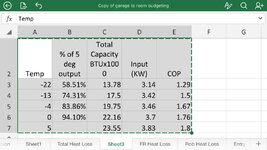
The 24k outside unit supports 3 indoor heads. I used the 5 deg heat capacity as 100%, which is about 1500 BTU/hr less than 17 deg capacity. So maybe officially it's less. For me -15 is the lowest recorded temp. Here's my spreadsheet which came from Carriers documentation.

c5fbab9aedc45100acebfad26d7901f2.jpg

Anyone else notice that with the current gas prices it's always more efficient to heat with a gas furnace? Our gas is $0.7331 per ccf, electric is $0.1364 per KW-hour. (Incremental costs, including taxes) If I did the math right, a 78% furnace requires a COP of 4.39 to break even at those prices. Does that sound right?


Sent from my iPhone using Tapatalk
 

Attachments

  • c5fbab9aedc45100acebfad26d7901f2.jpg
    c5fbab9aedc45100acebfad26d7901f2.jpg
    199.6 KB · Views: 0

aunsafe2015

Well-known member
Joined
Apr 2, 2016
Messages
436
Location
Northern VA
The 24k outside unit supports 3 indoor heads. I used the 5 deg heat capacity as 100%, which is about 1500 BTU/hr less than 17 deg capacity. So maybe officially it's less. For me -15 is the lowest recorded temp. Here's my spreadsheet which came from Carriers documentation.

c5fbab9aedc45100acebfad26d7901f2.jpg

Anyone else notice that with the current gas prices it's always more efficient to heat with a gas furnace? Our gas is $0.7331 per ccf, electric is $0.1364 per KW-hour. (Incremental costs, including taxes) If I did the math right, a 78% furnace requires a COP of 4.39 to break even at those prices. Does that sound right?


Sent from my iPhone using Tapatalk


So even at the low temps, you are saying it would be cheaper to heat your house with your carrier heat pump than with a natural gas furnace? Impressive. I don't need to replace my furnace for at least another 5 years, but maybe when I do I'll look into one of the high efficiency heat pump.
 

Attachments

  • c5fbab9aedc45100acebfad26d7901f2.jpg
    c5fbab9aedc45100acebfad26d7901f2.jpg
    125.9 KB · Views: 0

terabitdan

Well-known member
Joined
Jul 16, 2016
Messages
152
So even at the low temps, you are saying it would be cheaper to heat your house with your carrier heat pump than with a natural gas furnace? Impressive. I don't need to replace my furnace for at least another 5 years, but maybe when I do I'll look into one of the high efficiency heat pump.


No, the opposite is what I'm calculating, the gas furnace is cheaper even at 50 degrees, and much cheaper at 0.


Sent from my iPhone using Tapatalk
 

Retlaw 66

Well-known member
Joined
Oct 17, 2006
Messages
152
Location
Eastern Pa
Looks like prices jumped up this week, $100-$150.

I'm close to pulling the trigger on a Mits MZ-FH09NA or Fuj 9RLS3H, or maybe a 12k.
Both near full capacity down to 3*F. Primary use is heat for me.
Fuj has better price, includes base pan heater, and slightly higher output and efficiency.

Question.... This is for my house, LR/DR/Kit.....but there is an adjacent master bedroom that it will heat as well (thru the open doorway).
This will be a single zone unit.
Calc for main area is 9600 btu heat, 3000 for Bedroom= 12600k load
Used the calc tool on the ecomfort site.
Heat ratings are 11/12k for a 9k unit, 14-16k for a 12k unit.
Would a 9k unit be too small, or a 12k unit be too big?

I'm in eastern Pa. Been using a wood stove in main living area for primary heat, even tho house has oil heat that I barely used in 10 years. Only use AC a few days a year if at all.

I'm leaning towards the 12k Fujitsu 12RLS3H.
Thoughts?
 

yeldogt

Well-known member
Joined
Jan 2, 2012
Messages
18,184
Fujitsu was the leader 5+ years ago -- they fell behind when Mitsubishi came out with the hyper ... I think they have to be a bit more aggressive with the price even with the new models. I had one (single head) installed in a loft a few years ago -- it worked very well. The Mitsubishi's head unit was nicer looking and the "eye" works very well -- the controls are about the same. The Fujitsu head was not as wide -- but sticks out from the wall more.

Comfort with a single point heat or cool source is all about insulation and drafts ... Its' difficult to get comfort with a single point from far away.

Also -- some of the tables list the heads at 110 percent .. you should not size for them to be in that area for many days .. also some of those tables only give the highest outputs with the multi head unit feeding the single head.

Make sure you have the numbers correct .. I don;t remember any 12k unit getting 16k out.
 

justinjoyal

Well-known member
Joined
Apr 30, 2015
Messages
888
Location
Quebec
Actually a lot of the newer units put out more than their advertised rating.

If heat is the primary use and A/C to hardly ever be used, then I’d go with the 12k unit.
 

PoorOwner

Well-known member
Joined
Feb 10, 2007
Messages
5,032
Location
CA
Looks like prices jumped up this week, $100-$150.

I'm close to pulling the trigger on a Mits MZ-FH09NA or Fuj 9RLS3H, or maybe a 12k.
Both near full capacity down to 3*F. Primary use is heat for me.
Fuj has better price, includes base pan heater, and slightly higher output and efficiency.

Question.... This is for my house, LR/DR/Kit.....but there is an adjacent master bedroom that it will heat as well (thru the open doorway).
This will be a single zone unit.
Calc for main area is 9600 btu heat, 3000 for Bedroom= 12600k load
Used the calc tool on the ecomfort site.
Heat ratings are 11/12k for a 9k unit, 14-16k for a 12k unit.
Would a 9k unit be too small, or a 12k unit be too big?

I'm in eastern Pa. Been using a wood stove in main living area for primary heat, even tho house has oil heat that I barely used in 10 years. Only use AC a few days a year if at all.

I'm leaning towards the 12k Fujitsu 12RLS3H.
Thoughts?

I don't think you will get very much heat in the bedroom that way. The air simply doesn't travel that far. It's like relying on a vent in the living room to heat up a bedroom, it's going to get some, but it's not going to work well. You may need something to circulate the air.

Make sure you read the fine print if buying fujitsu online, you officially have no warranty.
 

bzinsky

Well-known member
Joined
Oct 27, 2014
Messages
5,565
No, the opposite is what I'm calculating, the gas furnace is cheaper even at 50 degrees, and much cheaper at 0.


Sent from my iPhone using Tapatalk

I ran all those numbers for my area awhile back. Keep in mind a gas btu's needs an exhaust, and the efficiency is highly variable just like the heat pump.

I found similar results. The high end heat pumps were pretty much right on the money with gas costs at warmer temps. As soon as it gets cold out, like below 25, gas starts to win. (with 25+ seer plus heat pumps)

Something to keep in mind though, most of the heat pumps are used as AC in the summer, and these 25 seer split systems will absolutely wreck a traditional ducted AC system in efficiency.
 

Diesel Dan

Well-known member
Joined
Jul 21, 2013
Messages
2,460
Location
TN
In the Mitsubishi line, is there any major efficiency difference comparing hyperheat/non-hyper models?
Regarding temp ranges that are usually above freezing.

Looking at a 20K (6k&9K) dual zone and it's $1200+ additional for the hyperheat. If we were still in the great lakes area I'd be all for it but now in middle Tennessee the winters are much milder. Have seen 5*F but only for a day or two.
 
To avoid these ads, REGISTER NOW!

PoorOwner

Well-known member
Joined
Feb 10, 2007
Messages
5,032
Location
CA
In the Mitsubishi line, is there any major efficiency difference comparing hyperheat/non-hyper models?
Regarding temp ranges that are usually above freezing.

Looking at a 20K (6k&9K) dual zone and it's $1200+ additional for the hyperheat. If we were still in the great lakes area I'd be all for it but now in middle Tennessee the winters are much milder. Have seen 5*F but only for a day or two.

If "usually" above freezing I would go with regular model. The condenser can supply 22K at 47F and 12.5K at 17F. You can compare the submittal docs on both units.

You only have a 15K, (6+9) total indoor added together it will not really strain it to supply the heat. according to the submittal, for any 2 zone both turned on, the condenser can supply up to 25K of heat on warmer winter days.

Note that because it is a dual zone unit, the compressor is oversized and the lowest it can spin is around 6K BTU or off. So your 6K unit will not be able to modulate lower than 6K, unless you also turn on the 9K unit to "share" the cooling/heating. Thus, it is often said the multi zone unit are less efficient because of this because there is a minimum BTU you must use.

18 SEER is not that great by today's standard, remember the multizone units naturally take a efficiency hit. The regular model this was a mr Slim model they just took off the sticker since it doesn't use that name anymore, clearing out the remaining stock.

note that with Mitsubishi, even the regular model typically gives more heat for the model. If you compare to some of the other brands, the heat capacity drop alot at 17F where as the Mitsubishi only lose a portion of heat output.

Now, make sure you have someone willing to install it before ordering. I have had a hard time finding someone, for one, local dealers which install Mitsubishi will generally not touch it. And, it is not easy to find a tech who would install something you bought, and when you say 2 zone.. oh my god it is 2 rooms the price quote inflate even more. Understandably, they get 5- figure jobs putting roof top big HVAC units. They really don't want to deal with this "small" job, so it is going to be a big price.

I tried to do this ecomfort thing, a la cart, I have received independent installation prices quotes blows up the total cost together, that I might as well ship everything back to eComfort and pay a diamond dealer for their system installed.
 
Last edited:

Retlaw 66

Well-known member
Joined
Oct 17, 2006
Messages
152
Location
Eastern Pa
......Make sure you read the fine print if buying fujitsu online, you officially have no warranty.

Ugh! ok, scratch Fujitsu off the list.
ecomfort will cover warranty parts but only when equipment has been installed by a qualified professional HVAC contractor.
I was a HVAC tech in 2004-2005..... don't suppose that counts.

There don't appear to be many great alternatives to a $2000 Mits MZ-FH12NA..... but I'm still searching.
 

yeldogt

Well-known member
Joined
Jan 2, 2012
Messages
18,184
Ugh! ok, scratch Fujitsu off the list.
ecomfort will cover warranty parts but only when equipment has been installed by a qualified professional HVAC contractor.
I was a HVAC tech in 2004-2005..... don't suppose that counts.

There don't appear to be many great alternatives to a $2000 Mits MZ-FH12NA..... but I'm still searching.


They are nice units -- the "eye" relay works ... and I like the independent split output vents.
 

Retlaw 66

Well-known member
Joined
Oct 17, 2006
Messages
152
Location
Eastern Pa
Well, I was about to order a Mits from ecomfort until Laura (sales) tells me no warranty with a DIY. This is getting aggravating!
A local HVAC will do the final pumpdown and sign off my install for $475. They'll even sell me the MZ-FH12NA for $1945. ecomfort is $1914.
Final total with lineset, etc likely pushing $2600.
They also offer DiamondAir products, also hyper heat, at a much lower cost. I don't see any exclusions for DIY install in their warranty either. The $1100 price is very attractive.

Any recommendations for hyper-heat systems that will warranty a DIY install?
I once did installs for a living, so paying $500 extra for a warranty is absurd.
 

PoorOwner

Well-known member
Joined
Feb 10, 2007
Messages
5,032
Location
CA
Well, I was about to order a Mits from ecomfort until Laura (sales) tells me no warranty with a DIY. This is getting aggravating!
A local HVAC will do the final pumpdown and sign off my install for $475. They'll even sell me the MZ-FH12NA for $1945. ecomfort is $1914.
Final total with lineset, etc likely pushing $2600.
They also offer DiamondAir products, also hyper heat, at a much lower cost. I don't see any exclusions for DIY install in their warranty either. The $1100 price is very attractive.

Any recommendations for hyper-heat systems that will warranty a DIY install?
I once did installs for a living, so paying $500 extra for a warranty is absurd.

Hard to say at this point, if you have all the tools I think I would just get an off brand and DIY. I would look very carefully, chart side by side, if something called "Diamond Air" would actually match Mitsubishi hyper heat performance.

All the major brands pretty much say you need to be installed by an licensed HVAC technician.

The other option is to install a Gas heater.
 

aunsafe2015

Well-known member
Joined
Apr 2, 2016
Messages
436
Location
Northern VA
The 24k outside unit supports 3 indoor heads. I used the 5 deg heat capacity as 100%, which is about 1500 BTU/hr less than 17 deg capacity. So maybe officially it's less. For me -15 is the lowest recorded temp. Here's my spreadsheet which came from Carriers documentation.

c5fbab9aedc45100acebfad26d7901f2.jpg

Anyone else notice that with the current gas prices it's always more efficient to heat with a gas furnace? Our gas is $0.7331 per ccf, electric is $0.1364 per KW-hour. (Incremental costs, including taxes) If I did the math right, a 78% furnace requires a COP of 4.39 to break even at those prices. Does that sound right?

Sorry to revive a dead thread, but I've been researching gas furnace vs. high efficiency heat pump, and I'm curious about the above conclusion.

There are some "heat fuel cost" calculators online. The one I like the best is an Excel calculator from Purdue: https://goo.gl/XKVFim, but there are others and they all seem pretty consistent with each other.

They give results similar to below:

at 12 cent/kWh, electric heating (resistive) costs about $35.84 per million Btu.

at $1.00/Therm, an 80% AFUE NG furnace is about $12.50 per million Btu, and a 96% AFUE NG furnace is about $10.50 per million Btu.

at 12 cent/kWh, a 9 HSPF electric heat pump costs about $13.32 per million Btu, and a 10 HSPF electric heat pump costs about $11.99 per million Btu

Based on that data, it seems that a 10 HSPF electric heat pump is cheaper per million Btu ($11.99) than an 80% AFUE natural gas furnace ($12.50).

I understand that, if you live somewhere that is so cold that your heat pump loses its capacity or auxilliary electric heat strips are required, your cost per million Btu on the heat pump would increase.

But say, for example, that you have a Mitsubishi hyper heat unit that is 10 HSPF and maintains 100% heating capacity down to 5 degrees F. As long as it is operating at 100% capacity, you would still be paying $11.99 per milliion Btu, correct? Even at 5 degrees F? And wouldn't that be cheaper than the 80% AFUE NG furnace?

I'm sure terabitdan knows more about this than I do, but I'm just curious why his numbers would suggest that the NG furnace is significantly cheaper to operate than the high efficiency heat pump, while the numbers I'm seeing in the online calculators seem to suggest that a high efficiency heat pump is very comparable to an 80% AFUE furnace (as long as you can avoid relying on auxiliary electric heat strips).

Thoughts/input??
 

Attachments

  • c5fbab9aedc45100acebfad26d7901f2.jpg
    c5fbab9aedc45100acebfad26d7901f2.jpg
    125.9 KB · Views: 0
Last edited:

terabitdan

Well-known member
Joined
Jul 16, 2016
Messages
152
I'm just someone trying to figure all this out like you, reading and calculating, making a few mistakes along the way.

I did use that spreadsheet to help compare the costs. Using HSPF is an average efficiency over the course of a season and the spreadsheet uses US averages for fuel and electric costs. My electric rates are higher and gas is cheaper than the national average, so my break even is different than yours would be.

Also, my heat pump coefficient of performance varies from 1.25 @ -22 to 3.59 @ 54. I think the Mitsubishi is more efficient than mine, but it's efficiency also drops similarly.

It's hard to beat a heat pump for year-round comfort, especially since you are in a milder climate than mine. Even if a gas furnace is cheaper to operate for you, paying back the additional cost for two separate systems for heating and cooling is just about impossible based on my research.

Good luck in your research and keep posting to let us know what you decide.


Sent from my iPad using Tapatalk
 

PoorOwner

Well-known member
Joined
Feb 10, 2007
Messages
5,032
Location
CA
But say, for example, that you have a Mitsubishi hyper heat unit that is 10 HSPF and maintains 100% heating capacity down to 5 degrees F. As long as it is operating at 100% capacity, you would still be paying $11.99 per milliion Btu, correct? Even at 5 degrees F? And wouldn't that be cheaper than the 80% AFUE NG furnace?

Thoughts/input??

100% capacity means output, it will use more power to extract the heat the colder it gets, when you compare the regular vs hyperheat, the hyperheat model require a bigger breaker.
 

tyme2par4

Well-known member
Joined
May 16, 2016
Messages
571
Location
NH
But say, for example, that you have a Mitsubishi hyper heat unit that is 10 HSPF and maintains 100% heating capacity down to 5 degrees F. As long as it is operating at 100% capacity, you would still be paying $11.99 per milliion Btu, correct? Even at 5 degrees F? And wouldn't that be cheaper than the 80% AFUE NG furnace?

Not quite. COP is really the metric you want to evaluate the cost on. HSPF is an average efficiency over a range of temperatures. I don't remember exactly how it's calculated.
COP is at one specific temp. COP will drop as the temp drops, or more specifically, as the differential of indoor and outdoor temp increases. It takes a lot less work to raise the air temp 5 degrees than it does to raise it 20 degrees.
To get the specific cost for a given COP, take that resistance heat cost (assumed to be 100% efficiency) and divide by the COP. Most manufacturers have published COP tables or graphs for each model.

I don't have access to NG, only oil for heat. A while back I calculated my Mitsubishi was cheaper than oil down to about 15 degrees. (That was a couple years ago, when oil prices were a bit higher).
 

yeldogt

Well-known member
Joined
Jan 2, 2012
Messages
18,184
Sorry to revive a dead thread, but I've been researching gas furnace vs. high efficiency heat pump, and I'm curious about the above conclusion.

There are some "heat fuel cost" calculators online. The one I like the best is an Excel calculator from Purdue: https://goo.gl/XKVFim, but there are others and they all seem pretty consistent with each other.

They give results similar to below:

at 12 cent/kWh, electric heating (resistive) costs about $35.84 per million Btu.

at $1.00/Therm, an 80% AFUE NG furnace is about $12.50 per million Btu, and a 96% AFUE NG furnace is about $10.50 per million Btu.

at 12 cent/kWh, a 9 HSPF electric heat pump costs about $13.32 per million Btu, and a 10 HSPF electric heat pump costs about $11.99 per million Btu

Based on that data, it seems that a 10 HSPF electric heat pump is cheaper per million Btu ($11.99) than an 80% AFUE natural gas furnace ($12.50).

I understand that, if you live somewhere that is so cold that your heat pump loses its capacity or auxilliary electric heat strips are required, your cost per million Btu on the heat pump would increase.

But say, for example, that you have a Mitsubishi hyper heat unit that is 10 HSPF and maintains 100% heating capacity down to 5 degrees F. As long as it is operating at 100% capacity, you would still be paying $11.99 per milliion Btu, correct? Even at 5 degrees F? And wouldn't that be cheaper than the 80% AFUE NG furnace?

I'm sure terabitdan knows more about this than I do, but I'm just curious why his numbers would suggest that the NG furnace is significantly cheaper to operate than the high efficiency heat pump, while the numbers I'm seeing in the online calculators seem to suggest that a high efficiency heat pump is very comparable to an 80% AFUE furnace (as long as you can avoid relying on auxiliary electric heat strips).

Thoughts/input??
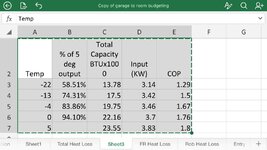
efficiency drops as the temps drop w/ HP -- still may get you full output but will require more KW to get it. NG is static -- same BTU cost at 50 and 0.

even with a 2 you are 2x resistance
 

aunsafe2015

Well-known member
Joined
Apr 2, 2016
Messages
436
Location
Northern VA
I'm just someone trying to figure all this out like you, reading and calculating, making a few mistakes along the way.

I did use that spreadsheet to help compare the costs. Using HSPF is an average efficiency over the course of a season and the spreadsheet uses US averages for fuel and electric costs. My electric rates are higher and gas is cheaper than the national average, so my break even is different than yours would be.

Also, my heat pump coefficient of performance varies from 1.25 @ -22 to 3.59 @ 54. I think the Mitsubishi is more efficient than mine, but it's efficiency also drops similarly.

It's hard to beat a heat pump for year-round comfort, especially since you are in a milder climate than mine. Even if a gas furnace is cheaper to operate for you, paying back the additional cost for two separate systems for heating and cooling is just about impossible based on my research.

Good luck in your research and keep posting to let us know what you decide.


Sent from my iPad using Tapatalk

Thank you for the response. And thanks to others for responding as well.
 

Retlaw 66

Well-known member
Joined
Oct 17, 2006
Messages
152
Location
Eastern Pa
After too much deliberation, I went with the Fujitsu 12RLS3H. A local supplier had it avail for $1576, over $400 less than I could buy online. The Fujitsu's have better support around here than the Mitzu's. Price difference is significant.
Spent $450 on the necessary equipment and did the install myself.

As a bonus the elec company will rebate me $175, and a new credit card will give me a $200 bonus. Final cost with tools and after rebates = $2073. Good deal.
 

yeldogt

Well-known member
Joined
Jan 2, 2012
Messages
18,184
where did you get the equipment ..

I'm in eastern PA .. Lots of Mitzu people in the area .. but Fujitsu .. I have used both .. Fujitsu make a nice unit.
 

PoorOwner

Well-known member
Joined
Feb 10, 2007
Messages
5,032
Location
CA
After too much deliberation, I went with the Fujitsu 12RLS3H. A local supplier had it avail for $1576, over $400 less than I could buy online. The Fujitsu's have better support around here than the Mitzu's. Price difference is significant.
Spent $450 on the necessary equipment and did the install myself.

As a bonus the elec company will rebate me $175, and a new credit card will give me a $200 bonus. Final cost with tools and after rebates = $2073. Good deal.

Can you list what you bought for $450? Did that include micron gauge?

Thanks
 

Retlaw 66

Well-known member
Joined
Oct 17, 2006
Messages
152
Location
Eastern Pa
Purchased the unit and lineset at Johnstone Supply. I do have 608 cert.
Tools include JB DV-6E pump, used on eBay, $168
Yellow jacket manifold w/ shut off valves on hoses, $118
Accutools Bluvac micron gauge, $97
+some tees, adapters, Nylog thread sealer, pump oil, etc.
Borrowed a N2 tank from work. It was a big one, probably weighs 100 lbs!

I didn't include the cost of electrical since I got carried away with my 'might as well' mentality and added garage outlets in EMT when I added a sub panel for the Fuj. Looking to add some Costco LED lights and wiring in EMT 'while I'm at it'.

It was a good project, glad I went this route.
 

okoyoray

Member
Joined
Dec 10, 2018
Messages
6
Location
Backyard
I have installed several ductless mini-split air conditioners. They are very easy to install. If you get one get a inverter one it changes the speed of compressor to use less power. If you get at least a 16 seer the heat out put is very good. They come pre charged with freon but it is best to pull a vacuum on line before opening valve to release freon. The only bad thing is the water condensation line make sure you clean it out once in a while, if it gets plugged the water comes out inside all over wall
 

jjrbus

Well-known member
Joined
Dec 8, 2018
Messages
619
Location
Florida
Interesting thread. I keep watching the AC threads looking for DIY troubleshooting procedures. As a DIY'er I did my due diligence, I saw that Fujitsu and Mitsubishi were #1 depending on who you talked too. Daikin is a strong #3.

I went with Daikin as I found much more online about installing them, troubleshooting and parts availability. Plus buying online the chances of getting a warranty repair are very slim, I don't want to have to call a service tech and an attorney. At the price of a Daikin if one bites the bullet I can afford to scrap it and buy a new one. The failure rates are very low for the top 3 and the bulk of failures is due to improper installation!

I purchased a Daikin tool kit for $300 and a nitrogen tank $100 and gauge $70, micron gauge $100+, I had a Harbor Freight vaccum pump that worked well with new oil.

One thing I read fairly often but do not see mentioned here was that the inverter units are very susceptible to power surges so I also installed a whole house surge protector. Which I should have done along time ago anyway.

Only my opinions and worth what you are paying for them!
 
To avoid these ads, REGISTER NOW!
Top Bottom