OP
four.cycle
Well-known member
are you missing any? 

 .
. 


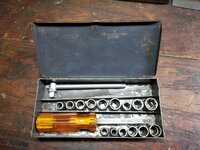
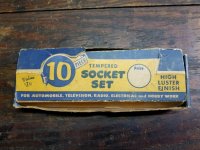
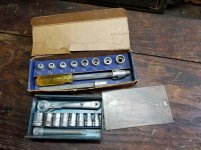
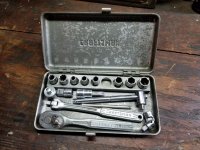
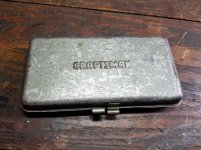
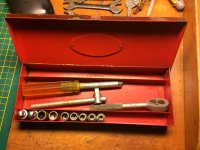
That's the same page I was looking at in the 1954 catalog to understand what I was missing, 4.c. Someone bought some nice extra accoutrements for their set, which will be a whopping and well-appointed 19-piecer once I find the 5/16-6 and extensions.That Craftsman set, unless I'm mistaken, didn't originally contain either the adapters or the universal joint. Lucky find on the tommy bar.
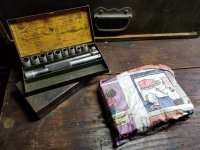
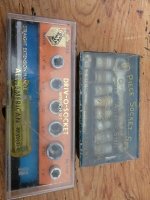
4.cA care package arrived from 4.c yesterday with the mysterious Walden-Worcester 39120-20 9/32-drive socket sets that we have been discussing on the 'Old Walden-Worcester' thread. MR. X helped identify these as previously unrecognized military and probably prewar USN origin and I am excited to research them as I am to try to complete the sets.
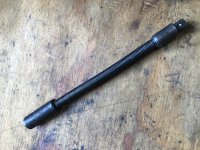
I have a black oxide finish Walden flex extension in 9/32” drive. Also labeled 7264. This one has a faint “U.S.” Stamp in addition to the regular markings.4.c
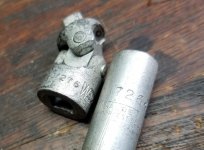
Just a little interesting update on this subject. I was saying on the Old Walden thread, where the subject first broke, that Walden did not make 9/32-drive tools during WWII, that they were known for supplying the 41-W-2615 1/4-drive sets found in GMTK's. But I forgot that I had these two orphan pieces. A cadmium-plated flex extension (7264) and a universal joint (7276). Obviously part of a 9/32-drive set that had 72xx part numbers, possibly wartime. And with the martial "US" markings, almost certainly military. As bonnyeman pointed out on the other Walden thread, the 9/32-drive uni joint seems unusual, and perhaps unique, unless someone can think of another example from another mfgr.


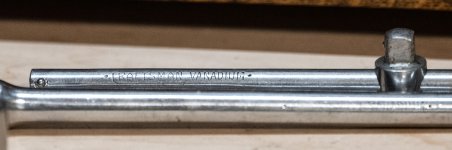
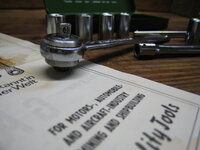
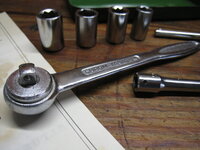
Because of the Indestro-ish pseudo beaver tail? The oddly bulky construction of the head? the knurled button dial selector? Or?...with an interesting ratchet.
Because of the Indestro-ish pseudo beaver tail? The oddly bulky construction of the head? the knurled button dial selector? Or?
 It’s just one of those you don’t see every day, between the brand and the drive size.
The overall appearance/style, plus the very thin handle thickness. Can't be very nice to use for long periods.Because of the Indestro-ish pseudo beaver tail? The oddly bulky construction of the head? the knurled button dial selector? Or?
True that. Strange how permanently their double flex socket head wrenches have been crescented into our lexicon, though!
Thanks, just curious. Maybe that's what's making the head look even thicker. At first I thought maybe it swiveled the way it sits so high above the frame like that. Not sure why it's not flush.The overall appearance/style, plus the very thin handle thickness. Can't be very nice to use for long periods.

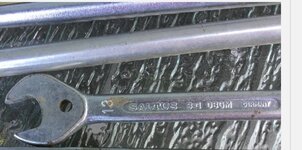

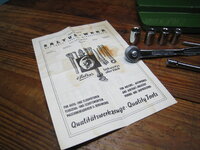
Thanks for posting this. The script looks similar to me as well. I believe Saltus supplied tooling to the German military at some point. It's been super hard finding any vintage info for his brand.Crescented, I like that term. Sounds better than Vise-Gripped or Channellocked.
As for the Saltus, this is the wrench I posted earlier in the year. Authentic German. Bad photos, just want to compare the two because it looks like the same font as on the ratchet. Sorry to get off track, but since the name was mentioned.
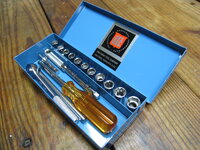
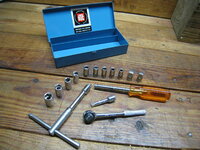
Thrilled to announce that I have recently acquired this Navy NAF 1108-1 wartime midget set, made by the Philadelphia Manufacturing Company, in a long-distance international trade.


The backstory on this set is a classic GJ saga.
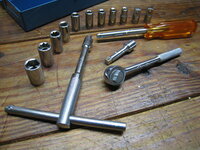
For those with short memories, I found an unusual spinner and sliding tee back in 2018. They were extra chunky, from much bigger stock than any midget set tools I had ever seen before, and unmarked. They were soon ID’d by Odes as Phila. Mfg Co., but nobody, including me, paid any attention to the rest of the decal in the fuzzy photos he posted of his set.
A few months later, OTG bought “a weird set” on eBay, linked here, apparently not remembering that earlier discussion and not making the connection to my orphans and the ID of them as Phila. Mfg. Co. His photos were clearer and the label was unmistakable. It was a partial NAF 1108-1 set, missing only one socket and the extension. A little research by me uncovered all of their WWII contracts…

…and photos of the set list in the Navy ASO catalog Class 41...


...and Don’s Plomb and UNAIU’s Williams NAF 1108-1 sets, respectively, demonstrated the exact same labels.


This set is perfectly complete. That near-white stuff on the sockets is a phosphate finish, and it can also be seen on the handles, just less of it remaining. They were milled, not forged, and cold-broached, without being finished inside to remove the thin leftover broaching fragments.


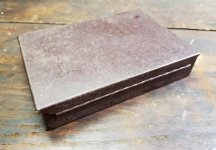
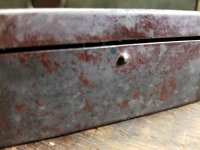
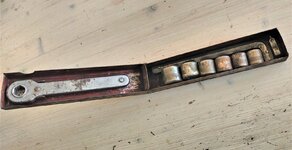
This Philadelphia Manufacturing Company box arrived in the mail today. Lugz mentioned that he has some spares for me. If anybody else has any in with their orphans it would be great to complete this set.It looks like the box may have been badly rusted on the outside, now completely stripped down to steel, and the PO was in the process of fixing the hinge. I may have to finish the job and repaint the same flat black as on the inside.


If anybody has some of these odd looking sockets to spare, I would appreciate adding them to my new Philadelphia set.This Philadelphia Manufacturing Company box arrived in the mail today. Lugz mentioned that he has some spares for me. If anybody else has any in with their orphans it would be great to complete this set.
-Don

Those aren’t my sockets, unfortunately. The picture came from my tool collecting buddy in the U.K. I do have the box you alerted me to and Lugz has sent a couple of key pieces, now I just need sockets like the examples above.wow.... hard to believe you managed to put that one together.... I guess maybe a few of my crazy emails do serve a purpose.
well done.
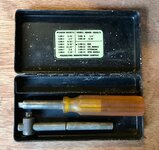
Private Lugnutz said:The sockets are going to be hens teeth, methinks.

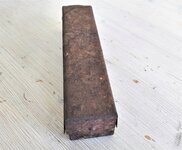



It's 1922, and the L-handle probably doesn't belong to that set, originally. The patent (1,438,900), for an open style holder called a "Handle Lock" in which the L-handle does double duty as the handle, laying across the top of the sockets and keeping them in place, was owned by a guy named Henry Chase. Chase initially tried to make a go of it on his own with his own company, called the Handle Lock Company, but he was soon bought out by New Britain, who used the design and the name on their early hex drive socket wrench kits.the only other marking I have found is "PATENTED DEC. 12. 1822" on the L -handle
Yes, of course 1922, sorry for the typo...It's 1922, and the L-handle probably doesn't belong to that set, originally. The patent (1,438,900), for an open style holder called a "Handle Lock" in which the L-handle does double duty as the handle, laying across the top of the sockets and keeping them in place, was owned by a guy named Henry Chase. Chase initially tried to make a go of it on his own with his own company, called the Handle Lock Company, but he was soon bought out by New Britain, who used the design and the name on their early hex drive socket wrench kits.
Thank youNew Britain/None Better, as Lugz says above. Here is a link to AA showing the sockets.
-DonThe New Britain Machine Company [Page 1]
Page 1 of an article on the New Britain Machine Company.alloy-artifacts.org
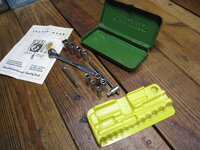
Thank you!And here is a little NB made Husky branded Handle Lock type set that I own with the same sockets.
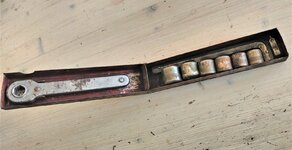
I have to admit, I don't recall seeing that container before, with the ratchet stored in the lid, atop the sockets when closed. That's a neat one.
What about the darker red, wine color, inside of the box? Can that give any clues?