To avoid these ads, REGISTER NOW!

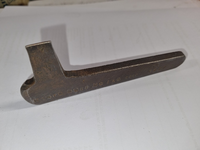
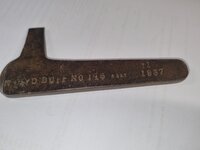
Mystery tool, 1937

Stubby1743

Well-known member
Joined
Jul 16, 2023
Messages
715
Location
UK
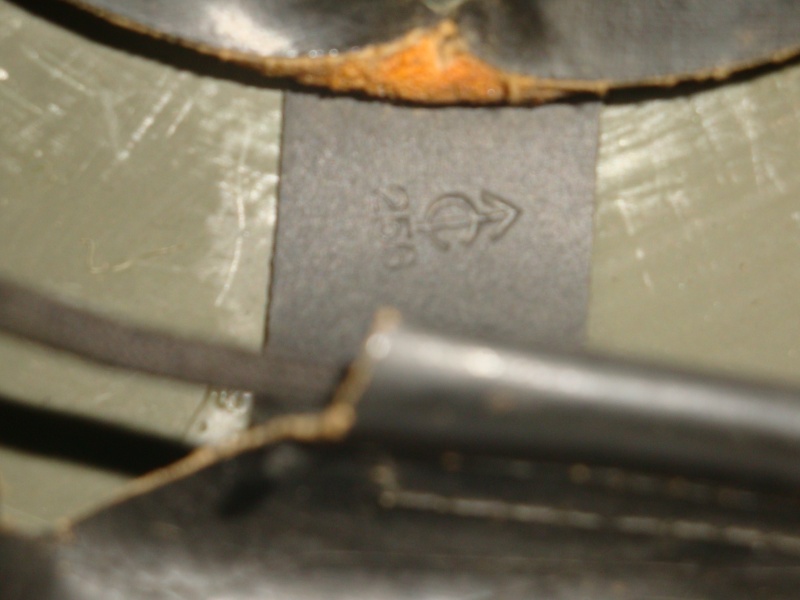
As far as I am aware, the Canadian Govt. property mark always had the broad arrow fully contained within the curve of the C. Therefore this mark on the mystery tool does not denote govt. ownership. In addition, the vertical shank of the arrow is way too long. 1755354849216.png
 
To avoid these ads, REGISTER NOW!

alfadan

Well-known member
Joined
Mar 9, 2007
Messages
2,104
Location
Augusta, ks
Sure looks like a screwdriver to me, but more like something you'd see in the 18th century.

After some searching, the small C broadarrow mark is an English variation used in the 30s. I believe this to be military, maybe a screwdriver for a hydraulic buffer system on a field gun.
 
Last edited:

Mintgrun

Well-known member
Joined
Oct 7, 2015
Messages
2,101
Location
Kingston, Wa.
To me, the fat end looks user-modified, or, shortened; based on the way it's ground down and how close to the end that N is. If so, there may have been more letters before the N.

1755368275905.png
 

Private Lugnutz

Well-known member
Joined
Mar 30, 2012
Messages
30,485
Location
The Authentic Jersey Shore
It is funny, because I selfishly used some words that are conducive for my artillery hydraulic buffer key explanation, but I think @Mintgrun really could be onto something, and now that I drew a tool with two wings instead of one, I actually can't unsee it, and the original actually does look more lopped off than I thought of it as before.
 

PCustoms

Well-known member
Joined
Jul 23, 2011
Messages
22,387
Location
VT
1000002455.png


1000002456.png

It's so close, but not quite an exact match
 

Attachments

  • 1000002456.png
    1000002456.png
    1.7 MB · Views: 10

Private Lugnutz

Well-known member
Joined
Mar 30, 2012
Messages
30,485
Location
The Authentic Jersey Shore
Those things are tiny, comparatively speaking.
True, but those were used on small arms. Scaling up to larger guns, you can see how manufacturers supporting the ordnance discipline with tools could scale a similar design up. Or not and we're just talking ourselves into it! :)
I think the biggest clue has got to be the AS&S.
Agreed. My searches have been futile.
 
OP
J

Junk&Disorder

Member
Joined
Aug 15, 2025
Messages
7
If it's ~5" long, I am guessing it's maybe about 3/8" thick maybe a little thicker at the "head" where it seems to slightly taper.
It's made from 1/4" plate. Of note is the wider end, it has a bevel, coarsely hand ground as per pic. Flip it over and there's a similar bevel there too.
20250817_082239.jpg
 

PCustoms

Well-known member
Joined
Jul 23, 2011
Messages
22,387
Location
VT
It's made from 1/4" plate. Of note is the wider end, it has a bevel, coarsely hand ground as per pic. Flip it over and there's a similar bevel there too.
20250817_082239.jpg

Looks like some remnant of a letter to the right on the "N". Unfortunately this looks like it may have been modified from something else
 

Oregon Dave

Well-known member
Joined
Sep 16, 2023
Messages
298
O.K. this getting interesting/something. First, it would really be nice of the O.P. to lay it down on a scale a re-submit a new image; measure the width and thickness of the blade tip etc. - especially if asking for identification assistance & especially in light of an earlier request for additional info. Don’t mean to be grumpy; such a request is just not necessary in some generations.

The ‘tool’ has always appeared to me for turning or twisting application; not necessarily as a screwdriver; Private Lugnutz’s hydraulic buffer extrapolation from the tool stamping tweaks a new thought direction as does the ‘keys’ in the limber box he posted.

If the tool is involved in the operation of hydraulic buffers, be they railroad or artillery; seems reasonable they would be described/pictured in tech manuals - I currently lack the computer skills to access them.

In a hydraulic system, if you wanted to adjust a valve and not have it easily re-adjusted, one way would be to cut a slot in the valve stem and make a ‘special stored away tool’ for that purpose.

Another though that rattles around is a pry; but hydraulic buffer is pulling the rational toward a tee-handled adjustment tool; that works pretty well with one arm sawed & ground off.
 

Private Lugnutz

Well-known member
Joined
Mar 30, 2012
Messages
30,485
Location
The Authentic Jersey Shore
...seems reasonable they would be described/pictured in tech manuals...
If the manuals I had found listing screwdrivers and keys in association with a gun using a hydraulic buffer (such as the one I posted, for example) had included an illustration or description of tools, I would've posted it. I haven't found one yet.
I currently lack the computer skills to access them.
No skills required. Instead of using Google, use Google Books. Everything else is the same, but the corpus is all historical documents, and only historical documents. It's reader nerd heaven. No YouTube. No sales. No websites. Just old books.
 

Oregon Dave

Well-known member
Joined
Sep 16, 2023
Messages
298
If the manuals I had found listing screwdrivers and keys in association with a gun using a hydraulic buffer (such as the one I posted, for example) had included an illustration or description of tools, I would've posted it. I haven't found one yet.

No skills required. Instead of using Google, use Google Books. Everything else is the same, but the corpus is all historical documents, and only historical documents. It's reader nerd heaven. No YouTube. No sales. No websites. Just old books.
Thanks for the Google books heads-up; yes I only use regular google; will enlist the help of my grandkids to move forward.

Do I understand correctly, you have accessed British artillery TM's with hyd. buffers & the tool kits DO NOT show this tool?
 

Private Lugnutz

Well-known member
Joined
Mar 30, 2012
Messages
30,485
Location
The Authentic Jersey Shore
Do I understand correctly, you have accessed artillery TM's with hyd. buffers & the tool kits DO NOT show this tool?
A yes or no answer would provide a misguided impression. There are dozens of TM's for large British guns with hydraulic buffers on Google Books, all dated between the 1880's and early 20th century, all of them referencing screwdrivers and/or keys in descriptions, in lists, in tables, etc, but most of them do not include an illustration of any of the tools. The guns, carriages, valves, packing diagrams, etc, are illustrated, but no tools. So it's not that I can't find this tool, explicitly. This tool might in fact be the tool or a tool like it being referenced. But the manuals are not definitive.

Here is a good example, from a 1914 Q.F. (Quick Firing) 15-pounder, which literally cites a "Key, hydraulic buffer" by name, but provides no illustration or description.
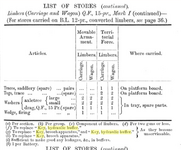
1755384463625.png

Other keys (breech, fuze, fuze hole, primer, etc) are listed and described (though not illustrated), but not the hydraulic buffer key. Not sure why.

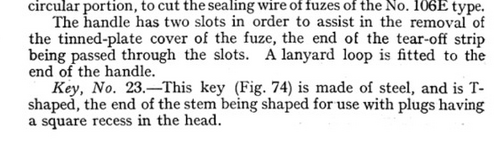
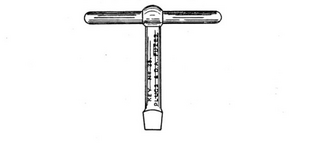
I have found a few later manuals starting to show more tools. Here is a figure from the 1928 Handbook for the BL 60-pounder, for example. I like the robust look of the blade. I really like the look (and implicit turning and spinning function) of that tommy bar with respect to my artistic rendering and extended logic of @Mintgrun's very good observation! But note that it's not associated with the hydraulic buffer. I'm getting strong inferences. But it's not definitive.
1755383291646.png

1755383213488.png
 

Oregon Dave

Well-known member
Joined
Sep 16, 2023
Messages
298
A yes or no answer would provide a misguided impression. There are dozens of TM's for large British guns with hydraulic buffers on Google Books, all dated between the 1880's and early 20th century, all of them referencing screwdrivers and/or keys in descriptions, in lists, in tables, etc, but most of them do not include an illustration of any of the tools. The guns, carriages, valves, packing diagrams, etc, are illustrated, but no tools. So it's not that I can't find this tool, explicitly. This tool might in fact be the tool or a tool like it being referenced. But the manuals are not definitive.

Here is a good example, from a 1914 Q.F. (Quick Firing) 15-pounder, which literally cites a "Key, hydraulic buffer" by name, but provides no illustration or description.

1755384463625.png

Other keys (breech, fuze, fuze hole, primer, etc) are listed and described (though not illustrated), but not the hydraulic buffer key. Not sure why.

I have found a few later manuals starting to show more tools. Here is a figure from the 1928 Handbook for the BL 60-pounder, for example. I like the robust look of the blade. I really like the look (and implicit turning and spinning function) of that tommy bar with respect to my artistic rendering and extended logic of @Mintgrun's very good observation! But note that it's not associated with the hydraulic buffer. I'm getting strong inferences. But it's not definitive.

1755383291646.png

1755383213488.png
Absolutely fantastic research. Since your earlier post, I dabbled around using reg. Google; found several mentions of an oil drain tool on a British hyd/buffer system, but the picture was unintelligible. Maybe this could be another lead.
 

RTM

Well-known member
Joined
May 13, 2019
Messages
13,087
Location
SF Bay Area
Wow, you all have been busy while I was away. During my little free time, I have been chasing AS&S. The only thing even potentially close when I include New Zealand, Australia or Britain is below (Auckland Sword and Shield seems to only exist on FB.). Searching Google and Google Books has been amazingly light on results


From Etsy
Vintage British Railways (BR and BR M) Spanners And Ball Pein Hammer. Vintage British Railways Tools By AS&S, Three Spanners And Hammer Head

ARe they tool makers, founders, or what?
 
To avoid these ads, REGISTER NOW!

Karl_B

Well-known member
Joined
Oct 13, 2013
Messages
428
Location
Killeen, TX
I don't know if it will help, but Armstrong, Stevens & Sons was making tools during that time in the UK. It looks like they used a lion in relation to trademarking, but maybe for only tools they sold to the public and not tools sold to other companies or the military?
 

Private Lugnutz

Well-known member
Joined
Mar 30, 2012
Messages
30,485
Location
The Authentic Jersey Shore
Thanks for the Google books heads-up;
You're welcome. It is the most important resource/reference in the vintage tool collectors research toolkit. First stop for me encountering any marking on any tool I don't know is GJ Search. Because there is no more diverse corpus for vintage hand tool terminology on the internet, and because I don't post questions before I look myself. (Dad didn't raise a lazy loafer. :)) Then Google Books. Then Internet Archive.
I have been chasing AS&S.
I noticed that the Detailed description differed from the Ad, saying, "Starting with the largest spanner this is marked BR (M) 1/8 and 3/4, marked AS&SW to Back, this spanner has been cleaned and dressed, the next spanner is marked BR, 11/16 BS - 5/8 W and 1 1/8 BS - 1 W AS&SW to back." I messaged the seller to clarify and inquire if he might elaborate on either variation. (Could be the same if the "W" is Works.)
Armstrong, Stevens & Sons was making tools during that time in the UK.
Thanks.
 

RTM

Well-known member
Joined
May 13, 2019
Messages
13,087
Location
SF Bay Area
I noticed that the Detailed description differed from the Ad, saying, "Starting with the largest spanner this is marked BR (M) 1/8 and 3/4, marked AS&SW to Back, this spanner has been cleaned and dressed, the next spanner is marked BR, 11/16 BS - 5/8 W and 1 1/8 BS - 1 W AS&SW to back." I messaged the seller to clarify and inquire if he might elaborate on either variation. (Could be the same if the "W" is Works.
Well, they hid that Item Details button well, took three looks over the listing to find it.

Added the W to my search, and AI found a link on Etsy from the same seller that said (apologies for the font).

Vintage British Railways (Midlands) Imperial Spanner By Armstrong Stevens And Son Willenhall. Vintage BR (M) Obstruction Wrench By AS&SW​


So thanks to your. Digging and @Karl_B , we have a little more to keep going.

First link took me here, but seems a later start to the archive, breaks a bit on my iPad.

And then of course Grace Guides, no coffee, so won’t try to read the ads.

And like all good fun tool threads, there is ALWAYS a GJ answer

And, if you wander back to books, we now have a plethora of data to dig thru.


AS&S Armstrong Works Willenhall did show up in one of the books references

Ok, gotta punt for a while, back later.
 
Last edited:

Private Lugnutz

Well-known member
Joined
Mar 30, 2012
Messages
30,485
Location
The Authentic Jersey Shore
The seller messaged me back while I was at the flea market and gave me the same information. "W" for Willenhall, ostensibly, although neither Grace's or Geesin mention it, the appendage corresponds to the period when the company was located there.

Per Grace's, "By 1959 the drop forged products were marked A.S.& S.W. in a diamond-shaped frame (see advert)," which leaves open the possibility that the "AS&S" (no "W", no diamond-shaped frame logo) marking on this tool stamped in 1937 could be them.

EDIT: Also, given the prevalence of Armstrong, Stevens, & Son supplying spanners and other tools to the British Railway system, I am not quite ready to give up on the other major use case for hydraulic buffer keys.
 
Last edited:

alfadan

Well-known member
Joined
Mar 9, 2007
Messages
2,104
Location
Augusta, ks
I found the small C mark shown on a forum asking about helmet liners from WW2. It was identical to the OP's tool and was said to be English.
 

1982fxr

Well-known member
Joined
Jan 7, 2012
Messages
9,997
Location
Phoenix
First post here. Pete from NZ, mad tool collector extraordinaire☺️
This tool turned up in scrap metal. It looks a bit like a morse taper wedge however it's not thin enough of a point to enter, at least not on my MT.
Stamping has some good clues. Thanks20250813_091913.jpg20250813_091924.jpg
I have no input. Other than to say nice screen name photo ☺
 

Private Lugnutz

Well-known member
Joined
Mar 30, 2012
Messages
30,485
Location
The Authentic Jersey Shore
Here is the discussion for those interested.
Thanks, Dan. At the risk of breaking my arm patting myself on the back, my take-away from that discussion is that it's not Canadian, but British, clearly some form of certification or acceptance, clearly martial, and evidently based on the number of examples, very common in the 1937-1939 timeframe, same as the tool. I think it strongly suggests the tool in question is military or martial, or at the very least, government order.
 

Private Lugnutz

Well-known member
Joined
Mar 30, 2012
Messages
30,485
Location
The Authentic Jersey Shore
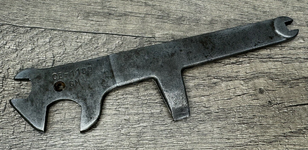
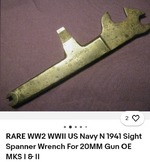
I'm thinking modified gun wrench.
We've been in the gun tool category all along, 3bay, mainly via the look and the words I suspected might be short for HYDRAULIC BUFFER, and Tom thought it looked modified, and these lend a lot of credence! If we could find examples made by Armstrong, Stevens, & Son (or whatever "AS&S" stands for, if something else) produced in the 1937 timeframe and bearing the certification marking, we'd really be cooking.
 
To avoid these ads, REGISTER NOW!
Top Bottom