Old Man Roger
Well-known member
I don’t get it?

Don't lose any sleep over it.I don’t get it?

Before I unveil a reference that will really put my arm in a sling and make it hard to get my ego's already overinflated head through a doorway, I thought it only courteous to inform you of a long, rich tradition we have here on Garage Journal for whatzit inquirer's to offer handsome rewards. (I accept Cash, Postal Money Orders, or rare spanners in return!)Great discussion, thanks!
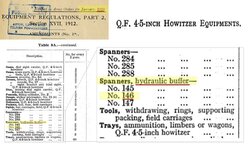
I agree the reference book is for Officer Training and is a broad list of items..not just the Howitzer (although the Howitzer is specifically referenced in the Site category above our Spanner section.Sorry. I can't help you. No illustration or description in the reference I found, because that reference document is a compilation of many, many guns and other equipment. I may poke around tomorrow or as I have time. I am a reference guy, and for me, having the abbreviated name ("HYD BUFF") and the exact number ("No. 146") of the spanner identified as a gun spanner on a tool with a shape that looks like what remains of tools that have been identified as gun spanners would do it for me! YMMV.
Nice work! Thanks for posting that. That's two references that list it by the name and number on the tool! And now we know it was kept in the carriage toolcase.Found this...Check page 64 of the manual. I references Spanner no 146
I'd still like to see it later than 1929, but I can attest that all kinds of inventory from the 1930's made its way into US Army issue during WWII.No idea. Almost impossible to say without seeing the actual recoil mechanism. And we're probably not seeing the entire tool. If it had milled square and basin openings, etc like the ones similar in shape that 3Bay posted. The blade would be used like a key or offset screwdriver to also engage something, probably a slot. If you go to Google Books and search on "Gun Hydraulic Buffer Key Spanner" you'll see a number of documents for various prewar British guns in a list, all of them having a hydraulic buffer. Open the documents and read until you can get a feel for the equipment. What you will find described and in some cases shown are cylinders, pistons, rods, valves, etc. Many of them describe the keys and spanners for inserting and removing plugs, or engaging with slots or prongs or "nibs".Would one of you describe what you believe this thing does?
Yes.To me it's weird it's called a 'spanner'. Is that another word for what we would call a wrench today?
Snerk."Zoom and enhance...there imbedded in the finish you can see a fingerprint of the workman from 1937...run that through the database..."
Ok thank you. I was thinking you were saying it was part of the recoil buffer, but its likely a tool for the breech mechanism or something.No idea. Almost impossible to say without seeing the actual recoil mechanism. And we're probably not seeing the entire tool. If it had milled square and basin openings, etc like the ones similar in shape that 3Bay posted. The blade would be used like a key or offset screwdriver to also engage something, probably a slot. If you go to Google Books and search on "Gun Hydraulic Buffer Key Spanner" you'll see a number of documents for various prewar British guns in a list, all of them having a hydraulic buffer. Open the documents and read until you can get a feel for the equipment. What you will find described and in some cases shown are cylinders, pistons, rods, valves, etc. Many of them describe the keys and spanners for inserting and removing plugs, or engaging with slots or prongs or "nibs".
Yes.
I think the British still call spanner what we call a wrench. I’m not old enough to recall spanner as a US term, but I don’t dig into manuals like Lugz does, so I may be amiss.To me it's weird it's called a 'spanner'. Is that another word for what we would call a wrench today?
I won't say never, as a rule, but I am not aware of a tool with one or two ends with milled openings (i.e., engineers wrench, tool post wrench, etc) ever being called a spanner in any American technical literature or the street, like the British did and still do. This forum is loaded with examples of US pin spanners, adjustable pin spanners, face spanners, etc, (photo of some of my Fairmounts below as reference) and I know you know that and weren't referring to those.I’m not old enough to recall spanner as a US term, but I don’t dig into manuals like Lugz does, so I may be amiss.
Huh!? Why would you suggest it's a tool for "the breech mechanism or something" or be trying to think of any alternative use case for it when the two references that I and @sgrammel posted above both definitively identify the tool as a hydraulic buffer spanner (i.e., a spanner to be used to service the hydraulic buffer) in standard government/military nomenclature format?I was thinking you were saying it was part of the recoil buffer, but its likely a tool for the breech mechanism or something.


^ Unless I am mistaken, "shifter" is the term generally used in Australia (and New Zealand) for what we call an "adjustable wrench" (e.g., "Crescent wrench") The Australians and New Zealanders, if I am not mistaken, use the term "spanner" for other types of wrenches.Aussies and others refer to a wrench as a shifter,
Correct, as @Private Lugnutz notes just above (post #138).A spanner in the U.S is usually something like a specialty wrench like a coil spring adjusting tool,
 www.garagejournal.com
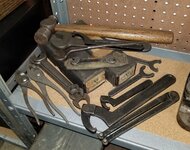
The original complete tool may very well have milled openings such as the US gun wrenches 3Bay found on eBay has, or perhaps even prongs for a retaining ring etc, but it almost certainly also has a deep "key" or offset screwdriver type blade, such as the OP's tool still has remaining. I'm not sure if you're saying you didn't read too much into it, Rog, or you are you telling me not to read too much into your comment, but if the latter, I wasn't. But I hope you can see how your statement not only seemed to be missing or ignoring the salience of the explicit identification of it as a spanner for a HYDraulic BUFFer with model No. 146 for a 4.5inch Howitzer in a period-correct British military technical manual on that artillery piece, but suggesting it was a spanner for some other part of the gun. I was just clarifying.I guess I just assumed it was a multi tool for a howitzer. Don’t read too much into it.
I guess I was also assuming the suspected missing part was an open end or box end wrench, considering your literature calls it a spanner.
Well, in France and America, too!...what we call "wrench" is a "Key" in eastern European countries and Russia, and I've seen a bit of "spill-over" on that one;

Yes I meant don’t read too much into my comment, I was assuming you nailed it.The original complete tool may very well have milled openings such as the US gun wrenches 3Bay found on eBay has, or perhaps even prongs for a retaining ring etc, but it almost certainly also has a deep "key" or offset screwdriver type blade, such as the OP's tool still has remaining. I'm not sure if you're saying you didn't read too much into it, Rog, or you are you telling me not to read too much into your comment, but if the latter, I wasn't. But I hope you can see how your statement not only seemed to be missing or ignoring the salience of the explicit identification of it as a spanner for a HYDraulic BUFFer with model No. 146 for a 4.5inch Howitzer in a period-correct British military technical manual on that artillery piece, but suggesting it was a spanner for some other part of the gun. I was just clarifying.
Funny and too true!The O.P. submitted an image of a tool meant to be used on the recoil suppression system of a British artillery piece, that some, likely WWII veteran fashioned into a paint can opener. Later thrown away, likely by a grandson; who like us, couldn’t figure out, what is was or how to use it.
Linky no workyView attachment 2386989
Is a possible current summation of the astute observation and research thus far:
The O.P. submitted an image of a tool meant to be used on the recoil suppression system of a British artillery piece, that some, likely WWII veteran fashioned into a paint can opener. Later thrown away, likely by a grandson; who like us, couldn’t figure out, what is was or how to use it. Aint ingenuity ingenious.
BTW: Found a labeled cross-sectional TM diagram of the hydraulic buffer on a British 15 pounder; but unless you have access to image enhancement; would spend much time googling/looking for it
Works here on my phoneLinky no worky
Working now. Looks like most of the tools I came across while searching.Works here on my phone
?? None of those would be as specifically relevant, though.Another problem is there are so many iterations of the howitzer. Models, manufacturers, COO.
Not so many iterations if you approaching the task from the standpoint this is a tool used on the British hydraulic buffer #136; lot of really astute observation & research (may take some re-reading) to rely on, up-thread↑.Linky no worky
Another problem is there are so many iterations of the howitzer. Models, manufacturers, COO.
The number marked on the spanner and in the manual (No. 146, by the way) is the number of the tool, not the hydraulic buffer. But yes, we had the same idea in reply to Rog.Not so many iterations if you approaching the task from the standpoint this is a tool used on the British hydraulic buffer #136;
Dollars to donuts there's a specimen in some military museum somewhere.My point being that in the absence of a complete example or an illustration of a complete example of the tool, i
?? None of those would be as specifically relevant, though.
We know that our poor, whittled, once-trusty "Spanner, Hydraulic Buffer, No. 146" was issued to the QF 4.5-inch Howitzer made by Conventry Ordnance Works and the Ordnance Factory in Woolich, and that the gun...
"....equipped some batteries of the British Expeditionary Force in France in 1940. Ninety-six were lost, leaving 403 in worldwide service (only 82 outside UK) with the British Army, plus those held by Australia, Canada, New Zealand and South Africa."
Source: https://en.wikipedia.org/wiki/QF_4.5-inch_howitzer
My point being that in the absence of a complete example or an illustration of a complete example of the tool, if the OP or you or any one of the collective "we" wanted to derive its likely male and female shaped maintenance service forms, the hydraulic buffer we would need to examine for plugs, glands, rings, etc should by definition be for the QF 4.5-inch Howitzer.
It won't be me. I am satisfied with what we have.
Enjoy that relic, @Junk&Disorder !
Not so many iterations if you approaching the task from the standpoint this is a tool used on the British hydraulic buffer #136; lot of really astute observation & research (may take some re-reading) to rely on, up-thread↑.
I wasn’t going to find an image of the tool by being so specific, I was searching through hundreds of photos.The number marked on the spanner and in the manual (No. 146, by the way) is the number of the tool, not the hydraulic buffer. But yes, we had the same idea in reply to Rog.
I just fired off an email to the Royal Artillery Museum in Salisbury.^ I've already notified several WWII collecting colleagues in the UK.
An approach in which you are likely to run into "many iterations, models, manufacturers, COOs" etc.I wasn’t going to find an image of the tool by being so specific, I was searching through hundreds of photos.
However, due to the evolution of human industrial technical capacity to standardize, you might run into a version with a different number for a different gun that isn't so different, having to perform similar services on similar apparatuses. That's at play in the US Naval gun wrenches looking similar. Which is part of why I say I am satisfied. If my blokes across the pond come up with one, it'll be icing on the cake, but I'm pretty happy we got this one. I'm more of a documentation guy anyway. Seeing that nomenclature in a manual three days after we had nothing but a question mark gives me a buzz.But but but, I want you to find a video of a guy with a British accent adjusting a recoil buffer with the exact tool.lolAn approach in which you are likely to run into "many iterations, models, manufacturers, COOs" etc.
It is but a flesh wound.lol^ maybe somebody at the Royal Artillery Museum can fix us up with a video!
( I am envisioning Rowan Atkinson playing the lead, doing the adjusting, with John Cleese standing by as his assistant.)