To avoid these ads, REGISTER NOW!

Need Help Wiring Air compressor motor and Starter

jcobra99

Active member
Joined
Apr 30, 2015
Messages
28
So im almost done building my air compressor. All i have left it to wire up the motor, starter, and pressure switch. The motor is a 7.5HP baldor than pulls 32 amps and the Starter is a Sqaure D.


So i believe i run wire to the starter then to the pressure switch and from there to the motor correct?
Im running a 50 amp breaker. I hear i need 8 gauge wire to be safe so ill go with that. The motor has 4 wires to wire up. (2) 10guage wires and (2) 14 gauge wires. The 14 gauge wires are Red and black. I assume the 10 gauge wires or hot wires. What are the 14 guage wires for?

Also where do i connect the wire from the break in the starter? I see four connections. Two on the bottom and two up top?
 

Attachments

  • 20160104_101221.jpg
    20160104_101221.jpg
    53.4 KB · Views: 82
  • 20160104_101317.jpg
    20160104_101317.jpg
    66.4 KB · Views: 98
To avoid these ads, REGISTER NOW!

FTG-05

Well-known member
Joined
Oct 11, 2012
Messages
1,541
Location
TN
Size main power wires per NEC not motor label and/or FLA; someone will be along shortly to give NEC chapter and verse.

I'm using 6 ga wires and a 60 amp CB for my compressor.
 

pattenp

Well-known member
Joined
Jun 4, 2008
Messages
10,175
Location
Virginia - USA
50A circuit needs #8 THHN or #6 NM-b. You didn't say which type of wire you plan to use.

7.5HP is 40A so 50A circuit is needed as a minimum.
 

Wistrick

Member
Joined
Jul 19, 2015
Messages
21
So im almost done building my air compressor. All i have left it to wire up the motor, starter, and pressure switch. The motor is a 7.5HP baldor than pulls 32 amps and the Starter is a Sqaure D.


So i believe i run wire to the starter then to the pressure switch and from there to the motor correct?
Im running a 50 amp breaker. I hear i need 8 gauge wire to be safe so ill go with that. The motor has 4 wires to wire up. (2) 10guage wires and (2) 14 gauge wires. The 14 gauge wires are Red and black. I assume the 10 gauge wires or hot wires. What are the 14 guage wires for?

Also where do i connect the wire from the break in the starter? I see four connections. Two on the bottom and two up top?

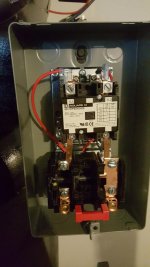
1. Power from the Circuit Breaker to the big screws on top of the starter....
2. Bottom of starter to larger leads on motor....
3. Pressure switch to the starter coil....(it looks like the 2 smaller screws on top of the starter..)
4. I am guessing the 2 smaller wires are for a heater....(there should be a diagram on the motor cover or an the motor itself to tell you...)

you probably also have NO and NC and which on you use is depending on how the pressure switch works....

hope this helps

Dan
 
OP
J

jcobra99

Active member
Joined
Apr 30, 2015
Messages
28
#8 THHN with a 50amp breaker. Do does the motor not have a ground wire? What are the heater wires and what do i do with them?
 

matt_i

Well-known member
Joined
Mar 14, 2008
Messages
10,730
Location
SE Michigan
Are you missing a heating element or a bus bar? The pole on the left is visually different from the one on the right. In a 3-phase setup all of the heaters are identical-looking.

Also, what is your coil voltage? Cannot see from here. That's important as the coil-and-press-switch circuit needs power as well to function.
 

matt_i

Well-known member
Joined
Mar 14, 2008
Messages
10,730
Location
SE Michigan
Edit: self-confused. Only 1 heater required in single-phase.

Here is something to argue about. It is how I'd wire it, with the very important assumption you are using a 220vac-coil motor starter. Anything you want to put in, to inhibit the motor, like a maintained stop-start button, would go in series with the normally closed contacts in the first rung -]/[-. Apologies for a photo of a hand drawing, it probably needs some cropping.

 
Last edited:

StevenMorgan

Well-known member
Joined
Oct 20, 2011
Messages
137
Location
Paris, KY
Take a look at this thread I started awhile back that summarizes a lot of good wiring practices. I need to update it with my final wiring setup, but I need some time to type it up accurately.

http://www.garagejournal.com/forum/showthread.php?t=309088

A glance at your motor starter says you are missing your heater element for the left side. Mine didn't come with one either. You'll need to use the chart on the motor starter cover to get the right part number.

Your power feed wires come in and connect to L1 and L2 at the top, and at the bottom they go out to the motor.

The thin little red wires that come pre-installed are for one half of the control circuit that goes to the heater. Don't mess with them.

You'll use your pressure switch to make up the other half of that circuit and function as the control circuit to determine when the motor is running or not... Long story short, the red side that is pre-wired is hot. The wiring you add as a mirror image of this circuit is the control half. The red pre-wired circuit taps off one hot leg 120v and goes through the heater and then to the spade connection below L1 and completely separate from it.

You can also install an on/off switch inline with the pressure switch for more control if your pressure switch doesn't have the on/off/auto type lever on it.
 

manwithtools

ALLIANCE MEMBER
Joined
Aug 24, 2015
Messages
13,976
Location
Lebanon, TN
Hire an electrician, preferably one with controls experience. You are asking way to many questions to give good answers too. It's too easy to make a mess in this instance. I admire you for your inclination to DIY.

Reading your question and the answers leaves me worried that you may misinterpret something.
 

Wistrick

Member
Joined
Jul 19, 2015
Messages
21
Hire an electrician, preferably one with controls experience. You are asking way to many questions to give good answers too. It's too easy to make a mess in this instance. I admire you for your inclination to DIY.

Reading your question and the answers leaves me worried that you may misinterpret something.

Have to agree....
 

Cyberbear

Well-known member
Joined
Nov 23, 2013
Messages
1,524
Location
California
Wiring such as yours is basic stuff for those who have the experience, but diagrams are available on line for reference. I spent over 12 years building motor control panels as a member of the I.B.E.W. while working for a commercial/industrial electrical contractor in So. Calif. We always put in a start/stop station for better safety and component durability. I found that factory supplied pressure switches fail sooner than any other part of the system. I wish I could easily describe what to do but its available on the Net. If you have everything mounted and ready to wire, it shouldn't take an electrician more than an hour to properly hook everything up.
 
OP
J

jcobra99

Active member
Joined
Apr 30, 2015
Messages
28
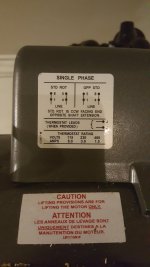
Ok i think i have it figured it out. Run the wire from the breaker to the lower screws on the starter and the upper screws go to the Motor. Ya i was missing the heaters i installed it. I attached a picture of my pressure switch i believe i just run the wires from the starter to the first set of connections closet to me and then the Furthest set of connections go to the motor? And those screws in the pressure switch that just go to metal are grounds correct? Only thing im confused about is the wiring diagram on the motor i attached a picture. Obviously, the 2 larger 10 gauge wires are Hot are the smaller ones grounds? Thanks again every one for your help! I cant wait to finish this compressor.
 

Attachments

  • 20160104_232922.jpg
    20160104_232922.jpg
    135.8 KB · Views: 34
  • 20160104_231334.jpg
    20160104_231334.jpg
    147.1 KB · Views: 37

matt_i

Well-known member
Joined
Mar 14, 2008
Messages
10,730
Location
SE Michigan
Only thing im confused about is the wiring diagram on the motor i attached a picture. Obviously, the 2 larger 10 gauge wires are Hot are the smaller ones grounds?.

I'm a little worried. The larger wires are likely for the motor windings and the smaller ones to a start capacitor which induces the correct (or opposite) rotation. As such, wire them just like the name plate with the appropriate numbered connectors tied together. They are all hot wires in a 240vac single phase circuit, with opposite poles. The only ground is a chassis ground which is more or less the metal case of the thing (plus other points daisy chained) which you tie back to the ground bar in the distribution panel. Make sure you know what you are doing. This is not a 120vac system with a neutral.
 

mattblast

Well-known member
Joined
Jan 30, 2013
Messages
786
Location
Bridgewater, NJ
The motor can be wired two different ways depending on if you want it to rotate CW or CCW. For standard rotation (CCW) wire one leg of the 230v input to the wires labeled 1 and 8. All 3 wires under one wire nut. The other leg connects to the wires labeled 4 and 5. Swap 5 and 8 to reverse rotation direction.

Take another look at diagram on motor and it should be clear. Most motors show a similar style wiring diagram.

I recommend you hook motor up directly to the power line bypassing the starter so you can test it. This way you can confirm wiring is right before you connect to starter.

4743a1f70e1c0871b53bdfec726f2d52.jpg

Take your time and be careful.
 
OP
J

jcobra99

Active member
Joined
Apr 30, 2015
Messages
28
I'm a little worried. The larger wires are likely for the motor windings and the smaller ones to a start capacitor which induces the correct (or opposite) rotation. As such, wire them just like the name plate with the appropriate numbered connectors tied together. They are all hot wires in a 240vac single phase circuit, with opposite poles. The only ground is a chassis ground which is more or less the metal case of the thing (plus other points daisy chained) which you tie back to the ground bar in the distribution panel. Make sure you know what you are doing. This is not a 120vac system with a neutral.


Ok gotcha. So connect wire 8 and 1 together and run on of the lines from the starter to those and do the same for wires 4 and 5? I think im reading the diagram correct now. Do i need to run a ground from the breaker box to the pressure switch?
 
Last edited:

mattblast

Well-known member
Joined
Jan 30, 2013
Messages
786
Location
Bridgewater, NJ
Ok gotcha. So connect wire 8 and 1 together and run on of the lines from the starter to those and do the same for wires 4 and 5? I think im reading the diagram correct now. Do i need to run a ground from the breaker box to the pressure switch?


Yes - that is how motor gets connected. Green screw behind wires is for ground wire from starter. Don't forget to ground motor (ground wire from motor to starter tied into ground from supply)

On my compressor I didn't run ground to pressure switch.
 
To avoid these ads, REGISTER NOW!
OP
J

jcobra99

Active member
Joined
Apr 30, 2015
Messages
28
Yes - that is how motor gets connected. Green screw behind wires is for ground wire from starter. Don't forget to ground motor (ground wire from motor to starter tied into ground from supply)

On my compressor I didn't run ground to pressure switch.

Cool. Does the starter have to be grounded? Or can i just run a ground to my pressure switch and run a wire from there to the green ground screw on the motor because i dont see where to ground in the starter assembly. Also, i dont have to run an 8 gauge ground from the breaker box correct. Should 10 Gauge be adequate?
 

mattblast

Well-known member
Joined
Jan 30, 2013
Messages
786
Location
Bridgewater, NJ
The starter needs to be grounded to the metal enclosure. There should be threaded holes in back to connect a ground screw (10-32 thread).

Wire gauge to use from panel is based on breaker size and distance. Under sized wire is unsafe and will not carry or deliver full current to motor. This will cause over heating.

10 gauge wire is not sufficient to feed a motor that draws 32a. See chart here

http://www.cerrowire.com/ampacity-charts
 
Last edited:

md21722

Well-known member
Joined
Nov 30, 2015
Messages
1,840
Location
Mt Juliet, TN
By code, 7.5HP 230V single phase motor requires wire capable of 50A (40A FLC x 1.25). That's typically 6 gauge wire. I do not recommend 10 ga for this motor. Because motors have high startup current the wire needs to be sized differently than say an electric dryer.
 
Last edited:

52wrench

Well-known member
Joined
Dec 20, 2015
Messages
69
Location
western NYS, land of taxes
"Ok i think i have it figured it out. Run the wire from the breaker to the lower screws on the starter and the upper screws go to the Motor."

Hire an electrician! You don't know what you are doing! You are asking very basic questions. Ask the electrician to explain what he's doing and you'll learn. This is not something that you want to learn by trial and error.
 

Norcal

Well-known member
Joined
Mar 16, 2008
Messages
13,764
By code, 7.5HP 230V single phase motor requires wire capable of 50A (40A FLC x 1.25). That's typically 6 gauge wire. I do not recommend 10 ga for this motor. Because motors have high startup current the wire needs to be sized differently than say an electric dryer.

Your wire size is correct if using NM cable "Romex®", 8 AWG THHN copper is rated for 50A.
 

pattenp

Well-known member
Joined
Jun 4, 2008
Messages
10,175
Location
Virginia - USA
By code, 7.5HP 230V single phase motor requires wire capable of 50A (40A FLC x 1.25). That's typically 6 gauge wire. I do not recommend 10 ga for this motor. Because motors have high startup current the wire needs to be sized differently than say an electric dryer.

I wouldn't say #6 is typical for 50A in this case. #6 if using NM-b (Romex) wire. #8 THHN in pipe is fine for 50A.

Wire size is not adjusted for startup current. Wire is sized by HP as to FLA per the NEC then adjusted 125% for being considered a continuous load. The breaker size is increased to handle startup current causing tripping. You could put a 100A breaker on the 50A wire if needed. This pertains to hardwired motor circuits. See NEC 430.52
 

Wistrick

Member
Joined
Jul 19, 2015
Messages
21
wire from the breaker to top of starter, and the bottom goes to the motor....Line is always on top........Hire an electrician !!!!!

Dan

IBEW 441
 

matt_i

Well-known member
Joined
Mar 14, 2008
Messages
10,730
Location
SE Michigan
You could put a 100A breaker on the 50A wire if needed. This pertains to hardwired motor circuits. See NEC 430.52

I don't care what the NEC says I would not do that. In my opinion, the circuit breaker needs to protect the downstream conductor. If there are inrush issues, upsize both.
 

Wistrick

Member
Joined
Jul 19, 2015
Messages
21
Ok i think i have it figured it out. Run the wire from the breaker to the lower screws on the starter and the upper screws go to the Motor. Ya i was missing the heaters i installed it. I attached a picture of my pressure switch i believe i just run the wires from the starter to the first set of connections closet to me and then the Furthest set of connections go to the motor? And those screws in the pressure switch that just go to metal are grounds correct? Only thing im confused about is the wiring diagram on the motor i attached a picture. Obviously, the 2 larger 10 gauge wires are Hot are the smaller ones grounds? Thanks again every one for your help! I cant wait to finish this compressor.


no no no the pressure switch wires to the coil on the motor starter....If you wire it this way the coil on the starter will never engage....Please do yourself a favor call an electrician...

Dan
 

md21722

Well-known member
Joined
Nov 30, 2015
Messages
1,840
Location
Mt Juliet, TN
I wouldn't say #6 is typical for 50A in this case. #6 if using NM-b (Romex) wire. #8 THHN in pipe is fine for 50A.

Wire size is not adjusted for startup current. Wire is sized by HP as to FLA per the NEC then adjusted 125% for being considered a continuous load. The breaker size is increased to handle startup current causing tripping. You could put a 100A breaker on the 50A wire if needed. This pertains to hardwired motor circuits. See NEC 430.52

I am not sure I agree completely. Does the NEC have specific tables for electric dryers, ovens, and baseboard heaters that indicate higher ratings should be used than nameplate like they do for motors? One would think they can simply go 125% of the nameplate rating of the motor for continuous load which in this case would be 32A x 125% = 40A but the code tells you to wire for 50A.

I'd also say that in industrial settings conduit and THHN is used, but for residential use folks are more likely to use Romex / NM wire so typical really depends on where its being installed...
 
Last edited:

pattenp

Well-known member
Joined
Jun 4, 2008
Messages
10,175
Location
Virginia - USA
I don't care what the NEC says I would not do that. In my opinion, the circuit breaker needs to protect the downstream conductor. If there are inrush issues, upsize both.

In the case with motor circuits the breaker is for short circuit protection. The motor should have overload protection. So what you are saying is just not needed for hardwired motor circuits. If you put an outlet on the circuit for plug and cord connection the the breaker needs to be sized no larger than the ampcapacity of the wire/outlet. There is no problem not caring what the NEC says as long as what you do goes beyond the NEC requirements.
 

Cyberbear

Well-known member
Joined
Nov 23, 2013
Messages
1,524
Location
California
I agree with 52wrench, just call out an electrician who knows motor control, otherwise you may regret trying to wire it yourself. People are always getting the terminology confused and don't know what they are talking about.
 

pattenp

Well-known member
Joined
Jun 4, 2008
Messages
10,175
Location
Virginia - USA
I am not sure I agree completely. Does the NEC have specific tables for electric dryers, ovens, and baseboard heaters that indicate higher ratings should be used than nameplate like they do for motors? One would think they can simply go 125% of the nameplate rating of the motor for continuous load which in this case would be 32A x 125% = 40A but the code tells you to wire for 50A.

I'd also say that in industrial settings conduit and THHN is used, but for residential use folks are more likely to use Romex / NM wire so typical really depends on where its being installed...

Nope, only motors are spelled out by HP as to what amperage to use.
 
OP
J

jcobra99

Active member
Joined
Apr 30, 2015
Messages
28
I got it all figured out and wired up. Fired right up! Thanks everyone for all of your input and assistance. No electrician was needed!
 
To avoid these ads, REGISTER NOW!
Top Bottom