To avoid these ads, REGISTER NOW!

Need help with concrete anchors

kwm322

Active member
Joined
Jul 19, 2016
Messages
25
Hi my name is Kyle. I'm a heavy duty diesel mechanic for the transit agency here in Whatcom county, WA state. I just had a 36x36 shop built at my place and I went ahead and put a Bend Pak XPR 10A in it. The middle bay of my shop has 8 inch thick 6 sack concrete. Anyway I set the whole thing up and after using it a few times I decided I wanted to adjust the right post a little bit. I took the anchors loose and when I went to tighten them back down they started pulling out. I got 4 out of 6 to actually make the wrench click but they're farther out of the concrete than I would like. 2 of them actually pulled out. The concrete actually cracked out from one of the holes as you can see in the picture. My poor brand new floor :(. Anyway, I have 2 questions. I think the empty holes are going to get longer anchors with epoxy, I should of went and got longer anchors instead I used 3/4 x 5 1/2 red heads. The lift came with 5 inch anchors no name on them. The other 4 holes have maybe 3.5 inches of anchor in them. Is this enough? Should I keep tightening the nut and pull them out all the way and do the same for them? Thanks for the advice in advance. Here's some pictures.


Last edited:
To avoid these ads, REGISTER NOW!

DougWil

Well-known member
Joined
Dec 29, 2015
Messages
545
Location
NW Montana
Looks like your concrete was a bit soupy and had lots of bleed water. That is why it spalled out so far from the holes.

Anyway, I can't tell by the pics but some of those anchors can be disengaged by loosing the nut when they bind and tapping down on the stud. That hopefully keeps you from fragging out more concrete trying to remove them.

I would epoxy them all in 7" into the slab.
You must blow out with compressed air with a long nozzle in the holes, then brush with a bristle brush (something like a 20 gauge shotgun brush, and keep repeating till you get no more dust coming out of the holes.

Use Simpson epoxy or similar, wait a couple of days before tightening the nuts.
 
OP
K

kwm322

Active member
Joined
Jul 19, 2016
Messages
25
Looks like your concrete was a bit soupy and had lots of bleed water. That is why it spalled out so far from the holes.

Anyway, I can't tell by the pics but some of those anchors can be disengaged by loosing the nut when they bind and tapping down on the stud. That hopefully keeps you from fragging out more concrete trying to remove them.

I would epoxy them all in 7" into the slab.
You must blow out with compressed air with a long nozzle in the holes, then brush with a bristle brush (something like a 20 gauge shotgun brush, and keep repeating till you get no more dust coming out of the holes.

Use Simpson epoxy or similar, wait a couple of days before tightening the nuts.

Thank you! Your the 3rd person to suggest that to me. The slab was poured probably 6 weeks ago. Maybe I should of waited a little longer. They are red head anchors.
 

DougWil

Well-known member
Joined
Dec 29, 2015
Messages
545
Location
NW Montana
If kept damp or a curing agent was used, it should be up to specified strength in 28 days.

If neither was done, it probably isn't near full strength at 6 weeks and you should be hosing it down daily because it needs water to cure.
 

DougWil

Well-known member
Joined
Dec 29, 2015
Messages
545
Location
NW Montana
You are not alone. Most think that concrete drys like paint.
It doesn't, it cures and hardens in a chemical process that requires water.
No water the process stops. The good thing is it can be restarted even years later just by soaking it down, and keeping it damp.

It can also use humidity from the air or ground moisture to continue curing if present.
 

michaelf

Well-known member
Joined
May 2, 2014
Messages
112
Location
SE MI
having installed hundreds of anchors of all sizes at work, we use Hilti bolts they are different than the bolts you show, if you check them out you will see that their is a collar that your bolts do not have. If I had to repair your lift I would re drill the hole for the next larger anchor even if I had to re drill the holes in the lift. If you have for example a 6in bolt drill a 7in deep hole blow the hole out so it is clean, put a nut on the bolt along with a washer and drive into the hole till it bottoms against the lift plate. If the holes are drilled correctly like not wobble the bit the bolt should torque quickly and all bolts should be the same height above the plate, we strive for 2-3 threads above the nut, not hard to do.
 

MagKarl

Well-known member
Joined
Oct 15, 2012
Messages
684
Location
Olympia, WA
I've seen epoxy and hole cleaning brushes at Home Depot in the Simpson bracket section. I'd probably start there if I were in your shoes.
 

pcmeiners

Well-known member
Joined
Aug 13, 2009
Messages
7,901
Location
In the only town in Pennsylvania, Bloomsburg.
Below is a recommended minimum embedment for different anchor sizes. I have to disagree with most recommended depths ( and these) posted on the Internet as they are generally for perfect situations.... high strength concrete, poured/cured correctly; even so the depth are to shallow, very few reasons to use minimum depths. I go along with the couple posters recommending 7" (or more). Years ago I set hundreds of steel beams, we anchored 7, 10, even 14" into 4000 psi crete

Sleeve diameter minimum Embedment
1/4” 1-1/8”
5/16” 1-7/16”
3/8” 1-1/2”
1/2” 2-1/4”
5/8” 2-3/4”
3/4” 3-3/8”
 
Last edited:
OP
K

kwm322

Active member
Joined
Jul 19, 2016
Messages
25
I think my plan right now is to use hilti bolts and epoxy them in. I'm hoping I can pull the other 4 out by tightening the nut like I did on the 2. I measured and I drilled my holes about 6.5-7 inches deep. The anchors left in probably are right around that minimum depth. 3.5 to 3 inches by my estimation. The other post did not have this issue, I drilled the holes, cleaned them out, and hammered them in and they torqued down solid with about 2 or 3 threads showing. I wish I would of gotten longer anchors but that's what bend Pak sent with the lift so I figured they were fine. I thought about drilling the holes to the next size up too. Still might do that. I won't have time to handle this till this weekend. Thanks for the help guys.
 
OP
K

kwm322

Active member
Joined
Jul 19, 2016
Messages
25
You are not alone. Most think that concrete drys like paint.
It doesn't, it cures and hardens in a chemical process that requires water.
No water the process stops. The good thing is it can be restarted even years later just by soaking it down, and keeping it damp.

It can also use humidity from the air or ground moisture to continue curing if present.

I'm in northwest Washington state, it's been very humid here this summer.
 

Kevin54

MEMBER EMERITUS
Joined
Jan 12, 2005
Messages
29,341
Location
Urbana, Ohio
You are not alone. Most think that concrete drys like paint.
It doesn't, it cures and hardens in a chemical process that requires water.
No water the process stops.
The good thing is it can be restarted even years later just by soaking it down, and keeping it damp.

It can also use humidity from the air or ground moisture to continue curing if present.

That's the first I have ever heard of that. Where do you have proof that is the way concrete cures? The reason for keeping concrete moist is to prevent it from drying out too fast. Concrete takes approximately 28 days to cure fully. You keep it wet to keep it from drying out too fast. Stopping the water on it does not stop the curing process. And applying water years later to restart it is just pure ********.
 

Ign

Well-known member
Joined
Jul 7, 2006
Messages
12,769
Location
Butte Peak ND
FWIW I used the anchors BP provided w my XPR-10XC. I cut the wings off and grooved the circumference w a cutting wheel in an angle grinder. I used Hilti epoxy which claims it's good within? 15 or 20 minutes was it?

I understand at this point this doesn't help the OP but I'm not sure the provided anchors themselves are to blame, just the physics of the anchoring force. Honestly seems to me if you're using a good epoxy nothing more than a graded bolt is required (or graded all-thread if you can find it), just cut the head off so it drops in the hole. The epoxy will grab the threads and there ya go.
 

DougWil

Well-known member
Joined
Dec 29, 2015
Messages
545
Location
NW Montana
That's the first I have ever heard of that. Where do you have proof that is the way concrete cures? The reason for keeping concrete moist is to prevent it from drying out too fast. Concrete takes approximately 28 days to cure fully. You keep it wet to keep it from drying out too fast. Stopping the water on it does not stop the curing process. And applying water years later to restart it is just pure ********.

Well rather than waiting to hear about it, why don't you read about it?

from the National Ready Mixed Association
http://www.nrmca.org/aboutconcrete/cips/11p.pdf

or the National Precast Concrete Association...
Curing is much more than simple hardening due to water and cementitious ingredients undergoing a chemical reaction. Fully cured concrete results from hydration between water and cement (see Figure 1).concrete permeability

During hydration, calcium silicate hydrate (CSH) gel forms and makes the “glue” that enables concrete to harden. CSH binds all of the concrete ingredients together, greatly increasing its strength, watertightness and service life. No glue: no concrete.

Concrete cures to maturity over time, but the rate of curing depends on the mix design and the curing environment (hot, cold, windy, rainy). When we think of curing, we usually think of making sure we keep moisture on the concrete’s surface. But a wet surface isn’t enough. For full design strength and all the service it delivers, concrete must be adequately cured at its surface and deep within its matrix.

http://precast.org/2011/07/to-cure-or-not-to-cure/

or how about Penn State University
Portland cement consists of several complex chemical compounds (see composition of cement). In the preparation of concrete, the cement acts as a glue which bonds together the aggregates to achieve the final castproduct. The concrete achieves its strength through a series of chemical reactions, known as hydration, which are initiated by the addition of water to the mixture. The rate of the reactions influences the properties of the hardened concrete such as strength, permeability, durability, abrasion resistance and resistance to freezing and thawing. As long as water is present, the hydration will continue for many years. The final strength of the concrete formed in the process will depend on the constituents in the original mixture, and the environment under which the reactions take place.
http://www.engr.psu.edu/ce/courses/ce584/concrete/library/construction/curing/curing.html

And yes the hydration process can be restarted BUT you will never have the strength or durability that was obtainable had it been cured properly to begin with.
 
Last edited:
OP
K

kwm322

Active member
Joined
Jul 19, 2016
Messages
25
FWIW I used the anchors BP provided w my XPR-10XC. I cut the wings off and grooved the circumference w a cutting wheel in an angle grinder. I used Hilti epoxy which claims it's good within? 15 or 20 minutes was it?

I understand at this point this doesn't help the OP but I'm not sure the provided anchors themselves are to blame, just the physics of the anchoring force. Honestly seems to me if you're using a good epoxy nothing more than a graded bolt is required (or graded all-thread if you can find it), just cut the head off so it drops in the hole. The epoxy will grab the threads and there ya go.

The other post worked just fine with the bend Pak anchors. I tried pulling another one out when I got home from work and it came out of the hole nice and easy. I measured the depth and it's about 6.5 inches deep too. So when i get time this weekend I'm gonna clean the holes out, epoxy and put longer anchors in and we should be all set. Then I gotta fix where it fragged out next to the name plate in the first picture. I'm a little concerned it may have done it under the post itself but I don't think it did with the base backing it up when the anchor cae out.
 

wssix99

Well-known member
Joined
Mar 2, 2011
Messages
5,160
Location
Chicago, IL
I got 4 out of 6 to actually make the wrench click but they're farther out of the concrete than I would like.

What are you torquing to?

The concrete actually cracked out from one of the holes as you can see in the picture.

This crack could be due to being so close to the saw cut joint i the floor.

I think the empty holes are going to get longer anchors with epoxy, I should of went and got longer anchors instead I used 3/4 x 5 1/2 red heads. The lift came with 5 inch anchors no name on them.

The instructions point out that the fasteners that come with the lift meet certain specs. Many epoxy fasteners will not. Some epoxy creeps and may not be safe to use in a tension application like this. The lift manufacturer should be able to tell you exactly what you should use.

The other 4 holes have maybe 3.5 inches of anchor in them. Is this enough? Should I keep tightening the nut and pull them out all the way and do the same for them?

The instructions say to drill 4" holes and then turn the nut 3-5 turns. So, I'd subtract the length of 5 threads from 4" and that should be what they are looking for. However, the deeper you go, generally the stronger things will be.

The slab was poured probably 6 weeks ago. Maybe I should of waited a little longer.

A lot of this is in the instructions. They say you only need to wait 4. (The concrete has most of its strength by then.) Many things can cause spalling, so it may not be related to the cure of the concrete.
 
OP
K

kwm322

Active member
Joined
Jul 19, 2016
Messages
25
I torqued them to 95 ft lbs. 3 to 5 turns is a pretty drastic difference in torque. So I went off a package of red heads I had that were similar. That was probably a mistake. But I don't think it's the cause of my problem since they did torque down the first time. Can't you use an epoxy and an anchor in the same hole? That's what I was thinking of doing.
 

DougWil

Well-known member
Joined
Dec 29, 2015
Messages
545
Location
NW Montana
I torqued them to 95 ft lbs. 3 to 5 turns is a pretty drastic difference in torque. So I went off a package of red heads I had that were similar. That was probably a mistake. But I don't think it's the cause of my problem since they did torque down the first time. Can't you use an epoxy and an anchor in the same hole? That's what I was thinking of doing.

I wouldn't, epoxy adheres to the serrated thread surface of a threaded rod.
Whereas you anchor is smooth where the epoxy would be attempting to bond.
 
OP
K

kwm322

Active member
Joined
Jul 19, 2016
Messages
25
But if the holes partially
Filled with epoxy, and you put the anchor in. Wouldn't the epoxy ooze up over the top
Of the anchor and once it's torqued the anchor sets then the epoxy sets helping holdit in place?
 
To avoid these ads, REGISTER NOW!

Z2V

Well-known member
Joined
Jul 19, 2016
Messages
418
Location
Cedar Park (Austin) Texas
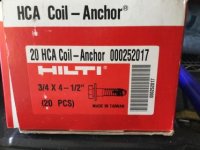
image.jpgI used these anchors from Hilti to set my twin post. They have a coil on the end of the bolt that expands in the hole to set it. I used a 1" drive breaker bar over 2' long to set these while I set on floor with my feet against the lift, like rowing a boat so to speak. They held all my 220lb *** could put on them. They have been in over 5 yrs, no problem with them working loose. The nice thing is if I want to remove the lift I don't have to get the tower off of the bolts.
Just another option for you.
 
Last edited:
OP
K

kwm322

Active member
Joined
Jul 19, 2016
Messages
25
I wouldn't, epoxy adheres to the serrated thread surface of a threaded rod.
Whereas you anchor is smooth where the epoxy would be attempting to bond.

You were right, thanks for your advice. I just got home from Fastenal and the gentleman there said using epoxy on anchors actually lessens the affect of both and I should just use threaded rod. So that's what I'm doing, if the other side comes out I'll pull them out and do the same over there. Thanks again.
 

trinaussie

Member
Joined
Dec 7, 2011
Messages
5
You are not alone. Most think that concrete drys like paint.
It doesn't, it cures and hardens in a chemical process that requires water.
No water the process stops. The good thing is it can be restarted even years later just by soaking it down, and keeping it damp.

It can also use humidity from the air or ground moisture to continue curing if present.

Doug,
Sorry even with your later quotations from the concrete societies/university you are wrong or at least not understanding what they are saying.

I have explained this in other posts and will keep doing so because there is a lot of misinformation on the concrete process.

The strength of concrete is purely dependent on the water cement ratio in the mix design. The more cement the higher the strength of the concrete as long as there is enough water present in the mix to ensure the hydration reaction takes place. Adding extra water at the site (a common occurrence) before it is poured will lower the concrete strength because you are altering the W/C ratio.

Concrete should not be poured in very hot weather or very cold weather because again the W/C ratio is altered either by water in the mix design evaporating (hot) or freezing (cold).

Even if concrete is poured on a cool day when neither evaporation or freezing occur, once the concrete is poured and has set- up it is a very good idea (essential in fact) to keep the surface moist. This is sometimes done by hosing down and more usually by placing wet burlap on the surface. The reason for this is that the concrete curing (hydration) reaction is exothermic (gives out heat), and even the heat from this can cause water loss. Also the heat can cause surface cracking due to shrinkage .

Extra water on the concrete from either of the above curing methods will not affect the concrete strength due to the extra water, it is the effect of the water/wet burlap that ensures that the original design W/C ratio is maintained so that you get the strength of concrete that you ordered.

In the commercial/construction world, we make the concrete company take samples (cylinders) and we have them tested to verify the strength. We also closely watch what is added to the concrete by the driver/operator. If they mess with the W/C ratio it gets sent back. If the test results are not up to design strength at 28 days the concrete company gets the bill for breaking it out and supplying new concrete.

Hope this helps.

Trinaussie P.E.
 

lakeroadster

Well-known member
Joined
Jan 19, 2015
Messages
5,166
Location
Central Colorado
Nice summary Trinaussie, thanks for taking the time to help us understand the process.

As a side note: The company that we got the concrete from for my barn did the concrete cylinders and the testing for free. I am betting others could get this done also, just by talking to them about it.
 

wssix99

Well-known member
Joined
Mar 2, 2011
Messages
5,160
Location
Chicago, IL
I torqued them to 95 ft lbs. 3 to 5 turns is a pretty drastic difference in torque. So I went off a package of red heads I had that were similar. That was probably a mistake. But I don't think it's the cause of my problem since they did torque down the first time.

You have the answer to the epoxy question, above. Your instructions also spec 90 ft lbs. on the bolt torque, so 95 shouldn't be the source of any of your problems.

I would suggest taking a detailed pass through the lift instructions, though. The answers to a lot of your questions are right in there - some in big warning boxes. :shocking:

I would also follow up with the manufacturer on whatever hardware/epoxy you want to use. The lift and the concrete pad make a more complex unit/mechanical device than you'd think and talking to the manufacturer will get you free engineering and expertise that aligns to the industry lift standards and your warranty. (My suggestions on what hardware you should use would do none of that and could even get you killed if I'm not careful about all the complicated details.)


Nice summary Trinaussie, thanks for taking the time to help us understand the process.

+1. It's complicated.... Lot's of reasons to follow best practices.
 
OP
K

kwm322

Active member
Joined
Jul 19, 2016
Messages
25
You have the answer to the epoxy question, above. Your instructions also spec 90 ft lbs. on the bolt torque, so 95 shouldn't be the source of any of your problems.

I would suggest taking a detailed pass through the lift instructions, though. The answers to a lot of your questions are right in there - some in big warning boxes. :shocking:

I would also follow up with the manufacturer on whatever hardware/epoxy you want to use. The lift and the concrete pad make a more complex unit/mechanical device than you'd think and talking to the manufacturer will get you free engineering and expertise that aligns to the industry lift standards and your warranty. (My suggestions on what hardware you should use would do none of that and could even get you killed if I'm not careful about all the complicated details.)


+1. It's complicated.... Lot's of reasons to follow best practices.

I will call them but so far their tech support has been poor for me. The instructions also are sort of vauge. They're ok. I'd give them a c minus. For example they don't even show how or where to hook up your hydraulic lines to the cylinders.
 

DougWil

Well-known member
Joined
Dec 29, 2015
Messages
545
Location
NW Montana
Epoxy or anything really has a hard time bonding to smooth surfaces. That is why you sandblast, or sand before painting to give the smooth surface some "tooth".

Or why rebar has raised ribs. To make it bond to the portland cement in the concrete mix better.
 

matt_i

Well-known member
Joined
Mar 14, 2008
Messages
10,726
Location
SE Michigan
I think your original cracking is due to drilling too close to the saw cuts. By sawing a slab with a control joint, you are begging for it to crack right there, all the way thru. So by drilling next to it there's already a weak spot. A wedge anchor completes the job because its sending out radial compresive forces into the concrete, from the center axis of the stud. Next to the saw cut its a recipe for breaking out a chunk.

I would not try to combine a mechanical wedge anchor and epoxy. Just use the epoxy and a B7 threaded rod (approximately Grade 5 fastener metallurgy) is what I'd do, making sure to clean the hole very well top to bottom with compressed air and a brush. Allow the epoxy to cure min 24hrs before tightening the nut.
 
Last edited:

pcmeiners

Well-known member
Joined
Aug 13, 2009
Messages
7,901
Location
In the only town in Pennsylvania, Bloomsburg.
" The good thing is it can be restarted even years later just by soaking it down, and keeping it damp."
Same here never heard of this.

To a degree you can restart the process but it is does not happen in all instances, does not provide concrete to original specs, does not alleviate issues caused by incomplete curing, at best it lessens poorly cured concrete issues to a small degree, and not always; basically it does not work and sounds like a line a NYC contractor would use to get out of breaking up a slab with issues

http://www.understanding-cement.com/concrete-curing.html

http://www.contractortalk.com/f4/keeping-concrete-wet-during-curing-76414/

http://www.concretedecor.net/decora...ith-concrete-countertops-understanding-water/
 
Last edited:
OP
K

kwm322

Active member
Joined
Jul 19, 2016
Messages
25
sorry haven't updated, havent had a chance to work on it. I got some time tonight and got the collars out of 4 of the holes. 3 of them came out quite easy so i drilled the holes all the way through. I ended up actually going back to fastenal and getting 8.5 long red heads and putting them in the 3 holes I was able to drill out, they tightened down no problems. One of them I hit rebar when I tried to drill through, probably 6 inches in. I don't think an anchor is going to set in that hole so I'm thinking I'm going to have to go get a 7/8 drill bit and mason bit and drill out the hole in the hoist and drill the hole in the concrete out to 7/8's and either put a 7/8's anchor in it or epoxy and all thread that hole.The directions on the epoxy tube say if your going to use a 3/4 inch rod to use a 1/8 inch larger hole. Unlike an anchor where you put the same size fastener in the same size hole so I haven't used the epoxy I bought yet, I was thinking about returning it if I could get away with using the long anchors. Anyways thats where I'm at. Going on vaca this weekend so wont have time to work on it for probably another week or so.
 
Last edited:

DougWil

Well-known member
Joined
Dec 29, 2015
Messages
545
Location
NW Montana
" The good thing is it can be restarted even years later just by soaking it down, and keeping it damp."
Same here never heard of this.

To a degree you can restart the process but it is does not happen in all instances, does not provide concrete to original specs, does not alleviate issues caused by incomplete curing, at best it lessens poorly cured concrete issues to a small degree, and not always; basically it does not work and sounds like a line a NYC contractor would use to get out of breaking up a slab with issues

1st off the word "can" doesn't mean always.

2nd I didn't phase my statement the best.

I should have said the weird thing is it can be restarted years later.

and

The good thing is that since your slab is only 6 weeks old (and probably still has water present and is still curing) adding water now can probably improve the final result.

Finally from one of the articles you linked...
When concrete dries out, hydration eventually stops. Adding water will restart hydration for the areas that have access to that added water. :thumbup:
Hey, I have heard that somewhere before! :lol:
 
Last edited:

59 wagon man

Well-known member
Joined
Oct 25, 2010
Messages
1,589
Location
hollywood fla
my first lift was a used 2 post and i helped the guy install it. he drilled completely throught the slab and no epoxy or anything but the anchor. his reasonng worked for me as had a 2 post for yrs and then upgraded to a 4 post and was very grateful to be able to hammer the old anchors thru the floor and seal the hole
 

sberry

Banned
Joined
Jun 18, 2005
Messages
35,747
Location
Brethren, Michigan
Some ******* match over nothing here and most of it is correct within certain parameters. Aint no amazement poorly mixed concrete isn't as good. Most my experience has been Hilti but if I had a stripped hole may use the gr 5 all thread and goo it in a clean hole.
 
OP
K

kwm322

Active member
Joined
Jul 19, 2016
Messages
25
I still have 2 holes to try a new anchor in. Does anyone think it would be alright if the other 2 holes are able to set anchors and I use a 5/8s rod and epoxy on that hole that won't take one instead of 3/4 rod?
 
OP
K

kwm322

Active member
Joined
Jul 19, 2016
Messages
25
my first lift was a used 2 post and i helped the guy install it. he drilled completely throught the slab and no epoxy or anything but the anchor. his reasonng worked for me as had a 2 post for yrs and then upgraded to a 4 post and was very grateful to be able to hammer the old anchors thru the floor and seal the hole

I never thought of that before and no one told
Me that. I really wish I had done that haha
 
OP
K

kwm322

Active member
Joined
Jul 19, 2016
Messages
25
Or does anyone have a bright idea to get through that rebar so I can drill deeper and put the longer anchor in
 

matt_i

Well-known member
Joined
Mar 14, 2008
Messages
10,726
Location
SE Michigan
Google "rebar cutting drill bit" and find many choices for SDS shank rotary hammers. Although not cheap.
 

wssix99

Well-known member
Joined
Mar 2, 2011
Messages
5,160
Location
Chicago, IL
You don't need that. ^ As long as you have a good hammer drill and a reinforced concrete bit, you'll be fine. If you look at the bits at your hardware store, they should say if they are intended for plain or reinforced concrete.

My hammer drill eats through 1/2" rebar (with a proper bit) with no problem and only fights back against the 7/8" stuff and larger. (I doubt you have any of that in your slab!)

If you have an undersized hammer drill, that may also contribute to over-sizing the holes...
 
To avoid these ads, REGISTER NOW!
Top Bottom