Sometimes Cr-Mo tools cost more than Cr-V tools and tool users want to know the reason. The difference in cost is not typically because one steel is better than the other. Because of the similar intrinsic performance capabilities of Cr-Mo and Cr-V, the higher cost of Cr-Mo tools appears to be a marketing practice that’s hard to justify through science. Perceptions become self-fulfilling as tool users sometimes expect to see certain alloys on certain tools. Supply chains build up around these perceptions and that can make one steel alloy far more cost-effective than another for a particular product.
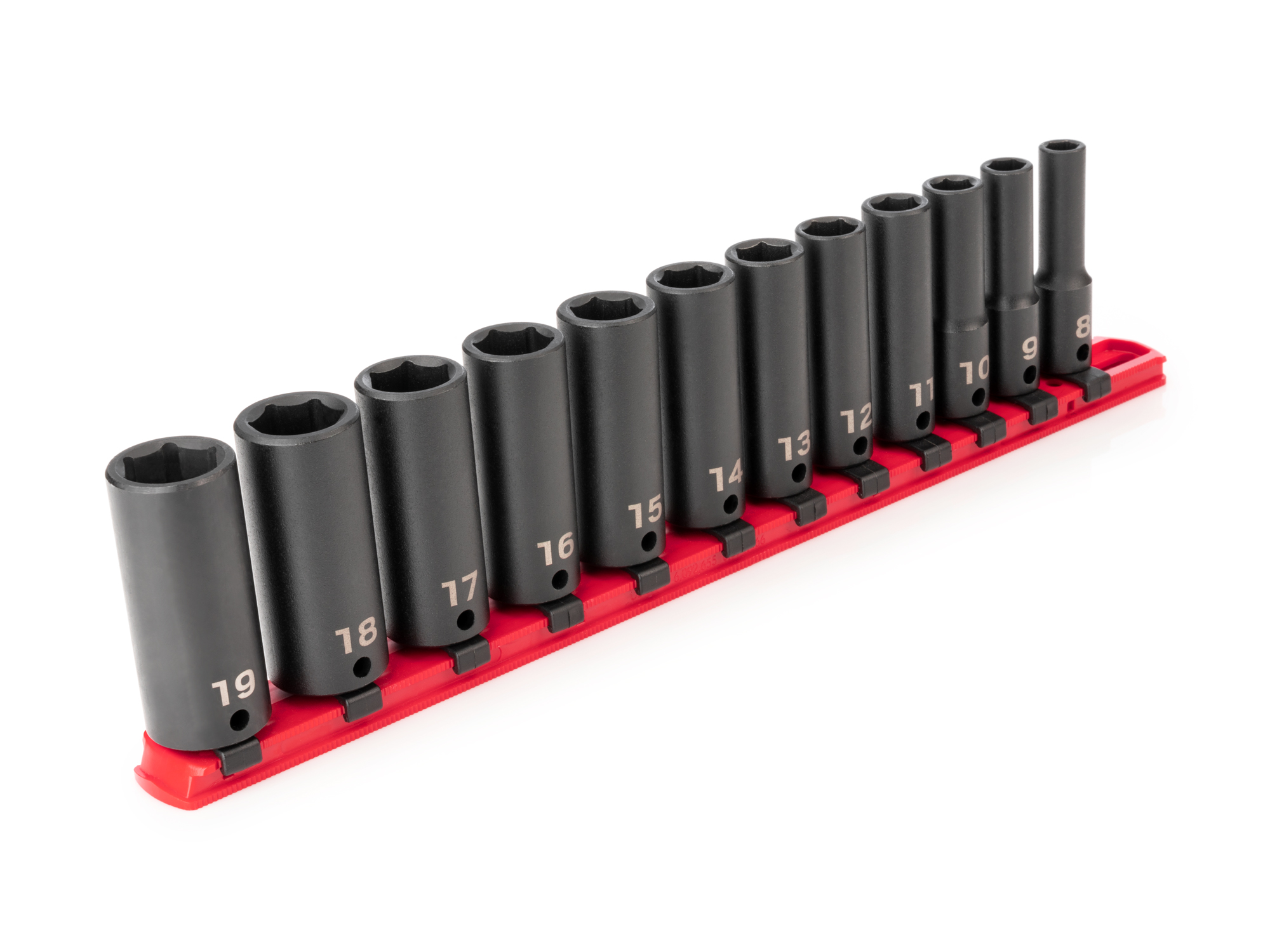
At Tekton, we use, among other things, alloys from both the chromium-molybdenum and chromium-vanadium families to make our tools. Once supply chains are established across an industry, it can be most efficient not to vary steel types within those supply chains. For example, in our US supply chains, 4140 chromium-molybdenum is most readily available in the rolled sheet form we require to make our angle head wrenches and 8650 nickel chromium-molybdenum is most readily available for making our screwdrivers. For similar reasons, some of our hand-drive and impact sockets made in Taiwan use a 4140 Cr-Mo alloy and others use a 50BV30 Cr-V alloy. In all these cases, the alloys meet all performance specifications, and the choice comes down to supply chain dynamics and cost.
The manufacturing method can also affect our material selection. For example, the variation on chromium-vanadium called 50BV30 contains boron and works better for some tools forged in a cold state. The addition of boron allows the steel to be soft for cold forging and then, after forging, highly hardenable through heat treating.


 Often when it comes to impact sockets, the only thing different is the color of the case the set comes in.