To avoid these ads, REGISTER NOW!

Between 265 & 485 SQ/FT Nick's Two-Car Detached Vdub Garage

Workspaces sized between 265 and 485 squarefeet.
OP
N

nicholam77

Well-known member
Joined
Dec 18, 2016
Messages
2,671
Location
Minneapolis, MN
Living Room Built Ins - part 6

This part doesn't have defined step. I was kind of just filling out some remaining tasks.

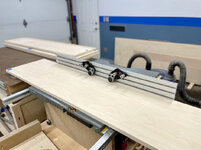
One thing I needed to do was cut a groove for the 6mm backing panel. I did this with a full-kerf blade on the table saw, using the stock guides since the top and bottom panels are so long:

IMG-1314.jpg

IMG-1315.jpg

Using the guides also helped hold the panels flat (some of this plywood has slight bow) and to the fence, for accurate, consistent depth grooves.

IMG-1316.jpg

There are plenty of ways to build cabinets and do backing panels from what I gather, but I am doing the grooves inset 1/2" so some 1/2" thick stretchers can go behind them.

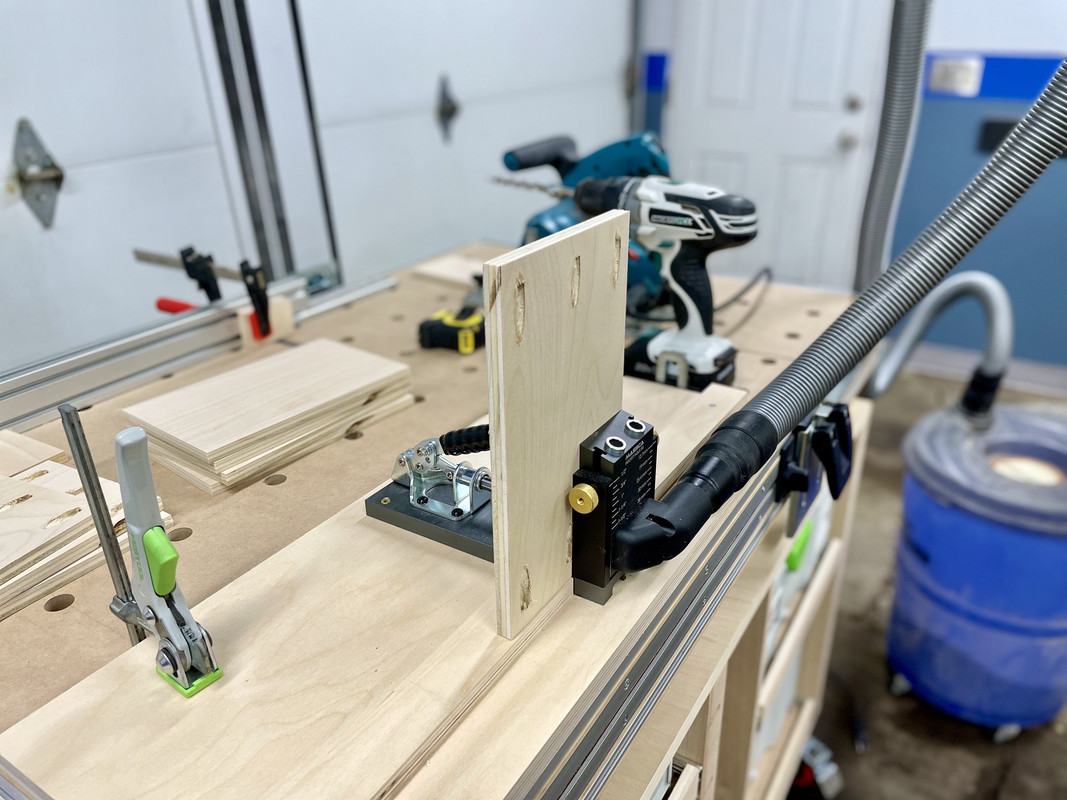
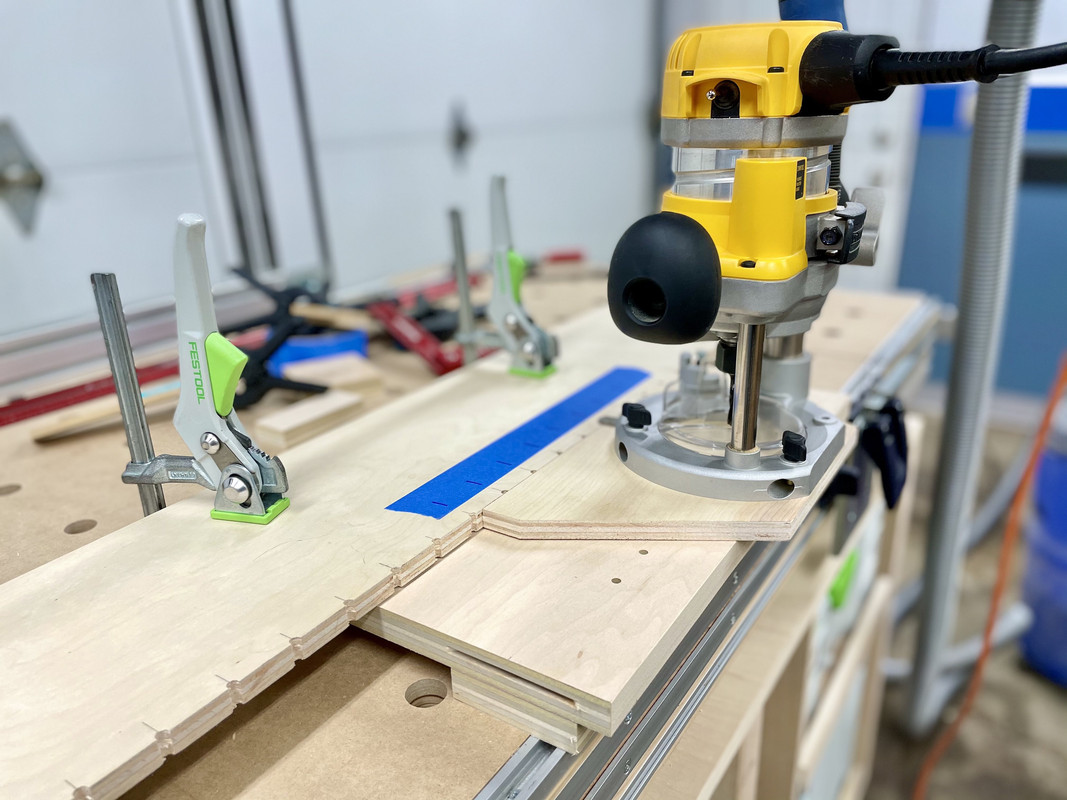
Next I cut the joinery (biscuits only) for the mid panels. Each case gets a middle divider that sits behind the sliding doors. Again, multiple ways to skin a cat here, but I tried a new setup with the biscuit joiner using the MFT rail and fence.

I got the idea from this video here @4:40, which coincidentally is another cool bench build if you ask me.

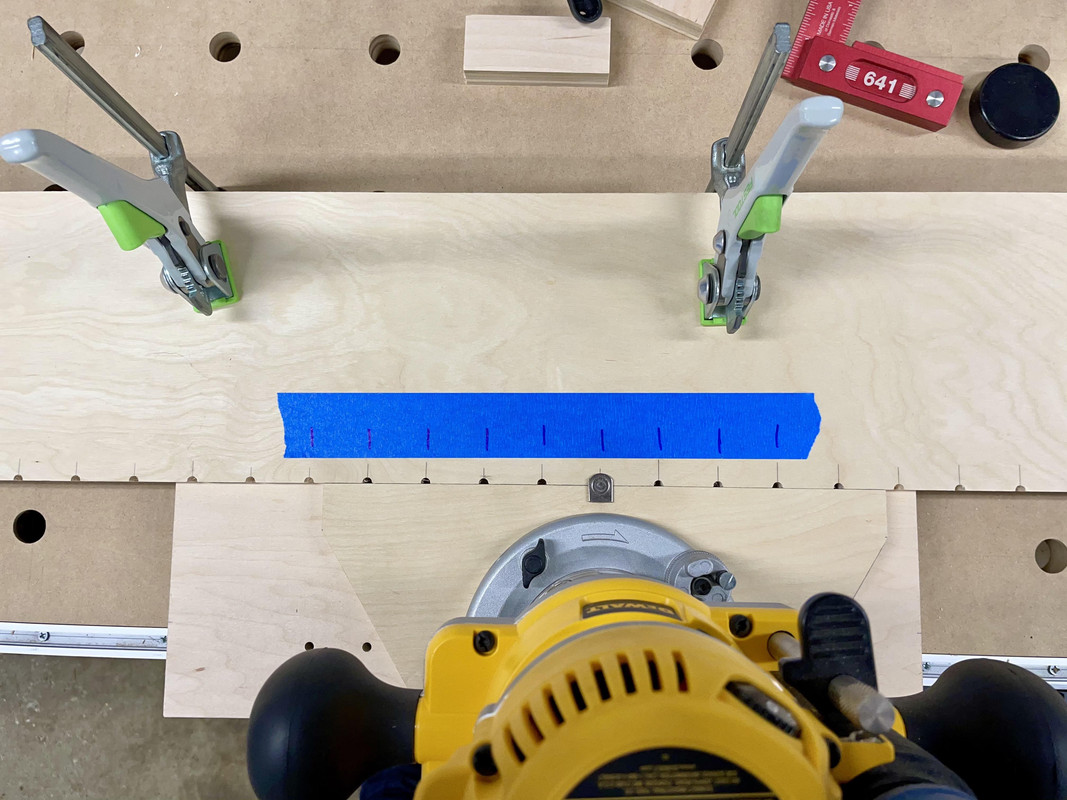
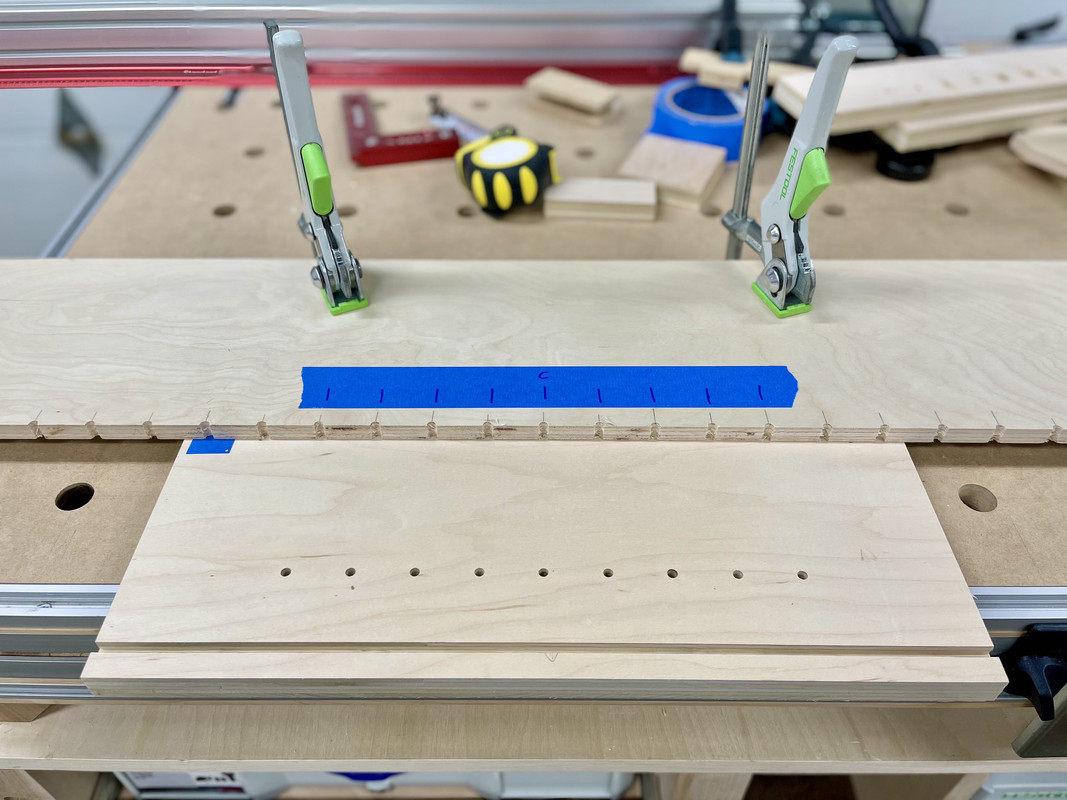
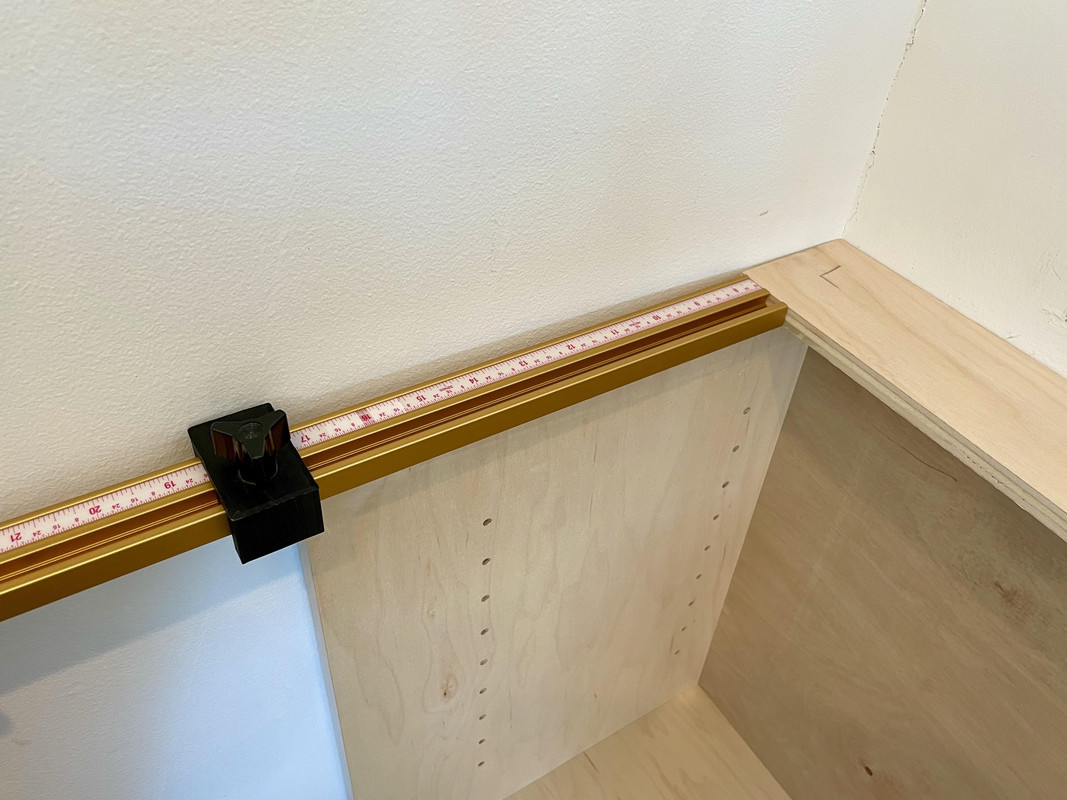
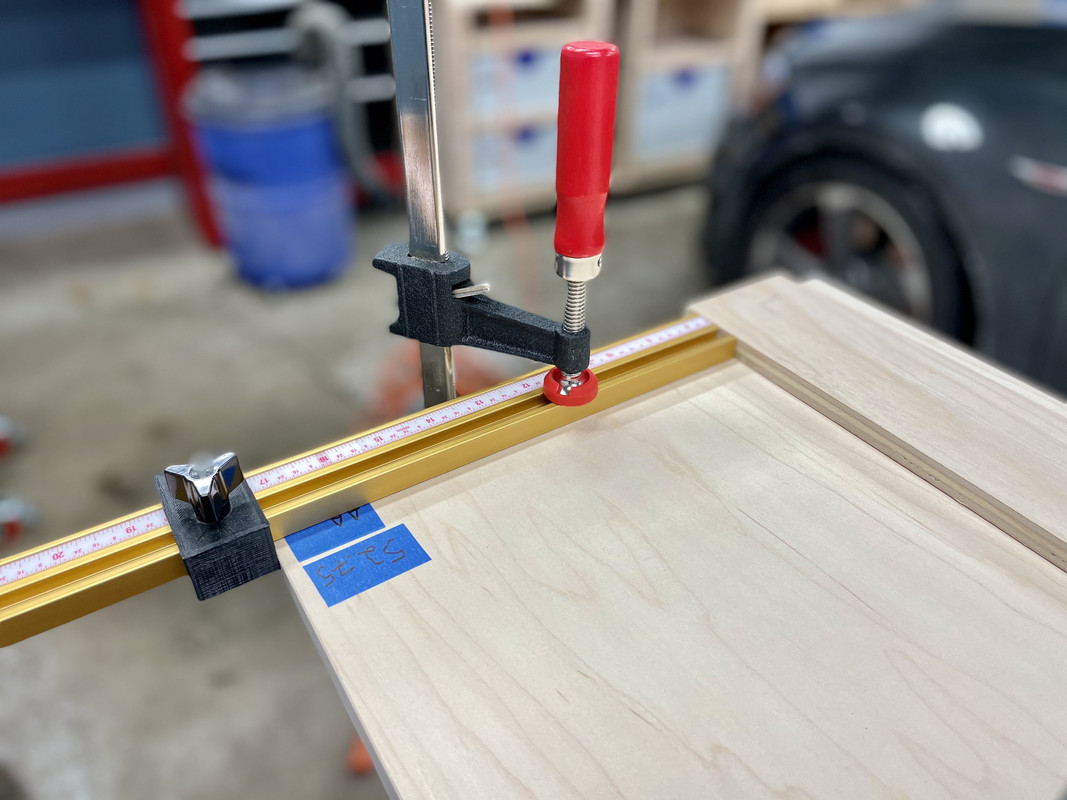
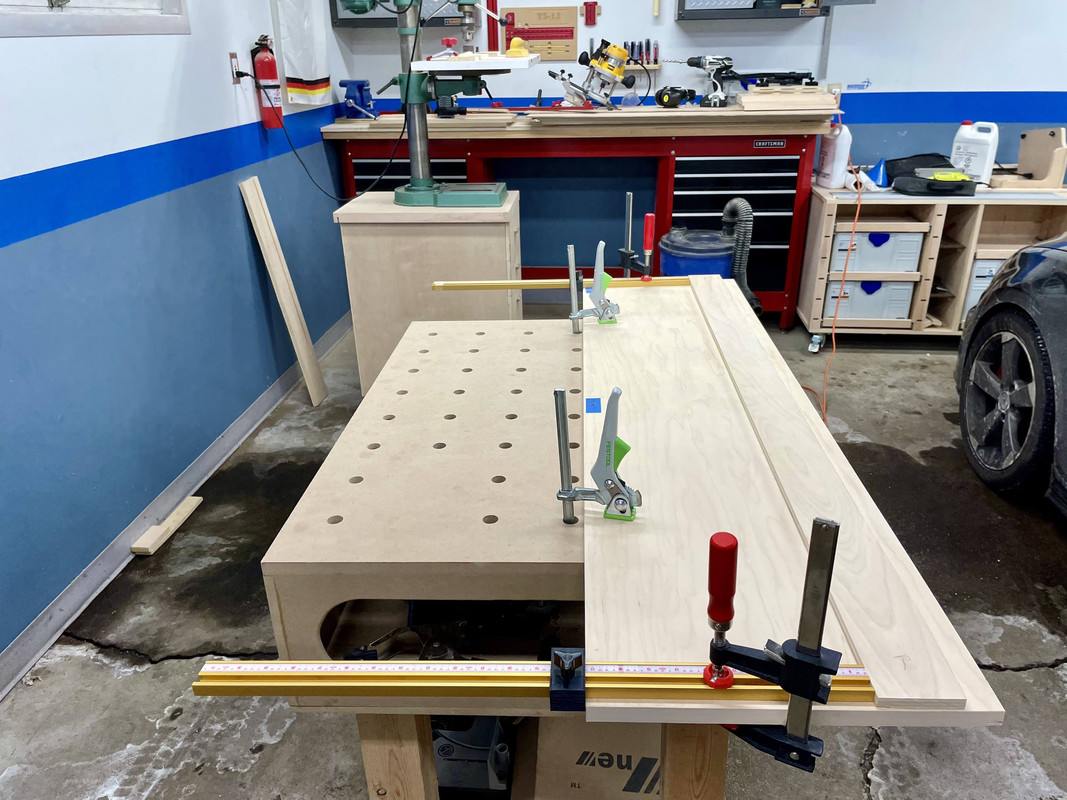
Basically I am using the fence to register the panel, and the guide rail (which is at perfect 90°) to register the biscuit joiner.
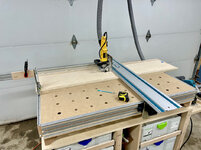

IMG-1318.jpg

IMG-1317.jpg

It works quite well. I just drew pencil marks on the rail where I wanted the biscuits, but I figured out I could use my little Woodpecker's flip stop from the drill press in the future.

IMG-1320.jpg

Some thought still has to go into the biscuit layout and orientation of the panels, but by using an end stop, the corresponding piece can be registered on the same end without having to mark where in the center of the panel the biscuits go.
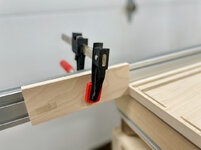
IMG-1323.jpg

It's a little tricky to explain, but with some forethought, if I ever had multiple mid-panels to do that were the same, I could theoretically lay out just one, and then use the stops to accurately position the remaining pieces. Not hugely useful for a one-off, but I could see the benefit for a handful of identical cabinets.

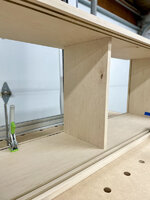
At this point I did another dry-fit test assembly to make sure it lined up:

IMG-1325.jpg

IMG-1326.jpg

Seems to have worked.

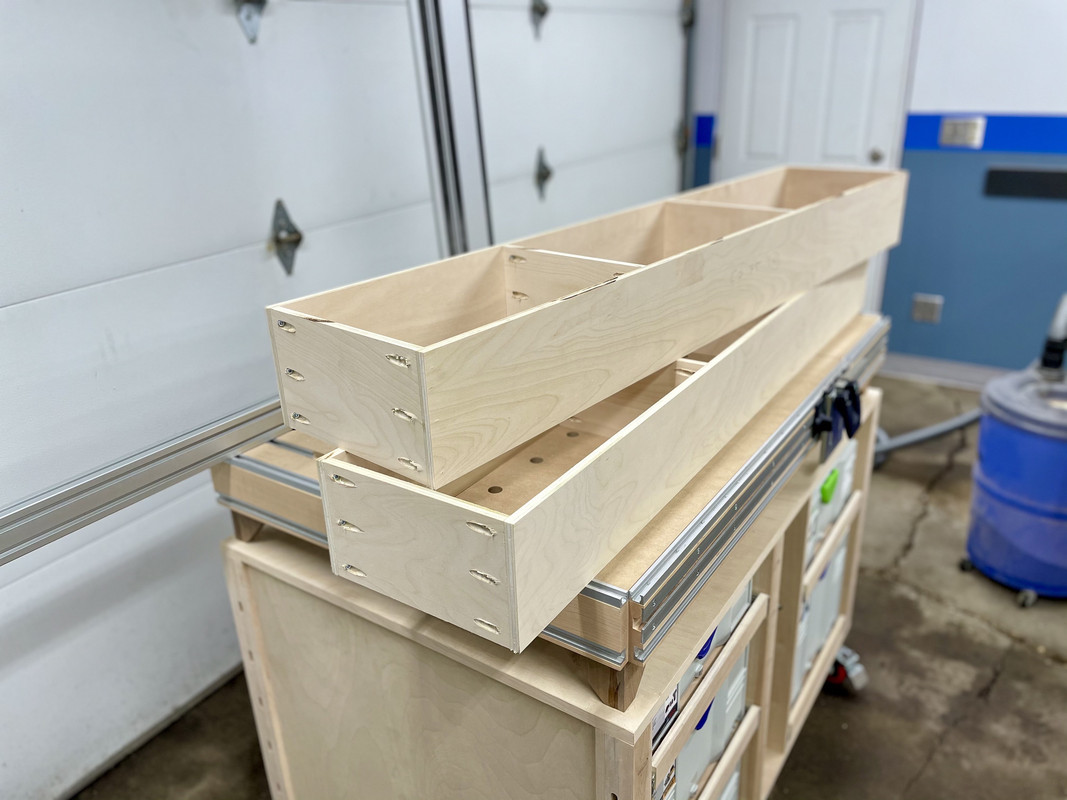
I still need to cut the backing panels to size, and the stretchers, which will be different for each cabinet. Sadly the widths on either side of my fireplace were slightly different, so I am making one cabinet 52 1/2" and the other 52 3/4", just to make things extra confusing. :lol:

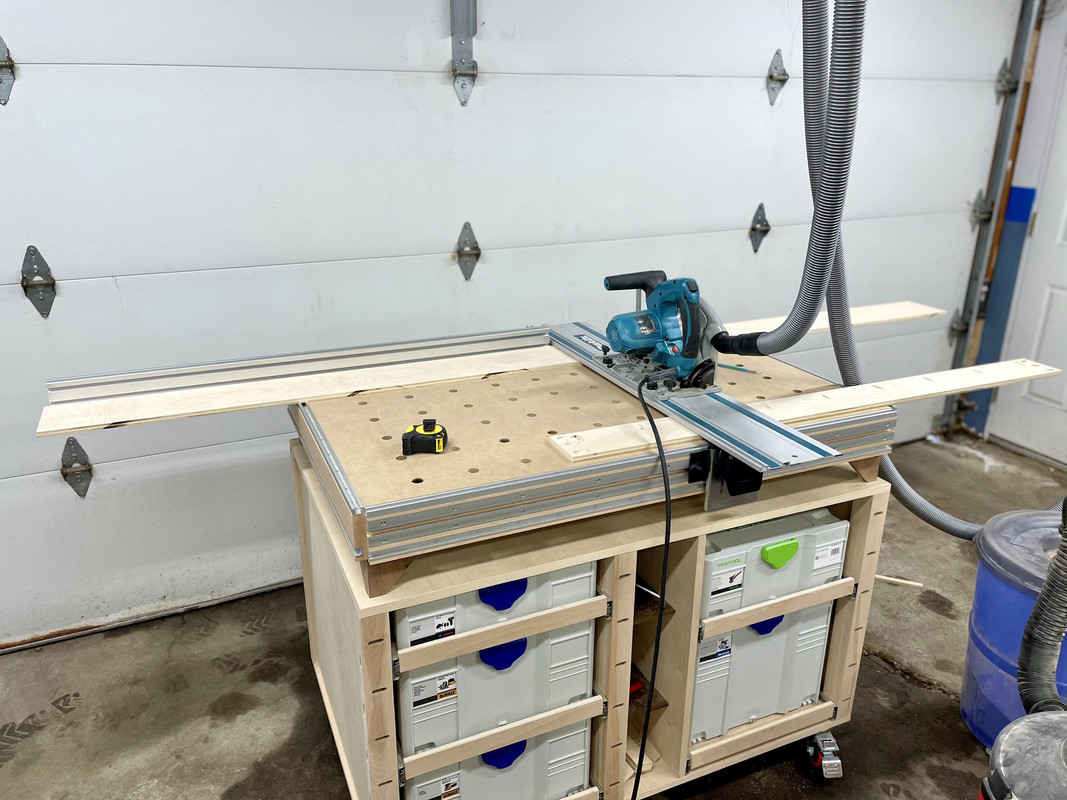
I'll close out with a wider pic of the MFT doin' it's thing:
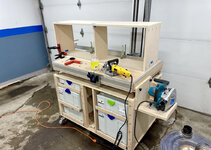
IMG-1328.jpg

Going to have a warmer stretch of weather coming up, so I hope to get out there and take advantage.

:rocker:
 
To avoid these ads, REGISTER NOW!

jar944

Well-known member
Joined
Jul 26, 2010
Messages
5,935
Location
Northern VA
Looks good and nice use of the track for biscuit placement.

When I first started building cabinets I built them like that with the backs captured in a dado. I have switched to a rabbit to make spraying easier. The backs are installed after paint / finish.
 

Unruh

Well-known member
Joined
Aug 12, 2017
Messages
1,431
Location
Silverdale, Washington
Nick you do such a great job taking pictures and walking us through your process. Keep showing the mistakes, it makes you seem human! BTW, when you start that youtube channel I’ll be one of your first subscribers!
 
OP
N

nicholam77

Well-known member
Joined
Dec 18, 2016
Messages
2,671
Location
Minneapolis, MN
Looking good Nick.

Bret

Thanks Bret!

Looks good and nice use of the track for biscuit placement.

When I first started building cabinets I built them like that with the backs captured in a dado. I have switched to a rabbit to make spraying easier. The backs are installed after paint / finish.

So if you rabbet in the backs, do you have nailing strips / stretchers (not sure the proper terminology)? If so would they go inside the cabinet (in front of the backing panel), or on the back side? I don't have a spray setup so that's not a concern for me but just curious how others go about it.

Nice technique. Thanks for the Hobelbank video link; I'll be using some of those concepts in my MFT build.

:beer:

An MFT you say?? :D I'll be following along on that for sure. I really like how the Hobelbank and Klavieratelier benches do the guide rail supports. It's such a simple mechanism but looks so accurate. I think I've mentioned before, but I am disappointed in the Festool rail supports and do not think they are worth the money. I know you have Bosch rail so that probably doesn't matter to you. I'd also check out the Paoson Woodworking bench if you haven't, he uses the Bosch track and has some pretty good ideas as well. Some of these benches I discovered after I was down a path, and looking back I would maybe change some things about mine.
Nick you do such a great job taking pictures and walking us through your process. Keep showing the mistakes, it makes you seem human! BTW, when you start that youtube channel I’ll be one of your first subscribers!

Thanks! I think I've always been heavy-handed on the pics so it's more or less second nature by now. I would actually love to turn some of these bigger builds into videos, not just for you guys but as a keepsake of the work that went into the project. Unfortunately it would just be too much work at this point. Struggling to fit it just building the project as it is. Maybe if there were 14 days in a week. :D
 
OP
N

nicholam77

Well-known member
Joined
Dec 18, 2016
Messages
2,671
Location
Minneapolis, MN
Living Room Built Ins - part 7 - toe kicks + 32mm holes

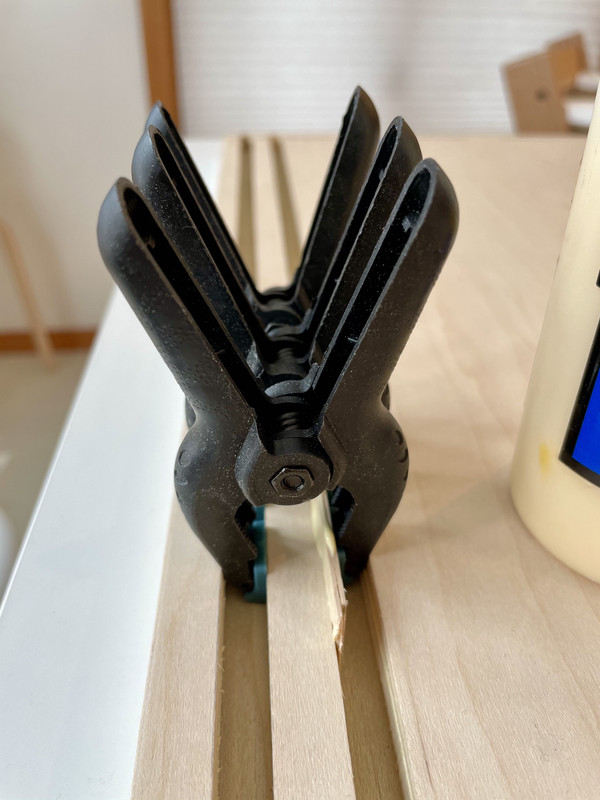
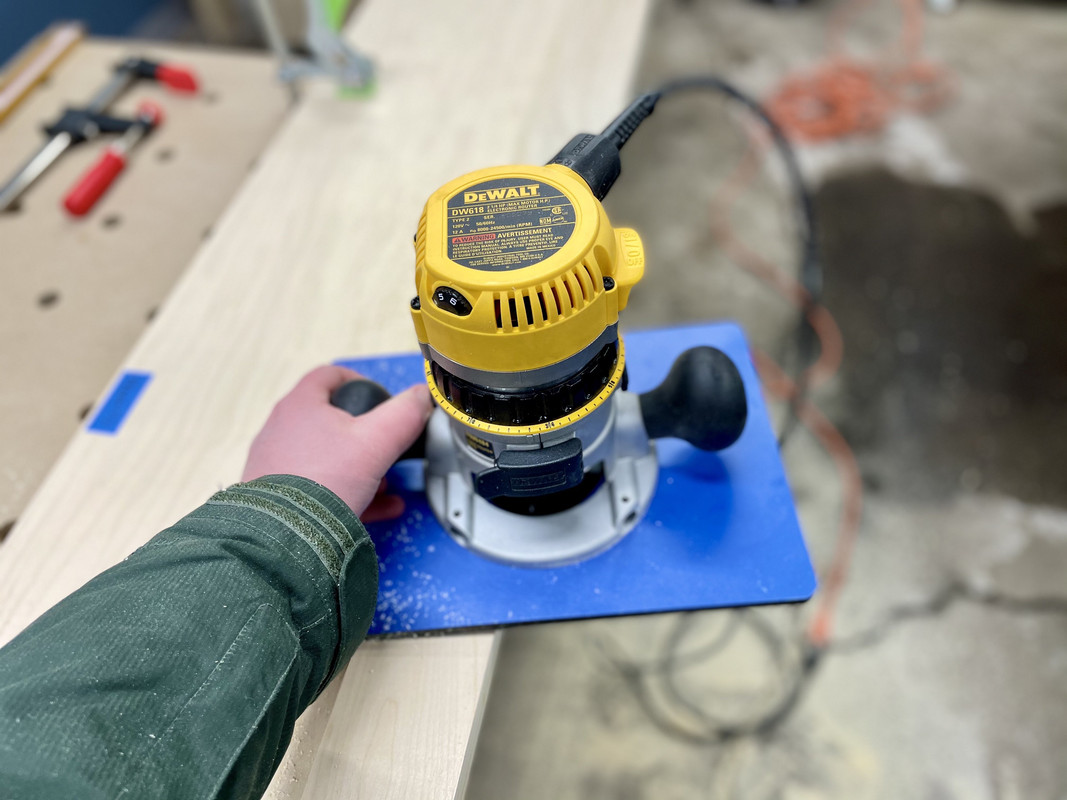
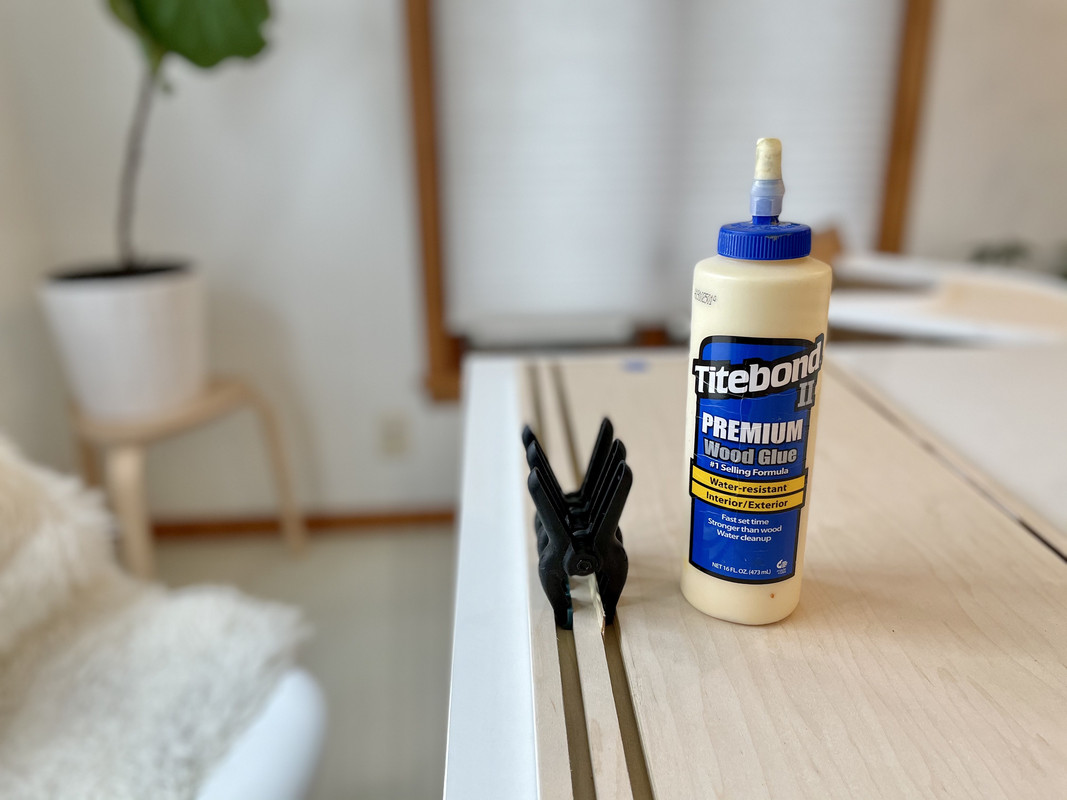
First up I'm trying to fix one of the router oopsies. I ripped some thin strips of maple and glued them in place with some small clamps. Too cold to glue outside so the dining table it is.

IMG-1352.jpg


IMG-1351.jpg


I'll have to somehow shave them down flush and then re-route the channel in that area. Any ideas on how to do that I'm all ears. The hand plane perhaps?

Next I built toe kicks.

IMG-1353.jpg


IMG-1355.jpg


IMG-1357.jpg


Still loving the speed and cleanliness of the pocket hole jig.

Although this time I noticed two things I wasn't over the moon with. One, there was a lot of tearout/splintering on the holes. I feel like the Kreg was maybe cleaner? It's possible it could just be the material, too. Secondly, when screwed together the screw heads didn't sit all the way flush with the face. Not a big deal for this application but if I was attaching false drawer fronts or something that would be a problem. I'm almost positive I had the depth configured correctly. This is 1/2" material.

Next I decided to add shelf pin holes. Had always planned on some shelves, not sure I need the adjustability but I made the jig so why not.

IMG-1359.jpg


One thing I will say is the jig is kind of pain to set up and get clamped securely and accurately. I think I need to make some improvements.

I used some blue tape to mark which holes I wanted to use:

IMG-1358.jpg


IMG-1360.jpg


It was also a LOT of math. I had two different depth panels (mid panel is shallower than the side panel), so two different set backs from the fronts of those. And then the side panels have the groove for the back panel whereas the mid panel does not, so two different set backs there, too. It turned out the "front stops" I had made as part of the jig were way too short for some of the needed placements, so I ended up just marking in pencil and lining the jig up by eye. Again, some improvements needed before it's really efficient.

But I got them all drilled, and the holes are super clean.

IMG-1362.jpg


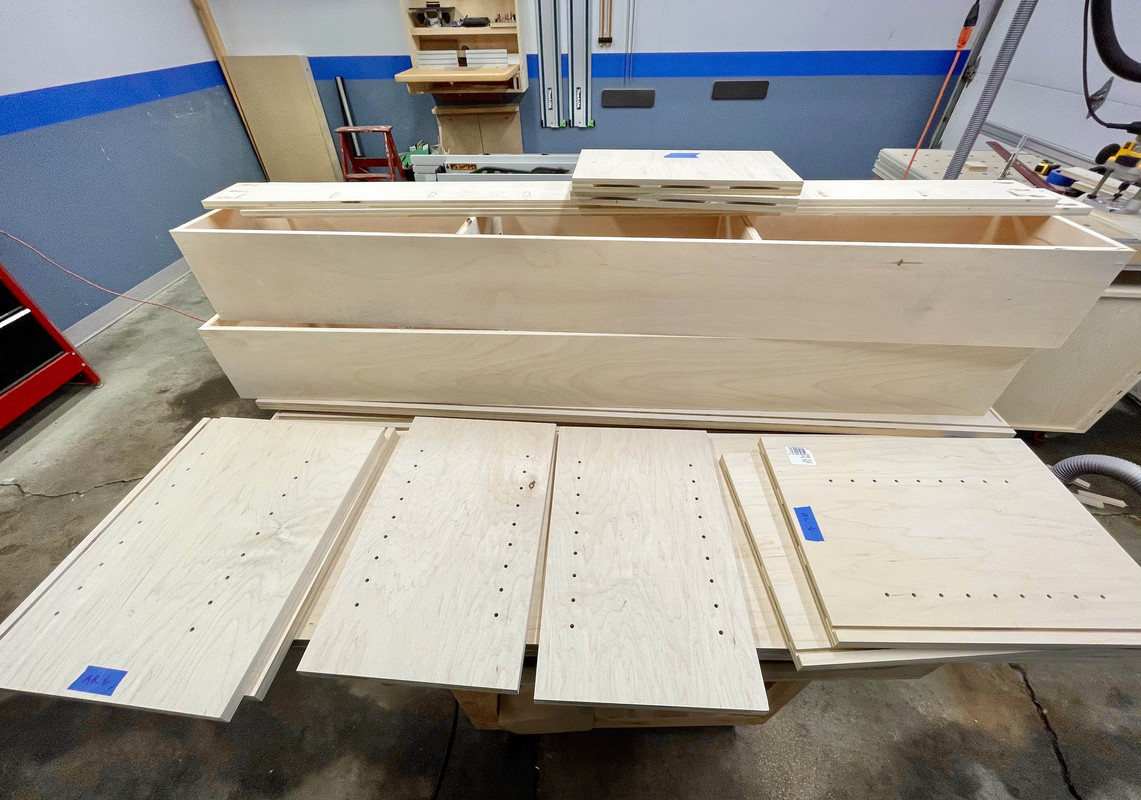
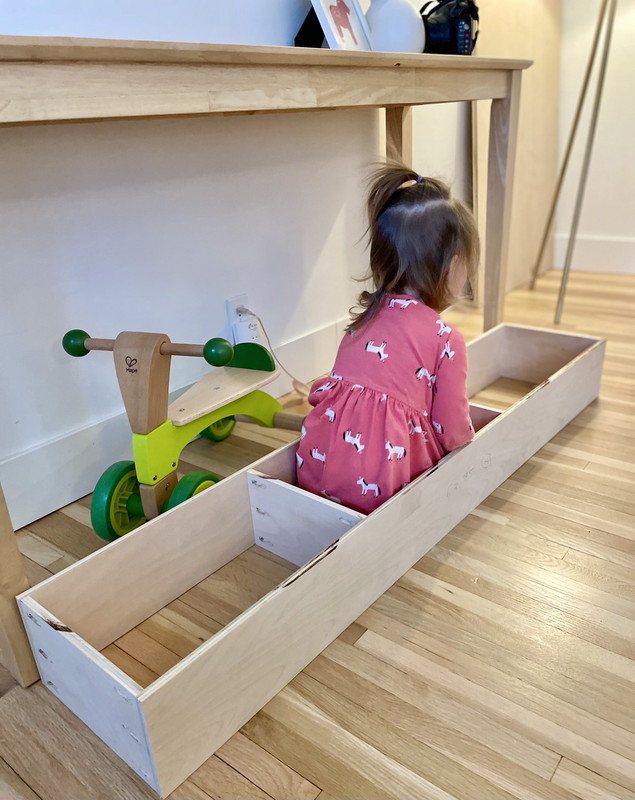
Lastly I brought the "A" cabinet in for a test fit in situ. My daughter immediately claimed the toe kick as a toy.

IMG-1365.jpg


The reason the toe kicks are so tall is to surpass the 5.5" baseboard I used in the living room.

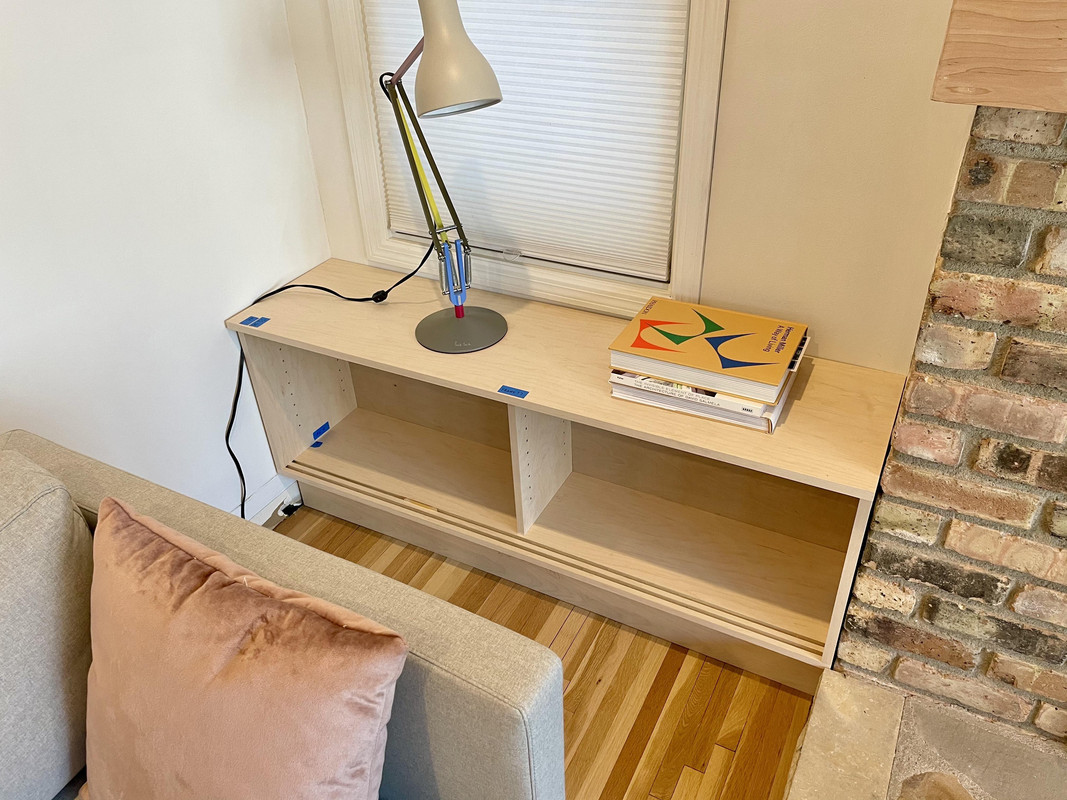
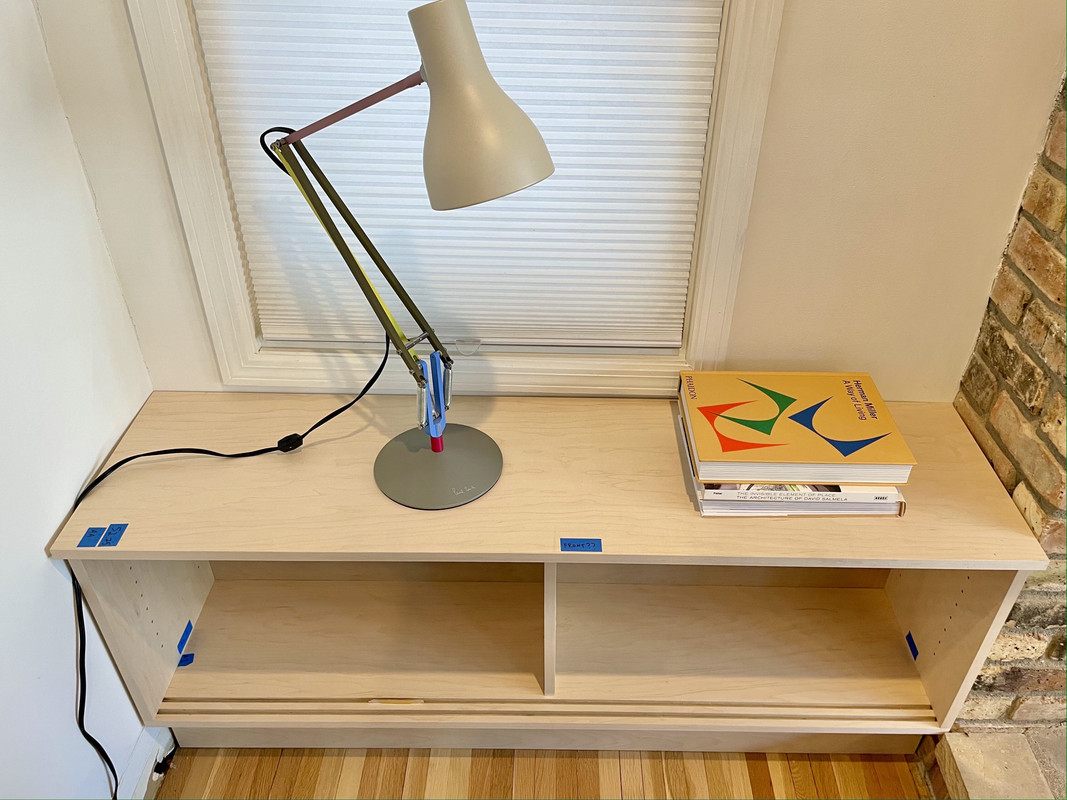
A couple pics of a complete dry fit:

IMG-1371.jpg


IMG-1375.jpg


I have to say I was extremely encouraged when I saw it in place. I think it's totally going to change the feel of the room.

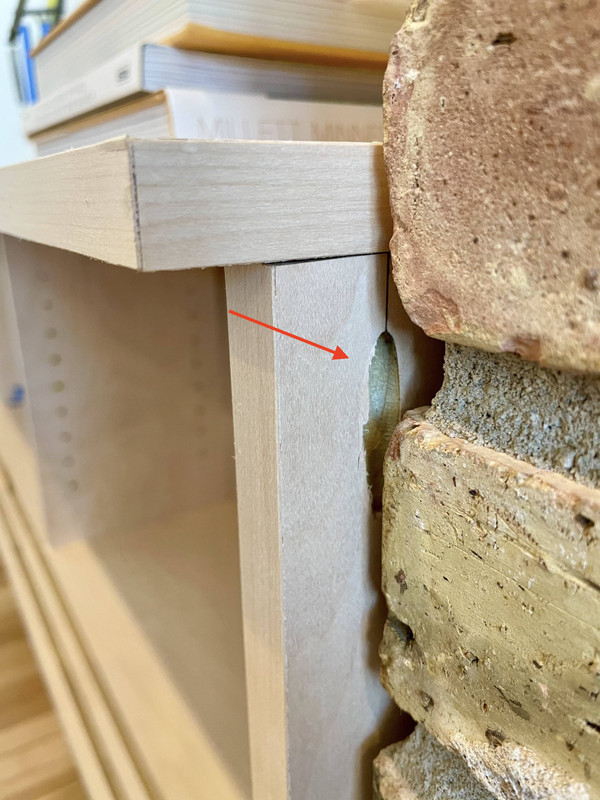
And in the spirit of sharing more mistakes, I definitely made another one. I thought the sides would be completely hidden, but I forgot I designed them to stick out slightly past the fireplace to take advantage of as much depth as possible in a shallow space. And because of that... a pocket hole is visible :eek:

IMG-1374.jpg


It will likely be the same on the other cabinet, too. Not sure what I'll do here, maybe just a plug? Again, if anyone has ideas, feel free to let me know.

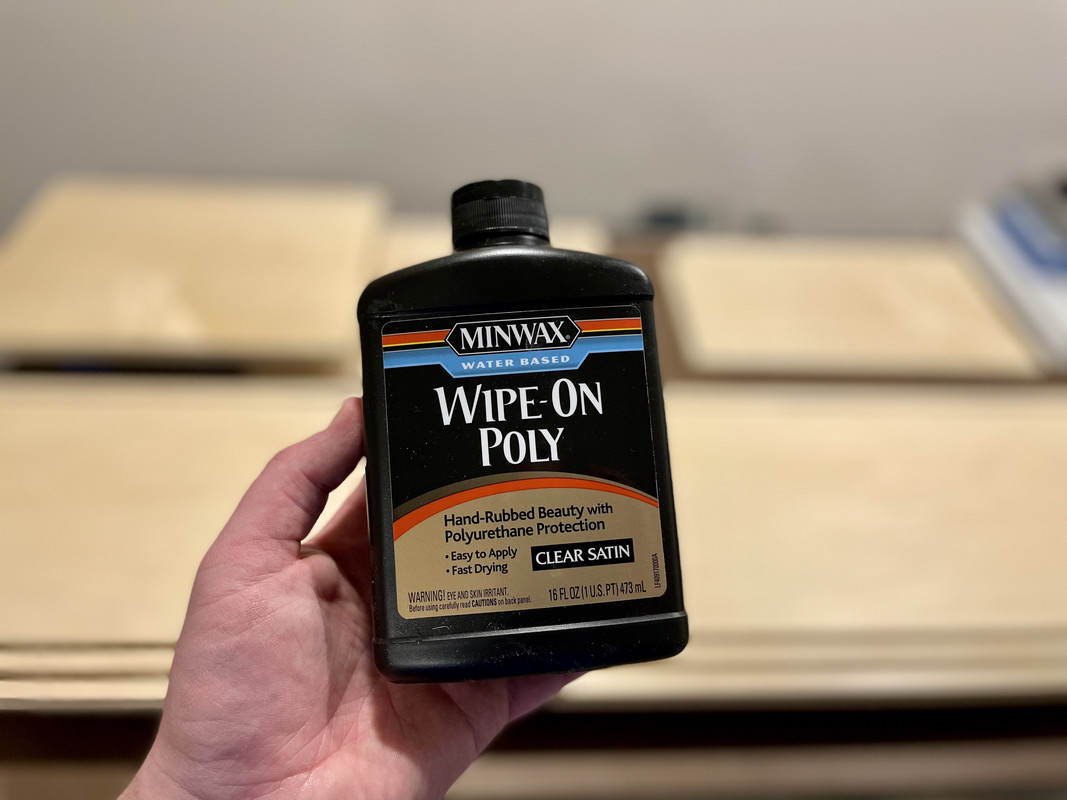
Another question to pose to the woodworking crowd: does anyone know of a wipe on finish that doesn't color the wood? Going for a light and natural look on the maple, but would love to avoid brushing on General Finishes pre-assembly.

I do have a LOT of work left on these cabinets, but I'm happy with the progress so far. I'll try to keep it moving.
 

jar944

Well-known member
Joined
Jul 26, 2010
Messages
5,935
Location
Northern VA
So if you rabbet in the backs, do you have nailing strips / stretchers (not sure the proper terminology)? If so would they go inside the cabinet (in front of the backing panel), or on the back side? I don't have a spray setup so that's not a concern for me but just curious how others go about it.

My backs are always 1/2" ply. No nailers, I'm not a fan of the look when they are inside or the lost space when they are outside.
 

bdbecker

ALLIANCE MEMBER
Joined
Nov 18, 2015
Messages
5,572
Location
Iowa
Clear wipe on poly. Anything you apply is going to change the look a little, but clear should have the least impact.
 

AGuinn

Well-known member
Joined
Jan 5, 2015
Messages
48
Location
West TN.
Still loving the speed and cleanliness of the pocket hole jig.

Although this time I noticed two things I wasn't over the moon with. One, there was a lot of tearout/splintering on the holes. I feel like the Kreg was maybe cleaner? It's possible it could just be the material, too. Secondly, when screwed together the screw heads didn't sit all the way flush with the face. Not a big deal for this application but if I was attaching false drawer fronts or something that would be a problem. I'm almost positive I had the depth configured correctly. This is 1/2" material.

I've noticed similar issues with my Massca jig. In 1/2' plywood, sometimes the screw heads sit proud if the surface - other times they're below. Seems like there is a little 'wiggle room' on the insertion angle when I'm driving the screws in. Also had issues with the tips of the screws starting to protrude through the finished veneer using the recommended #7 x 1" screws. Need to double check my setup and make sure the stop collar on the bit hasn't moved.
 

jar944

Well-known member
Joined
Jul 26, 2010
Messages
5,935
Location
Northern VA
I've noticed similar issues with my Massca jig. In 1/2' plywood, sometimes the screw heads sit proud if the surface - other times they're below. Seems like there is a little 'wiggle room' on the insertion angle when I'm driving the screws in. Also had issues with the tips of the screws starting to protrude through the finished veneer using the recommended #7 x 1" screws. Need to double check my setup and make sure the stop collar on the bit hasn't moved.

1' screws are at the absolute limit for true 1/2 plywood. Iirc kreg recommends 3/4". Even on a castle machine where you can adjust the web length they can be irritating.
 

jar944

Well-known member
Joined
Jul 26, 2010
Messages
5,935
Location
Northern VA
If you are going for that Scandinavian white clear beech/maple look WB poly or lacquer would be your best bet. Any of the solvent based poly or lacquers will darken the color with a more golden hue.
 

bepjrfan

Well-known member
Joined
Aug 14, 2015
Messages
170
Location
North Dakota
To minimize color change, definitely will want water based poly. Varathane ultimate water based poly is what I generally use. Satin or matte will give it a nice flatter finish with minimal color change. Also makes for easy cleanup.

As far as those pocket holes, plugs actually work pretty well if you can get a nice snug fit. Would hardly be noticeable.
 

AGuinn

Well-known member
Joined
Jan 5, 2015
Messages
48
Location
West TN.
1' screws are at the absolute limit for true 1/2 plywood. Iirc kreg recommends 3/4". Even on a castle machine where you can adjust the web length they can be irritating.

Checked the Kreg website, and they recommend either 3/4" or 1" for 1/2" ply depending on which jig is being used. Evidently, my local home center doesn't stock the 3/4" screws, and the box for the 1" screws said they would work for 1/2" material. Guess I'll need to keep an eye out next time I head into town.

It's in a pantry shelf, so while I'm bummed it's not perfect, I can still sleep at night.
 
Last edited:

T-handle

Well-known member
Joined
Jun 17, 2019
Messages
440
Location
Northern Ostrobothnia Finland
Great work Nick! Nice fix for the router oops! Do you have two router fences? Longer pins and fence for both sides of the panel and the router will stay put when doing full width grooves.

Love your MFT table:thumbup: Keep up the good work!
 

mfg0772

Well-known member
Joined
Aug 8, 2018
Messages
146
Location
Northeast CT
I got the Kreg jig for shelf pins. It works surprisingly well and I think fairly priced.

I'll second the water based finish for keeping a clear yet protective finish. I've been using Minwax Polycryilc with some success. Just be careful with sanding because I have found that it can show through if you are not careful. I was doing some finishing in less than ideal lighting conditions and my errors only showed up once I moved the piece into its space.

I'm thinking you have two options for the pocket hole mistake. First is a plug. Second would be to caulk the gap between the cabinet and fireplace. Go a little heavy at the joints and it might cover it all. Hard to really tell from the picture but it might work.
 

kwyjibo

Well-known member
Joined
Apr 8, 2008
Messages
743
I found that a carefully selected plug could do a good job of hiding pocket holes. How about covering with veneer? or to save $ and you really only need to finish the front ~2", wide edge banding?

Also, I've been eyeing that Herman Miller book: does it have detailed photos? (for example... if you were looking to replicate some of the designs)
 

jake28

Well-known member
Joined
Aug 28, 2018
Messages
487
Location
SF, CA
[mention]nicholam77 [/mention]

Plugging: Kreg makes little plugs for the holes, or you can make your own with a dowel. Glue in place, and then shave down with a flush-cut (no kerf) saw, or block plane. Or chisel. Something sharp.

Trimming the maple in the dado: nice sharp chisel in a shearing cut, pushing into the wall of the slot. Then re-rout the dado. It might rip out. You could try a piece of coarse sand paper in a hard backer and sanding over the inserted piece to widen the dado as well.

Kreg screws: is it actually a full 1/2”? My birch ply is ~7/16” and I have to be super careful not to blow through with 1” screws. It’s a pain. Adjust and tweak as needed.
 

bj383ss

Well-known member
Joined
Sep 29, 2011
Messages
3,166
Location
TX
Well Nick you have just a got a ton of good advice. The water based poly is the way to go for non yellowing. It will raise the grain on the first coat though so a through sanding will have to be done to sand off all the fibers it raises. I have used both the Varathane and Minwax. I don't care for either and they both stink really bad but the cleanup is easier.

As far as what Jar was saying on how he mounts his backs to the cabinets I do the same as it is so much easier when you don't have to brush in corners and worry about runs or too much material left from your brush. If you are spraying it won't be as big of a deal however with the back off it would be even easier to spray but you would obviously need to mask off the areas you need to glue.

You work looks really good. I think you can hide the pocket hole with a plug and only you are going to know its there.

Bret
 

bj383ss

Well-known member
Joined
Sep 29, 2011
Messages
3,166
Location
TX
Checked the Kreg website, and they recommend either 3/4" or 1" for 1/2" ply depending on which jig is being used. Evidently, my local home center doesn't stock the 3/4" screws, and the box for the 1" screws said they would work for 1/2" material. Guess I'll need to keep an eye out next time I head into town.

It's in a pantry shelf, so while I'm bummed it's not perfect, I can still sleep at night.

McFeely's has all the different size pocket screws you could possibly want.

https://www.mcfeelys.com/screw-fastener-web-store/shop-screws-by-application/pocket-hole-screws.html

Bret
 
To avoid these ads, REGISTER NOW!

jar944

Well-known member
Joined
Jul 26, 2010
Messages
5,935
Location
Northern VA
Well Nick you have just a got a ton of good advice. The water based poly is the way to go for non yellowing. It will raise the grain on the first coat though so a through sanding will have to be done to sand off all the fibers it raises. I have used both the Varathane and Minwax. I don't care for either and they both stink really bad but the cleanup is easier.

As far as what Jar was saying on how he mounts his backs to the cabinets I do the same as it is so much easier when you don't have to brush in corners and worry about runs or too much material left from your brush. If you are spraying it won't be as big of a deal however with the back off it would be even easier to spray but you would obviously need to mask off the areas you need to glue.

You work looks really good. I think you can hide the pocket hole with a plug and only you are going to know its there.

Bret

Backs off make spraying a lot easier, its not as much of a issue with an airless, but there is a lot of bounce back with a hvlp that makes getting even coverage into the corner a PITA.

I don't even bother masking the rabbit since I don't glue the backs on. They get pocket screwed if its a internal partition or stapled every 4" or so if its an accessible external edge.
 
OP
N

nicholam77

Well-known member
Joined
Dec 18, 2016
Messages
2,671
Location
Minneapolis, MN
Wow, thanks for the replies everyone! Lot's of great advice. A lot of you echoed some of the same thoughts but I'll try to respond to everyone below. :D

______________________________________________​


My backs are always 1/2" ply. No nailers, I'm not a fan of the look when they are inside or the lost space when they are outside.

Ah, makes sense! I will give that way a try next time. I don't like the nailers on the inside, either. I could have used every millimeter of depth available and this would have saved me a 1/4" :lol:

I've noticed similar issues with my Massca jig. In 1/2' plywood, sometimes the screw heads sit proud if the surface - other times they're below. Seems like there is a little 'wiggle room' on the insertion angle when I'm driving the screws in. Also had issues with the tips of the screws starting to protrude through the finished veneer using the recommended #7 x 1" screws. Need to double check my setup and make sure the stop collar on the bit hasn't moved.

1' screws are at the absolute limit for true 1/2 plywood. Iirc kreg recommends 3/4". Even on a castle machine where you can adjust the web length they can be irritating.

AGuinn and jar944, I've had the screws protrude, too, even with the Kreg jig. I used to back off the depth collar with that. I'll have to look into the 3/4" screws, thanks for that.

If you are going for that Scandinavian white clear beech/maple look WB poly or lacquer would be your best bet. Any of the solvent based poly or lacquers will darken the color with a more golden hue.

Clear wipe on poly. Anything you apply is going to change the look a little, but clear should have the least impact.

To minimize color change, definitely will want water based poly. Varathane ultimate water based poly is what I generally use. Satin or matte will give it a nice flatter finish with minimal color change. Also makes for easy cleanup.

As far as those pocket holes, plugs actually work pretty well if you can get a nice snug fit. Would hardly be noticeable.

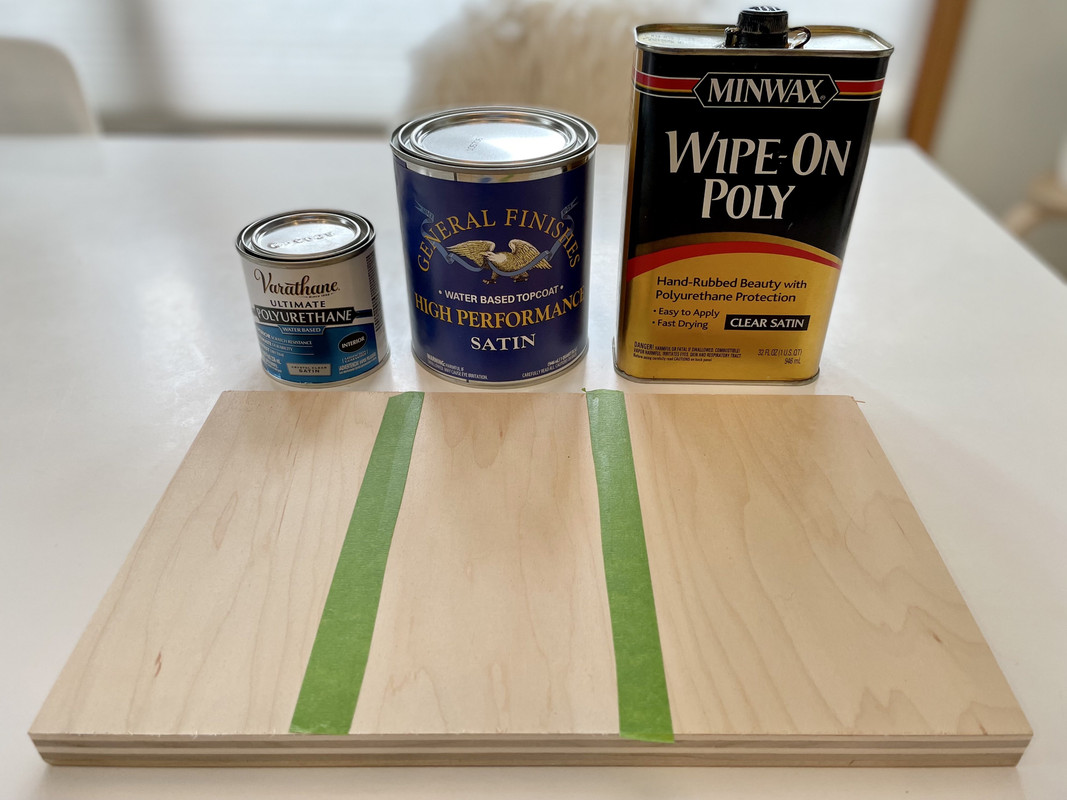
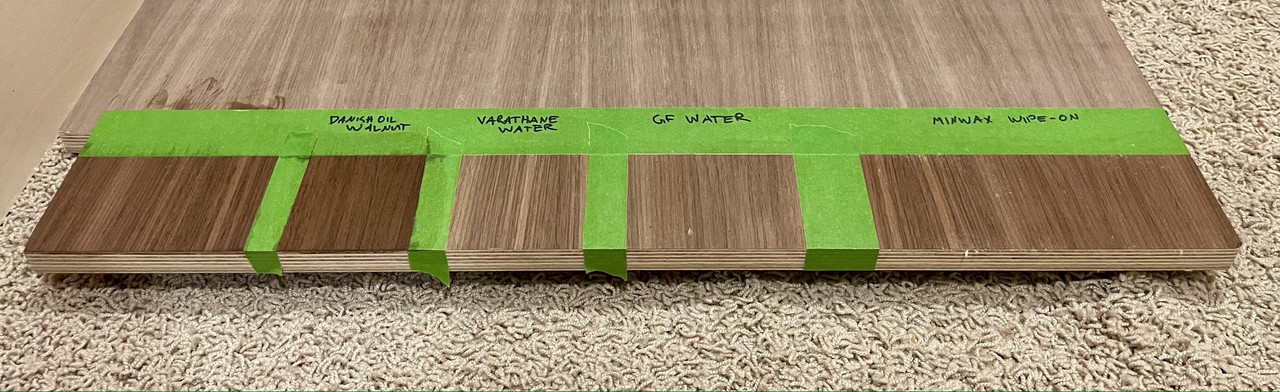
jar944, yes I am going for a light wood Scandinavian / modern look. I am 100% Swedish after all. A lot of my house projects have been maple finished with clear satin water-based poly (General Finishes High Performance Top Coat), so for continuity I'm trying to stick similar to that. So to everyone who said water-based poly, I am well-familiar, and you are spot on. It doesn't yellow at all and super durable. But... I don't have a spray setup and I find it a PITA to brush on, especially larger intricate projects. So I guess I was asking about a wipe-on product that has a similar look. I did find this Minwax Waterbased Wipe-On, and ordered some, but after doing a test of 3 products I had on hand I found that they look almost identical on the maple, including Minwax Wipe On (regular):

IMG-1377.jpg


I'll test their waterbased wipe-on when it arrives but right now I'm leaning towards the standard Minwax wipe-on. It's more matte and just a hint of color.

I got the Kreg jig for shelf pins. It works surprisingly well and I think fairly priced.

I'll second the water based finish for keeping a clear yet protective finish. I've been using Minwax Polycryilc with some success. Just be careful with sanding because I have found that it can show through if you are not careful. I was doing some finishing in less than ideal lighting conditions and my errors only showed up once I moved the piece into its space.

I have no doubt the Kreg jig works well for its intended purpose. I have not used it. I found the Rockler one just ok do to some slop in the holes. Where the metric Kreg jig confuses me is the fence setback is 1" or 2" I believe, not the standard 37mm of the 32mm system. Also, to be clear, my jig is able to be used with any setback I want, which was very useful in this project already because the setbacks where not the same across the panels. So, depends on the usage of course, but the homemade jig can definitely do things the Rockler and Kreg jigs cannot.

I came across the Polycrylic, too, although as mentioned above I'm looking for something as easy as possible to apply. I find the brush-ons to be fussy, too.

I found that a carefully selected plug could do a good job of hiding pocket holes. How about covering with veneer? or to save $ and you really only need to finish the front ~2", wide edge banding?

Also, I've been eyeing that Herman Miller book: does it have detailed photos? (for example... if you were looking to replicate some of the designs)

I ordered some maple Kreg plugs. I like your other ideas! But will try a plug first I think.

I like the Herman Miller book quite a bit. It has a lot of photos, but usually not full page photos, more collage-y. Here is an example:

IMG-1381.jpg


There are plenty of photos of their furniture in factory, showrooms, real houses, and even prototypes. But the book is really the story of the company and its leaders first and foremost, not the furniture (although they intertwine). So, I don't know that the photos will help you build your own version of their stuff to scale, but for someone who obviously likes MCM and modernism it is a great book with interesting insight. I think you would enjoy it regardless.

Great work Nick! Nice fix for the router oops! Do you have two router fences? Longer pins and fence for both sides of the panel and the router will stay put when doing full width grooves.

Love your MFT table:thumbup: Keep up the good work!

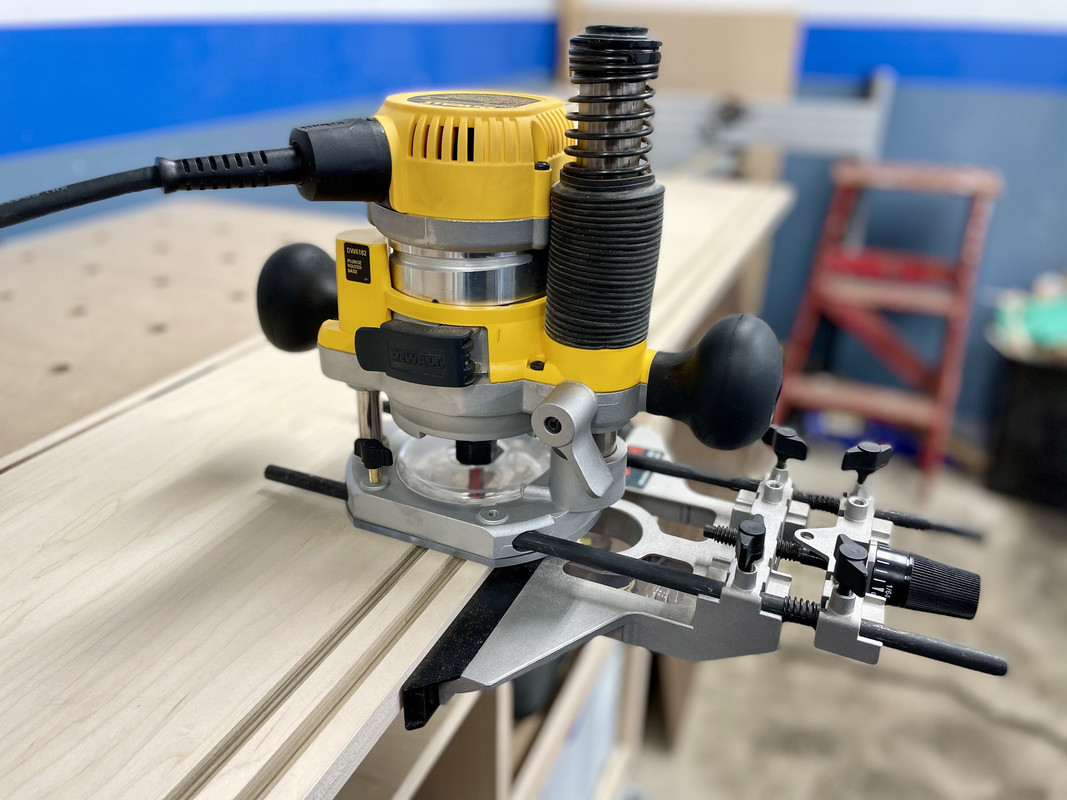
Thanks T-Handle! Interesting, I'm not familiar with the two fences. My router edge guide only has one fence. Ultimately I think I'm going to make a base that slides on the guide rail.

Plugging: Kreg makes little plugs for the holes, or you can make your own with a dowel. Glue in place, and then shave down with a flush-cut (no kerf) saw, or block plane. Or chisel. Something sharp.

Trimming the maple in the dado: nice sharp chisel in a shearing cut, pushing into the wall of the slot. Then re-rout the dado. It might rip out. You could try a piece of coarse sand paper in a hard backer and sanding over the inserted piece to widen the dado as well.

Kreg screws: is it actually a full 1/2”? My birch ply is ~7/16” and I have to be super careful not to blow through with 1” screws. It’s a pain. Adjust and tweak as needed.

If only I had useable block plane or chisels :lol_hitti

Thanks for the tips. Maybe I'll try honing one of my crappy chisels. And yeah, my ply was undersized, too.

Well Nick you have just a got a ton of good advice. The water based poly is the way to go for non yellowing. It will raise the grain on the first coat though so a through sanding will have to be done to sand off all the fibers it raises. I have used both the Varathane and Minwax. I don't care for either and they both stink really bad but the cleanup is easier.

As far as what Jar was saying on how he mounts his backs to the cabinets I do the same as it is so much easier when you don't have to brush in corners and worry about runs or too much material left from your brush. If you are spraying it won't be as big of a deal however with the back off it would be even easier to spray but you would obviously need to mask off the areas you need to glue.

You work looks really good. I think you can hide the pocket hole with a plug and only you are going to know its there.

Bret

Thank you Bret, I appreciate the kind words. Despite the hiccups I am overall happy with how it's going. I think you are right on the plug, I'm going to give that a shot.

McFeely's has all the different size pocket screws you could possibly want.

https://www.mcfeelys.com/screw-fastener-web-store/shop-screws-by-application/pocket-hole-screws.html

Bret

^^

This is great. I don't think my home centers carry 3/4" either.
 
OP
N

nicholam77

Well-known member
Joined
Dec 18, 2016
Messages
2,671
Location
Minneapolis, MN
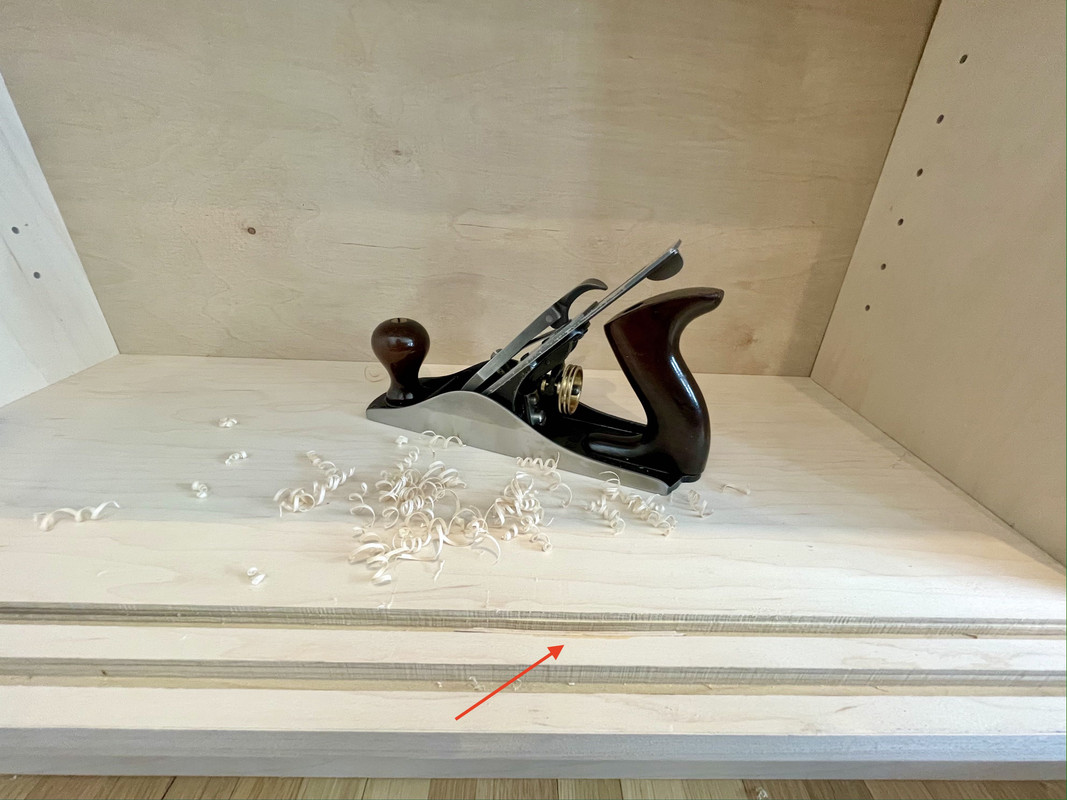
Quick mid-day update. During my lunch break I tried taking down the dado patch with my newly restored No. 4:

IMG-1382.jpg


I know there are probably more ideal tools like block plane or chisel as Jake suggested, but I don't have those prepped and I thought it was worth a try. It took a clean shaving off the top, so I kept going and got it pretty dang flush!

Now the question is will the router rip out the patch? :lol:
 

mfg0772

Well-known member
Joined
Aug 8, 2018
Messages
146
Location
Northeast CT
nicholam77;8926379 I have no doubt the Kreg jig works well for its intended purpose. I have not used it. I found the Rockler one just ok do to some slop in the holes. Where the metric Kreg jig confuses me is the fence setback is 1" or 2" I believe said:
Ok so I disregard my note on the Kreg jig. I would still recommend it and I like it but I just dove head first into your thread and just finished it. I see what your doing with yours and can certainty appreciate it.

Overall, loving all the projects. I'd say we have some similar circumstances it seems. I've been wanting to build an MFT but am having analysis paralysis with how I should design it. Maybe this summer I'll bite the bullet and get it done.
 
OP
N

nicholam77

Well-known member
Joined
Dec 18, 2016
Messages
2,671
Location
Minneapolis, MN
Ok so I disregard my note on the Kreg jig. I would still recommend it and I like it but I just dove head first into your thread and just finished it. I see what your doing with yours and can certainty appreciate it.

Overall, loving all the projects. I'd say we have some similar circumstances it seems. I've been wanting to build an MFT but am having analysis paralysis with how I should design it. Maybe this summer I'll bite the bullet and get it done.

Thanks! I've read through your thread, and we have some similar circumstances indeed! I hear you on analysis paralysis. That's probably why I heavily adapted other people's designs instead of coming up with something original. I'd just think through everything you'd use an MFT for and start there. "MFT" stands for "Multi-Function Table" of course, so I think determining the "functions" you need it to perform could help inform the design. I've linked quite a few youtube benches in some recent posts if you haven't checked them out, and visiting Festool Owners Group, or yes, Pinterest, is a great way to discover other's custom MFT designs. If it helps, some considerations that went into mine were:

- track saw use w/rail supports
- vertical and horiztontal clamping
- systainer storage
- weight -- it's actually quite heavy fully loaded, and since I don't have a traditional bench it's nice because I recently found I can even use a hand plane on it!
- table saw outfeed (matched height)
- removable top
- replaceable MDF work surface
- ability for expansion and accessories (extension wings, etc)

If you just want the clamping surface and don't need the track saw implementation or storage, I will say I was quite happy with my Paulk top, too.

:beer:
 
OP
N

nicholam77

Well-known member
Joined
Dec 18, 2016
Messages
2,671
Location
Minneapolis, MN
Living Room Built Ins - part 8

So somehow I hurt my back which has bummed me out. It must have been lifting something awkward and heavy. I'm always shuffling **** around in the garage like Tetris trying to park the cars, etc. So no big leaps on the project, but I've been determined to keep hitting odds and ends and move it forward.

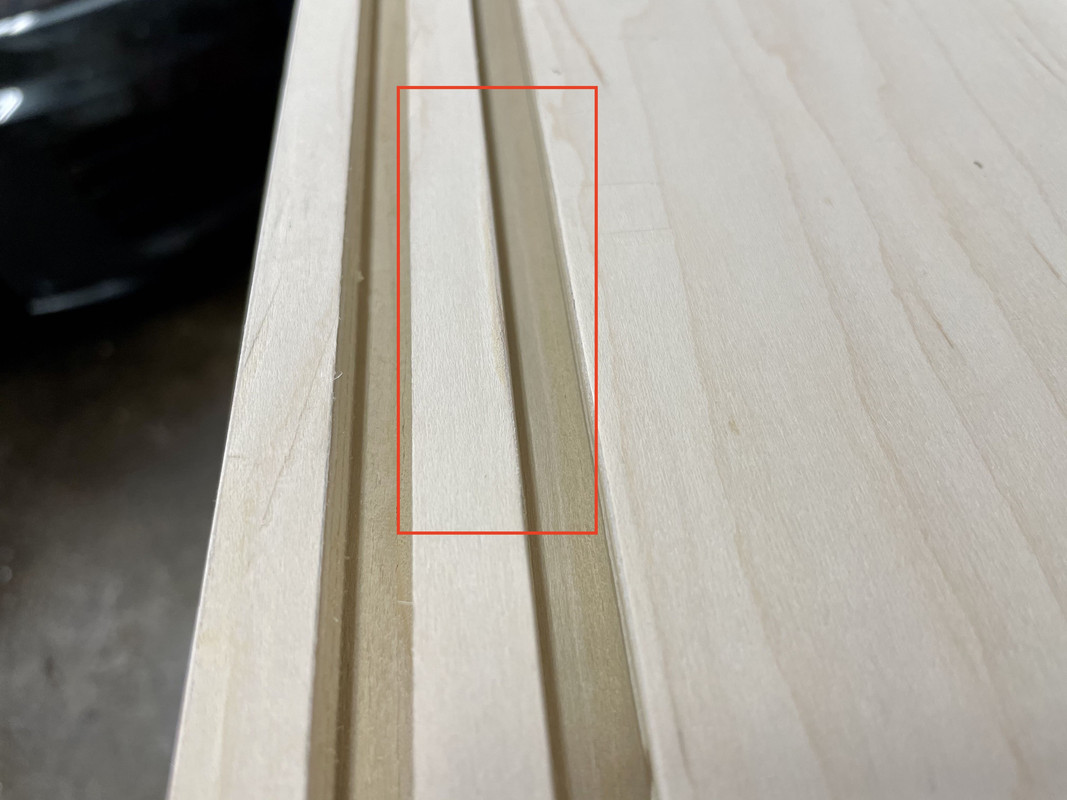
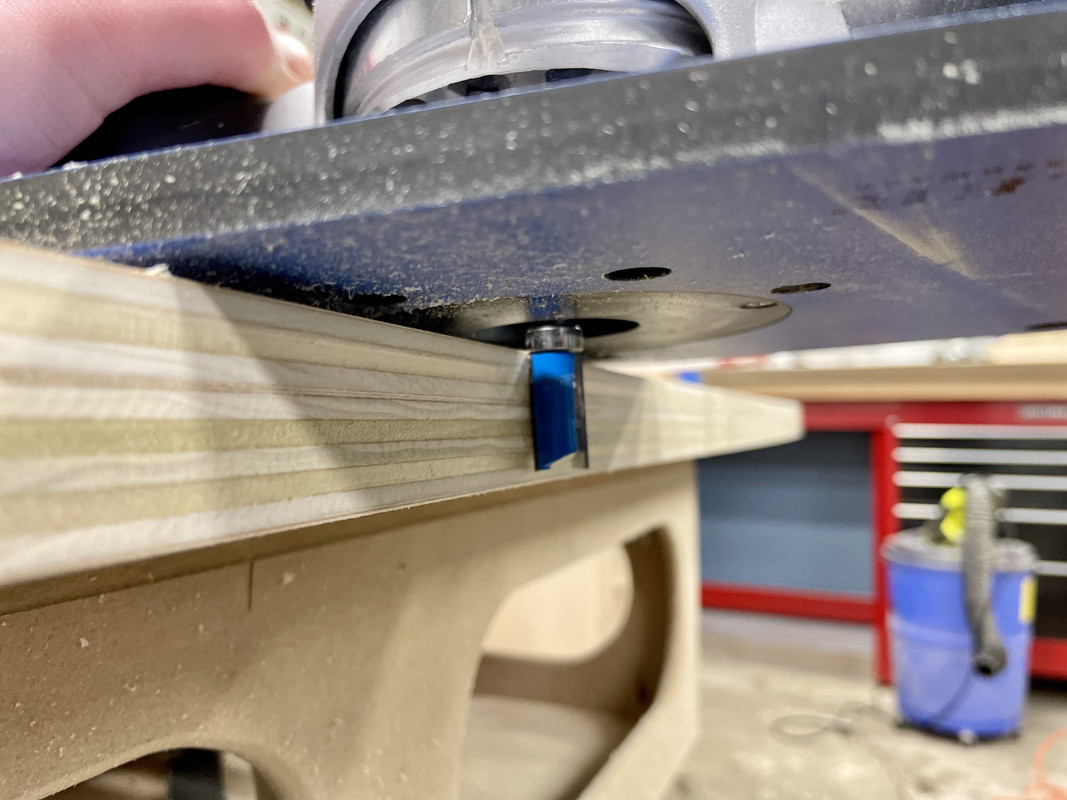
Before the Polar Vortex settled in I routed out that dado patch:

IMG-1397.jpg


Ran the router the right way this time. :lol:

A little sanding and it came out great I think! Pic below, in the red box is where the slip used to be:
IMG-1396.jpg


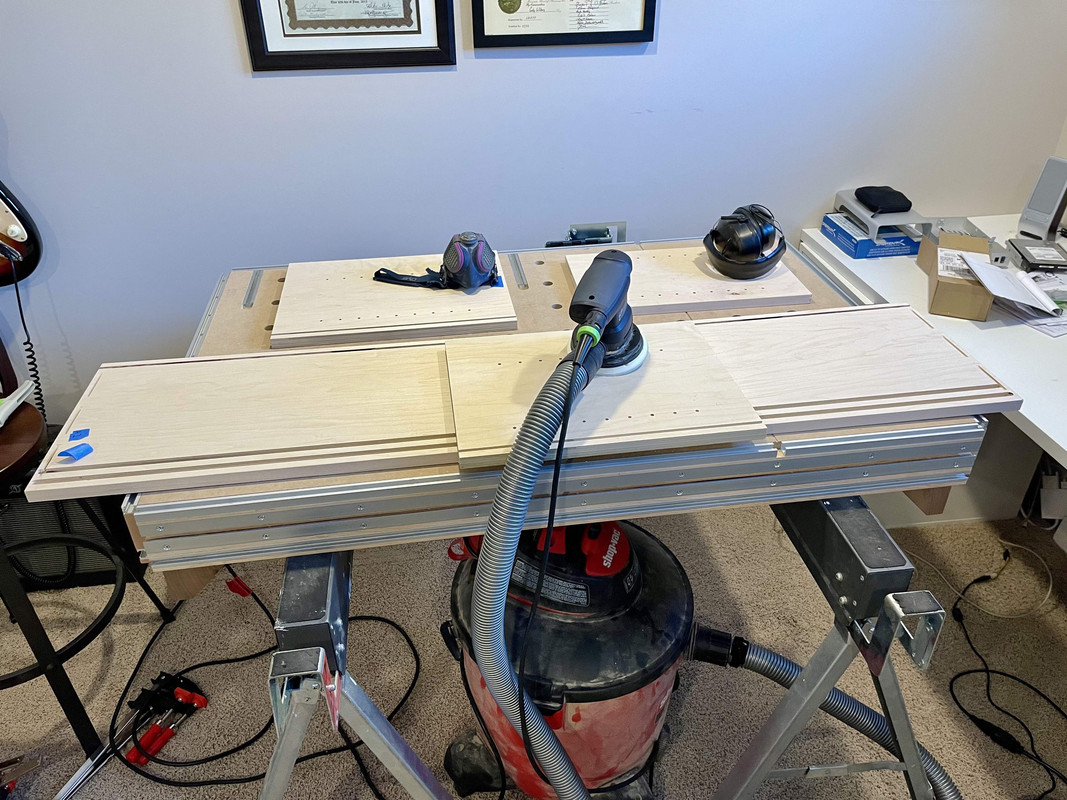
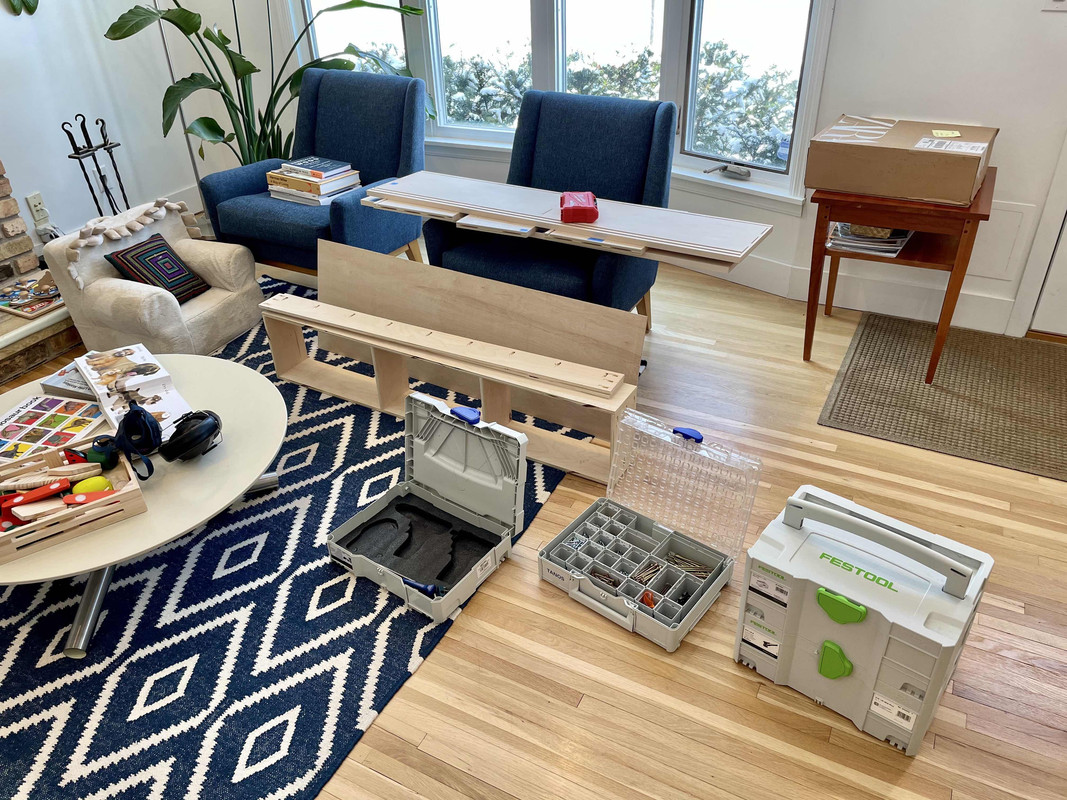
Then we started getting hit with the negative temps and I moved ALL my stuff inside. It's here to stay for a couple weeks and I won't be able to work outside so I brought it in! Including my MFT top into the basement office:
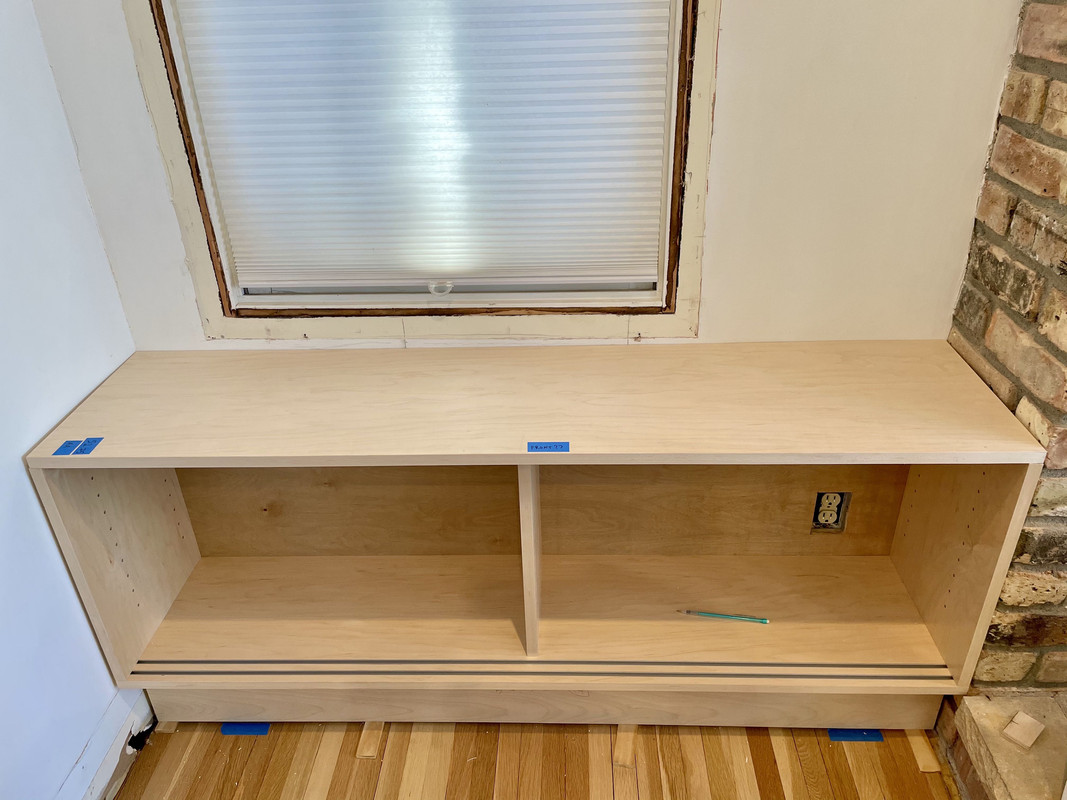
IMG-1405.jpg


Systainers taking over the living room:

IMG-1393.jpg


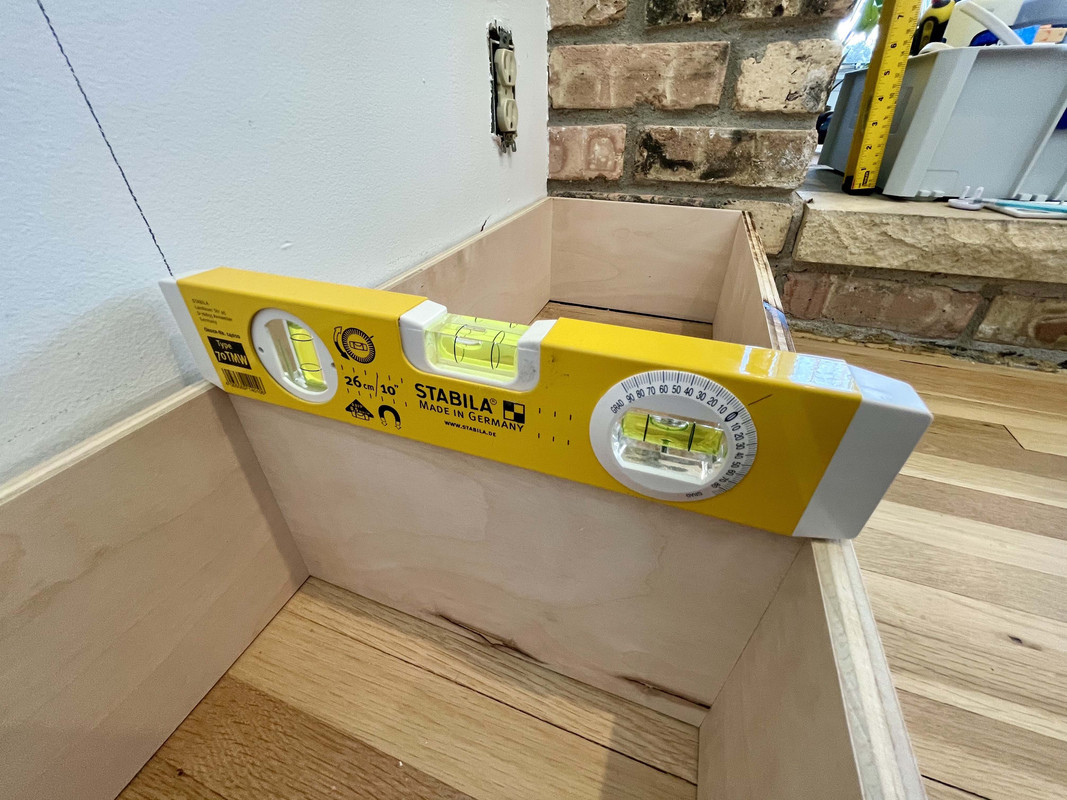
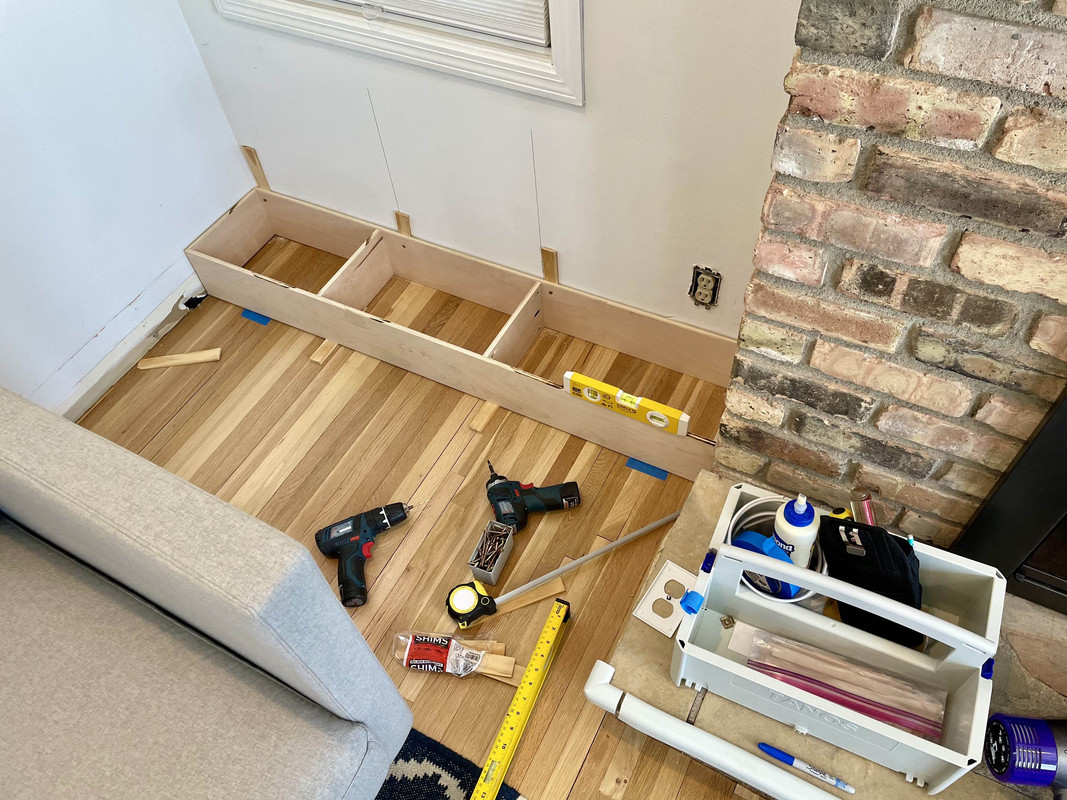
Started installing the toe kick / ladder base for the first cabinet. Turns out the floor was super sloped away from the wall:

IMG-1389.jpg


I've never done this before but I just used some wood shims to get it level and screwed the back into the studs.

IMG-1392.jpg


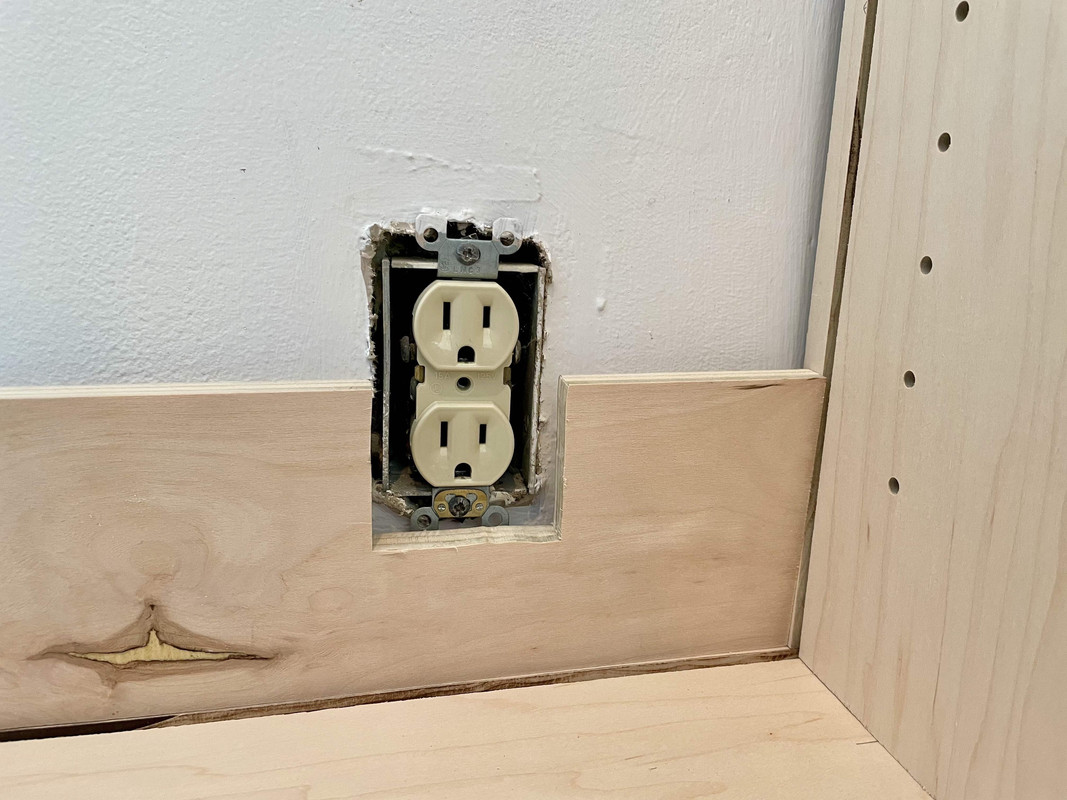
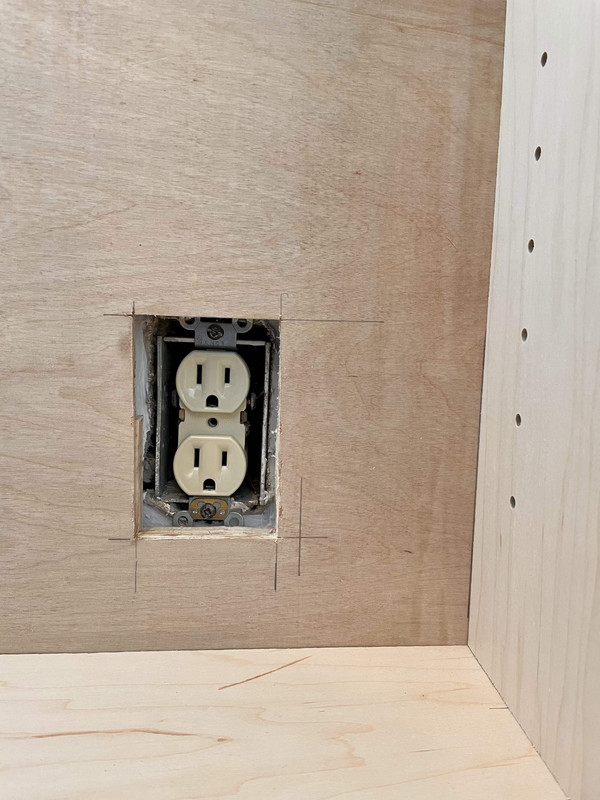
Then made some measurements and cuts in the lower nailer strip and backing panel for an outlet that needs to be passed through:

IMG-1394.jpg


IMG-1395.jpg


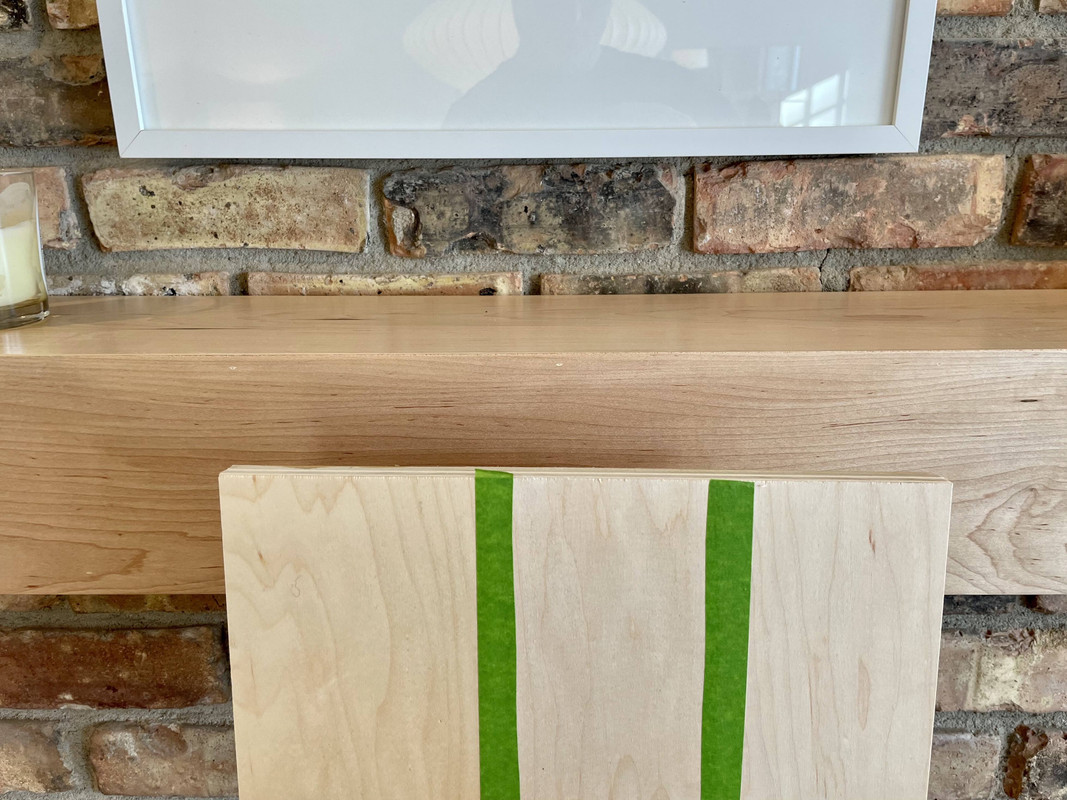
And lastly I did some sanding and put some more thought into finish. I decided the regular Minwax Wipe On was too yellow, especially against the mantle which is a particularly darker red specimen of maple.

IMG-1407.jpg


It's never going to match but I thought neutral would be better than yellow. So I tested the new waterbased Minwax Wipe On I ordered and went for it.

IMG-1410.jpg


IMG-1412.jpg


It dries super fast. Will be interesting to see what 2nd and 3rd coats are like.

I'm also trying to decide on what to put on the walnut:

IMG-1411.jpg


So far I've tested from left to right: Watco Danish Oil, Watco Danish Oil "Walnut", Varathane Water Based Poly, General Finishes Water Based Poly, and Minwax Wipe On.

Out of these I'm definitely leaning towards the regular Danish Oil on the left most test patch. I haven't branched out much with finishes, if someone has something they really like for walnut I'm open to suggestions.

:beer:
 

Unruh

Well-known member
Joined
Aug 12, 2017
Messages
1,431
Location
Silverdale, Washington
I always have the best lunch with General Finishes Arm-R-Seal. It is really similar to the Minwax Wipe-on, but I think it levels better. I also like the Deft Clear Wood finish spry. I don’t even sand the Deft between coats. I just add about 5 coats and call it a day...lol
 

topcok88

Well-known member
Joined
Jun 3, 2013
Messages
660
My preference on walnut is two coats of GF Arm-R-Seal Gloss and one coat of Arm-R-Seal Satin. These are the shelves in my built in area.

7f23d2ef628438c5364f0bb57b2bf656.jpg


Sent from my iPhone using Tapatalk
 

Attachments

  • 7f23d2ef628438c5364f0bb57b2bf656.jpg
    7f23d2ef628438c5364f0bb57b2bf656.jpg
    126.5 KB · Views: 0

Pingel85

Well-known member
Joined
Oct 10, 2017
Messages
115
Location
Green Bay, WI
Nick-

Quick question, I see the shop vac hose you have hanging to hook up to your tools. Do you happen to know what brand it is and do you like it? Replacing my worn out ridgid hose and would like something better

Thanks
 
OP
N

nicholam77

Well-known member
Joined
Dec 18, 2016
Messages
2,671
Location
Minneapolis, MN
I always have the best lunch with General Finishes Arm-R-Seal. It is really similar to the Minwax Wipe-on, but I think it levels better. I also like the Deft Clear Wood finish spry. I don’t even sand the Deft between coats. I just add about 5 coats and call it a day...lol

Well first off I don't think you should be eating Arm-R-Seal. Probably not good for you. :lol:

And thank you for the recommendation. I will have to try it. I had always assumed it was thicker, whereas the Minwax seems so fluid. I actually thought it had to be brushed on, too, but saw a Youtube from General Finishes themselves today showing it being applied with a rag. Not that I'm opposed to brushing... just in search for finishes that are easy to work with as I'll be more inclined to use them again.

My preference on walnut is two coats of GF Arm-R-Seal Gloss and one coat of Arm-R-Seal Satin. These are the shelves in my built in area.

[pic]

Well that's two votes so I'll definitely give it a test. Thanks for the pics... your shelves look great and I think some of that "warmth" is what I'm after. Everything I've put on so far darkens and pops the grain but stays pretty brown. Don't forget to post or send me a pic of your project when it's done!

Nick-

Quick question, I see the shop vac hose you have hanging to hook up to your tools. Do you happen to know what brand it is and do you like it? Replacing my worn out ridgid hose and would like something better

Thanks

Yes, it is this Bosch VAC005 hose I got on Amazon here. I see it's about $45 at the moment, I looked at my order and I only paid $32. I do like it. The larger end fits my Shop Vac brand 2 1/2" port natively, and the smaller nozzle end fits almost all my small power tools natively, either by fitting inside or over the outside of the tool's port. This includes the track saw, biscuit joiner, DeWalt sander, and Festool sander. The nozzle end is a rubber material. The hose is nothing special, but light weight and a good length. Size-wise it seems to be very similar to the Festool hoses, at a fraction of the price and without anti-static feature.

I also got two adapters for it, the VAC004 which adapts to 2 1/2" ports, and the VAC003 which adapts to 1 1/4" ports. This covers my table saw if needed, Ryobi jigsaw, and Massca pocket hole jig.

Lastly, my plunge router base has built in dust collection, but none of the adapters work, so I use the Rockler Dust Right small tools flexible hose, and this actually can connect to the Bosch hose nozzle end! Whereas previously I couldn't get it to work with a standard 2 1/2" shop vac hose.

I've not found the smaller 35mm diameter a problem, in fact all of my tools that support dust collection work quite well with it.

:beer:
 

mfg0772

Well-known member
Joined
Aug 8, 2018
Messages
146
Location
Northeast CT
Your patch turned out great. As for the finishes on the walnut, I like the left two on your sample.

You might want to try to change out the outlet to be a quad receptacle, possibly with usb ports. I have quad outlets in one built in, one with usb and the other with surge protection so I can plug the TV in there. My other built in is only a duplex and I will likely be switching that to a quad. It's nice to store laptops, iPads, and various charges inside out of sight but still able to charge.
 

topcok88

Well-known member
Joined
Jun 3, 2013
Messages
660
Nick - the only progress I have made is throwing together the cabinet boxes. Still have to cut the back panel, face frame, paint and mill/glue the walnut tops. Most certainly won’t be competed anytime soon due to work ramping back up for spring. I’ll probably get back to them in June.

Can’t wait to see more from you and watch the thread for updates!

97eb0e0e83965a0863603a19f2094c47.jpg


Sent from my iPhone using Tapatalk
 

Attachments

  • 97eb0e0e83965a0863603a19f2094c47.jpg
    97eb0e0e83965a0863603a19f2094c47.jpg
    79.4 KB · Views: 0
OP
N

nicholam77

Well-known member
Joined
Dec 18, 2016
Messages
2,671
Location
Minneapolis, MN
Your patch turned out great. As for the finishes on the walnut, I like the left two on your sample.

You might want to try to change out the outlet to be a quad receptacle, possibly with usb ports. I have quad outlets in one built in, one with usb and the other with surge protection so I can plug the TV in there. My other built in is only a duplex and I will likely be switching that to a quad. It's nice to store laptops, iPads, and various charges inside out of sight but still able to charge.

Thanks! Actually that is a great idea on the receptacles. I think I'm going to leave the one I'm working on as-is, but the cabinet on the other side will be accommodating an outlet, a dataport receptacle (coax and cat5e), and speaker wire. And due to your comment I realized I have several devices plugged in a 3 socket expansion plug currently (receiver, Airport Express, Sonos Connect). So I definitely need another outlet on that side. I think I'll have to open up the wall and do some reconfiguring.

Nick - the only progress I have made is throwing together the cabinet boxes. Still have to cut the back panel, face frame, paint and mill/glue the walnut tops. Most certainly won’t be competed anytime soon due to work ramping back up for spring. I’ll probably get back to them in June.

Can’t wait to see more from you and watch the thread for updates!

Those look great! Making stuff is a long process... I always forget how many steps there are. I've been working on mine almost daily it feels like. Your pic is one of my favorite stages in a project though -- partially done but in the space so you can start to visualize it.

Is that a speaker in the middle cavity?
 
OP
N

nicholam77

Well-known member
Joined
Dec 18, 2016
Messages
2,671
Location
Minneapolis, MN
Living Room Built Ins - part 9 - scribing

Tired of this project yet?? :lol::lol::lol:

It's been damn cold. I've been seeing a lot of sun dogs though which is cool.

IMG-1427.jpg


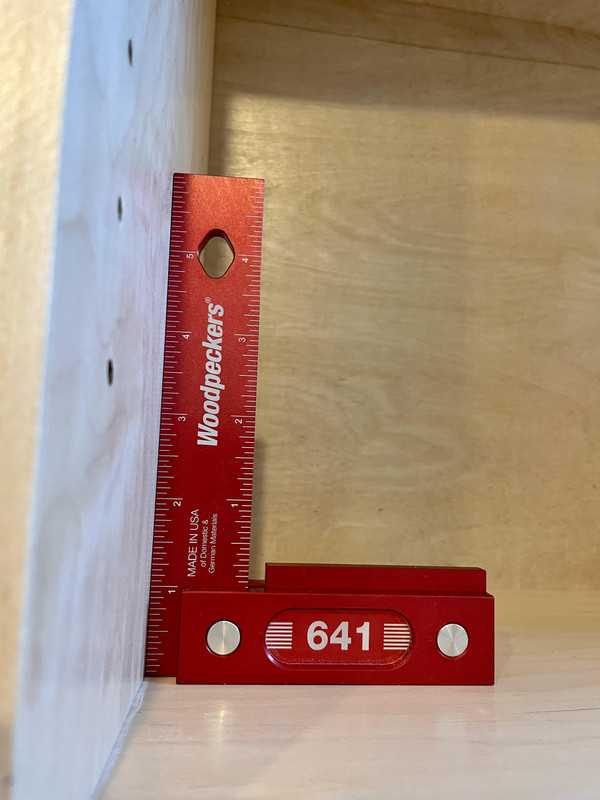
I won't bore you guys with another glue up, it went successfully, other than the obligatory Woodpecker square shot to prove it's square from at least one joint:

IMG-1424.jpg


But really, the whole thing is square as I've ever done. Feeling good about that.

I've never scribed anything before, so I thought I'd share a little about that in case it helps anyone, or maybe some of you can give me some tips. :D After all, it's the one part of this project that actually makes them "built ins" in my opinion, and a loose definition at that.

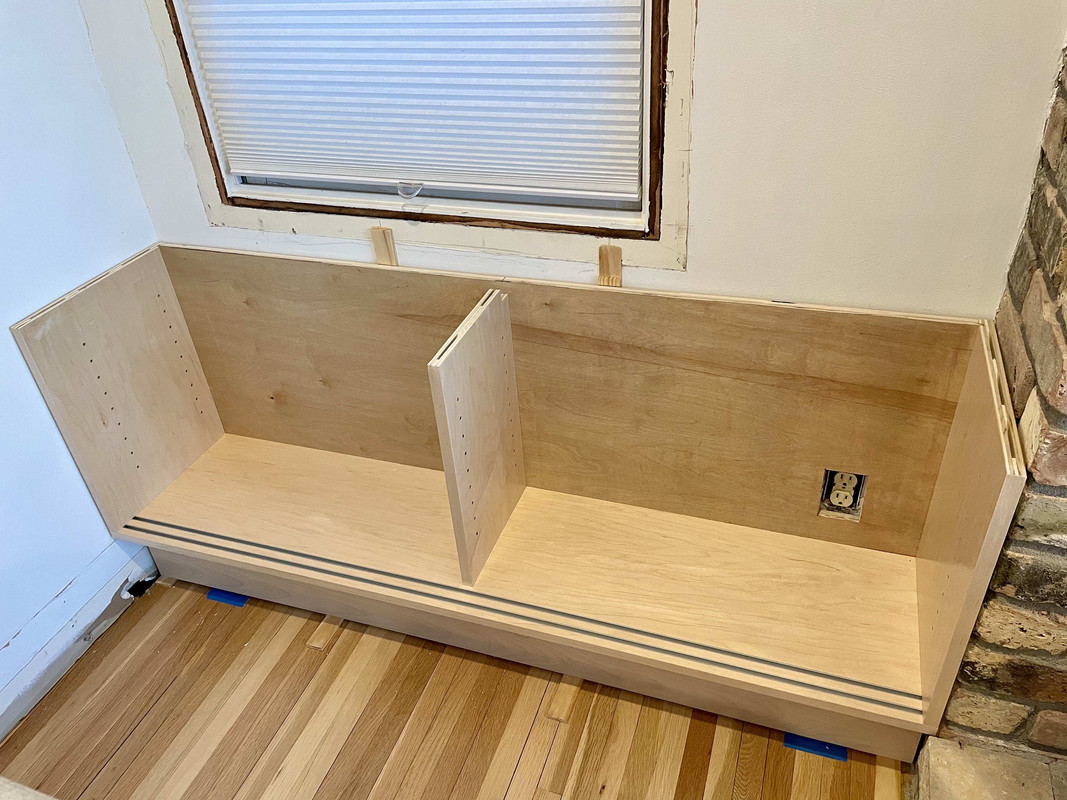
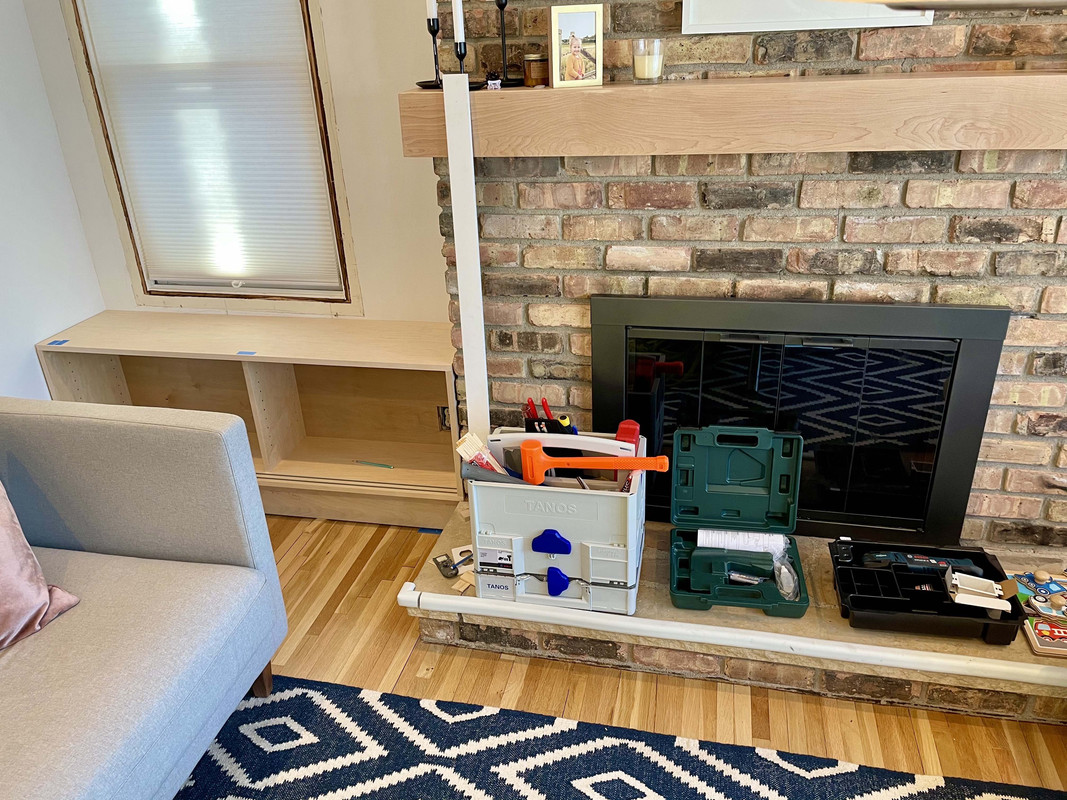
Basically with the toe kick base leveled, and the cabinet screwed and glued together (except the top), I set it in place:

IMG-1434.jpg


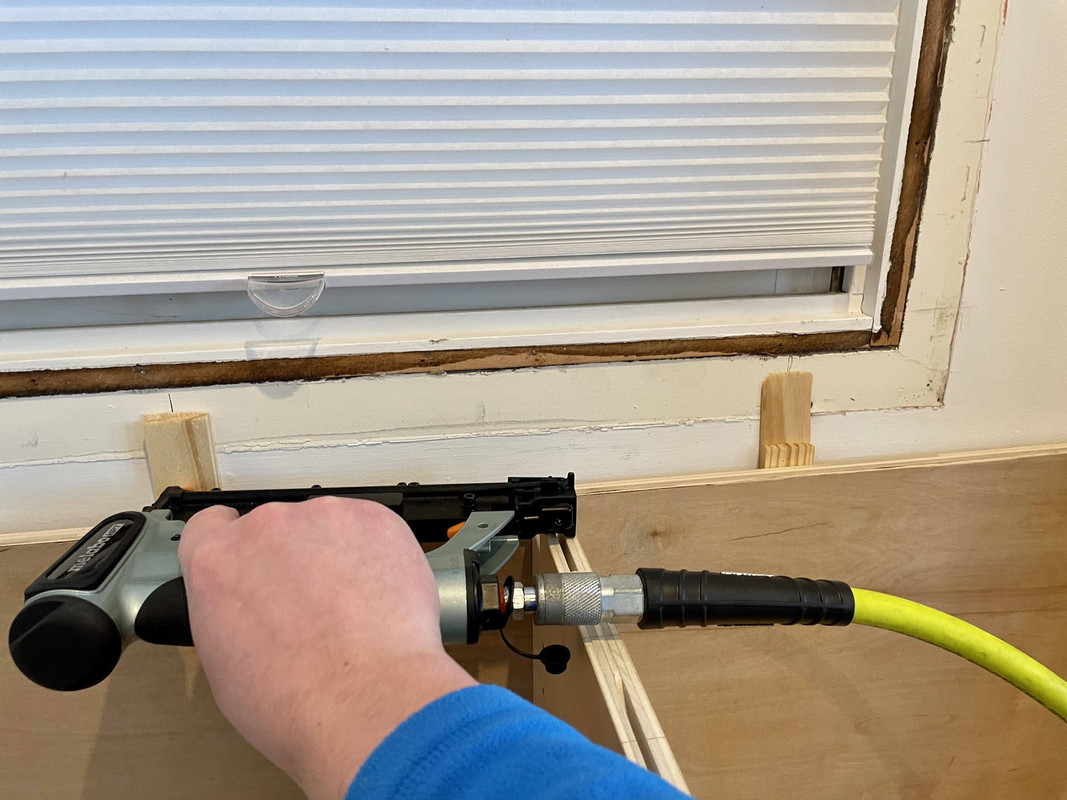
I measured from the wall on each side to make sure it was sticking out the same amount, positioned where I wanted, and then placed some shims behind the top nailer strip aligned with some studs, and tacked them into place.

IMG-1428.jpg


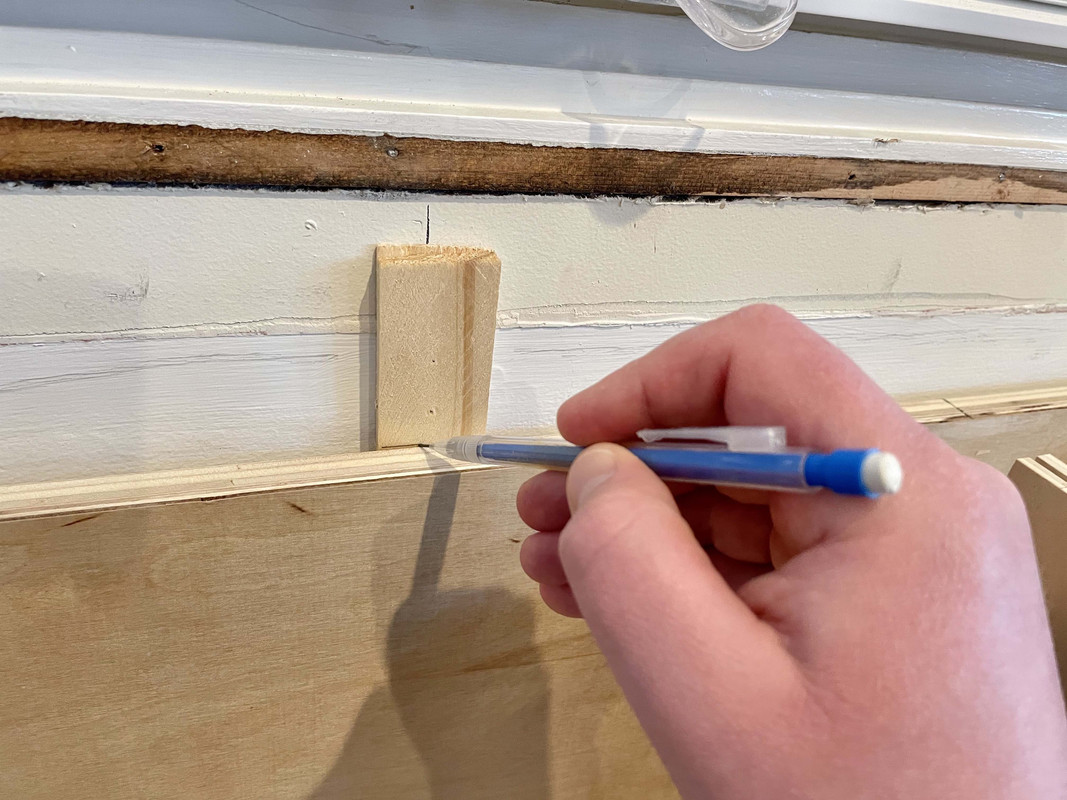
Then I marked on the shims where the top of the cabinet was, and cut them away so they don't stick up above the surface.

IMG-1432.jpg


IMG-1437.jpg


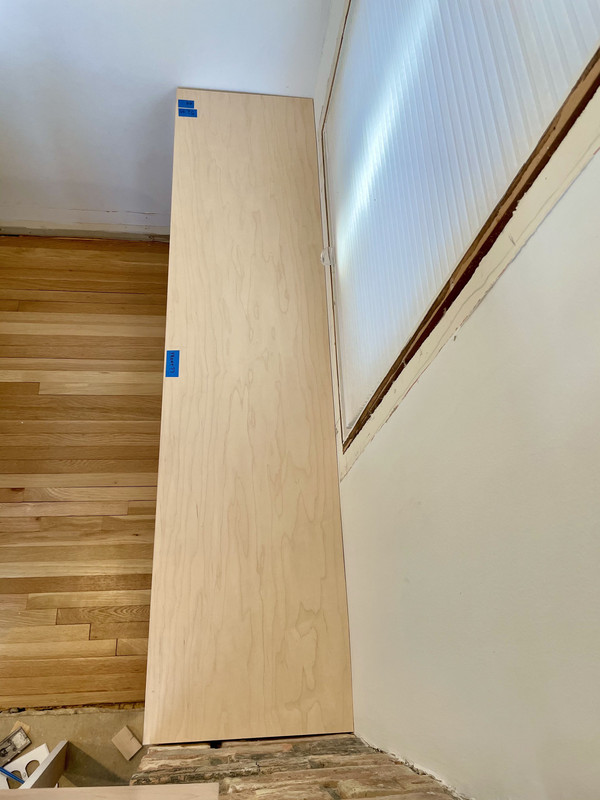
Next I cut a long board of plywood the same length as the cabinet is wide. Exactly. And place it on the top and push it all the way to the wall. It will be used as a template.

IMG-1442.jpg


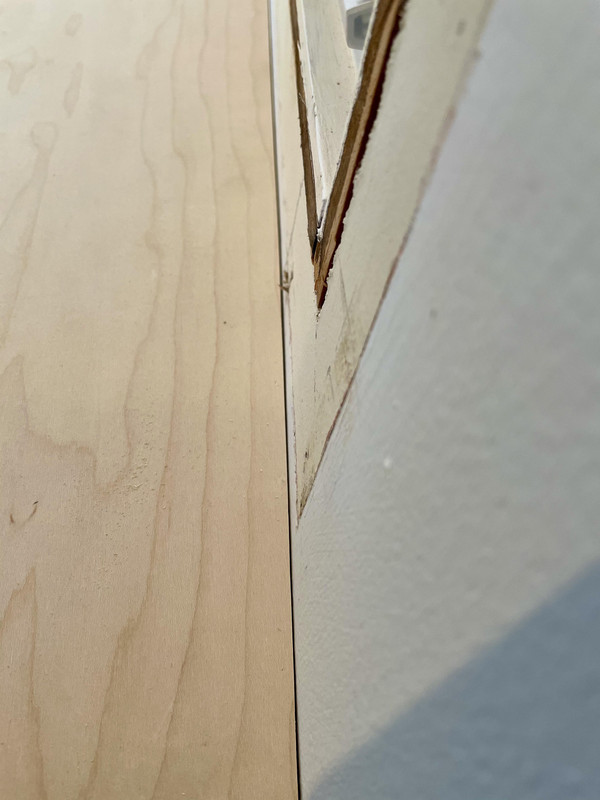
It's immediately evident there is "sag" in the middle of the wall, i.e. the corners are tight but the middle is not. At it's worst it was about a 1/4" gap!

IMG-1440.jpg


IMG-1441.jpg


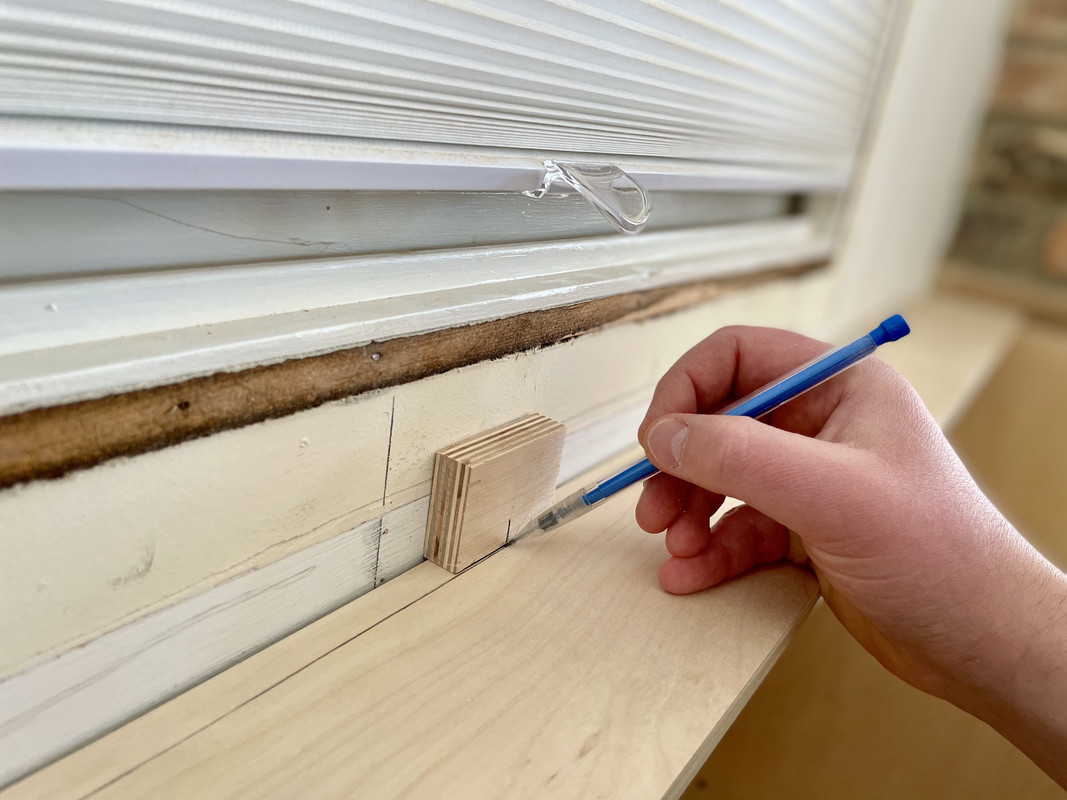
Securing the template board with some double sided tape, I scribed against the back wall with a small block of plywood and pencil:

IMG-1445.jpg


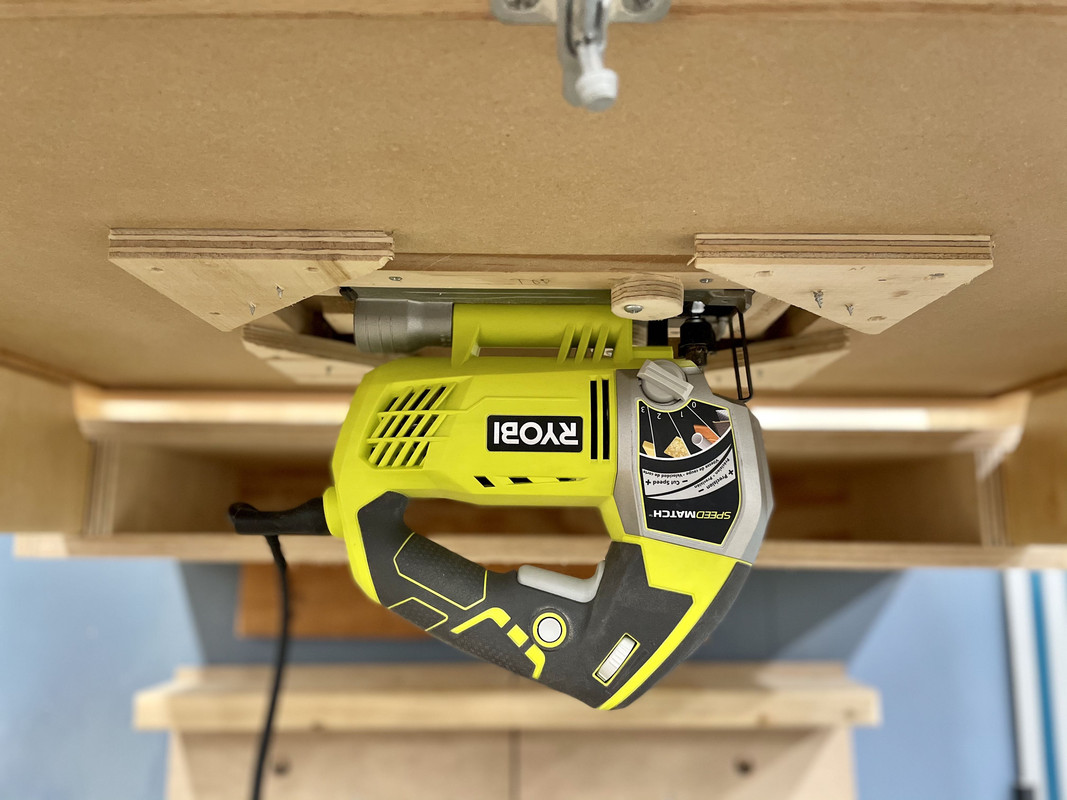
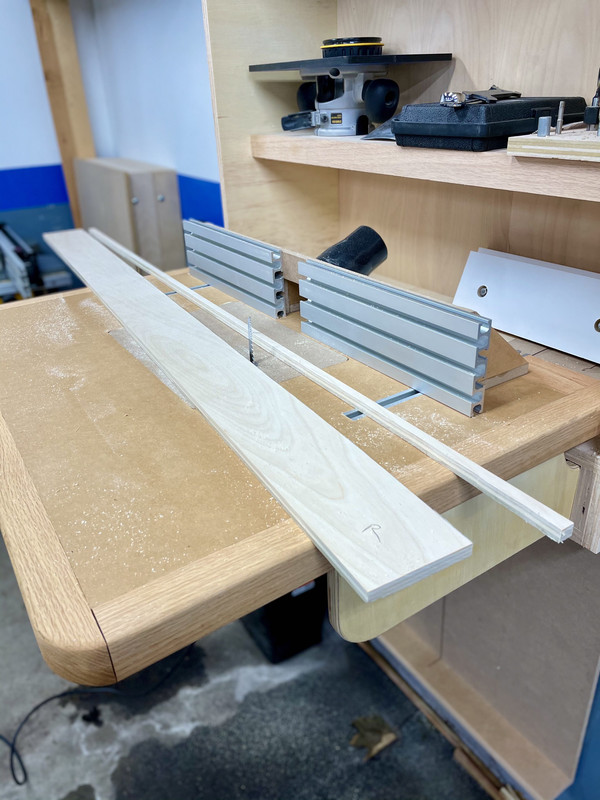
Then I take it out to the shop and cut to the line with the jigsaw. Because of the long skinny board I thought this would be easiest on the router table (some of you may recall I made an inverse jigsaw module for my router table):

IMG-1446.jpg


IMG-1450.jpg


And this is why I never use it. The blade wanders too much. I've never had great luck with jigsaws. Maybe I'm just bad at using them haha.

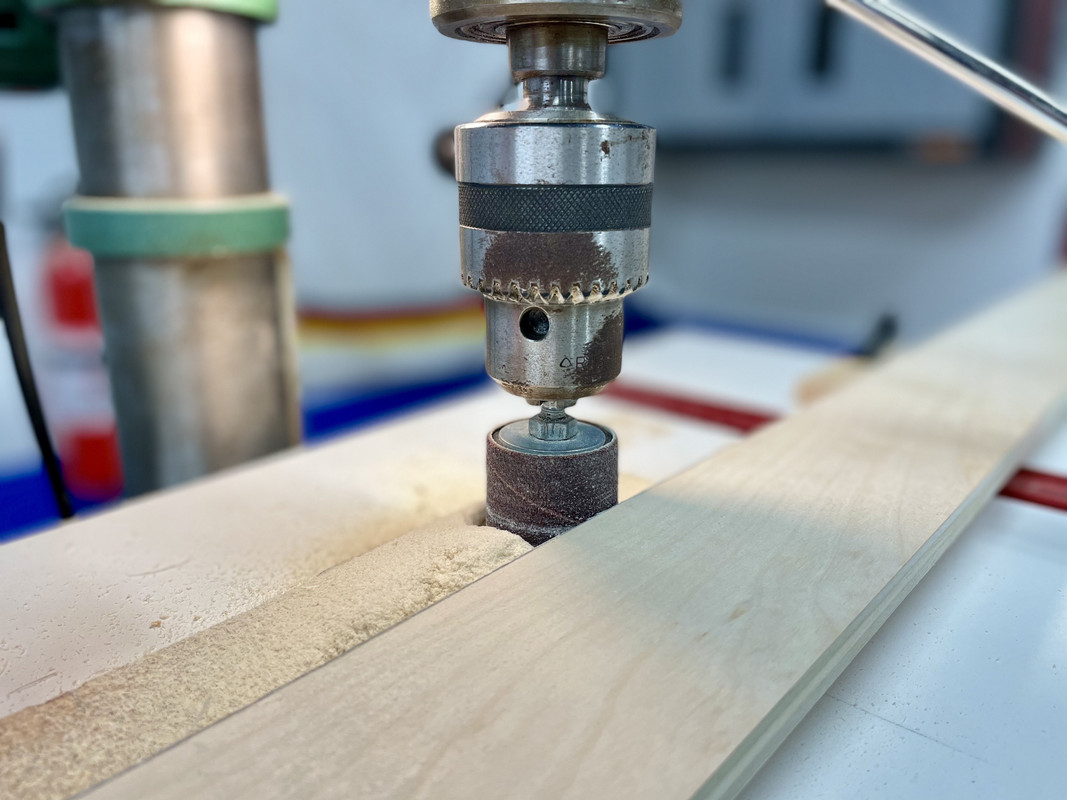
I brought it in for a test fit, but wasn't 100% happy, so I scribed again and tried again. This time I cut freehand right side up, a little proud of the line, and attempted to sneak up to it with a sanding drum on the drill press:

IMG-1452.jpg


Again... I got quite close, but not the perfection I was after. It's difficult to sneak up on a line with a small drum. I feel like a larger oscillating belt sander would be easier. To smooth it out I tried using a sanding block and orbital sander. I felt like I was just making things worse. But, it turned out acceptable. Or perhaps I just got tired of trying. They say third time's the charm but sometimes the second time is good enough. :dunno:

Next step is to place the board fit in place again, and I needed something to reference the front edge of the cabinet, and the back edge of the template board, on each side. I used my 3D printed parallel guides for this:

IMG-1454.jpg


Then back in the garage I can take the actual oversized top of the cabinet, clamp the parallel guides in place, and **** the template up to them:

IMG-1456.jpg


IMG-1455.jpg


And finally, jigsaw within 1/8" of the line, and then follow up with router and flush trim bit:

IMG-1458.jpg


IMG-1459.jpg


So, why did I do it like this vs. just scribing the actual top? First, I didn't trust my jigsaw skills to get it right the first time. Second, I didn't trust my jigsaw to leave a clean cut. And I wasn't going to leave anything to chance ruining this top I had one try to get right.

But it was a lot of time. What should have been a simple task took hours. It did however, seem to work. Haven't attached the top but here is the fit:

IMG-1461.jpg


IMG-1462.jpg


IMG-1463.jpg


It's about a 1/16" off in some spots. I feel like I could get it even tighter if I chamfered the underside for a knife edge. In any case, much better than the original 1/4" gap.

One step closer...

IMG-1465.jpg


Like I said at the top I've never scribed before, or installed cabinets before. I've watched some YouTubes but I'm also kind of making it up as I go. So if I'm doing it wrong be sure to let me know. :D

:beer:
 

loganb

ALLIANCE MEMBER
Joined
Dec 29, 2011
Messages
5,572
Location
Omaha, NE
I'd say that's a pretty nice job there scribing that! Guess it means you should add a 12" to 14" bandsaw to the 2021 XMas list so you can cut closer to the line than you can with the jigsaw!
 

mfg0772

Well-known member
Joined
Aug 8, 2018
Messages
146
Location
Northeast CT
Nice update. At first, I was thinking just cheat with a backsplash type trim. However, seeing it in place, it looks clean without it and I think it was worth the effort.
 

jar944

Well-known member
Joined
Jul 26, 2010
Messages
5,935
Location
Northern VA
So a tip for the next scribe. Cut about 1/16 to maybe 1/32 or so short of the line, but cut it on a bevel. Then use you block plane, RO, palm belt sander or angle grinder with a sanding disc to sneak up to the line. The back bevel on the primary cut means you only have a small amount to sand off but you maintain clearance under the line.
 

jake28

Well-known member
Joined
Aug 28, 2018
Messages
487
Location
SF, CA
So a tip for the next scribe. Cut about 1/16 to maybe 1/32 or so short of the line, but cut it on a bevel. Then use you block plane, RO, palm belt sander or angle grinder with a sanding disc to sneak up to the line. The back bevel on the primary cut means you only have a small amount to sand off but you maintain clearance under the line.


genius. To be filed under “today I learned.”
 

TomGW

Well-known member
Joined
Apr 14, 2014
Messages
48
Only catching up on this thread just now. Great work.
As the two routing errors were into the margin between the two slots, I would have been inclined to use the router to remove the top 2 plys in that centre section and do the reverse on a scrap piece of ply, then glue it into the gap and re-route the slots. I suppose it would have been advisable to create the patch first, to whatever thickness, before reducing the centre out of the workpiece. Too late now but just an idea.
 
To avoid these ads, REGISTER NOW!
Top Bottom