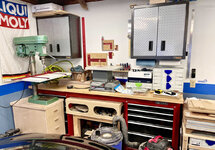
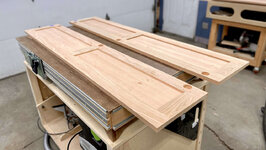
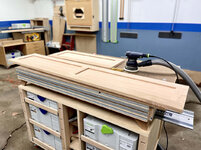
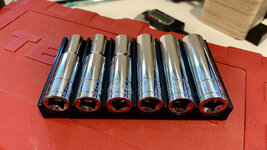
I was going to give you a hard time about completing the "YouTube Woodworker Starter Pack" collection of tools, but held back because I didn't want to rain on your parade. That's what I get for trying to be nice...
Lol! I would not have been upset by that in the least... I've spent my fair share of time on woodworking YouTube channels and I know how true it is...
___________________________________
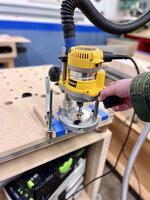
So the purpose for the Dominos is to make a router-based loose tenon jig for cabinets. Heavy inspiration from Peter Millard:
For what it's worth, an actual Domino is a tool I would like to have (as I'm sure a lot of people would), and I have considered it before but always come back to price and the work I currently do. I think if I was building hardwood furniture with angled joints and such I'd be more open to it, but right now focusing on cabinets it's simply too expensive.
My biscuits-and-pocket holes strategy has worked fine for cabinets, but what I'm hoping to improve with this loose tenon jig is:
1/ improved accuracy (biscuits help align, but have enough play where I still need to finesse everything in glue up)
2/ not use two joinery methods. The pocket holes add a lot of strength to the joint but doing that
and biscuits takes twice as long
3/ have a viable joinery method for materials like melamine where pocket screws don't hold that well
I couldn't copy Peter Millard's jig exactly, because he's using a metric router bushing and metric plywood.
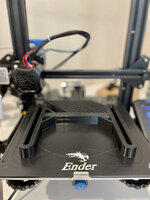
Because getting the exact size opening for the bushing requires some math and could be pretty fiddly, I decided to turn to Fusion360 and the 3D printer to make up a little spacer block to reference:
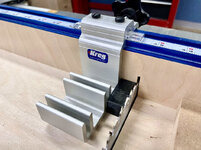

Which got me close. But I'm planning on a "narrow" and "loose" mortise setting just like the actual Domino, so I wanted the "narrow" setting to fit quite snug, and this first pass was a little loose side-to-side:

I figured this would happen, and intentionally made my Fusion360 model parameterized, so I could easily change the needed spacer length without redoing a bunch of math:

Once I was happy with the fit, I glued everything up:

Not very pretty, but next I will use this as a template to remake the jig in 1/2" baltic birch plywood, same as Peter Millard did. Which involved some layout, clearing out the waste sections of the plywood with the drill press and jig saw, and then template routing with the router.

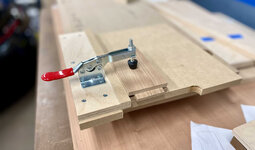
MDF clamped to plywood below for template routing:

This mostly worked, but the bushing was a
very tight fit in the resulting plywood pieces. A little too tight. So I had to open the holes up a bit with some careful hand sanding. I hope this won't affect the accuracy much, I tried to sand consistent faces.
Next the two plywood halves needed to be glued together:
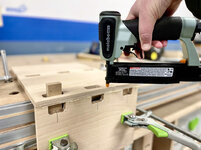
This type of operation is easier said than done, and the inside face of the wide mortise needs to be flush with the lower plywood piece (hence the MDF registration stick poking up out the hole).

The MFT helped a lot with this operation, but it wasn't square, so I took it out of the clamps and clamped some 90° squares to it while it dried.
Time for the big test.
I highly suggest watching the Peter Millard video for better idea on how it works, but basically one side has "loose" mortise templates, and the other has "narrow" mortise templates. I marked out some scrap 3/4" MDF and routed the loose mortises first.
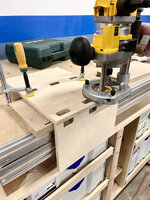
Then the narrow:

Here you can see what I mean about narrow vs. loose:

The purpose of the narrow mortise is to align the front edge of the cabinet flush, then the rest of the joints get narrow on one piece but loose on the other so they aren't too difficult to put together.
When I first put it together I was disappointed to see a lip:

But then I flipped it around and all good:
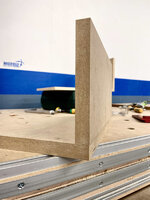
This comes down to the orientation of the jig and which face of the workpiece it references. I tried to make everything to tolerance so it wouldn't matter, but with different material thicknesses etc, unfortunately I think it's something that will have to be kept track of. One of the confusing elements of biscuit-joinery I don't like (where to reference the fence).
I need to do some more tests and build a practice carcass, but hopefully it will be another tool in the cabinet-making repertoire!


 so... April Fools I guess?! (there is no Domino)