
You are using an out of date browser. It may not display this or other websites correctly.
You should upgrade or use an alternative browser.
You should upgrade or use an alternative browser.
nine4's projects, restorations and blunders
- Thread starter nine4gmc
- Start date


Outlawmws
Well-known member
So that drive uses both a jack-shaft, with what appear to be flat belts, and a gear reducer? They are not too concerned with belt slippage if they are using flat belts...
As I mentioned before, it uses a reeves drive which has axial spring pressure to compresses the sides of the belt decreasing the chance for slippage. Off the top of my head, the reeves system gives ~7:1 max ratio and their gearbox gives ~12:1 fixed ratio.
Last edited:
As I mentioned before, it uses a reeves drive which has axial spring pressure to compresses the sides of the belt decreasing the chance for slippage. Off the top of my head, the reeves system gives ~7:1 max ratio and their gearbox gives ~12:1 fixed ratio.
This ^^^
The reeves drive is very much like the drive in a snowmobile and give a great range of speeds depending on where the belts are riding on the sheeves.
Outlawmws
Well-known member
As I mentioned before, it uses a reeves drive which has axial spring pressure to compresses the sides of the belt decreasing the chance for slippage. Off the top of my head, the reeves system gives ~7:1 max ratio and their gearbox gives ~12:1 fixed ratio.
So for practical purposes the concerns about "belt slippage" are nil as the factory is using belts at both ends, and those reeves drives aren't exactly known for being "slip free"... The Reeve gives you a slight variation in SFPM for different metals but the saw is less than ideal for cutting wood.
All design parameters clearly driven by the selection of an AC motor which lacks torque, and needs to run at full speed to perform optimally. Completely understandable in a factory environment running on three phase; not a limit for a home hobbyist.
Treadmill motors being AC/DC designs have tons of torque, are variable speed with minimal loss in torque, and moreover develop well over 2 HP total, so are more than powerful enough for the job...
Nines, if you want, you CAN use a TM motor, and one jackshaft. You can get there easily with the pulleys you have. The jackshaft needs a 10" and a 3" and you can get to 200 SFPM at 750 RPM. A cake walk for a TM motor.
You will be more limited at top speed to about 1000 SFPM (depends on the particular TM motor) with those pulleys. An option is to run a double pulley with maybe a 4 & 6 on the motor, and an 10 + an 8 on the jackshaft and you can get to at least 2500 SFPM with a quick belt change. - Mount the motor on a hinge so its weight does the belt tension, and you just lift the motor and move the belt to the second set.
So now you have two options.
Outlaw, the good thing is, the motor is already on a hinge. if you check out the manual link above, this machine has a foot pedal on front that is the "brake". It allows you to step on the pedal when you turn off the machine to stop the blade from turning and potentially injuring someone that does not know it's spinning(according to the instructions). Anyway, it has a foot operated motor hinge, perfect for easy belt changes.
Manual: http://vintagemachinery.org/pubs/1141/6050.pdf
Manual: http://vintagemachinery.org/pubs/1141/6050.pdf
Last edited:
slodat
ALLIANCE MEMBER
The brake has a brake shoe. It doesn't interact with the motor plate.
Oops, the roller base is in the way on mine so I didn't get to check it out good but I know my motor is on a hinged plate as well, I lifted it and pulled the belts off a couple days back.
Thanks slodat!
Sent from my iThingy using Tapatalk
Thanks slodat!
Sent from my iThingy using Tapatalk
slodat
ALLIANCE MEMBER
I have a friend who might have a chunk of the friction lining if you need it.
OccupantRJ
Well-known member
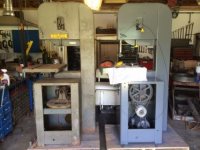
I hate to be the one to break this to you Nines, but a complete conversion to get 200 fpm on a Delta 20 is sitting in my shop. It is a reduction gearbox that takes a NEMA C face motor. Brackets already made, and bolts right into the base of the saw. A #50 chain drive with 2 sprockets was used. I will get some pics for you while in the shop this afternoon.
I have both a wood/metal saw with vari-speed, and a wood saw in the Delta 20" models.
I have both a wood/metal saw with vari-speed, and a wood saw in the Delta 20" models.
Attachments
So for practical purposes the concerns about "belt slippage" are nil as the factory is using belts at both ends, and those reeves drives aren't exactly known for being "slip free"... The Reeve gives you a slight variation in SFPM for different metals but the saw is less than ideal for cutting wood.
NO THEY ARE NOT. I don't understand why this is so difficult for you to understand, I would think in all your years of "experience" you would be able to understand the basics of drive systems. Belt slippage on the extreme surface of the pulley in a reeves drive minimized due to the higher belt tensions due to the axial compression of the variable pitch sheave.
THE GEAR BOX IS DIRECTLY COUPLED TO THE DRIVE WHEEL.
Where torque and thus the chance for belt slippage is at a maximum. Read that however many times it takes for you to understand and retain.
Rant over

Outlawmws
Well-known member
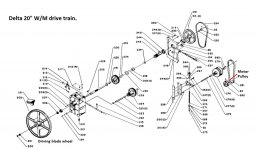
OK, I missed the fact the the drive wheel was on the box on your postage stamp sized diagram, it looked like a pulley to me.
As to slippage, instead of reading only advertising hype, read some real life commentary from some the lathe groups that deal with these drives. It NOT a low slip system. The design was still built around an AC motor, hence the decision to use a Reeves. Its called design compromise, a well known fact of life to any engineer.
As to slippage, instead of reading only advertising hype, read some real life commentary from some the lathe groups that deal with these drives. It NOT a low slip system. The design was still built around an AC motor, hence the decision to use a Reeves. Its called design compromise, a well known fact of life to any engineer.
I'm in the middle of a road trip and can't do research conveniently right now but why would something as simple as a 10:1 reducer on the motor with the output directly driving the drive wheel? Would that not be in the 175 rpm range for a 1750 motor? What am I missing here?
Sent from my iThingy using Tapatalk
Sent from my iThingy using Tapatalk
Outlawmws
Well-known member
Nine, I think you confused the RPM with the SFPM.
I know the difference in name but the calculator I'm using on vintage machinery doesn't explain how to figure sfpm from rpm when using a gear reducer.
I'm thinking it's more manual math with numbers and symbols and maybe some pie... Mmmm pie...
Sent from my iThingy using Tapatalk
I'm thinking it's more manual math with numbers and symbols and maybe some pie... Mmmm pie...
Sent from my iThingy using Tapatalk
Thanks Slodat, I'll have a look at it when I tear into the machine.
Occupant, nice! I would like to think that I don't need any more band saws but after seeing your two together, I can't think of a reason that I wouldn't need at least one more...
So how much $$ do you want for that five dollar conversion?
Sent from my iThingy using Tapatalk
Occupant, nice! I would like to think that I don't need any more band saws but after seeing your two together, I can't think of a reason that I wouldn't need at least one more...
So how much $$ do you want for that five dollar conversion?
Sent from my iThingy using Tapatalk
Outlawmws
Well-known member
I know the difference in name but the calculator I'm using on vintage machinery doesn't explain how to figure sfpm from rpm when using a gear reducer.
I'm thinking it's more manual math with numbers and symbols and maybe some pie... Mmmm pie...
Sent from my iThingy using Tapatalk
If you have the final wheel's RPM, its RPM X ((3.1415*20)/12) or RPM X 5.23583
Pi (3.1415) times the Diameter in inches (20) = the circumference of the wheel, divided that by 12 = how many feet (per revolution)
OK, I missed the fact the the drive wheel was on the box on your postage stamp sized diagram, it looked like a pulley to me.
As to slippage, instead of reading only advertising hype, read some real life commentary from some the lathe groups that deal with these drives. It NOT a low slip system. The design was still built around an AC motor, hence the decision to use a Reeves. Its called design compromise, a well known fact of life to any engineer.
As the picture guru you are, you should know that if you click on the image it will enlarge.
Not to mention the fact that I stated it is a direct drive numerous times in this thread. The decision to use a reeves drives was to increase packaging efficiency and to prevent the operator from from having to go in and manually switch the belt from one sheave to another. The only other advantage to a reeves drive in a machine tool is to be able to dial slightly away if you happen to hit a natural frequency, which is seldom an issue on a bandsaw. As a belt drive it still has to adhere to the same limitations of ~7:1 max ratio as I mentioned before in this thread.If you want to play mechanical wizard with a number of jack shafts and a DC motor go right ahead, it's not the right way to do it, but go ahead.
Last edited:
Outlawmws
Well-known member
ZK, it was never a matter of a "right way" or a "wrong way" it a matter of options Nine has to accomplish what HE wants out of this saw. Period.
It can be done either way, and more. If he goes with the "factory" option he has a metal cutting saw no longer optimized for wood.
If he uses your proposal of a gear drive motor, unless that motor is also easily variable, he has a saw optimized for ONE speed and might not be as well suited for softer metals.
With a TM motor and ONE jackshaft he gets all of the Metal cutting speed optimized, and MUCH better wood cutting speeds. If the TM motor is one of the TM motors like the one on my DP, (5000 RPM+) he gets it all with plenty of speed for wood.
Bottom line it HIS choice, not yours, not mine.
It can be done either way, and more. If he goes with the "factory" option he has a metal cutting saw no longer optimized for wood.
If he uses your proposal of a gear drive motor, unless that motor is also easily variable, he has a saw optimized for ONE speed and might not be as well suited for softer metals.
With a TM motor and ONE jackshaft he gets all of the Metal cutting speed optimized, and MUCH better wood cutting speeds. If the TM motor is one of the TM motors like the one on my DP, (5000 RPM+) he gets it all with plenty of speed for wood.
Bottom line it HIS choice, not yours, not mine.
OccupantRJ
Well-known member
Even if I keep it for wood and foam(which is fine too), I'd want to slow this machine down to 2500 or so, it's just too fast at over 5k.
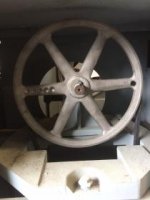
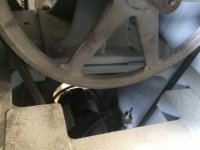
You can use a 12" V pulley on the lower wheel shaft along with a 4" V pulley on the 1725 motor shaft and get 3,010 feet per minute blade speed. This is how I have my wood saw set up. The motor mount will allow you to slide it toward the operator side of the saw, then a 12" pulley will clear in the larger part of the opening in the lower wheel support casting. See the pics.
Attachments
OccupantRJ
Well-known member
Outlawmws
Well-known member
He could also get an 1100 RPM motor and be just under 3300 SFPM with the 4" pulley, or 2880 with a 3.5" pulley.
OccupantRJ
Well-known member
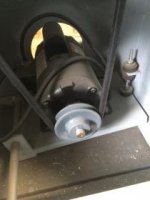
OccupantRJ
Well-known member
Nine, here is a pic of the mounting bracket and gearbox I had made up for the saw to make it for metal cutting. This saw went under in a flood, but since the gearbox is oil sealed, no harm done. The motor did not take to the water so well. I was using a double reduction 100:1 gearbox with a 3450 motor to produce approximately 180 fpm blade speed. Motor was vertically mounted to the flange in the lower part of the pic. I used a #50 roller chain drive to the lower wheel shaft at a 1:1 ratio.
Attachments

OccupantRJ
Well-known member
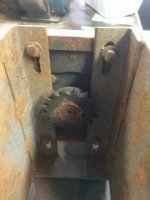
OccupantRJ
Well-known member
Last pic. Maybe these pulley and gearbox pics will help with ideas on your project. This is a view of the double reduction gearbox, 100:1 ratio, sitting as it was mounted in the saw. Not a very difficult project really. Two holes were drilled in the lower wheel support crossbar, and a piece of angle iron used on the lower end to bolt the bracket across the doorway of the saw frame.
Attachments

Last edited:
OccupantRJ
Well-known member
Occupant, super thanks for posting that, do you have any issues with belt slipping using a single belt?
Sent from my SM-T230NU using Tapatalk
Hopefully not, as the saws for wood cutting were designed this way. I just used different pulleys to drop the blade speed where I wanted it, as I already have another Dewalt direct drive 20" with around 4500 fpm blade speed. It is almost scary fast. Doesn't everyone need three 20" bandsaws?

Last edited:
jeffmoss26
Well-known member
Haven't checked this thread in a while but your projects are looking great!!
Occupant, super thanks for posting that, do you have any issues with belt slipping using a single belt?
Sent from my SM-T230NU using Tapatalk
Correct me if I am wrong OccupantRJ, but I am pretty sure he his using a chain drive on the outside of the gearbox, where slippage is the most likely to occur, to get to the drive wheel.
Outlawmws
Well-known member
I think he's asking about the saw setup for wood, where there is only one belt.
OccupantRJ
Well-known member
Correct me if I am wrong OccupantRJ, but I am pretty sure he his using a chain drive on the outside of the gearbox, where slippage is the most likely to occur, to get to the drive wheel.
Yes, on the original gearbox setup for metal cutting on the wood saw, the final output to the lower wheel shaft was roller chain. I think he was asking relative to the belt setup I just did to convert that saw back to wood cutting at a slower blade speed. That one should end up at about 3010 fpm.
Last edited:
Exactly guys, I was talking about the machine he converted back to wood. It feels like it may take some torque to get those big wheels spinning on mine so I was thinking it needed two belts(mine are double groove sheaves with two belts).
Thanks Jeff, stop back by anytime!
Thanks Jeff, stop back by anytime!
dlcwent
Member Emeritus
Nines, I stop by but there is nothing I can add right now. Just seeing if the air cleared yet. I thought you were going to be around more during NPT this week. What's happening with that?
I can never be on NPT too long Dan 
Last night I spent several hours on a mod for a drill press table. It's been on my mind for a while and since Merc is getting the machine from me any day now, I decided to knock it out while I still have it. I've been saving these old rocker arm springs knowing they would come in to use at some point, now is the time. The inner support spring fits perfectly between the pole grips on the drill press table allowing the tension to release for easier table moving. I polished up the pole grip too so the spring would push it out when loosened, works PERFECTLY!

Last night I spent several hours on a mod for a drill press table. It's been on my mind for a while and since Merc is getting the machine from me any day now, I decided to knock it out while I still have it. I've been saving these old rocker arm springs knowing they would come in to use at some point, now is the time. The inner support spring fits perfectly between the pole grips on the drill press table allowing the tension to release for easier table moving. I polished up the pole grip too so the spring would push it out when loosened, works PERFECTLY!
dlcwent
Member Emeritus
Ah so being a hoarder has paid off for you. Good thing you saved those springs. Looks nice and happy to hear that it works perfectly.
This isn't the first time being a hoarder paid off but yeah, worked out perfectly for this application. I spent a while trying to find the right spring, almost gave up right before I found these thinking I need to throw a bunch of junk away, now I feel the junk is justified.
dlcwent
Member Emeritus
I have just the opposite problem. I keep things for a while, then finally throw them away only to need them within a month after.
DonPowers
Well-known member
I have just the opposite problem. I keep things for a while, then finally throw them away only to need them within a month after.
Thats why I stopped throwing things away.