Success!
I love it when things just work like you expect them to. Got the system evacuated and running this morning. No leaks. Blows cold and hot. What more could you want?
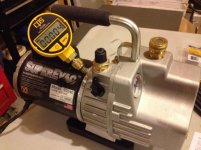
This multi-zone compressor is set up a bit different than most. It only has one set of service valves for all three zones. There is a common internal manifold for the gas side of all three zones. Then each zone has an internal solenoid valve on its liquid side feed. What this means is that one or all of the zones gets evacuated together. The vacuum pump gets connected to the gas side service port. Both the gas and liquid side valves must be fully closed while evacuating.
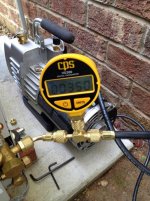
One thing I like about having a wide concrete pad under the compressor is that it gives you a clean place to put all the tools.
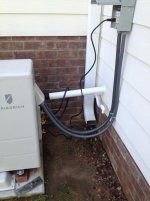
The outlet in the disconnect box is handy for plugging in the vacuum pump.
Evacuation went pretty well. It only took about 10 or 15 minutes to pull down to 800 microns the first time. But then the pressure started rising and wouldn't go back down. Eventually I tried opening the gas relief port on the vacuum pump and let a bunch of vapor out. I guess it had a fair bit of water vapor that was keeping it from pulling any deeper. After letting the pump gas off a bit, I closed the gas port and this time it quickly pulled down to about 600 and then started rising again.
The manual says it needs to go below 800 microns (.8 torr) but It was drifting back up towards 800. I had to relieve the gas vapor from the gas port a few more times before I could get the vacuum to stay low. The lowest I finally got it to stabilize at was about 350 microns. Good enough! This took a couple of hours all total.
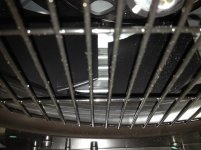
Then I shut the vacuum isolation valve on the pump, opened the liquid and gas valves to release the refrigerant, disconnected the hoses and replaced all the valve caps. Next was to test run the system and check for leaks. All good!