To avoid these ads, REGISTER NOW!

Not your usual Mini-Split install

yeldogt

Well-known member
Joined
Jan 2, 2012
Messages
18,184
Good looking install!

I'm about to have a whole system installed in my home/ office -- going to be using three ceiling units as well as one wall and two of the air handlers.

I'm not sure if I will be doing my own work out in my studio or have some one do it ..

So what did the tools cost? and I looked over the thread again .. did you keep the factory flare ends on the tubing? Many say they can be a problem and should be re-flared with a high quality flare tool?
 
Last edited:
To avoid these ads, REGISTER NOW!

Falcon67

Well-known member
Joined
Jun 11, 2009
Messages
18,371
Location
Merkel, TX
Timely. Been thinking about cassette type units as a retro fit for our house. We'd probably end up with two, one on each side of the house. Install would be a real beotch in the master with a tray ceiling between the attic access and the master bath. Ugh! Nice work.
 
OP
G

Gerald O

Well-known member
Joined
Mar 5, 2013
Messages
1,884
Location
NC
Good looking install!
Thanks! Total cost of the HVAC tools I showed was $678 through Amazon. I figure they will hold a decent percentage of that in residual value. Yes, I did redo the flares. This allowed me to use the better quality (heavier) flare nuts that came on the heat pump; I made better flares than the premade ones, and I shortened the lines by about 10'.

I didn't have to invest in a flaring tool as I already owned an old but trusty one.
 
Last edited:

yeldogt

Well-known member
Joined
Jan 2, 2012
Messages
18,184
Thanks Gerald -- I believe the recommend quality flare tool is around $100.00
 

pseudorealityx

Well-known member
Joined
Nov 10, 2009
Messages
999
Location
USA
Just fyi... the cassettes typically have an integral condensate pump, but it's been my experience that they are a bit of a weak link. We almost always specify an additional remote condensate pump, especially as the location is typically in a 'nicer' area where a condensate leak can cause issues in a hurry.

Also, most of the cassettes have an option for a 4" ventilation duct to be connected. Not a terrible idea if you want to bring in some conditioned fresh air into your space.
 
OP
G

Gerald O

Well-known member
Joined
Mar 5, 2013
Messages
1,884
Location
NC
Are you saying that the built-in pumps fail or that they just don't keep up? How would you install a remote pump, and where would you put the condensate level switch? On my units the drip tray is integral and I see no place to put such a thing.
 

pseudorealityx

Well-known member
Joined
Nov 10, 2009
Messages
999
Location
USA
Are you saying that the built-in pumps fail or that they just don't keep up? How would you install a remote pump, and where would you put the condensate level switch? On my units the drip tray is integral and I see no place to put such a thing.

They have very little lift. If you've got a straight basically gravity drop for it, that's fine. But if you need to route up and around something, you can run into issues. We'll typically locate the remote pump right next to, or in one case, on top of the cassette.
 

Jackfre

Well-known member
Joined
Dec 26, 2010
Messages
4,406
Location
N CA
Pseudo is correct on the limits of the provided pumps. I think the Fujitsu supplied units were good for about 16" of lift, so we would try arrange a gravity drain right above the unit and only pump up to whatever height gave us that gravity drain. Anyway, check the spec for lift on your pump.
 
OP
G

Gerald O

Well-known member
Joined
Mar 5, 2013
Messages
1,884
Location
NC
Ahh, OK. I think I'm good for that with this install. The built-in pump is rated for a maximum of 27" lift above the bottom of the unit. I've got only about 1" lift above the pump outlet (about 9" total lift), and then it's all downhill from there.
 

yeldogt

Well-known member
Joined
Jan 2, 2012
Messages
18,184
So you must use a pump/ No way to have a continues drop from the unit?
 
OP
G

Gerald O

Well-known member
Joined
Mar 5, 2013
Messages
1,884
Location
NC
On the ceiling cassettes the pump is typically built in. The condensate from the evaporator drips into an integral drip tray that is about at the level of the ceiling surface. To have just a gravity drain the piping would then have to run below the ceiling. To keep the condensate drain piping hidden it needs to be above the ceiling, hence the need to pump it up to that level.

This is a particular consequence of ceiling mounting versus wall mounting. A wall mount unit can have the drain at its bottom on the backside and just go down inside (or outside) the wall from there.
 
Last edited:

Falcon67

Well-known member
Joined
Jun 11, 2009
Messages
18,371
Location
Merkel, TX
So you must use a pump/ No way to have a continues drop from the unit?

Why after a search I'm now more interested in concealed ducted mini's. Could be mounted hanging and use a "conventional" type condensate line, or a condensate pump.
 
OP
G

Gerald O

Well-known member
Joined
Mar 5, 2013
Messages
1,884
Location
NC
Vacuum pump testing

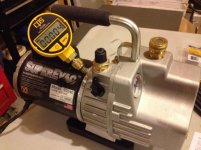
Just tested the pump. With the digital gauge connected directly to the pump it quickly pulled down to a reading of 4 microns.
attachment.php
 

Attachments

  • mshp_43.jpg
    mshp_43.jpg
    64.6 KB · Views: 1,031

CWO4GUNNER

Well-known member
Joined
Aug 17, 2014
Messages
229
Location
BHC AZ
Our instructor use to have us test our new hoses to verify no leaks, but none ever failed. After pressure testing, I'm considering soldering the flair fittings with Stay-brite rather than using a sealer.
 
OP
G

Gerald O

Well-known member
Joined
Mar 5, 2013
Messages
1,884
Location
NC
Success!

I love it when things just work like you expect them to. Got the system evacuated and running this morning. No leaks. Blows cold and hot. What more could you want?

This multi-zone compressor is set up a bit different than most. It only has one set of service valves for all three zones. There is a common internal manifold for the gas side of all three zones. Then each zone has an internal solenoid valve on its liquid side feed. What this means is that one or all of the zones gets evacuated together. The vacuum pump gets connected to the gas side service port. Both the gas and liquid side valves must be fully closed while evacuating.

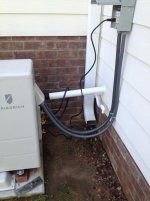
One thing I like about having a wide concrete pad under the compressor is that it gives you a clean place to put all the tools.
attachment.php


The outlet in the disconnect box is handy for plugging in the vacuum pump.
attachment.php


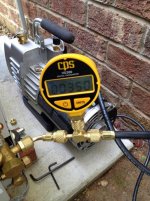
Evacuation went pretty well. It only took about 10 or 15 minutes to pull down to 800 microns the first time. But then the pressure started rising and wouldn't go back down. Eventually I tried opening the gas relief port on the vacuum pump and let a bunch of vapor out. I guess it had a fair bit of water vapor that was keeping it from pulling any deeper. After letting the pump gas off a bit, I closed the gas port and this time it quickly pulled down to about 600 and then started rising again.

The manual says it needs to go below 800 microns (.8 torr) but It was drifting back up towards 800. I had to relieve the gas vapor from the gas port a few more times before I could get the vacuum to stay low. The lowest I finally got it to stabilize at was about 350 microns. Good enough! This took a couple of hours all total.
attachment.php


Then I shut the vacuum isolation valve on the pump, opened the liquid and gas valves to release the refrigerant, disconnected the hoses and replaced all the valve caps. Next was to test run the system and check for leaks. All good!
 

Attachments

  • mshp_44.jpg
    mshp_44.jpg
    82.5 KB · Views: 1,009
  • mshp_46.jpg
    mshp_46.jpg
    64 KB · Views: 1,006
  • mshp_47.jpg
    mshp_47.jpg
    100.6 KB · Views: 1,005
Last edited:

LS6 Tommy

Well-known member
Joined
Dec 27, 2013
Messages
26,162
Location
Northern NJ
I hope the cassette has enough static pressure to carry through a 4" duct, especially if (like it looks) it is branching off to the loft. I hope it works and settles that debate concern.:thumbup:


A cassette will create ZERO static pressure if it has a propeller style evaporator fan...

Tommy
 
Last edited:

CWO4GUNNER

Well-known member
Joined
Aug 17, 2014
Messages
229
Location
BHC AZ
Congratulations, as my instructor would have said...Doing it yourself probubly paid for the price of all your investment in the mechanicals and tools combined, maybe more.:thumbup:
 

theoldwizard1

Well-known member
Joined
Feb 22, 2011
Messages
43,076
Location
SE MI
Re: Success!

The manual says it needs to go below 800 microns (.8 torr) but It was drifting back up towards 800.

I am sorry to "pick a nit" on such a great job (including detailed posts with picture :thumbup: ! ) but my OCD is kicking in.

A "micron" (µm) is a unit of length. It is one millionth of a meter.

A torr is a unit of pressure. It is approximately equal to (and commonly accepted as equivalent) a millimeter of mercury.
 
OP
G

Gerald O

Well-known member
Joined
Mar 5, 2013
Messages
1,884
Location
NC
I hear ya wiz, and I wondered about that too. Seems the HVAC industry has adopted the micron unit as short hand for microns of mercury, which is why it is 1000th of 1 torr.

The CPS gauge lets you switch the units to read 'micron' , torr, inches, etc. When switching from torr to micron it moves the decimal point and gives more digits of resolution.
 
To avoid these ads, REGISTER NOW!
OP
G

Gerald O

Well-known member
Joined
Mar 5, 2013
Messages
1,884
Location
NC
A cassette will create ZERO static pressure if it has a propeller style evaporator fan...

Tommy
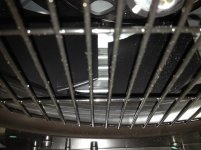
These cassettes have a centrifugal type fan, sort of like a squirrel cage but with larger and fewer blades. It runs slower for quieter operation. The fan output passes directly outward through the evap coil that encircles it for better efficiency of airflow. The fan motor is inverter driven too, so it runs at variable speeds depending on demand.
attachment.php


I have no clue about what static pressure this produces, but I can confirm that there is enough pressure developed to create adequate airflow through the branch ducts. I can stand under the branch duct vents and feel the breeze. Its not a forceful flow like it is directly under the main cassette vents, but I'm satisfied that it meets my needs.
 

Attachments

  • mshp_51.jpg
    mshp_51.jpg
    59.1 KB · Views: 1,080
Last edited:
OP
G

Gerald O

Well-known member
Joined
Mar 5, 2013
Messages
1,884
Location
NC
Condensation

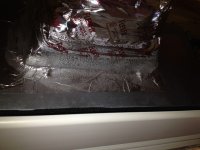
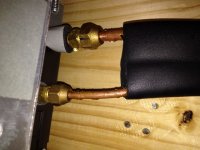
Here's why its so important to fully insulate all exposed metal surfaces in the heat pump indoor unit. This short exposed section of refrigerant lines only 3" long is steadily dripping with condensate. This would end up leaking out and causing ceiling or floor damage. The cassette unit ships with a kit of small insulation pieces provided specifically for insulating this part of the lines.
attachment.php


This short uninsulated section of the ducting boots is sweating profusely with condensation. This will get fully insulated.
attachment.php


With all this condensation, I wondered how well the built in condensate pump and drain line was working. It's working very well it seems. Outside there was a near steady stream of water dripping out of the drain outlet. You would not want all of this water leaking inside your building.
 

Attachments

  • mshp_52.jpg
    mshp_52.jpg
    107.7 KB · Views: 1,068
  • mshp_53.jpg
    mshp_53.jpg
    112.3 KB · Views: 1,071

LS6 Tommy

Well-known member
Joined
Dec 27, 2013
Messages
26,162
Location
Northern NJ
Re: Success!

I am sorry to "pick a nit" on such a great job (including detailed posts with picture :thumbup: ! ) but my OCD is kicking in.

A "micron" (µm) is a unit of length. It is one millionth of a meter.

A torr is a unit of pressure. It is approximately equal to (and commonly accepted as equivalent) a millimeter of mercury.


You're not nit picking, you're correct. It's confusing because negative pressures are often described as units of length on a manometric column. Vacuum on a gauge is labeled as a unit of length, but it describes a negative pressure, as in inches of mercury column. 1 Torr is 1mm of mercury absolute. It gets more confusing on compound gauges since they must display both positive and negative pressures, but two different scales are used.

Tommy
 
OP
G

Gerald O

Well-known member
Joined
Mar 5, 2013
Messages
1,884
Location
NC
Insulating the duct boots

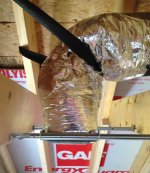
I'm not going to show all of them, but this is typical of how I'm completing the insulation on the duct boots. I used leftover pieces of the flex duct insulation by splitting it open, wrapping it around the boot to fit well, and then taping it with the plastic duct tape. You want to use tape that is specifically rated for this.
attachment.php


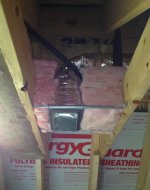
Now this area in the ceiling is going to be insulated with fiberglass to R-38 which is 12" thick, but it's hard to be sure that there will be no gaps around the duct. Any gaps would permit condensation on exposed metal duct. So the wrapping of the duct itself is important. Even so, I'll still try to get the fiberglass neatly packed in.
attachment.php

attachment.php
 

Attachments

  • mshp_48.jpg
    mshp_48.jpg
    64.5 KB · Views: 1,063
  • mshp_49.jpg
    mshp_49.jpg
    48.3 KB · Views: 1,067
  • mshp_50.jpg
    mshp_50.jpg
    145.6 KB · Views: 1,068

Jackfre

Well-known member
Joined
Dec 26, 2010
Messages
4,406
Location
N CA
Make sure the condensate lines are insulated as well. They will sweat like crazy
 

cagullett1

Well-known member
Joined
Sep 29, 2013
Messages
2,203
Location
North Texas
Just curious, would you still have a condensation issue on the back of the main cassette, had you not added the extra duct/vents? How did you go about insulating the boots?
 

pseudorealityx

Well-known member
Joined
Nov 10, 2009
Messages
999
Location
USA
I have no clue about what static pressure this produces, but I can confirm that there is enough pressure developed to create adequate airflow through the branch ducts. I can stand under the branch duct vents and feel the breeze. Its not a forceful flow like it is directly under the main cassette vents, but I'm satisfied that it meets my needs.

I believe most of the cassette manufacturers will allow a max of 2 of the knockouts to be used, and it's just for these specific applications when you want just a little airflow into a small bathroom/closet/etc. I probably would have gone with 5" or 6" flex, but with your super straight run, it shouldn't matter too much.

Also, I don't think you'll have recirc issues with the supply outlet and exhaust fan so close. There will likely be enough inertia in the cold/hot air supply to get away from the high negative pressure area. When cold, the density will keep pushing it down.
 
OP
G

Gerald O

Well-known member
Joined
Mar 5, 2013
Messages
1,884
Location
NC
Just curious, would you still have a condensation issue on the back of the main cassette, had you not added the extra duct/vents? How did you go about insulating the boots?
There was some light condensation here and there on the main cassette body. The installation manual states that additional insulation will be needed when the unit is operated in conditions where the dew point is above 73deg.

You have to understand that these cassette units are designed primarily for installation in commercial buildings with suspended ceilings. That would have them running in conditioned space which would be less humid. It has only about 1/2" of foam insulation inside, which is not enough for installation in an unconditioned area.

My installation is unconventional. It's not quite in an unconditioned attic nor in conditioned space. Situated as it is in the midst of the ceiling with a ventilated 'attic' space directly above I have no choice but to fully insulate it. It's going to be more or less 'cocooned' in place, along with the rest of the ceiling insulation. But I haven't yet quite figured out exactly how that will end up. I'm making these details up as I go...
 
Last edited:

theoldwizard1

Well-known member
Joined
Feb 22, 2011
Messages
43,076
Location
SE MI
Re: Success!

The manual says it needs to go below 800 microns (.8 torr) but It was drifting back up towards 800.
I am sorry to "pick a nit" on such a great job (including detailed posts with picture :thumbup: ! ) but my OCD is kicking in.

A "micron" (µm) is a unit of length. It is one millionth of a meter.

A torr is a unit of pressure. It is approximately equal to (and commonly accepted as equivalent) a millimeter of mercury.

Well time to apologize !

While my statements are correct, they did not take into account HVAC "slang". On HVAC gauges, a "micron" is one millionth of a meter of mercury (μm-Hg) in a glass manometer. This is probably the smallest unit of absolute pressure. 1 torr = 1000 "microns".

For you flow bench guys, 1 inch of water is 1,868 "microns"
 

msgross

Well-known member
Joined
Feb 22, 2013
Messages
331
Location
Central PA
Nice install... I added a 500 sq ft master bedroom to my house and opted for a mini-split. Another option for people is the Ductless setup like this http://www.fujitsugeneral.com/duct.htm

I placed the unit in the basement and the ducts go to the bathroom and closet. So far i'm super happy with the performance. The ductless option was an extra $1,000 but it allowed for air in both rooms and we didn't have the big box hanging off the wall.
 
OP
G

Gerald O

Well-known member
Joined
Mar 5, 2013
Messages
1,884
Location
NC
Nice install...
Thanks!
I added a 500 sq ft master bedroom to my house and opted for a mini-split. Another option for people is the Ductless setup like this http://www.fujitsugeneral.com/duct.htm

I placed the unit in the basement and the ducts go to the bathroom and closet. So far i'm super happy with the performance. The ductless option was an extra $1,000 but it allowed for air in both rooms and we didn't have the big box hanging off the wall.
Got any pics of the install? I think folks are pretty familiar now with the common wall-mount units, but these specialty solutions are not well known.
 

jad3675

Well-known member
Joined
Jul 12, 2010
Messages
52
Thanks!
Got any pics of the install? I think folks are pretty familiar now with the common wall-mount units, but these specialty solutions are not well known.

I recently did a ducted install at my place. I have a cape cod, so the units went into the knee-wall space on the 2nd floor.
yyMqTQSopBwF2Rnl1uFolwwByPXH-Xd4WXmjzuK3xVw=w356-h201-p-no
c83uyitoYBkrY-vhiuOXSLYNbpfy-jq6Sz-PmkkWJvY=w338-h191-p-no


John
 

St-rider

Well-known member
Joined
May 30, 2005
Messages
283
Location
Mentor, Ohio
Is that rigid duct covered in insulation being supported by the fabric band? If its flex duct are you worried that it may collapse over time?
 

jad3675

Well-known member
Joined
Jul 12, 2010
Messages
52
Is that rigid duct covered in insulation being supported by the fabric band? If its flex duct are you worried that it may collapse over time?

The fabric band is what is used for flex - no worries of it collapsing. There's a mix of solid duct and flex in there to keep the noise transmission down.

John
 
OP
G

Gerald O

Well-known member
Joined
Mar 5, 2013
Messages
1,884
Location
NC
The fabric strapping is about 2" wide, so it spreads the support out a bit. It could be a problem if too much weight is supported with too few straps.

In mine there are multiple straps to distribute the weight, and in addition most of the insulated flex duct run is resting lightly on top of the attic insulation.
At the elbows there is an angled strap to keep the flex duct in tension so that it stays stretched out. That strap is pulling against the rigid duct elbow.
 
Last edited:

bzinsky

Well-known member
Joined
Oct 27, 2014
Messages
5,565
Thanks!
Got any pics of the install? I think folks are pretty familiar now with the common wall-mount units, but these specialty solutions are not well known.

With good reason, not only do the cassettes significantly lower the lab tested seer value. Also the entire reason minisplits perform so well is because they completely eliminate ductwork. Combine the cassette with the duct work and you've pretty much got a regular hvac system.

The typical forced air hvac looses A LOT of efficiency just from the duct work. From various sources I've concluded on average 20%-25% loss. Not just the heat transfer from the ductwork itself, but leaks play a big role as well. I've never seen a forced air system that doesn't have leaks going in or going out.

The typical mini-split wall mount type is no doubt not attractive, but if you go with any other way of doing it, probably would have been better off just using a typical forced air setup. Mini-splits with the wall mount are about the most efficient way you can have AC or heat using electric as your power source. There are always more exotic systems for hvac, like ground source heat pumps combined with radiant floor heat, but for a regular consumer products, mini-split is king. The new heat pumps are probably about as costly to run as a natural gas heater, and that's impressive considering how much cheaper gas is.

edit: I suppose there are several circumstances where the size of the cassette makes it a great option instead of a full size air handler, so I definitely should not say it's pointless.
 
Last edited:

Trey T

Well-known member
Joined
Aug 3, 2011
Messages
3,749
Location
Houston, TX
looks like a pro installation. Ain't to tech can do a better job than that unless you throw them a bunch of money.
 
To avoid these ads, REGISTER NOW!
Top Bottom