To avoid these ads, REGISTER NOW!

Off-grid property, need power

OP
D

Daveyclimber

Well-known member
Joined
Apr 21, 2017
Messages
213
Location
Montana
Everyone you mentioned is good, but the packaging with the powehead can vary dramatically.

the RV units are standardized.

The reason I picked RV units is that they come completely in an enclosure already packaged up you can toss the thing in a pickup bed.

On the powerhead you want to make sure its something you can can work on, you are looking for brushless if you can get it, and if brushed buy a couple of spares and belts for it when you pick the unit up. Some of the easier powertech replacement head can be pricey...

I have a full set of UOAs done on my kubota D722 mills- they wear incredibly slowly and well on modern oil I think I pushed one oil change out to 350 hours and still had serviceable oil from a 3quart sump , some of the kubotas are up to 1000 oil change intervals running lighthouses and traffic signs.


Interesting. I didn't think that far ahead regarding RV units. I always associated them as being propane loud air cooled units and forgot that diesel pushers can use diesel powered units.
 
To avoid these ads, REGISTER NOW!

Davegvg

Well-known member
Joined
Jul 21, 2018
Messages
285
Location
Corona Ca.
Interesting. I didn't think that far ahead regarding RV units. I always associated them as being propane loud air cooled units and forgot that diesel pushers can use diesel powered units.

I have two real experiences to share.


My wife ran a dog grooming business and the only way to make money was to have diesel infrastructure so I have years of maintenance history for commercial duty use on diesel gensets. These vans have extremely high requirements for power and run 10 -12 hours day 7 days a week for years on end. We started with gas units and the economics were laughable.
The vans each had a genset, an inverter system AND propane.

These vans were mostly based on RV parts.


I off-road dry camp in the desert every year and act as as " basecamp" for satellite rigs and a diesel genset is what allows the whole thing to work first thing i did was ditch the propane unit and put a real genset in. I usually ran hot site 16x7 for weeks at time.


You can set up a homestead on 12V&120 V RV parts for the most part water pumps, heaters, power -
 
Last edited:

u3b3rg33k

Well-known member
Joined
Dec 18, 2017
Messages
4,047
Totally agree! They were saying the same thing about Lithium Ion batteries 10 years ago! And then the data just kept looking worse, and worse, and worse... And then the fires... And the absolute destruction of the environment where the lithium was being mined and processed...

Edison had it right. NiFe batteries are damn expensive nowadays but FLA is the second best in my book. If you're really paranoid about the lifespan of the bank and availability of batteries later, just buy double and store one bank dry for the first 10-20 years until you need to use it, then wake them up, and go. You'll surely be able to get (or make) electrolyte.

NiFe batteries sound great until they show you the price tag. other major issues are voltage drop under high load (meaning you need a really big battery bank to supply kW demand to keep your inverters from shutting down, not just hold kWh), and their round trip efficiencies are downright bad, like 65%. the latter issue can be solved by over-sizing your solar array, but if you're refilling it with fuel you're buying a lot of extra fuel to charge them up. they also make a LOT of hydrogen gas and that needs to be managed as well.

the two viable chemistries on a budget are lead acid and Li-ion. the former is established and well known, and "easy" to manage (overcharge them? just add water!), the latter finally has economies of scale and efficiency, and if you treat them right (a BMS for monitoring, a REAL charger, etc) they are solid technology.
 

davo727

Well-known member
Joined
Jun 17, 2012
Messages
1,660
This thread is relevent to me.... so how about inverters and battery chargers for an off grid solar---- combination units good ( brand? ) or should go with separate inverters and battery chargers? Im thinking about 4kw inverter size and initially about 3kw of panels and 48V of battery and 5KWH battery size to start. Thanks, ill start a new thread eventually on this if I proceed.
 

Solarphil

Well-known member
Joined
Mar 21, 2017
Messages
47
OP I think you’ve got a good handle on this, based on your posts. What you’re describing is a Submariner system - batteries make the base of the system and power most normal loads, and the batteries are charged whenever you “surface” to run large loads or need to charge the batteries. Add some solar to your equation because batteries are really good at taking everything the generator can put out when between 20% and 80% SOC, but getting the batteries to 100% gets really, really expensive with diesel only - and you will need to get the batteries to 100% at least once a week. No matter how tree locked your property is, there’s space for 1-2kW of PV. Consider getting it up high, like a carport or awning, and you get bonus shade and snow protection ;-)

I’d second the recommendation for either Rolls or Crown for batteries, and IMO Magnum makes the best inverter and balance of plant equipment for this type of system - look at the MS4448PAE - it’s one of the only I know of that can natively charge from both a 120v source (your EU gen) and 240v (your eventual diesel set). Plus it’s got probably the best battery charger circuitry in the industry, which is good for your application. Magnum’s PV charge controller is also one of the best available.

My experience with designing off grid - the system design is driven by water and budget. Based on what you’ve said, I’d prepare for running a deep well pump off the main generator, which will help loading, and pump into a large underground storage tank, controlled by a float switch. Small battery powered booster pump to pressurize to the house. Whenever the genset runs, the pump is available as a load to fill the tank. Depending on static water depth, get a soft start pump and you can run it off the inverter as well.

Invest in one good power system, and run both the house and the shop off it. It ***** to have to fire up the generator every time you want to make a cut, and part of the beauty of living in a remote area like what you’ve found is the native quiet. With a modern inverter power system, you can power most loads off the system, but have the inverter start the generator when you kick on larger loads like the table saw and dust collector for a batch of cuts. Once the genset is running the inverter supports the generator while also charging the batteries.

For owner-builder construction, I’m a huge fan of ICFs and a pumper truck. BIg chunks of wall go together quick and simply, solo, and you can spend as much time as you want and need to get things straight, plumb and braced. Get your friends together to handle the hose, call out the pumper truck and you have all your walls poured by lunch time. Don’t forget to insulate under your slab, and run radiant tubing in the slab. Use a Combi-cor hot water heater and a Laing DC circulatory and you’ve got radiant heat and domestic H20 with near zero electric draw, plus you can easily add solar thermal later and decrease your fuel dependence.

Have fun, and enjoy your new property!
 
OP
D

Daveyclimber

Well-known member
Joined
Apr 21, 2017
Messages
213
Location
Montana
My crawlspace will be ICF, but not sure on the pump truck yet. Its a 4 hour round trip for them. But it doesn't sound like fun dropping in the mud from a chute either and not enough hands on deck. So I'm continuing my research and looking into pre wired split phase inverters from Magnum or Schneider. My shop is up in the air given building supply prices. I am considering building a lean to shed that is built off of one side of the shop to house the power generation stuff. I am a bit leary of attaching it to the shop as I've already had one shop fire and lost nearly everything I owned. But it would simplify developing the property and not jam up the property so much.

I'm also looking into a Grundfos SQ series well pump, plumbed to two 86 gallon pressure tanks under the cabin. Also researching tankless water heaters, something that can keep up with the demand of a corner bathtub with high flow faucet. Got to keep the Wife happy. Still lookin into radiant heat as well but stuck on options. I was trying to avoid a slab under the crawlspace and was looking at a staple up installation in between the floor joists and a staple down installation in the loft bedroom. Part of me feels if I end up doing a slab, I might as well just do a full basement but we really can't afford that. So in reality the staple up/down install seems more financially feasible right now especially since its a common retrofit and can be done down the line if needed.

I have enough room for enough solar to make it count, especially if I use half cut panels to limit shaded losses. Hoping for 2 pole mount arrays. Probably 12-16 panels depending on how the numbers work out which should be enough to limit generator usage. Keep in mind, i don't get any appreciable sun until 11-12 pm, much worse in the winter. Batteries are another issue. As much as I'd like to use Rolls, I'm afraid of being out out town for an extended period of time and something going haywire and trashing the batteries. There isn't enough consistent wind to bother with wind generators in my particular area due to trees.


On the generator side, I have looked at alot of surplus units from gov planet. I have actually bought a fair bit of stuff from Iron Planet and Gov Planet. Problem is, most stuff looks great but most of it is project material and they don't test anything. I think I'd be better off with a new or low hour known good unit.
 

u3b3rg33k

Well-known member
Joined
Dec 18, 2017
Messages
4,047
saw this:

the $/Wh numbers are interesting. Lead acid does much worse than anticipated, even up front, lifecycle costs notwithstanding.
 
To avoid these ads, REGISTER NOW!

gnpenning

Well-known member
Joined
Jan 25, 2015
Messages
2,754
Location
I have more questions than answers.
I live in Mt as well, north of you. Right now it is sunny and beautiful, during the winter we have long periods of no sunshine. There is a reason why we have a high suicide rate. Now that I know generally where you are it can be even worse for winter sun due to mountains and trees. I've spent a fair amount of time in the arena in town and in the past some shooting at the old gravel pit. I fully understand your situation.

Many of the local Poco's have setup solar power banks and sold them to customers. The poco covers all repairs and maintenance, our local one is hoping for a 20 year pay back. Privately some insiders think it will be much longer. Keep in mind this is with out infrastructure cost, repairs and maintenance. This is different in different parts of the country, same with wind. Just like having a hydro electric plant in the flats part of death valley. Some places work better than others.

Can't you buy lumber direct from pyramid?

Depending on access around your foundation you may not need a pumper truck, just adapter on the chute. It was done this way for many years before pumper trucks. I would suggest you use ICF all the way, you can always side with log. We have 2 really good ICF suppliers here. Btdt, much easier to heat and cool. Radiant heat with an exchanger on the wood stove. I've built houses for myself with staple down and staple up. Part of my last house was staple up, never again for anything I plan to live in. Huge difference in efficiency.

i agree diesel would be the best for your situation, it works very well in our area. Large number of diesel vehicles running around all year. Diesel stores much better than gas. As you mentioned oil changes are no big deal. Walmart always has the best price and selection.
 

Diesel Dan

Well-known member
Joined
Jul 21, 2013
Messages
2,457
Location
TN
This makes for good read.
We are considering building off grid too. Couple differences for us are municipal water at the road and plenty of access to sunshine. We were interested in adding solar to our current home but then found the local poco is not favorable to alternate power sources. They don't pay for excess generated and during a outage you can run your house off a battery bank but can not use your solar array to charge the batteries, WTH.

As you mentioned oil changes are no big deal. Walmart always has the best price and selection.
Lately diesel oil is getting hard to find in quantities. Walmart, TSC, parts stores...15w-40 shelves empty. Need to start buying in 30 gallon drums, SMH.
 

zeke67

Well-known member
Joined
Jun 11, 2010
Messages
272
Location
Houston
You may wish to start your own thread. if your POCO won't accept net back, why not install a smaller array to do an offset of only part of your demand and skip the storage. That said, as mentioned earlier in this post there are chargers that can natively work with gird and array.
 

Diesel Dan

Well-known member
Joined
Jul 21, 2013
Messages
2,457
Location
TN
You may wish to start your own thread. if your POCO won't accept net back, why not install a smaller array to do an offset of only part of your demand and skip the storage. That said, as mentioned earlier in this post there are chargers that can natively work with gird and array.
Not trying to turn this into a debate about cost payback.
Like OP we have a property that we are looking at building on that would be off grid, power wise. Hooking up to POCO would not be free and does come with strings attached.
Will it be cheap, no.
Do I expect it to be cheap, no.
 

dcg9381

Well-known member
Joined
Jun 20, 2018
Messages
11,627
Location
Austin, TX
This makes for good read.
We are considering building off grid too. Couple differences for us are municipal water at the road and plenty of access to sunshine. We were interested in adding solar to our current home but then found the local poco is not favorable to alternate power sources. They don't pay for excess generated and during a outage you can run your house off a battery bank but can not use your solar array to charge the batteries, WTH.


Lately diesel oil is getting hard to find in quantities. Walmart, TSC, parts stores...15w-40 shelves empty. Need to start buying in 30 gallon drums, SMH.

In my experience, POCOs (like many "traditional" electricians) have limited experience and do not know much about solar. I'm buying what they are telling you about no-buy back if they are a private entity, but make sure:

" Public Utility Regulatory Policy Act (PURPA) dictates that electric utilities on the traditional power grid must purchase the excess electricity that renewable energy systems generate."

In regard to "you can't use solar array to charge the batteries" - that's incorrect. If that's what the utility is telling you, I'd ignore it. The POCO can't tell you how you store power or use power in an-off grid condition. I have yet to install a system with a battery, but my understanding is that the batteries will charge from solar, grid, or both. When the POCO goes down, essentially the grid gets disconnected and the battery is allowed to power specific circuits (or more, depending on battery and inverter capacity).

Have you considered propane instead of diesel fuel oil?

Last time I was out in the Colorado desert, we met more than a few people who were off grid out there... Interesting discussions. Most of them had designed homes that were highly insulated / passive solar - and power was almost exclusively solar with generator backup.
 
Last edited:

Diesel Dan

Well-known member
Joined
Jul 21, 2013
Messages
2,457
Location
TN
In my experience, POCOs (like many "traditional" electricians) have limited experience and do not know much about solar. I'm buying what they are telling you about no-buy back if they are a private entity, but make sure:

" Public Utility Regulatory Policy Act (PURPA) dictates that electric utilities on the traditional power grid must purchase the excess electricity that renewable energy systems generate."

In regard to "you can't use solar array to charge the batteries" - that's incorrect. If that's what the utility is telling you, I'd ignore it. The POCO can't tell you how you store power or use power in an-off grid condition. I have yet to install a system with a battery, but my understanding is that the batteries will charge from solar, grid, or both. When the POCO goes down, essentially the grid gets disconnected and the battery is allowed to power specific circuits (or more, depending on battery and inverter capacity).

Have you considered propane instead of diesel fuel oil?

Last time I was out in the Colorado desert, we met more than a few people who were off grid out there... Interesting discussions. Most of them had designed homes that were highly insulated / passive solar - and power was almost exclusively solar with generator backup.
The POCO is a co-op. You can sell back to the TVA....separate application and fees apply.

Yes on the propane for water heater, stove and a 7-10kw gen set. I was just replying to a comment on how cheap and easy oil changes are/were. Our current home has 8" walls, 2" closed cell with blown cellulose or rock wool making up the rest.

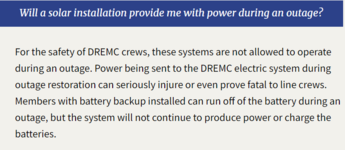
This is directly from their website.
I'm assuming a battery/inverter system will have a transfer switch just like a generator so why won't they let your array charge the batteries instead of letting you be in the dark like everyone else?

In the past I was interested in purchasing a meter mounted transfer switch. Was allowable only if I leased it from them.
solar.png
 

dcg9381

Well-known member
Joined
Jun 20, 2018
Messages
11,627
Location
Austin, TX
I understand, based on that policy, why it's confusing.

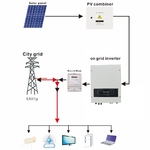
No, PV solar does not have a transfer switch. These systems "turn off" during grid outage and do not produce any power. You cannot use them during a grid outage (at least without battery storage). More recent systems include "rapid shutdown" modules which are NEC compliant systems that are so fast that you don't even need disconnects - they actually disconnect the DC panels..

You don't need a transfer switch with PV solar... At least not with any inverter that I've ever installed.

The solar systems that have batteries are going to be "smart" enough to not backfeed the grid when the power is offline. I think the POCO is calling out how they work (below) incorrectly, but I assure you they are designed not to back-feed the grid.. If you look at the design diagrams of may of them, they are typically shown with the house sub panel downstream of the power main.

The below is from Tesla:
https://www.tesla.com/support/energy/powerwall/own/best-practices-during-power-outages

Note apparently the Tesla system can also integrate with a generator... Which again, is a bit of a newer function.
 
Last edited:

u3b3rg33k

Well-known member
Joined
Dec 18, 2017
Messages
4,047
it doesn't sound like they're not properly acknowledging the difference between "grid-tie solar" and "AC/DC coupled battery backup solar".

grid-tie cannot work without the grid.
1636779450224.png


AC coupled (aka tesla powerwall) works by having a "gateway" that acts to separate you from the grid, uses the powerwall to act as though IT was the grid (which is now off in la-la land), and NOW your grid-tie solar (from any provider) sees the powerwall as "the grid", and will feed the powerwall power.

1636779189956.png

DC coupled uses DC solar to directly feed a battery bank (technically its charge controller), and then inverts AC off of that to run your house when the grid is down.

1636779271539.png


AC coupled is newer, but it has a bunch of advantages, one major advantage being you don't to use special (read: expensive) DC breakers, fuses, switches, to switch power.

also I think this is part of Lord Elon's plan to make his "virtual power plants", where people can "opt in" to their solar + powerwalls being used in bulk as a 4 hour peaker plant.
 

Firebrick43

Well-known member
Joined
May 12, 2015
Messages
13,992
Location
West central Indiana
In my experience, POCOs (like many "traditional" electricians) have limited experience and do not know much about solar. I'm buying what they are telling you about no-buy back if they are a private entity, but make sure:

" Public Utility Regulatory Policy Act (PURPA) dictates that electric utilities on the traditional power grid must purchase the excess electricity that renewable energy systems generate."

In regard to "you can't use solar array to charge the batteries" - that's incorrect. If that's what the utility is telling you, I'd ignore it. The POCO can't tell you how you store power or use power in an-off grid condition. I have yet to install a system with a battery, but my understanding is that the batteries will charge from solar, grid, or both. When the POCO goes down, essentially the grid gets disconnected and the battery is allowed to power specific circuits (or more, depending on battery and inverter capacity).

Have you considered propane instead of diesel fuel oil?

Last time I was out in the Colorado desert, we met more than a few people who were off grid out there... Interesting discussions. Most of them had designed homes that were highly insulated / passive solar - and power was almost exclusively solar with generator backup.
Purpa in no way really applies to small home systems. The states are left up to implement it and their terms differ. Montana is 100KW to 3000 KW. Not many home systems are going to have that.

Most state laws also exclude Co-ops. Indiana has net metering for home systems but only for investor-owned utilities. Some co-ops still have net metering but that is up to the co-op, not law.
 
To avoid these ads, REGISTER NOW!
Top Bottom