

You are using an out of date browser. It may not display this or other websites correctly.
You should upgrade or use an alternative browser.
You should upgrade or use an alternative browser.
Open End Stress Test Results
- Thread starter Skin
- Start date
thanks for posting this.
Doesn't the new Williams USA wrench have an open end design like the Matco?
Its slightly different but the same idea, the cut-outs are very pronounced like the grooved section on the FD+, and there are 4 so it functions in either direction.
Skin, what were you using to get the extra leverage?
Nothing. Each wrenchs length was its own leverage.
marlinspike
Well-known member
I wish Hazet or Stahlwille would use those grooves. As it is, I have applications where I can't get two Hazets in place (e.g. breaking loose certain fuel lines on a K-Jetronic system) without a lot of difficulty and instead use one Hazet and one Stahlwille. That Matco would be a non-starter, but those little lines seem to work wonders without marring the fastener.
That said, I guess it's all academic since I've never rounded anything since buying a set of Hazets. Still though, can't help but be a little jealous lol.
That said, I guess it's all academic since I've never rounded anything since buying a set of Hazets. Still though, can't help but be a little jealous lol.
superautobacs
Well-known member
Thanks for taking the time and putting the effort into this demonstration.
A few things that popped into my mind...
Because there's variances in dimensional tolerances on fasteners (in this instance it's the distance across flats), can you use fasteners that are as close to being equal and of the same supplier?
The smaller the measurement across flats on the fastener, the more prone the wrench is going to round over the edge. If you can narrow the variances as much as possible between the fasteners we can really pin-point what the wrenches are capable of doing (the level of marring at the corners).
You mentioned that the wrenches that did roll over the corner were stretched beyond yield and the spread was measurable at the ends of the open-end. I just want to clarify that it was only at the ends, where spread is inevitably going to happen, correct? When using the open-end it's critical that the operator places the fastener head right against the base of the open-end. The farther out the fastener is from the base of the open-end the more likely it is to round over the corners under torque, as there's less material.
It would be interesting to know how the others would stack up to the experiment:
Stahlwille:


Carlyle (Napa):

Wright Wrightgrip, Armstrong/Gearwrench, Williams SuperCombo:

Stanley:

Proto ASD:

A few things that popped into my mind...
Because there's variances in dimensional tolerances on fasteners (in this instance it's the distance across flats), can you use fasteners that are as close to being equal and of the same supplier?
The smaller the measurement across flats on the fastener, the more prone the wrench is going to round over the edge. If you can narrow the variances as much as possible between the fasteners we can really pin-point what the wrenches are capable of doing (the level of marring at the corners).
You mentioned that the wrenches that did roll over the corner were stretched beyond yield and the spread was measurable at the ends of the open-end. I just want to clarify that it was only at the ends, where spread is inevitably going to happen, correct? When using the open-end it's critical that the operator places the fastener head right against the base of the open-end. The farther out the fastener is from the base of the open-end the more likely it is to round over the corners under torque, as there's less material.
It would be interesting to know how the others would stack up to the experiment:
Stahlwille:
Carlyle (Napa):
Wright Wrightgrip, Armstrong/Gearwrench, Williams SuperCombo:
Stanley:
Proto ASD:
Attachments
-
 Infar Non-slip Open End.jpg58.9 KB · Views: 364
 -
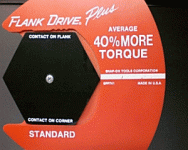 Flank Drive Plus Demo.gif45.1 KB · Views: 18
 -
 Flank Drive Plus Demo 2.gif39.3 KB · Views: 14
 -
 Flank Drive Plus Demo 3.gif40.2 KB · Views: 13
 -
 WrightGrip Armstrong JH Williams Snap-on FDP.jpg107.6 KB · Views: 373
 -
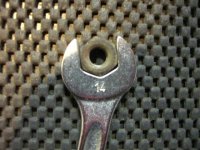 Stahlwille #15 SoftGrip 2.jpg49.9 KB · Views: 12
marlinspike
Well-known member
I have a set of those Stahlwille Type 15 wrenches (the Stahlwille in the picture). I like their size, but that Softgrip head is no good for bolts that susceptible to rounding. They're were discontinued a few years ago. That said, I've only had issues with it rounding soft fittings (brass and such). I'd be happy to mail one to OP if he'll mail it back after testing.
Last edited:
Nothing. Each wrenchs length was its own leverage.
Good crimany seriously? Pulling on those thin beam Snap-on wrenches must've hurt. I hope you had a glove on or a towel wrapped around it.

lwlobo
Well-known member
The wrenches are metal and if you round a bolt it will spread permanently. The question is by how much.
Just because the wrenches are metal and deform during the process doesn't mean they will spread permanently. They may, but its possible, even likely, that high quality wrenches are designed to keep deformation from rounding a bolt head within the elastic zone of the steel, meaning no plastic or permanent deformation.
Cheaper wrenches, not as likely.
There is not doubt that FD+ type features will generate more torque before slipping, thanks for the tests and good pictures showing it.
marlinspike
Well-known member
even likely, that high quality wrenches are designed to keep deformation from rounding a bolt head within the elastic zone of the steel, meaning no plastic or permanent deformation.
If I remember the marketing right, the Stahlwille Type 15 were designed to take advantage of this as part of the convex jaws thing, which is why I think they cause problems with fittings made from soft metals.
Just because the wrenches are metal and deform during the process doesn't mean they will spread permanently.
Okay, lets agree to disagree then. They're hardened metal objects, they're being flexed, they will all spread permanently, the question is simply how much and how often is it being spread.
Because there's variances in dimensional tolerances on fasteners (in this instance it's the distance across flats), can you use fasteners that are as close to being equal and of the same supplier?
The smaller the measurement across flats on the fastener, the more prone the wrench is going to round over the edge. If you can narrow the variances as much as possible between the fasteners we can really pin-point what the wrenches are capable of doing (the level of marring at the corners).
I could get all **** about it but, why? Actually trying to fix things you don't have the luxury to hand pick what fasteners are used, and especially on corroded junk a lot of times the wrench doesn't even fit properly anymore without being pushed or hammered on. If I can get a group of corroded fasteners together I might go there because I think that test has merit but as far as hand picking nuts and bolts that are as perfect to their labeled size as possible, i'll pass.
You mentioned that the wrenches that did roll over the corner were stretched beyond yield and the spread was measurable at the ends of the open-end. I just want to clarify that it was only at the ends, where spread is inevitably going to happen, correct?
correct
Good crimany seriously? Pulling on those thin beam Snap-on wrenches must've hurt. I hope you had a glove on or a towel wrapped around it.
you can see a blue shop towel in the first string of pics. I actually don't find Snap-On wrenches nearly as bad as people make them out to be.
Last edited:
ihateminimumwage
Well-known member
- Joined
- Jan 26, 2012
- Messages
- 3,962
Now let's try this test on some CAT bolts. 
SantaAna12
Well-known member
- Joined
- Mar 1, 2012
- Messages
- 1,091
Thank you Skin!
N.I.
Well-known member
Okay, lets agree to disagree then. They're hardened metal objects, they're being flexed, they will all spread permanently, the question is simply how much and how often is it being spread.
Sorry, but you are completely wrong!
Please keep an open mind, and learn from others trying to correct you. The joy of forums is that they are a wealth of knowledge.
Time to brush up on your basic Physics.
All metals are like an elastic spring (untill the yield point).
The strain ( i.e. extension) is directly proportional to to stress (i.e load).
Strain = Stress/ Young's Modulus.
The very basic principle all Engineering Design is based on.
A stronger/ harder material will have a higher Young's Modulus value.
This basically means that it will flex less for a given load, but a spring it remains.
N.I.
Well-known member
Engineering at its finest:-
Not the best quality, but it shows the deflection that has been designed into an aircraft wing, to keep weight to a minimum.
It is difficult to get a picture of the scale, but it is 26 feet at the tip.
Another video showing deflection when landing at the stage the 'load' is removed from the wings:
Not the best quality, but it shows the deflection that has been designed into an aircraft wing, to keep weight to a minimum.
It is difficult to get a picture of the scale, but it is 26 feet at the tip.
Another video showing deflection when landing at the stage the 'load' is removed from the wings:
Last edited:
Sorry, but you are completely wrong!
Please keep an open mind, and learn from others trying to correct you. The joy of forums is that they are a wealth of knowledge.
Time to brush up on your basic Physics.
All metals are like an elastic spring (untill the yield point).
The strain ( i.e. extension) is directly proportional to to stress (i.e load).
Strain = Stress/ Young's Modulus.
The very basic principle all Engineering Design is based on.
A stronger/ harder material will have a higher Young's Modulus value.
This basically means that it will flex less for a given load, but a spring it remains.
you are somewhat correct in that the OP is wrong on this statement:
They're hardened metal objects, they're being flexed, they will all spread permanently, the question is simply how much and how often is it being spread
and you are correct when you said this:
All metals are like an elastic spring (untill the yield point).
But, once you said this
A stronger/ harder material will have a higher Young's Modulus value.
it's not necessarily true. Yes, steel has a higher E (young's modulus) than AL (by a factor of ~3). But steel, whether it's 1020, or 4140 at RC 40, has essentially the same E value.
Look it up on matweb.com before you argue and you'll see it's 29,000-30,000ksi for steel whether it's 1020 as-rolled or 4140 at RC 40, or whatever). Yes, the yield strength greatly varies, but both materials have the same E value and therefore WILL deform the same amount below the yield of the 1020. Of course the 1020 will reach yield sooner and permanently deform.
Last edited:
N.I.
Well-known member
But, once you said this
A stronger/ harder material will have a higher Young's Modulus value.
it's not necessarily true. Yes, steel has a higher E (young's modulus) than AL (by a factor of ~3). But steel, whether it's 1020, or 4140 at RC 40, has essentially the same E value.
Actually thanks for pointing that out. You made me spend the last hour looking into this more and comparing all the various grades and alloys of steel.

With such a pronounced difference between the modulus of iron and many of its alloying elements, along with forging and tempering processes, etc, I did assume these would all have a more notable effect on the modulus.
Forums and a wealth of knowledge
.vintagefan
Well-known member
- Joined
- Mar 2, 2012
- Messages
- 613
I own Wright's WrightGrip, and SO FD+. I find them to be equal to each other.
The Wright's teeth are very sharp and well cut, but smaller than the SO, so they don't mar as bad but still grip very well.
I find the Wrights to be slightly more comfortable and maybe even a bit stronger than the SO (they are beefier), but also harder to get into tight spaces, and are a bit on the short side. That's why I own both.
The Wright's teeth are very sharp and well cut, but smaller than the SO, so they don't mar as bad but still grip very well.
I find the Wrights to be slightly more comfortable and maybe even a bit stronger than the SO (they are beefier), but also harder to get into tight spaces, and are a bit on the short side. That's why I own both.
kxxr
Well-known member
Great thread! I was reminded of another that appeared here some time ago. Here's a link to it (I think this link is to the second of at least 2 threads on the topic, find them all by searching for threads by user DavidB):
http://www.garagejournal.com/forum/showthread.php?t=59707
Anyway, for those of you interested, you may find this thread informative as well.
I'd like to see how the Metrinch design would fare under Skin's methodology.
http://www.garagejournal.com/forum/showthread.php?t=59707
Anyway, for those of you interested, you may find this thread informative as well.
I'd like to see how the Metrinch design would fare under Skin's methodology.
Last edited:
lwlobo
Well-known member
you are somewhat correct in that the OP is wrong on this statement:
They're hardened metal objects, they're being flexed, they will all spread permanently, the question is simply how much and how often is it being spread
and you are correct when you said this:
All metals are like an elastic spring (untill the yield point).
But, once you said this
A stronger/ harder material will have a higher Young's Modulus value.
it's not necessarily true. Yes, steel has a higher E (young's modulus) than AL (by a factor of ~3). But steel, whether it's 1020, or 4140 at RC 40, has essentially the same E value.
Look it up on matweb.com before you argue and you'll see it's 29,000-30,000ksi for steel whether it's 1020 as-rolled or 4140 at RC 40, or whatever). Yes, the yield strength greatly varies, but both materials have the same E value and therefore WILL deform the same amount below the yield of the 1020. Of course the 1020 will reach yield sooner and permanently deform.
Exactly right, Steve. I remember wrestling with this idea back when I was studying engineering materials, and I had to adjust my intuition to reality. Fact is, hardening doesn't make something stiffer.
BTW, I've found it's not uncommon for engineers to misunderstand this.