To avoid these ads, REGISTER NOW!

Overseas Jack Rebuild Help Tutorial.

kduniverse

Member
Joined
May 21, 2005
Messages
5
Location
FL
I’m not real familiar with the AC lineup, but a quick look at there manual claims the hydraulic unit must be “demounted”, Assuming that means it needs to be removed from the frame to re-fill. Is there a hole in the frame that lines up with the plug?

I have it removed, but there's no "plug" as stated in the manuals found online.
 
To avoid these ads, REGISTER NOW!

kduniverse

Member
Joined
May 21, 2005
Messages
5
Location
FL
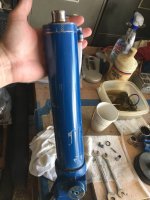
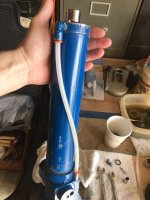
How about some pictures from various angles? I'm fairly confident I can pick it out of a crowd.

Here's what I have
 

Attachments

  • 5Fp2jWIh.jpg
    5Fp2jWIh.jpg
    117.9 KB · Views: 64
  • yOo8WhBh.jpg
    yOo8WhBh.jpg
    98.3 KB · Views: 64
  • OrXBY6kh.jpg
    OrXBY6kh.jpg
    95.6 KB · Views: 72
  • OoIxnPHh.jpg
    OoIxnPHh.jpg
    96.6 KB · Views: 62
Last edited:
OP
H

Hiball

Well-known member
Joined
Apr 30, 2009
Messages
14,026
Location
Missery
Here's what I have

I’m currently on my phone and the pictures are kinda small, but based off the jacks design, the reservoir is at same end as the tank nut, the pump pulls oil via the plastic tube. I would look for some sort of plug on the reservoir or maybe on the tank nut itself.

Maybe it’s a early design and needs to be filled via fitting with the proper amount of oil. Dunno.. ?
 
Last edited:

kduniverse

Member
Joined
May 21, 2005
Messages
5
Location
FL
I’m currently on my phone and the pictures are kinda small, but based off the jacks design, the reservoir is at same end as the tank nut, the pump pulls oil via the plastic tube. I would look for some sort of plug on the reservoir or maybe on the tank nut itself.

Maybe it’s a early design and needs to be filled via fitting with the proper amount of oil. Dunno.. ?

Sorry. Resized them. Also, thanks for your prompt responses.
 

Indexmill

Well-known member
Joined
Apr 12, 2013
Messages
1,413
Location
Central NC
Hi Everybody.

HiBall - Perhaps you can share your experience on this question. My "overseas"' manufactured Hein-Werner Winner Series Model H68040 has a solid reservoir tank cap (plug) that screws into the tank cylinder with an M10 thread and a rubber washer. This cap is solid and does not have any vent or breather.

Then this reservoir cap is tight, I notice that oil will enter the overload gallery ABOVE the ball at the bottom but UNDER the tightening screw. Thus, it easily rises past the threads of the tightening screw and wells up above the screw and below the gallery plug at the very top. This makes sense as there is a port between the reservoir and that spot in the overload gallery to allow oil that goes past the overload ball to return to the reservoir. I have read threads where people ask why is there oil above the tightening screw in the overload but I have not seen this explained as an answer.

What does not make sense to me is why does the reservoir tank cap/plug NOT have a breather port to release air to the outside rather than thru the overload gallery. Most USA-made jacks that I have worked on have a tank plug with a breather vent built into the cap; usually a small piece of sintered bronze like an aerator for a fish aquarium. I have searched hi and lo and cannot find a vented tank cap with a M10 thread. The jack I am working on seems very fussy about venting air and will always spew some oil into the overload gallery if the tank cap is tight. I have double and triple checked that there is not too much oil in the jack.

Any experience and input on this question is requested and will be valued. Thank you, Indexmill.
 
OP
H

Hiball

Well-known member
Joined
Apr 30, 2009
Messages
14,026
Location
Missery
Hi Everybody.

HiBall - Perhaps you can share your experience on this question. My "overseas"' manufactured Hein-Werner Winner Series Model H68040 has a solid reservoir tank cap (plug) that screws into the tank cylinder with an M10 thread and a rubber washer. This cap is solid and does not have any vent or breather.

Then this reservoir cap is tight, I notice that oil will enter the overload gallery ABOVE the ball at the bottom but UNDER the tightening screw. Thus, it easily rises past the threads of the tightening screw and wells up above the screw and below the gallery plug at the very top. This makes sense as there is a port between the reservoir and that spot in the overload gallery to allow oil that goes past the overload ball to return to the reservoir. I have read threads where people ask why is there oil above the tightening screw in the overload but I have not seen this explained as an answer.

What does not make sense to me is why does the reservoir tank cap/plug NOT have a breather port to release air to the outside rather than thru the overload gallery. Most USA-made jacks that I have worked on have a tank plug with a breather vent built into the cap; usually a small piece of sintered bronze like an aerator for a fish aquarium. I have searched hi and lo and cannot find a vented tank cap with a M10 thread. The jack I am working on seems very fussy about venting air and will always spew some oil into the overload gallery if the tank cap is tight. I have double and triple checked that there is not too much oil in the jack.

Any experience and input on this question is requested and will be valued. Thank you, Indexmill.

The hydraulic system whether sealed or vented is not related to your overload seapage issue, as long as your reservoir isn’t overfilled, there should be enough headspace to handle the oil leaving and returning to the reservoir. If your having excess overload pressure building up, you need to verify seat condition, ball placement/condition, seat pressure via a test station to ascertain that your jack is capable of lifting the tonnage the jack is rated at. The reason oil gets by ball/seat is because the ball/seat is damaged or the ball is lifting prematurely account being set too light, cylinder pressure can exceed a properly set overload via spikes from releasing a load while in the air and then closing the valve prior to he wheels touching down, rapid pumping (increasing the rate of oil flow) and is especially common with some of the smaller bored/bigger tonnage units running rampant in today’s market. To recap: it’s permissible to have some seapage, there is a reason most overload plugs are sealed to persuade oil back to the reservoir via being dumped on the floor, excess oil buildup needs to be evaluated further.
 

Indexmill

Well-known member
Joined
Apr 12, 2013
Messages
1,413
Location
Central NC
HI guys,

I have another good one for the community. Since reassembling this pump unit, I have left it in the vise, and every day or two, I release it, pump it release it, etc. to watch for leaks and for proper operation while I clean and paint the rest of the parts. What I have noticed is that after sitting for a day in the vise in the shop, the pump piston becomes very tight in its cylinder (two orings and two white plactic backup rings). At this point, it takes quite a good hit to start it to move. Once moved, it is free an is easy to pump up and down by hand. After sitting a day, it is quite stuck again but will immediately free up and pump fine after being whacked to start it to move in the cylinder.

Any ideas on why it is getting so stuck sitting there all nice an clean and dry??

Thank you, Indexmill.
 

DonB1

New member
Joined
Apr 4, 2018
Messages
1
Thank you for the informative tutorial on floor jack rebuild. I have repaired numerous hydraulic cylinders in industry. Thus I have done most of whet you have said here. I am rebuilding an Alltrade floor jack for my son. He does not have some resources I would want to do this job. A sturdy vise to remove the cylinder cap.
I have not removed the overload valve as it says do not attempt to adjust. But after your information I will do that next. This is my first time on this forum so Hi and thank you for the info.
 

BrianJ

Well-known member
Joined
May 2, 2005
Messages
234
Looking for some input on a 2 ton craftsman aluminum jack.

I’ve noticed some fluid on the floor after lifting a car. I thought it leaked as I had the saddle lifted to the highest point (and beyond).

I’ve bled the jack after adding hydraulic fluid, but, now the saddle studders near the top and when I continue to pump, studders for 2 strokes then the saddle move upwards again.

Any idea as to what’s going on? Do I bleed the jack some more?
 

krellboy

New member
Joined
Apr 26, 2018
Messages
2
How different is this re-build from that of the Torin 1.5 Blue Racing Jack?

Looking for how to's, step by step's, photos or videos of the actual disassembly/rebuild process for this jack.

If someone knows where to find this info please let me know....PM or email OK too.
 

bpc23

Member
Joined
Jun 4, 2010
Messages
13
Major thanks to Hiball for sharing his hard-earned knowledge! I can't believe I scrolled through all 49 pages of this thread. Suppose I should go disassemble my Allied 3T jack and diagnose it.
 

mooch91

Member
Joined
Feb 24, 2008
Messages
13
Great to read this thread! Is there any troubleshooting activity still going on in here? I'm looking for some help with a quick-lift floor jack that appears to have developed some problems with the quick-lift functionality. I haven't found any source of information on how this mechanism works. Thanks!
 
OP
H

Hiball

Well-known member
Joined
Apr 30, 2009
Messages
14,026
Location
Missery
Great to read this thread! Is there any troubleshooting activity still going on in here? I'm looking for some help with a quick-lift floor jack that appears to have developed some problems with the quick-lift functionality. I haven't found any source of information on how this mechanism works. Thanks!

Single pump piston or twin? Regardless there is tons of info on this site, If it’s a older single pump piston, it will utilize a inner smaller cylinder inside the Main cylinder to activate the quick lift function. The Oring over time wears and it suffers in the performance department, if you search for Michelin 3.5 ton jack you will find numerous threads. If it’s a dual pump model, outside of valve issues your dealing with a seal issue.
 

paulm12

Well-known member
Joined
Apr 29, 2015
Messages
584
Location
NW Chicago 'burbs
Thanks Hiball for all of the info here, very informative. I decided to try to repair a free HF jack I got from a neighbor. It is a 1-1/2 ton quick pump aluminum racing jack, model 60569. The right side piston got stuck half way on him, and he left it that way for a few years. I removed the pump assembly, removed the left side piston, and was able to tap out the stuck piston pretty easily. I cleaned the cylinders and the pistons well, inspected the o-rings and they looked pretty good. There is a slight mark on the cylinder wall, probably where the piston stuck, but the piston moved easily past it. I also removed and cleaned the release valve. I put it all back together, put in new jack oil and tried it out. I did not mess at all with the ram piston, it moves smoothly. The results:

It didn't seem to ever fully purge the air, I went thru the purge cycle many times, but I decided to try it anyways. The first part of the stroke doesn't move the ram much at all. When the lift goes up, there is definitely mushiness to it. Also the ram will not go full extension. The unit will hold ~ 50 lbs overnight, I did not try anything heavier. Also, I heard hissing from the right side safety valve when releasing the lift back down. I removed both safety valves (after counting the rotations to closed), cleaned, inspected and reinstalled.

I am wondering if this is a valve issue, or could it be that slightly scarred cylinder? I know the unit is not worth alot, I'm more working on it out of curiosity. If I get it functional I will use it on outdoor equipment, maybe up to 250 lbs. I would appreciate any thoughts on what could be causing the problems.
 
OP
H

Hiball

Well-known member
Joined
Apr 30, 2009
Messages
14,026
Location
Missery
Thanks Hiball for all of the info here, very informative. I decided to try to repair a free HF jack I got from a neighbor. It is a 1-1/2 ton quick pump aluminum racing jack, model 60569. The right side piston got stuck half way on him, and he left it that way for a few years. I removed the pump assembly, removed the left side piston, and was able to tap out the stuck piston pretty easily. I cleaned the cylinders and the pistons well, inspected the o-rings and they looked pretty good. There is a slight mark on the cylinder wall, probably where the piston stuck, but the piston moved easily past it. I also removed and cleaned the release valve. I put it all back together, put in new jack oil and tried it out. I did not mess at all with the ram piston, it moves smoothly. The results:

It didn't seem to ever fully purge the air, I went thru the purge cycle many times, but I decided to try it anyways. The first part of the stroke doesn't move the ram much at all. When the lift goes up, there is definitely mushiness to it. Also the ram will not go full extension. The unit will hold ~ 50 lbs overnight, I did not try anything heavier. Also, I heard hissing from the right side safety valve when releasing the lift back down. I removed both safety valves (after counting the rotations to closed), cleaned, inspected and reinstalled.

I am wondering if this is a valve issue, or could it be that slightly scarred cylinder? I know the unit is not worth alot, I'm more working on it out of curiosity. If I get it functional I will use it on outdoor equipment, maybe up to 250 lbs. I would appreciate any thoughts on what could be causing the problems.


It sounds like a valve issue, possibly something restricting oil flow from the reservoir or possibly weak seals. My memory isn’t too good on those old racing jacks, is there just two valve plugs on top? Don’t count the fill plug, Also is the Right side pump piston have a bigger diameter than the left?

Here is what I would try in order.

1. Verify correct oil level

2. I would try bleeding the jack, open the release and pump the jack 10-12 times. Try the Jack


3. Forceful bleeding/flushing method if #2 doesn’t work
A. Make sure the lift arm is down
B. Close the release
C. Physically pull up on the lift arm, If the ram seal is good it should pull oil from the reservoir -> Valves -> cylinder and seat. Once the lift arm is up, open the release valve and depress with some force till down.

I’m not a big fan of (3) technique because it doesn’t fix the underlying problems of heavy contaminates in the system. Once you have completed this, try and use the jack to see if things start working better, If not pull the fill plug and repeat the standard bleed process in (2), leave the plug out and attempt to use the jack. If it works, with the plug out, it’s weak pump seals.

Report back.
 

paulm12

Well-known member
Joined
Apr 29, 2015
Messages
584
Location
NW Chicago 'burbs
Thanks for the reply Hiball. The 2 piston pumps are the same size.

I tried both purge methods, no change to jack functionality. How difficult should it be to lift the lift arm, it seemed to resist quite a bit. When I had the pump removed, I could cycle the ram piston fairly easily by hand, and it was quite smooth.

Note that when I removed the safety valve parts, the ball for the right side valve is smaller, as is the port at the bottom. I could not get a picture of the 2 ports, but attached are the 2 valve sets showing the ball dimension difference.

For curiosity I switched the 2 safety valve balls, and the right side one seemed to no longer hiss/leak, and the left side one now did (which makes sense there because the small ball is in the larger port). Not sure what any of this means, I don't think the PO messed with this.

Note also that the fluid was quite dirty.

Thanks again
 

Attachments

  • IMG_20190511_134925518.jpg
    IMG_20190511_134925518.jpg
    55.4 KB · Views: 37
  • IMG_20190512_175137914.jpg
    IMG_20190512_175137914.jpg
    93.9 KB · Views: 39
  • IMG_20190512_175133703.jpg
    IMG_20190512_175133703.jpg
    151.5 KB · Views: 46
  • IMG_20190503_184446465_HDR.jpg
    IMG_20190503_184446465_HDR.jpg
    97.1 KB · Views: 54
OP
H

Hiball

Well-known member
Joined
Apr 30, 2009
Messages
14,026
Location
Missery
Thanks for the reply Hiball. The 2 piston pumps are the same size.

I tried both purge methods, no change to jack functionality. How difficult should it be to lift the lift arm, it seemed to resist quite a bit. When I had the pump removed, I could cycle the ram piston fairly easily by hand, and it was quite smooth.

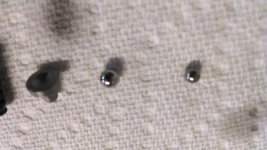
Note that when I removed the safety valve parts, the ball for the right side valve is smaller, as is the port at the bottom. I could not get a picture of the 2 ports, but attached are the 2 valve sets showing the ball dimension difference.

For curiosity I switched the 2 safety valve balls, and the right side one seemed to no longer hiss/leak, and the left side one now did (which makes sense there because the small ball is in the larger port). Not sure what any of this means, I don't think the PO messed with this.

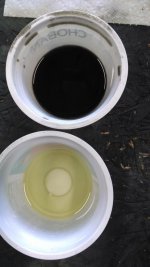
Note also that the fluid was quite dirty.

Thanks again

Hmm... Well I would definitely put the balls back in the correct (previous) orientation. It’s never a good idea to swap balls when they are different sizes, they tend to get stuck.. lol.

What was original setting (how many turns out?) prior to removing the components? It’s possible when reassembling that maybe the ball was knocked off the seat, make sure the ball is centered and I always use a dab of bearing grease to keep the stem inside the spring and drop them as one piece.
 
To avoid these ads, REGISTER NOW!

paulm12

Well-known member
Joined
Apr 29, 2015
Messages
584
Location
NW Chicago 'burbs
Yeah, everything is back in proper place, and I think are all seated ok. Note that the safety valve leaks when I open the release valve, but not when the ram is holding a small load. That is the part that has me confused.

Thanks again.
 
OP
H

Hiball

Well-known member
Joined
Apr 30, 2009
Messages
14,026
Location
Missery
Yeah, everything is back in proper place, and I think are all seated ok. Note that the safety valve leaks when I open the release valve, but not when the ram is holding a small load. That is the part that has me confused.

Thanks again.

How tight do you have the adjustment screws? If memory serves, the left is the overload, it should be “roughly” 1- 1 1/2 out from closed, the right is speed side bypass, you should tighten it down till you get some quick lift and then back of a 1/2 turn or so. Since it’s leaking on the outer cap, you are either missing a seal or they are too light and to much pressure is bypassing.
 

paulm12

Well-known member
Joined
Apr 29, 2015
Messages
584
Location
NW Chicago 'burbs
I have both safety valve screws set tight down right now (though I am hesitant to tighten too much, and I wonder if I am really compressing the springs). I know this is not correct for use, and I will set to proper turns once the jack is working.

Thanks again Hiball. I know this jack is not worth much, I am mostly tinkering. In fact, I just drained, refilled, and purged an old Sears bottle jack that I remembered I had, must be 50 years old.
 
OP
H

Hiball

Well-known member
Joined
Apr 30, 2009
Messages
14,026
Location
Missery
I have both safety valve screws set tight down right now (though I am hesitant to tighten too much, and I wonder if I am really compressing the springs). I know this is not correct for use, and I will set to proper turns once the jack is working.

Thanks again Hiball. I know this jack is not worth much, I am mostly tinkering. In fact, I just drained, refilled, and purged an old Sears bottle jack that I remembered I had, must be 50 years old.

It won’t hurt anything to have the overload tightened down all the way, that is until you go to use the jack and accidentally over estimate the load and rupture a seal, 1 1/2 out should get you close.

If you have the speed bypass cranked down all the way, you are essentially taking it out of the picture and not allowing that pump piston to work because it thinks it’s under load from the get go and bypassing immediately.
 

paulm12

Well-known member
Joined
Apr 29, 2015
Messages
584
Location
NW Chicago 'burbs
ahh, I was thinking the 2 valves were both safety valves, I forgot about the rapid pump function, and that valve is not safety, but part of the rapid functionality. I understand better now. Some of my earlier statements are inaccurate. Thanks much.

So any ideas why the rapid pump valve ball and seat (regardless of setting) is leaking when purging the system or when the release valve is opened? This condition has existed since I started working on the jack.

Thanks.
 
OP
H

Hiball

Well-known member
Joined
Apr 30, 2009
Messages
14,026
Location
Missery
ahh, I was thinking the 2 valves were both safety valves, I forgot about the rapid pump function, and that valve is not safety, but part of the rapid functionality. I understand better now. Some of my earlier statements are inaccurate. Thanks much.

So any ideas why the rapid pump valve ball and seat (regardless of setting) is leaking when purging the system or when the release valve is opened? This condition has existed since I started working on the jack.

Thanks.

Quick question, when you reference that you have the screws bottomed out, you are referencing the inside adjustment and not just the Cap? I only ask because I’ve run into this before when helping members out in the past, the inside part threads down into the block to compress the spring and set seat pressure. Outside of that, there should be a Oring on the bottom of the cap to aid in sealing that cap.
 
OP
H

Hiball

Well-known member
Joined
Apr 30, 2009
Messages
14,026
Location
Missery
yep, the internal screw, not the cap. I have had the caps out since the start (surprisingly no o-rings on those).

Thanks.

I can’t hardly believe there wasn’t Orings there from the factory, I’m not real familiar with the older 1 1/2 ton aluminum jacks, most people just tossed them. I can’t help but recall that some of those units had a ball under the pump pistons, it’s job was to lift on the upstroke and block the reservoir passage on the downstroke to force oil towards the ball/seat which if memory serves is what’s under the other plug on top of the jack. Did you see any when you pulled the pistons?

I think I have some notes at the shop to cover these units, but it’s definitely not my specialty.
 

paulm12

Well-known member
Joined
Apr 29, 2015
Messages
584
Location
NW Chicago 'burbs
yep, each drive pump had a copper washer (held on by the cylinder), and a 0.195" dia ball below the copper washer. Also another hole or channel in each of these. There were no observed issues with any of the pump piston parts.

No worries Hiball, appreciate all the comments so far. As I mentioned, if this ends up being only a learning experience for me, I am still happy.
 

paulm12

Well-known member
Joined
Apr 29, 2015
Messages
584
Location
NW Chicago 'burbs
Hiball: a quick status on the HF 1-1/2 ton rapid pump jack. I removed the ram and reservoir, but I was not able to remove the cylinder, I was hesitant to push too hard on the pipe wrench over fears of warping it. I think I will leave it as is. The inside of the cylinder looks good to me. I tried to lightly pry at the ram o-rings, and I damaged the brittle cup during removal, so I just ripped it off. I will at least have to replace the ram o-ring and retainer cup. I flushed out the casting with carb cleaner, and was able to run a soft wire through each port to the next. I had already changed out the oil once, but I did notice some gunk at the inside bottom of the cylinder during this cleaning.

ram dimensions for o-rings:
21.90 mm OD below the o-ring assembly
20.75 mm OD inside the groove

I think I should also replace the pump piston o-rings while I am it, one of them was originally stuck for a few years. I need to get those dimensions.

Thanks.
 

Attachments

  • IMG_20190521_143240825.jpg
    IMG_20190521_143240825.jpg
    149.9 KB · Views: 70
  • IMG_20190521_150359145.jpg
    IMG_20190521_150359145.jpg
    151.2 KB · Views: 55
  • IMG_20190521_143352061.jpg
    IMG_20190521_143352061.jpg
    59.8 KB · Views: 52
  • IMG_20190521_143459650.jpg
    IMG_20190521_143459650.jpg
    149.8 KB · Views: 60

paulm12

Well-known member
Joined
Apr 29, 2015
Messages
584
Location
NW Chicago 'burbs
Hiball: quick update on the Pittsburgh Rapid pump racing jack. I replaced the ram seal/cup, and the pump piston o-rings. Had a slight leak after assembly, needed to tighten up the piston cylinders a bit more. I now know about how much torque these can take (alot). I have had the jack holding up a lawn tractor front end (~ 300 lbs) overnight without any drop. I have not tried anything heavier yet.

I did notice some oil in the 2 "do not adjust" cavities (overload and speed bypass) after the 1st use, as I had those covers off. I don't know if the overload leaked a bit or popped once during use. I tightened up the springs in each ~ 1/2 turn, and I will check again in the morning to see if that happened again.

Thanks again for all your help.
 
OP
H

Hiball

Well-known member
Joined
Apr 30, 2009
Messages
14,026
Location
Missery
It’s not uncommon to find some oil above the seat when using the jack as intended, especially when operating near the overload setting. If your getting a lot of blow by at 300lbs, I’m guessing something is wrong. It’s either way too light or the seat is damaged/incorrect ball etc... if you know it’s the right size, you can try reseating the ball to form a better fitment by giving the ball a few taps with a hammer/punch.
 

KE6KA

Member
Joined
Jun 25, 2019
Messages
6
Location
California
A couple of questions: I'm doing a cheap refurb a Sears 3 Ton (328.12291). I found what I needed at a local machine shop, but they only had a loaded seal. It works, but it appears to be really tight. I wasn't able to find an unloaded u-cup in this size (22x40x12/IDxODxHT). Well, I did see them on Alibaba, but the two issues I have with those are they don't state what material they are made of and they appear to be the identical products that several posters here have had problems with in jacks that are a few years old, so I'm thinking they may be the same low-quality u-cups made for manufacturers of Chinese jacks. Does anyone know of any place that sells regular u-cups for this application?

Also, I've taken apart the jack as much as I could so I can repaint it. This is one of the models that is riveted together, so it is a partial disassembly. This isn't a big deal for cleaning up and repainting the body, but the wheels on the rear casters use a rivet or a pin for the axle. The stem also appears to be pressed into the part that bolts to the frame of the jack. Has anyone taken these apart without damaging them? I would really like to clean them up, paint, and lubricate them. I can do it without taking them apart, but I can do a better job if I can disassemble them.

And on the topic of paint, the original paint job on these jacks was about as low-quality as it can get. It chipped easily, flaked off in other areas, and was dissolved by the hydraulic fluid elsewhere. I've primed a few parts with Rustoleum industrial primer. It appears to be doing an excellent adhering to the metal via a scrape test, so I have a decent prepped surface. However, I started thinking about resistance to hydraulic fluid. Does anyone know how resistant normal Rustoleum spray paint is to hydraulic fluid? Engine enamel is advertised as oil and chemical resistant, but color choices are limited. This is without going into two-part epoxy paints and powder coating. I don't have the resources to do either one, so I'm hoping to get feedback from someone who has painted a jack.
 
OP
H

Hiball

Well-known member
Joined
Apr 30, 2009
Messages
14,026
Location
Missery
A couple of questions: I'm doing a cheap refurb a Sears 3 Ton (328.12291). I found what I needed at a local machine shop, but they only had a loaded seal. It works, but it appears to be really tight. I wasn't able to find an unloaded u-cup in this size (22x40x12/IDxODxHT). Well, I did see them on Alibaba, but the two issues I have with those are they don't state what material they are made of and they appear to be the identical products that several posters here have had problems with in jacks that are a few years old, so I'm thinking they may be the same low-quality u-cups made for manufacturers of Chinese jacks. Does anyone know of any place that sells regular u-cups for this application?

Also, I've taken apart the jack as much as I could so I can repaint it. This is one of the models that is riveted together, so it is a partial disassembly. This isn't a big deal for cleaning up and repainting the body, but the wheels on the rear casters use a rivet or a pin for the axle. The stem also appears to be pressed into the part that bolts to the frame of the jack. Has anyone taken these apart without damaging them? I would really like to clean them up, paint, and lubricate them. I can do it without taking them apart, but I can do a better job if I can disassemble them.

And on the topic of paint, the original paint job on these jacks was about as low-quality as it can get. It chipped easily, flaked off in other areas, and was dissolved by the hydraulic fluid elsewhere. I've primed a few parts with Rustoleum industrial primer. It appears to be doing an excellent adhering to the metal via a scrape test, so I have a decent prepped surface. However, I started thinking about resistance to hydraulic fluid. Does anyone know how resistant normal Rustoleum spray paint is to hydraulic fluid? Engine enamel is advertised as oil and chemical resistant, but color choices are limited. This is without going into two-part epoxy paints and powder coating. I don't have the resources to do either one, so I'm hoping to get feedback from someone who has painted a jack.

In regards to the loaded Ucup, just remove the inner X ring and it will operate like a normal Ucup and reduce wall pressure at rest.
 

KE6KA

Member
Joined
Jun 25, 2019
Messages
6
Location
California
In regards to the loaded Ucup, just remove the inner X ring and it will operate like a normal Ucup and reduce wall pressure at rest.


If the tightness continues to be a problem I'll give that a try. For future reference, do you know of any place that sells the normal u-cups? I didn't see them on the mfpseals website. In the future, I'm probably going to order this stuff online. I could only find one place in town that was helpful, but it's a long trip across the metro area to get there. The other locals were mostly full of comments about metric parts being the beginning of the end (why do so many Americans have a hard time with anything metric?).
 
OP
H

Hiball

Well-known member
Joined
Apr 30, 2009
Messages
14,026
Location
Missery
If the tightness continues to be a problem I'll give that a try. For future reference, do you know of any place that sells the normal u-cups? I didn't see them on the mfpseals website. In the future, I'm probably going to order this stuff online. I could only find one place in town that was helpful, but it's a long trip across the metro area to get there. The other locals were mostly full of comments about metric parts being the beginning of the end (why do so many Americans have a hard time with anything metric?).

Martin fluid power definitely sells them, there is also Hercules in Florida, but both of those places mainly cater to large orders, they will sell small orders but shipping is far from economical. I know some of the membership has had luck with “The Oring Store”. The majority of metric comments are because most shops don’t want to mess with small orders, the cost to keep a inventory + the customer base really doesn’t add up.
 

Sledhead70

Member
Joined
Jun 23, 2019
Messages
9
Location
Utah
Hiball, as others have said...thanks for doing this post, but also for keeping it going for almost 10 years! Wow.

I have a HF 4 ton that we were using on the front (heavy end) of my Dodge Diesel, but unfortunately my son in law didn’t know to stop pumping once it reached the high point. Now it leaks but still lifts and drops smoothly. I tore it down based on this thread and realize it is leaking only from the base of the reservoir/tank where it mates to the main body. The tank nut was pretty easy to get off and after inspecting everything I thought maybe it was just too loose, so I reassembled and tightened it pretty darned good, but it still leaks right at the base ever so slightly. I didn’t take a picture of the seal (should have) but it looked plastic with a flat side against the body and the U shape on the side that mates to the bottom of the tank. My first question is how tight should I crank on the tank nut as I wonder if that will do it? I worry it’ll just press right through the plastic and cut it in half. My second question is where can I source a replacement? I measured the flat portion of the body and the I.D. Is 68mm and the O.D. of the tank is 75mm but can’t seem to find anything like it. Is there an alternative to the plastic?

Thanks again!
 
OP
H

Hiball

Well-known member
Joined
Apr 30, 2009
Messages
14,026
Location
Missery
Hiball, as others have said...thanks for doing this post, but also for keeping it going for almost 10 years! Wow.

I have a HF 4 ton that we were using on the front (heavy end) of my Dodge Diesel, but unfortunately my son in law didn’t know to stop pumping once it reached the high point. Now it leaks but still lifts and drops smoothly. I tore it down based on this thread and realize it is leaking only from the base of the reservoir/tank where it mates to the main body. The tank nut was pretty easy to get off and after inspecting everything I thought maybe it was just too loose, so I reassembled and tightened it pretty darned good, but it still leaks right at the base ever so slightly. I didn’t take a picture of the seal (should have) but it looked plastic with a flat side against the body and the U shape on the side that mates to the bottom of the tank. My first question is how tight should I crank on the tank nut as I wonder if that will do it? I worry it’ll just press right through the plastic and cut it in half. My second question is where can I source a replacement? I measured the flat portion of the body and the I.D. Is 68mm and the O.D. of the tank is 75mm but can’t seem to find anything like it. Is there an alternative to the plastic?

Thanks again!

I know what your talking about, but I’m not aware of where to tell you to look for a direct replacement outside of HPS in my signature or any local shops in your area. Was there not a Oring that sealed the inside of reservoir at the base? If it was mine I would check that Oring for damage, replace as needed and make sure there are no burs on the reservoir base, make sure it’s uniformly flat and if needed remove that plastic u channel and replace with some loctite 518.

I will say that hydraulic fluid is extremely sneaky, it will run down and have you chasing your tail on it’s origin. My gut tells me that the overextension of you jack probably damaged the seal on the factory weep hole that prevents overextension and it’s sleeping out around tank seal and finding its way to the reservoir base. Regardless it’s a easy check, next time you have the tank nut off, pull the ram and put eyes on the seal.

If you can take some pictures, post them up or send me a PM and I’ll give you my email and I’ll look at your actual components and be more able to assist.

Hope this helps.
 

Sledhead70

Member
Joined
Jun 23, 2019
Messages
9
Location
Utah
Thanks Hiball. I’ll tear it down later this week and get some pictures. There was no o-ring inside, just that plastic piece. I have been paying close attention to the fluid track (it was at the top before I tore it down but now right at the bottom).

In the meantime, what is that called (an oil seal)? And how tight is that nut supposed to be?

I’ll look at that loctite 518 as I’ve never used it (I have used permatex gasket maker), but again how tight do I make the tank nut?

Finally, is there something I should check on that weep hole or anything else having been overextended? I am not sure where the weep hole is.
 
To avoid these ads, REGISTER NOW!
Top Bottom