To avoid these ads, REGISTER NOW!

Packard Built Rolls Royce Merlin Tool Kit AT9368

To avoid these ads, REGISTER NOW!

Farmer J.

Well-known member
Joined
Sep 18, 2016
Messages
1,995
Location
UK, Cornwall/Hertfordshire.
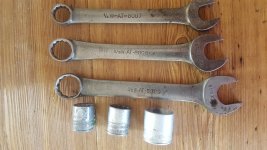
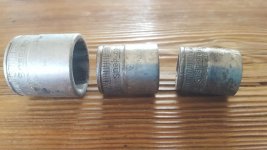
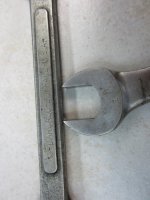
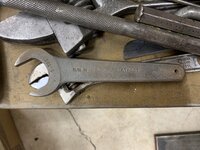
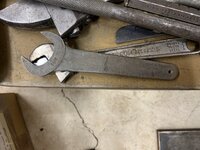
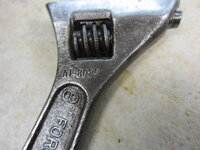
I'm unavailable to be there to welcome President Trump for D Day Anniversary, but have got some pictures taken of my 75 year old 3/8" drive whitworth sockets, and a question about the Merlin tool kit ones.

Were the ones in the Merlin kits stamped with their 'AT' prefix number or were they just stamped the same as my 'E' code WF100, WF101 and WF102?
 

Attachments

  • 20190605_080322_resized - Edited.jpg
    20190605_080322_resized - Edited.jpg
    151.7 KB · Views: 67
  • 20190605_080058_resized.jpg
    20190605_080058_resized.jpg
    118.4 KB · Views: 57
  • 20190605_080218_resized.jpg
    20190605_080218_resized.jpg
    126.3 KB · Views: 56
OP
S

snapmom

Well-known member
Joined
Sep 4, 2008
Messages
3,520
Location
Florida
Most all of the sockets I have with the "AT" have no makers name nor the "WF" model number. I have one AT socket with the Snap on name with only the AT model number.
It is odd that the wrenches show both model numbers
Many of the AT tools show up in the UK, most are not made by Snap on. They are fun to collect, a nice piece of history.
 
Last edited:

Farmer J.

Well-known member
Joined
Sep 18, 2016
Messages
1,995
Location
UK, Cornwall/Hertfordshire.
Most all of the sockets I have with the "AT" have no makers name nor the "WF" model number. I have one AT socket with the Snap on name with only the AT model number.
It is odd that the wrenches show both model numbers
Many of the AT tools show up in the UK, most are not made by Snap on. They are fun to collect, a nice piece of history.

Thanks for that information Snapmom.
My 2 larger wrenches have all the part numbers of a standard Snap On wrench as well as the 'AT' number stamped in to them. My 1/4 W-AT-8007 looks like it's snap on manufacture but doesn't have the usual ''WOEX..' number on the open end. Instead it has a lightly stamped 0 where the SO part number would usually be, and on the other side it has the jaw dimension .525 stamped in to it exactly as Snap On wrenches usually do.
My 5/16-W also has 'RR' stamped in to it. I was told it came from someone who had worked in the Rolls Royce plant in Derby.
 
OP
S

snapmom

Well-known member
Joined
Sep 4, 2008
Messages
3,520
Location
Florida
I was thinking the RR was Rolls Royce too. I wonder if some were made just for RR.
There are lots of AT tools in UK ebay. Some reasonable priced ones, and some, what are they thinking.
 

Junkdrawer Dog

Well-known member
Joined
Jan 14, 2019
Messages
1,460
Location
LV NV
Not to derail this thread, but I have a question. What level of maintenance and repair work is achievable with this set? I mean, it's a fairly basic collection of tools. Is this what the mechanic would use for between flights inspection and PM work? Or is it just one part of a larger set that was issued? I do remember touring the Dallara factory in Speedway, IN and being surprised by the relatively modest tool boxes in the car assembly area. Looked like about what you'd need to maintain a crotch rocket sportbike. Three work stations, each with a 3 or 4 drawer top chest sitting on a bench. Nothing more.
 

ttpete

Well-known member
Joined
Mar 8, 2011
Messages
6,737
Location
Dearborn, MI
Not to derail this thread, but I have a question. What level of maintenance and repair work is achievable with this set? I mean, it's a fairly basic collection of tools. Is this what the mechanic would use for between flights inspection and PM work? Or is it just one part of a larger set that was issued? I do remember touring the Dallara factory in Speedway, IN and being surprised by the relatively modest tool boxes in the car assembly area. Looked like about what you'd need to maintain a crotch rocket sportbike. Three work stations, each with a 3 or 4 drawer top chest sitting on a bench. Nothing more.

That's probably for a flight line mechanic and would cover maintenance and engine swaps along with regular hand tools.
 
OP
S

snapmom

Well-known member
Joined
Sep 4, 2008
Messages
3,520
Location
Florida
That's probably for a flight line mechanic and would cover maintenance and engine swaps along with regular hand tools.

I would think so too. Most of these tools are whitworth, with many specialized tools, so most mechanics would need this kit to work on these engines.
 

Junkdrawer Dog

Well-known member
Joined
Jan 14, 2019
Messages
1,460
Location
LV NV
So this would be an a application (Merlin) specific, supplemental kit to go along with other general aviation tools. Presumably, if you were maintaining P-51's you would need this kit for the Merlin and SAE for the airframe? Were Packard built Merlins Whitworth as well?
 

ttpete

Well-known member
Joined
Mar 8, 2011
Messages
6,737
Location
Dearborn, MI
So this would be an application (Merlin) specific, supplemental kit to go along with other general aviation tools. Presumably, if you were maintaining P-51's you would need this kit for the Merlin and SAE for the airframe? Were Packard built Merlins Whitworth as well?

Yes, and yes. Packard had to have tools, taps and dies made up in Whitworth and had to re-draw all drawings to US standards because we use 3rd angle projection, while Brits use 1st angle projection.
 

Provincial

Well-known member
Joined
Sep 21, 2011
Messages
6,871
Location
Near Salem, OR
The kit includes a valve adjusting tool, various special wrenches for packing nuts (intake pipes and coolant connections), and wrenches small enough to be for working on magnetos. Remove and replace external components on the engine and adjusting valves and ignition timing would be about the limit of field maintenance on the Merlin.

I would guess this kit would take care of any item that would be encountered between engine changes. To put this statement in perspective, engines were changed for relatively minor problems, compared to civilian use. This is because the military supplied many spare engines thinking that it was better to just swap out the problem engine for a new one, which would then be expected to be relatively trouble-free for it's planned life time. Understand, changing aircraft engines was designed to be relatively quick and easy. Low compression on one cylinder of a Merlin would require considerable work to fix, while the same problem on a Wright R1820 (B-17 engine) would be relatively quick and easy, because individual cylinders were bolted onto the Wright, while the Merlin had two banks of six cylinders. Thus a repair would be likely on the Wright, and completely impossible on the Merlin. This is one reason the Merlin was never popular with the airlines, while they standardized on radials.
 

cvairwerks

Well-known member
Joined
Aug 12, 2016
Messages
7,227
Location
Within hearing distance of Texas Motor Speedway
Most of the military engines had very low TBO's...about 250 hours for a Merlin. Typically, if a problem was found that couldn't be fixed in a relatively short time, a fresh QEC was installed and the old one sent back to be gone thru.

At the end of the war, the later versions of the Merlin morphed into what is known as Transport series engines. These had much greater TBO's and were run at much higher power levels. One of the Mustangs that I used to maintain had it's main engine and the spare come from the commercial side of the engine world. Both had their entire set of log books from day one, and the low time motor had just over 13,400 hours on it.
 

Provincial

Well-known member
Joined
Sep 21, 2011
Messages
6,871
Location
Near Salem, OR
One of the reasons for the low TBO's for fighter engines was the expectation that in combat the pilots would use use very high power settings while in combat.

Often, they would use more power than the engine was rated for. When that happened, the engine was supposed to be changed, even if it was still running well. That policy may or may not have been followed in a comprehensive manner.

Some British airliners and the Canadair North Star were Merlin-powered after WWII, but compared to the rest of the post-war airliner fleet, they were only a small percentage. The "Transport" Merlin was well-respected, and benefited from the temperature stabiltiy of liquid cooling, which resulted in long service life. But cylinder problems could not be repaired piecemeal, which was an important factor in maintainance.
 
OP
S

snapmom

Well-known member
Joined
Sep 4, 2008
Messages
3,520
Location
Florida
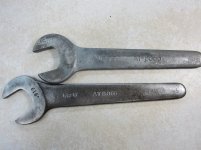
Some model numbers have different makers.
AT8066 Williams and ? (only clue is a "AU") stamp
AT8052 Barcalo Buffalo and Snap on
probably others
 

Attachments

  • IMG_9758.jpg
    IMG_9758.jpg
    68.7 KB · Views: 50
  • IMG_9757.jpg
    IMG_9757.jpg
    65.5 KB · Views: 49
  • IMG_9756.jpg
    IMG_9756.jpg
    66.2 KB · Views: 45
  • IMG_9755.jpg
    IMG_9755.jpg
    146.3 KB · Views: 54

MR.X

Well-known member
Joined
Dec 13, 2010
Messages
1,793
The AU is Bonney. I've seen many Barc 8052's but that's the first Snap On made one I've seen.
 

MR.X

Well-known member
Joined
Dec 13, 2010
Messages
1,793
..and normally the only Williams stuff I see in that kit are the adjustable hook spanners, that 8066 you're showing is also a bit unusual....at least in my experience
 

ZRX61

Well-known member
Joined
Aug 15, 2006
Messages
28,716
Location
Solar Blight Valley, SoCal
Not to derail this thread, but I have a question. What level of maintenance and repair work is achievable with this set? I mean, it's a fairly basic collection of tools. Is this what the mechanic would use for between flights inspection and PM work? Or is it just one part of a larger set that was issued? I do remember touring the Dallara factory in Speedway, IN and being surprised by the relatively modest tool boxes in the car assembly area. Looked like about what you'd need to maintain a crotch rocket sportbike. Three work stations, each with a 3 or 4 drawer top chest sitting on a bench. Nothing more.


No jacks for removing the cylinder banks & the heads are removed with the banks as one... it's possible that larger socket will fit cyl head nuts though.
 

Dave455

Well-known member
Joined
Mar 19, 2013
Messages
5,821
Location
Sussex, England
Some British airliners and the Canadair North Star were Merlin-powered after WWII, but compared to the rest of the post-war airliner fleet, they were only a small percentage. The "Transport" Merlin was well-respected, and benefited from the temperature stabiltiy of liquid cooling, which resulted in long service life. But cylinder problems could not be repaired piecemeal, which was an important factor in maintainance.

Provincial - my Father flew Canadair C4’s in the early 1960’s. They were only ever known as “North Stars” in Canada. In the U.K. they were “Argonauts”.

They were old aeroplanes by the standards of the day, and while the “Transport” Merlin was undoubtedly an improvement on the military models, I wouldn’t call it well respected. In fact it was universally hated!

The whole design was full of bugs - supercharger high gear was prohibited below one altitude, but low gear was prohibited above another, lower, altitude, so you couldn’t get from one to the other without busting a restriction.

Cooling was inadequate, and on a hot day the aircraft wouldn’t climb at all with the cowl flaps open. Climbing out of Palma on a holiday flight, they could often only make 4000 feet before having to level off, throttle back, open the cowl flaps, cool the engines, then repeat, up to maybe 8 or 9k! A climb to 18k would need 4 or 5 steps!

The cooling system needed, to quote Dad, “about 50 hoses and 100 Jubilee clips, the failure of any one causing an engine shutdown”

The fuel system was a nightmare, and badly built. This, combined with the aircraft’s appalling handling with two engines out on the same side, were the main contributory causes of the Stockport air crash.

Most pilots have a liking for types they have flown, but in the late 90’s my Father met two friends, both ex Aden Airways, who had both flown the Argonaut. By unanimous agreement, the thing was a dog! Maybe guys flying York’s or Lancastrians had better experiences.
 

Provincial

Well-known member
Joined
Sep 21, 2011
Messages
6,871
Location
Near Salem, OR
Dave455, I can imagine trying to keep four Merlins running on a 15-year old airliner. This is one reason air-cooled radial engines dominated the piston-airliner market!

The whole reason for using the Merlins on this airframe was upgrading 30% in horsepower output (1,760 vs. 1,350) over the original DC-4/C-54), and about a 100 mph increase in cruising speed. Ironically, the DC-4's soldiered on long after the the C4's were put out to pasture.
 
To avoid these ads, REGISTER NOW!

Dave455

Well-known member
Joined
Mar 19, 2013
Messages
5,821
Location
Sussex, England
Re: Packard Built Rolls Royce Merlin Tool Kit AT9368don’t think it was an easy task

Dave455, I can imagine trying to keep four Merlins running on a 15-year old airliner. This is one reason air-cooled radial engines dominated the piston-airliner market!

The whole reason for using the Merlins on this airframe was upgrading 30% in horsepower output (1,760 vs. 1,350) over the original DC-4/C-54), and about a 100 mph increase in cruising speed. Ironically, the DC-4's soldiered on long after the the C4's were put out to pasture.

I don’t think it was an easy task, despite the engineers being very experienced on Merlin’s!

You are absolutely right about the reasoning behind the design. It all looked great on paper, but was a bit of a “dogs breakfast” in practice.

There was a better option back then, which was of course the DC-6, and a hugely better option, which was the Viscount. Unfortunately, DC-6’s were costly, and Argonauts were not!

Dad flew the Argonaut very little after ‘64, but back then it was easy to operate multiple types, and I see from his licence that his last Argonaut base check was ‘67! Argonaut engine failures were commonplace, but Dad reckoned that once he flew turbines, he didn’t have another failure for 28 years!

As a small child I remember being taken into the hangar and stores. By then the Argonauts were long gone but the company still held the approvals. There were huge boards full of specialist tools for every engine they worked on! I’m still in touch with one of the engineers from that era. To say he has a “substantial stash” of tools and spares, would probably be an understatement!

The D.C.-6 continued in service in the U.K. till the early 2000’s. It was still very viable for ‘ad-hoc’ freight where a turbine aircraft would have been costly to keep hanging around on the ground!
 
Last edited:

d42jeep

Well-known member
Joined
Oct 22, 2014
Messages
16,554
Location
Northern California
Some model numbers have different makers.
AT8066 Williams and ? (only clue is a "AU") stamp
AT8052 Barcalo Buffalo and Snap on
probably others

I’ve had several of the AT8005 Barcalo combos.
-Don
 

Attachments

  • F3768E45-28B1-413A-8ADE-AC05463A3597.jpg
    F3768E45-28B1-413A-8ADE-AC05463A3597.jpg
    149.2 KB · Views: 51

Smokeshow69

Well-known member
Joined
Dec 7, 2012
Messages
8,383
Location
Pacific Northwest
I just found this At8067 in case anyone needs it? Is this made by Bonney?
 

Attachments

  • 76ECCB09-E480-474C-AC94-EF05445817E7.jpeg
    76ECCB09-E480-474C-AC94-EF05445817E7.jpeg
    337 KB · Views: 30
  • EB1CEF84-9A3A-4ADB-9D29-D862EB56F20F.jpeg
    EB1CEF84-9A3A-4ADB-9D29-D862EB56F20F.jpeg
    309.3 KB · Views: 34

driftpin

Well-known member
Joined
Dec 22, 2016
Messages
11,268
Location
Miami-Dade/Broward Co. Florida
Reading this thread from beginning, I saw much discussion about the Merlin, and its use in various airframes. Here are several pics I took last week at an aviation museum in the San Francisco Bay area.

While wikipedia is often used as a source of info, I would want a better, more-reliable reference resource, personally.

This is a Packard V1650-7 manufacture of a RR Merlin.
Merlin.01.jpgMerlin.02.jpg

Back in the 1980's while attending the unlimited hydroplane races at Miami Marine Stadium, FL, both Allisons and Merlins (1,650 cu. in.) were used in the racers of the day. It was before the predominance of the helicopter turbines. Bernie Little, the Anheuser-Bush distributor in the Tampa area, sponsored 'Miss Budweiser' and using RR Griffon engines (2,240 cu. in.!), which was piloted by first, Dean Chenoweth, who tragically died, and then Jim Kropfeld. The pit team used a crane to lift the boat out of the water, and they could change-out an engine in a few minutes. It was amazing to watch. I have old Kodacolor prints of being in the pits to watch, and there were probably 4 engines sitting on cradles, waiting to be installed. The cleaver prop that it drove looked to be ~ 12" in diameter.

The pic below is from Roger Schaaf.

Miss Budweiser RR Griffon-Roger Schaaf pic.jpeg

My hat's off to any mechanic who can use the tools mentioned to maintain these babies!
 

driftpin

Well-known member
Joined
Dec 22, 2016
Messages
11,268
Location
Miami-Dade/Broward Co. Florida
Driftpin: Pop over to Kermit Week's youtube channel and look back about 5 years. He did a 3 part series out at Vintage V-12's on the Merlins and Allisons.
Thank-you, I'd visited his air museum when he was at Tamiami Airport (TMB) in Miami FL. The last time I was there was about a month before Sept. 24, 1992: Hurricane Andrew. I took a friend, a woman who is a private pilot and who was visiting, to see the museum. The museum was destroyed by Andrew, and Weeks decided to move to the center of the state. As I recall an Avro biplane which was one of the oldest still-operable planes was one of the victims of Andrew. I'd seen it flying, and you could buy a ride in it, back-then. I recall watching it trundle down the runway, pop into the air, and with a slight plume of smoke from the exhaust stacks, it would slowly float along.
 
OP
S

snapmom

Well-known member
Joined
Sep 4, 2008
Messages
3,520
Location
Florida
Diamalloy AT-8029
 

Attachments

  • IMG_4073.JPG
    IMG_4073.JPG
    348.8 KB · Views: 31
  • IMG_4074.JPG
    IMG_4074.JPG
    231.6 KB · Views: 31
OP
S

snapmom

Well-known member
Joined
Sep 4, 2008
Messages
3,520
Location
Florida
Plomb AT-8027 with AT-8027 3/16w socket
 

Attachments

  • IMG_4075.JPG
    IMG_4075.JPG
    279.6 KB · Views: 28
  • IMG_4076.JPG
    IMG_4076.JPG
    223.3 KB · Views: 17
  • IMG_4078.JPG
    IMG_4078.JPG
    188.4 KB · Views: 17
  • IMG_4079.JPG
    IMG_4079.JPG
    235.4 KB · Views: 23

Dave455

Well-known member
Joined
Mar 19, 2013
Messages
5,821
Location
Sussex, England
I do not think so, would have the AT8036 model number, and would look more like a regular feeler gauge. Thanks for looking for me,

An update:
Only need five items
AT8029 Adjustable wrench
AT8030 Looks like some sort of long finger plunger
AT8036 Feeler gaug
AT8065 Wrench small comb.
AT9209 Socket stubby multi pronged
AT9217 Socket
Hi Snapmom,

Sadly, I don’t think I have any of the missing items you need.

I may have missed it, but what is the significance of the “AT” numbers? Obviously not all the ”AT” tools are for Packard Merlins, or even Whitworth.

I do have quite a few “AT” marked tools. These sockets are an example. I’ve got probably 50 or so of these.

As I touched on before, the tool kits you have would be rare in the U.K. as British engineers already had full sets of Whitworth tools, but other AT marked tools are common.3ABB787D-930B-4BE2-8623-454C4C3472C5.jpeg
 
OP
S

snapmom

Well-known member
Joined
Sep 4, 2008
Messages
3,520
Location
Florida
Hi Snapmom,

Sadly, I don’t think I have any of the missing items you need.

I may have missed it, but what is the significance of the “AT” numbers? Obviously not all the ”AT” tools are for Packard Merlins, or even Whitworth.

I do have quite a few “AT” marked tools. These sockets are an example. I’ve got probably 50 or so of these.

As I touched on before, the tool kits you have would be rare in the U.K. as British engineers already had full sets of Whitworth tools, but other AT marked tools are common.3ABB787D-930B-4BE2-8623-454C4C3472C5.jpeg
Not sure of meaning of the AT could be aircraft tool. Some are metric and AF
 

Private Lugnutz

Well-known member
Joined
Mar 30, 2012
Messages
30,604
Location
The Authentic Jersey Shore
I may have missed it, but what is the significance of the “AT” numbers? Obviously not all the ”AT” tools are for Packard Merlins, or even Whitworth.
I've looked at this before, Dave, and still have not found a definitive answer.

"AT" as an aircraft designation stands for Advanced Trainer.

"AT" as a parts designation does not appear in any period references I have, which includes a 1944 Navy Aviation Supply Office catalog and a 1943 H.M.S. Admiralty Fleet Order: Tool Kits for American Types of Aircraft. All my references, and especially the Navy ASO, are replete with stock number cross-references and indexes to help make supply easier. Tables and tables correlating parts. The Navy, including the Navy ASO, used the Federal Stock Number with an "R" prefix. Other common correlations include Naval Aircraft Factory numbers (NAF), Army Navy numbers (AN)(for parts interchangeable from Navy to Army Air Corps), US Army Air Corps numbers (AC), mfgrs codes (e.g., numbers unique to Wright, PWA, etc), and even some RAF numbers. I could flood the thread with excerpts, but suffice it to say, in every category you can think of, from nuts and bolts to hydraulic hose and couplings to extruded parts to hand tools to electronics, "AT" is very conspicuous in its absence. Nuts and bolts and electronics are especially packed with parts listed by R, NAF, AN, AC, and in some cases RAF stock numbers. No "AT" anywhere to be found.

My theory is that it may indeed refer only to parts (including tools) associated with US equipment in British aircraft, such as Packard-built Merlin engines (Lancaster?), and whatever the Fairchild Ranger engines went in (Argus?). But my knowledge of US-British collaborations ends there.

Fairchild did make AT-21 Gunner trainers, which could complicate the problem.

Could we back ourselves into an answer empirically? Deriving it through the process of elimination?

Has anyone seen any WWII "AT" numbers on tools associated with aircraft other than Packard Merlin and Fairchild Ranger or other US-British aviation hybrid kits? And were the Fairchild Ranger tools for British Lend-Lease aircraft or the AT-21 Gunner trainers?
 

Provincial

Well-known member
Joined
Sep 21, 2011
Messages
6,871
Location
Near Salem, OR
Ranger-engined Fairchild PT-19's and especially enclosed cockpit PT-26's (for cold weather) were supplied to Canada where they trained both Canadian and British pilots during WWII.

I believe that Ranger used the AT- numbering system for tools back into the early 1930's when they introduced the 6-390 engine. They may have been the only one using that designation then.

Packard may have chosen to use "AT" to separate the aircraft tools from automotive lines. It makes sense.
 

Private Lugnutz

Well-known member
Joined
Mar 30, 2012
Messages
30,604
Location
The Authentic Jersey Shore
Interesting, Jock. The prefix could be a complete coincidence without any common extraneous (e.g., US or US/British military) significance, which is not something I previously thought.

Just to help put that further to rest, or not, are there any commonalities in the numbers after the "AT" prefix across Ranger and RR/Merlin tools? I don't necessarily mean the actual number (e.g., identical numbers for identical wrenches), but perhaps the number of digits and the series (i.e., 8xxx), etc. I only have a few RR/Merlin tools, I don't have any Plomb Fairchild Ranger tools, I'm not familiar enough with their type and range, and I'm too lazy to research it when I know there are guys who know it better than me.
 
OP
S

snapmom

Well-known member
Joined
Sep 4, 2008
Messages
3,520
Location
Florida
I think all the ATxxxx packard tools are AT8xxx or AT9xxx. most are whitworth, some are AF, one is metric. There are several different kits.

I started collecting blue point whitworth and BP aircraft tools a long time ago, got into the Blue Point AT8xxx wrenches, then I thought about it and said what the heck why not do the Packard P51 set. Still need three pcs to finish.
 

Private Lugnutz

Well-known member
Joined
Mar 30, 2012
Messages
30,604
Location
The Authentic Jersey Shore
You'd think it would be "Aircraft/Aviation Tool"
If you mean as a way for Packard to exclusively distinguish tools they were buying from OEM's to provision in kits intended for performing maintenance on aircraft engines vs automotive engines, completely separate from the various part numbering systems that the Navy, USAAF, and other aircraft companies were using for parts, including tools, as Jock suggested, it does make sense. But that wouldn't explain why Fairchild, a company only making aircraft engines and aircraft, would need to use such a designation for tools to maintain them. Unless it was just a coincidence.
I think all the ATxxxx packard tools are AT8xxx or AT9xxx.
Thanks. Yes, and that literature (manuals, etc) is fairly well known. It's the Fairchild Ranger tools I am not sure of. I am hoping @MR.X sees this.

EDIT: Quick search sure looks like Ranger AT- tools were low 1-, 2- and 3-digit numbers. So, doesn't seem like any overlap, even in format.
 
Last edited:

Littlebuddy

Active member
Joined
Sep 16, 2022
Messages
41
Location
UK
Hi all ! Newbie here who is into all things that are USAAF related .
I have been reading this thread with interest and trying to nail down an exact date for the AT-9368 Tool roll, which I belive and correct me if I'm wrong could be early 1950's ?
 
To avoid these ads, REGISTER NOW!
Top Bottom