To avoid these ads, REGISTER NOW!

Pliers; How Many Is Too Many?

Leviton

Well-known member
Joined
Feb 25, 2019
Messages
898
Location
Oregon
...

1-Jul-25:0413 from Private Lugnutz. . . . the pliers not looking old enough to be 1899 production.
I didn’t mean to imply LesserSon & four.cycle’s pliers were pre-1900 vintage, only that the McKaig-Dorntge plant burned down in 1900. I have no information on the companies further history and McKaig's further association to that particular business. My feel is the pliers in question were produced by drop/stamp forging in the Ford Model T and Model A era; possibly WWII.

...

I LOVE this Mc.D mystery regarding LesserSon's great plier find.

McKaig-Dorntge dissolved only a few months after the December 1900 fire so it looks like they did not produce the Mc.D pliers.
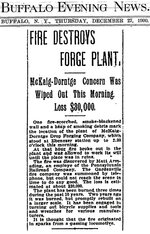


McKaig-Dorntge 1900.jpg


McKaig-Dorntge Dissolution 1901.jpg


(Interesting that the final fire that finished off a drop forging plant was started externally.)
 
To avoid these ads, REGISTER NOW!

Mintgrun

Well-known member
Joined
Oct 7, 2015
Messages
2,113
Location
Kingston, Wa.
I'm unsure of its intended application, but I like it.

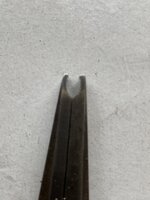
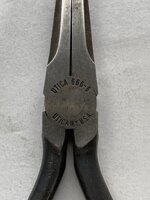
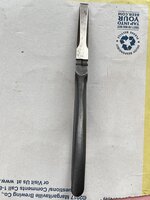
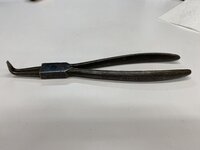
There was a pair of those evil model 666 pliers shared in the Utica thread recently and my post afterwards compares them to a Klein pair I found and a catalog description. They're called "heat coil pliers."


Mintgrun

Well-known member
Joined
Oct 7, 2015
Messages
2,113
Location
Kingston, Wa.
Do you have any rods to see what Dia "heat coil" the 666-6 pliers are for?

The listing in the Klein catalog says they're for holding any cylindrical object. That's an exaggeration.

I checked mine and they'll grab something as small as 1/8" within the curved tips, but anything smaller slips through.

The biggest socket I could grab in the tips was 3/4" diameter. Any bigger and it pops out.

The notch appears to be 5/16" ID. When grabbing a 5/16" rod, it matches the notch curves.
 

d42jeep

Well-known member
Joined
Oct 22, 2014
Messages
16,520
Location
Northern California
Ironically, also trademarked, with a hyphen ("Arc-Joint"), by Sears, Roebuck, & Co. in 1970, first use in 1953, to describe the arcing shape of the joints of the famous tongue-and-groove style invented by Champion DeArment and branded "Channellock" in 1934. When that utility patent expired in 1951, the joint type was free game. Even more ironically, Champion DeArment was one of the OEM's supplying Sears with Craftsman and Dunlap "Arc-Joint" branded pliers, along with Wilde and McKaig-Hatch (who made them under license with Utica, for a design Utica branded "Rib-Joint" in competition with Sear's "Arc-Joint"), in such great numbers that the name became synonymized by a whole new generation of users as the type of pliers (i.e., arc joints), as you just correctly identified, regardless of the mfgr. @four.cycle just posted a pair of Craftsman "Arc-Joint" branded arc joint pliers a couple pages ago.
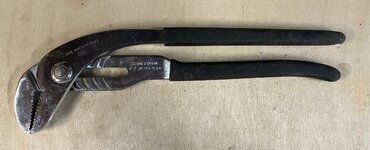
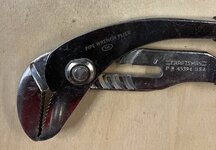
These may be Arc-Joint but they are marked “Pipe Wrench Plier” which seems kind of odd to me.IMG_3090.jpegIMG_3091.jpeg
-Don
 

four.cycle

Well-known member
Joined
Oct 19, 2015
Messages
28,654
Location
Tacoma, Washington
The "Arc Joint" model I picked up with all those screwdrivers you got was ID'd by @LesserSon, who suggested that it was made by Channellock. There didn't seem to be any "production code" anywhere on the piece - only the "Arc Joint" moniker.
 

Attachments

  • Craftsman 10 in arc joint pliers 061425 01.jpg
    Craftsman 10 in arc joint pliers 061425 01.jpg
    316.4 KB · Views: 12
  • Craftsman 10 in arc joint pliers 061425 02.jpg
    Craftsman 10 in arc joint pliers 061425 02.jpg
    305.7 KB · Views: 14
  • Craftsman 10 in arc joint pliers 061425 03.jpg
    Craftsman 10 in arc joint pliers 061425 03.jpg
    355.3 KB · Views: 15
To avoid these ads, REGISTER NOW!

Beerhippie

Well-known member
Joined
Oct 13, 2023
Messages
9,712
Location
Far NE Oregon
Companies have been billing various pliers and "pipe wrench pliers" forever. they really aren't well suited for the job.
I find myself reaching for them pretty often when the piece is too small or the access too limited for a pipe wrench. If you know how to use them, they work quite well--within their limits.
 

Oregon Dave

Well-known member
Joined
Sep 16, 2023
Messages
298
Thanks for clarifying. That's not how I interpreted the part of your post I have emboldened below...

The only way for that to be true is for McKaig-Dorntge to have survived the fire in 1900 and gone on to become a going enterprise in the mid-century production era. Nothing in the historical knowledge base (Google Books, IA/ITCL) suggests that's the case. McKaig went on to patent slip-joint pliers in 1911 and co-found McKaig-Hatch, Inc. in 1913, and, apparently, McKaig Drop Forge Co. (no Hatch), at least as early as 1914. I have never seen a good explanation/distinction/disambiguation of those two names appearing in period trade mags.

I still think "Mc.D" would be an odd and very unlikely abbreviation for Mc(Kaig) D(rop Forge Co.). EDIT: Not just because of the odd syntax. Because McKaig-Hatch was such a prolific pliers mfgr.
First. I hope everyone had a great 4th of July; extended mine some - HAPPY BIRTHDAY AMERICA - blessed gift to me; make it better for next.
Bad deal; the flood in Texas Hill Country; been there several times - Luckenbach mostly; the beer & music - the ‘Texas-State-of-Mind’; marrow of America - thoughts/prayers/good vibes to them.

Second. Leviton, how serendipitous to find the McKaig-Dorntge fire article; aint technology getting to be technological!

Private Lugnutz . . . I still think "Mc.D" would be an odd and very unlikely abbreviation for Mc(Kaig) D(rop Forge Co.). EDIT: Not just because of the odd syntax. Because McKaig-Hatch was such a prolific pliers mfgr.

For me, it’s not so much whether McKaig-Dorntge continued or not beyond the fire of 1900; but I wonder if Archibald McKaig Sr. kept any intellectual properties that ended up later on LesserSon’s pliers. Agree McKaig-Hatch was a prolific pliers mfgr., but there were several others; the ‘big-dog’ in Buffalo at the time being Williams. The attributes of Buffalo; Niagra Falls power, Erie Canal to Hudson River/Great Lakes and rail transport of raw materials & product - had to accumulate an massive/unbelievable amout of industrial/manufacturing creativety/ingenuity/talent and skilled craftsmen. A stretch, but it may have also been a location where bins/totes of drop/stamped forged pliers halves were accumulated at the end of WWII???

Enlarging the mystery/expanding ‘pressed in triangle’ with the “Forged in the USA”; we've all seen that text & variations on a lot of less than decent quality tools - Hey, we want to sell this junk, but don’t our name on it; putting USA can’t hurt the sale. Another thought is that is was a business adjustment to a dump of cheap off-shore product; similar to what cast iron cookware went through - Griswold & the boys took their name off their pans and lowered the price, however they did NOT lower the quality. Maybe ol’ Archy kicked it up a notch.

Another too longie - Probably time to put this on shelf; maybe others will pick it up later and move it on a few pegs.
 

LesserSon

Well-known member
Joined
Feb 7, 2016
Messages
5,054
Location
PA USA
IMG_6411.jpegIMG_6412.jpeg
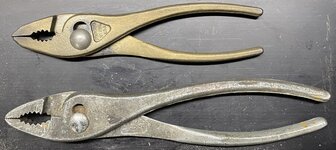
Received slipjoint pliers from @four.cycle (along w 2 unrelated pliers:ninja:) and had time to compare them today.
The pivot bolt head is not identical in size (the smaller pair has the larger bolthead, or rather, rivet). The triangular stamp is, as noted before, not identical, though the radiused points are similar. The number of teeth in the jaws is different. I think the other characteristics are artifacts of the forging process, which would be similar for any slipjoints without patterned grips.
I don’t think it is impossible both pairs were manufactured by the same forge, but I don’t see any reason to think they were, either. Let’s hope for more examples or more records, or both.
 

Oregon Dave

Well-known member
Joined
Sep 16, 2023
Messages
298
IMG_6411.jpegIMG_6412.jpeg
Received slipjoint pliers from @four.cycle (along w 2 unrelated pliers:ninja:) and had time to compare them today.
The pivot bolt head is not identical in size (the smaller pair has the larger bolthead, or rather, rivet). The triangular stamp is, as noted before, not identical, though the radiused points are similar. The number of teeth in the jaws is different. I think the other characteristics are artifacts of the forging process, which would be similar for any slipjoints without patterned grips.
I don’t think it is impossible both pairs were manufactured by the same forge, but I don’t see any reason to think they were, either. Let’s hope for more examples or more records, or both.
Thank-You for posting your observations and the pictures.

The ‘Triangle’ stamp on your pliers appears shallower and is pressed in much closer to the handle edges than four.cycles’s and on mine. It may not yield an idententity, but it may provide some further insight into the manufacturing process; i.e. was it applied during or after the original drop/stamp forging process or after. Can you dectect any deformation or anomally along the handle edges in the stamp area? Thank-You again.
 

d42jeep

Well-known member
Joined
Oct 22, 2014
Messages
16,520
Location
Northern California
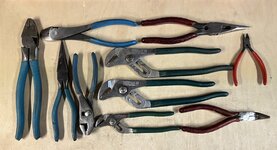
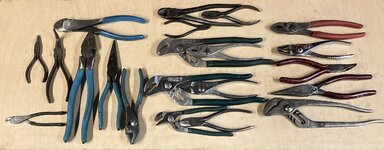
I went through the plier drawer in my user toolbox today and took several pictures. There were quite a few different brands.
Vacuum Grip (My favorite dykes).IMG_3217.jpegIMG_3215.jpeg
Klein.IMG_3218.jpeg
Cee Tee and Crescent.IMG_3219.jpeg
Diamond.IMG_3214.jpeg
Plastic handles pliers including Channellock.IMG_3213.jpeg
CamronIMG_3220.jpeg
All the pliers from the drawer. (Missed the tiny red handled Snap-on)IMG_3222.jpeg
-Don
 

LesserSon

Well-known member
Joined
Feb 7, 2016
Messages
5,054
Location
PA USA
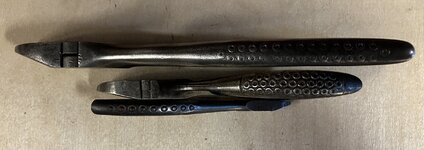
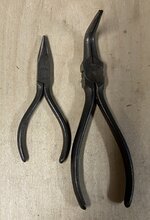
The other pliers were an unmarked, smooth-gripped 4” slipjoints.
IMG_6419.jpeg
IMG_6420.jpeg
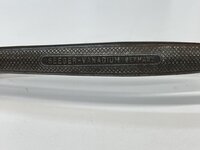
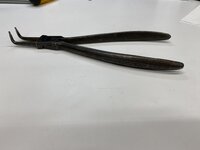
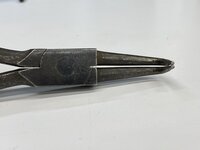
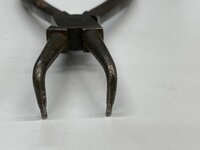
A pair of “Made in Western Germany” longnose pliers with the same grip pattern was among my left-behinds yesterday at the flea. I probably would not have noticed them if not for looking these over beforehand.
 

LesserSon

Well-known member
Joined
Feb 7, 2016
Messages
5,054
Location
PA USA
Thank-You for posting your observations and the pictures.

The ‘Triangle’ stamp on your pliers appears shallower and is pressed in much closer to the handle edges than four.cycles’s and on mine. It may not yield an idententity, but it may provide some further insight into the manufacturing process; i.e. was it applied during or after the original drop/stamp forging process or after. Can you dectect any deformation or anomally along the handle edges in the stamp area? Thank-You again.
IMG_6425.jpegIMG_6424.jpegIMG_6423.jpegIMG_6422.jpeg
I don’t notice bulges or deformation. The outside curves are from the overall pattern, and the handles, generally, are straight as an arrow shot into the sun. I suppose that suggests the stamp is part of the basic forging dies and not a secondary forging to obliterate some other mfr’s mark.
Oddly, considering the attention they have received, these were just a random pair of pliers in a box half-full of junk I bought. They don’t have any decorative features, just decent utilitarian slipjoints. I wasn’t going to keep them. I didn’t even clean them. But then “Mc.D.” The mystery continues.
 

Oregon Dave

Well-known member
Joined
Sep 16, 2023
Messages
298
IMG_6425.jpegIMG_6424.jpegIMG_6423.jpegIMG_6422.jpeg
I don’t notice bulges or deformation. The outside curves are from the overall pattern, and the handles, generally, are straight as an arrow shot into the sun. I suppose that suggests the stamp is part of the basic forging dies and not a secondary forging to obliterate some other mfr’s mark.
Oddly, considering the attention they have received, these were just a random pair of pliers in a box half-full of junk I bought. They don’t have any decorative features, just decent utilitarian slipjoints. I wasn’t going to keep them. I didn’t even clean them. But then “Mc.D.” The mystery continues.
Thank-You; your pictures eliminates the ‘eraser stamp’ for me, will settle for now on marketing product not proud enough to put a maker’s name on, but using USA to help sell it. I understand this was used by other U.S. manufacturers in the 1930’s. Hope someone else picks this up later; would like knowing.

By the way, you probably already know this, the handle grip pattern on your West German side cutters was also used by German tool makers, at least, Hoppe and Harry P. Will
 

Oregon Dave

Well-known member
Joined
Sep 16, 2023
Messages
298
The other pliers were an unmarked, smooth-gripped 4” slipjoints.
IMG_6419.jpeg
IMG_6420.jpeg
A pair of “Made in Western Germany” longnose pliers with the same grip pattern was among my left-behinds yesterday at the flea. I probably would not have noticed them if not for looking these over beforehand.
LesserSon, I, and I’m sure many others, appreciate very much the images/photos and information you & others share here.

I would in no way want to impose on your generosity, but your images for example; you take the time to arrange/pose the tools, with a scale, photograph both sides, handle patterns etc. & they have a great depth of field. I personally like to harvest images from Garage Journal for my own ‘puter tool files. Could you possible share some techniques/tips or even submit a picture of your set-up and equipment? I would humbly encourage others to do the same if they felt so inclined; the knowledge and helping spirit is so strong here.

Am a ‘baby-boomer’ and have the obligatory pick-up bed full of hand tools; would like to share some that I find interesting.

Garage Journal is a large forum & there may be a better place for this request, but didn’t pop-up on a search for images or photographs - would appreciate knowing a better GJ section if available.


Thank-You
 

LesserSon

Well-known member
Joined
Feb 7, 2016
Messages
5,054
Location
PA USA
Well, thank you for the kind words! But I don’t actually have a set-up. If there is any merit to my photos, it’s partly awareness of available light, and mostly OCD editing.
All of my photos are taken with a hand-held iPhone, which is a fine tool for capturing informal group photos around the water cooler, but I curse Apple constantly for not including a manual focus in the iOS app. I curse it equally for failure to focus at macro (tools) and telephoto (mountains, sky). Why does it have three lenses if it only focuses at social distances? Give me an infinity option, and I’ll capture the moon! (I am too cheap to pay for an aftermarket app that does.)
My backgrounds are often wherever I’m standing. Low light level requires something to steady the camera and the object - I rarely get good results holding both freehand. If I don’t get what I want easily, I lock the autofocus and take several pics at varied distances (inches), then chose and edit the ones that capture the detail I’m looking to represent.
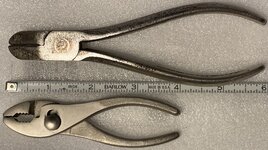
If size is under discussion, I include a tape measure, but that can be deceptive, depending on angle and depth. I take multiple shots varying my angle till the real and apparent size match acceptably.
I generally try to make use of two or more light sources, like a window and a lamp, especially if one is warm and the other cool - this is effective showing different surfaces without throwing one into shadow. But some things, like an etched or stamped logo, want a harsh, single-point light.
I rotate and crop a lot, frequently adjust keystone to achieve the look of a dead-on shot when the lighting (glare, shadows) doesn’t permit it.
 

LesserSon

Well-known member
Joined
Feb 7, 2016
Messages
5,054
Location
PA USA
Oops, I added to that post, but on the Utica thread, where I posted several similar photos today. If interested, check out examples of freehand snaps on post 419, 420, and composition details on post 421.
 

Oregon Dave

Well-known member
Joined
Sep 16, 2023
Messages
298
Oops, I added to that post, but on the Utica thread, where I posted several similar photos today. If interested, check out examples of freehand snaps on post 419, 420, and composition details on post 421.
Actually I was at the Utica posts before I came here; harvested your excellent images into my files - I came so close to posting the reply there: See!!! THAT’S WHAT I’M TALKING ABOUT. May have been a ‘head-scratcher’ for the Utica folks. Anyway once your images are inserted in my files; your genius/OK it’s the light, is evident. The clarity, resolution, thoroughness, depth of field - don’t need to read the subtitles to pick your images out & very much appreciate your extra effort. Appreciate the insight your shared; if you care to further explain “frequently (adjust keystone) to achieve the look of a dead-on shot” - unfamiliar with that term.

Others have also contributed & shared incredible knowledge on this forum; among other things of a major educational value - for those so inclined.

Thanks to all; I’m sure many others agree.
 

LesserSon

Well-known member
Joined
Feb 7, 2016
Messages
5,054
Location
PA USA
if you care to further explain “frequently (adjust keystone) to achieve the look of a dead-on shot” - unfamiliar with that term.
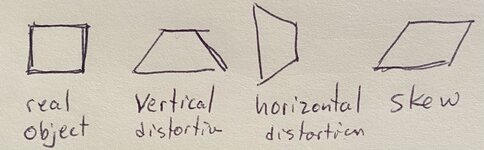
“Keystone correction” is a term I picked up from using LCD projectors. When a projector cannot be set up to project “dead-on” (centered and perpendicular to the screen, both vertically and horizontally), there were manual adjustments (later, automatic for vertical tilt) that corrected the projected frame to square it to the screen border. Photography/projection - flipsides of the same coin. Actually, many disciplines have idiosyncratic terms for what amounts to the same idea: point-of-view, perspective, attitude.
I’m using “keystone” (originally from masonry) generally to include any situation where parallel lines would appear to converge, or put another way, rectangular shapes would appear trapezoidal.
IMG_6470.jpegThe basic photoeditor on my phone allows horizontal and a vertical correction. I used to use a free editor that also corrected skew, which can result from pushing those corrections too far, but also from taking still images out the side of a speeding vehicle (at least with older, slower digital cameras).
So, in application:
if I find a glare in a dead-on shotIMG_6465.jpeg
I can take another pic from an oblique angle to avoid the glareIMG_6467.jpeg
and then correct the trapezoidal distortion (“keystone”) with the editorIMG_6468.jpeg
which I think yields better resolution than simply eliminating the source of the glare
IMG_6473.jpeg
 

Oregon Dave

Well-known member
Joined
Sep 16, 2023
Messages
298
“Keystone correction” is a term I picked up from using LCD projectors. When a projector cannot be set up to project “dead-on” (centered and perpendicular to the screen, both vertically and horizontally), there were manual adjustments (later, automatic for vertical tilt) that corrected the projected frame to square it to the screen border. Photography/projection - flipsides of the same coin. Actually, many disciplines have idiosyncratic terms for what amounts to the same idea: point-of-view, perspective, attitude.
I’m using “keystone” (originally from masonry) generally to include any situation where parallel lines would appear to converge, or put another way, rectangular shapes would appear trapezoidal.
IMG_6470.jpegThe basic photoeditor on my phone allows horizontal and a vertical correction. I used to use a free editor that also corrected skew, which can result from pushing those corrections too far, but also from taking still images out the side of a speeding vehicle (at least with older, slower digital cameras).
So, in application:
if I find a glare in a dead-on shotIMG_6465.jpeg
I can take another pic from an oblique angle to avoid the glareIMG_6467.jpeg
and then correct the trapezoidal distortion (“keystone”) with the editorIMG_6468.jpeg
which I think yields better resolution than simply eliminating the source of the glare
IMG_6473.jpeg
Wow! - I made it half-way through my junior year at OSU before ‘nam; received 12mo.’s of schooling/training via the US Army (several magnitudes above the civilian version, by the way); your answer/explanation is a 10, borderline 11 - If your not an educator, you should be teaching them - Thank-You.

To preface additional comments; I have always been blessed with serendipity. Your Mc.D pliers; after viewing hundreds of plier images on GJ, AA, Ebay, & buckets of my own, yours were the only pair where the stamping was solely in the ‘arm pits’, nothing on the outside - until this weekend camping. I keep some POC pliers in the cook-box to handle hot objects as needed; yep, one pair was stamped like yours - only it was made in India!

Question is, have you or any other person here seen pliers so marked inside the handles; so as provide a clue to your mystery and if not, and there being enough plier talent on this forum, you may have a museum piece.
 

four.cycle

Well-known member
Joined
Oct 19, 2015
Messages
28,654
Location
Tacoma, Washington
The other pliers were an unmarked, smooth-gripped 4” slipjoints.
Ahh.. yes.. the toy pliers!
I don't know where those came from! They've been in a cabinet in my kitchen for over a year. Can't recall how I came by them.
I thought they might have been from a kid's toy set.
The German set I picked up at a garage sale somewhere because the handle pattern looked interesting and I figured I'd shoot 'em your way as you've been trying to suss out various handle patterns.
 
To avoid these ads, REGISTER NOW!
Top Bottom