d42jeep
Well-known member
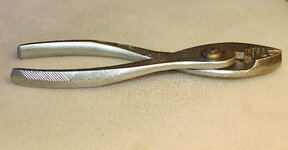
The handle pattern definitely is that of Proto and Challenger. 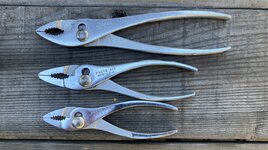

-Don
-Don


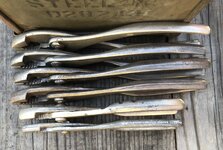
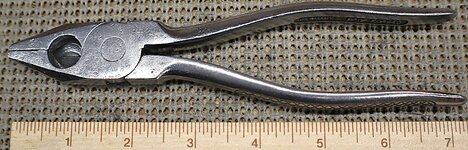
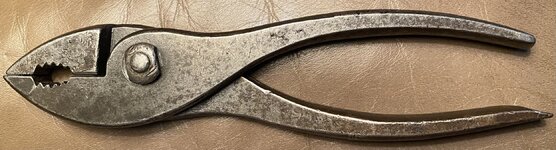
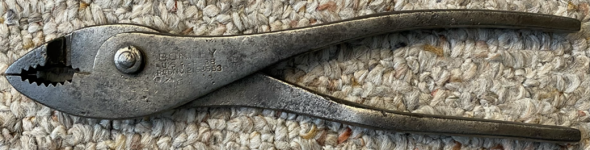
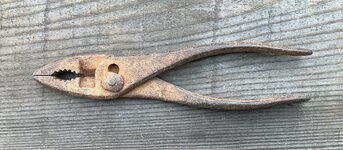
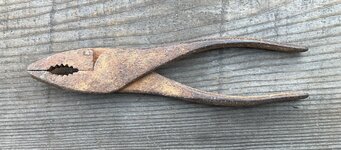
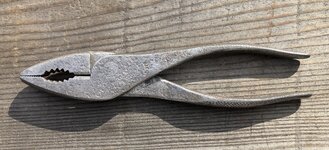
It would be helpful if you would post a straight-on overhead picture of the handle grip.OK, here is one I am trying to ID. Just got it in a box of tools at a garage sale. Tried finding a similar on here and elsewhere with no luck.
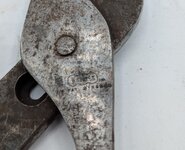
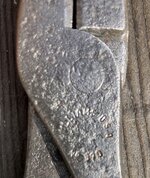
The grip pattern reminds me of Proto. The U.S.A. in a hexagon seems to stir a memory of similar on a Diamond Calk tool I had except it was inside a stretched diamond shape.
What you see in the photo are the only markings. Next to the U.S.A. in hexagon is a small circle with a r in it for a registered trade mark I believe.
There is also a small 6 stamped there.
They do not look like high quality pliers.
Anyone know the maker? Thanks.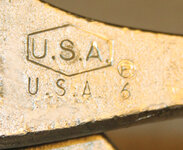
OK, here you go.It would be helpful if you would post a straight-on overhead picture of the handle grip.

Next to the U.S.A. in hexagon is a small circle with a R in it for a registered trade mark I believe.
This is a brilliant observation, LS, and it sure does look like Debcrow is right about the Registered TM symbol. The tool is later than my collecting window, but tangentially, it's a fascinating case raising some interesting questions.The P&C hex is similar to your USA hex

...was also spot on.They do not look like high quality pliers.

Thanks. As always, great people on here with a lot of knowledge and talent for finding things!
I've been looking into these a little more and the answer is really not clear yet. If I search for Dixie pliers I can find a bunch the refer to them as seaming pliers. They are in at least three different sizes, 1,2,3. Most do not show the wooden tapered mandrel like above. They could have been lost over the years. But here is a thought: Could these have been used for making funnel spouts shaping the funnel with the mandrel and then soldering them? I really have not found any information about how they would be used on hair. There are other plier like tools for hair but the hair could easily be put into them. This one just looks awkward to use that way. However, I also have not found them yet mentioned by tinsmiths. On the other hand the Adoration pliers apparently were made by a company (Giesen & Forsthoff) that mostly made grooming tools like razors and such. Guess I need more research.
Is that google including eBay, or google books?If I search for Dixie pliers I can find a bunch the refer to them as seaming pliers.

That is why it's puzzling. I also haven't found where these types of pliers are used on hair.Is that google including eBay, or google books?
While I get metric boatloads of results in the former, only 6 in the latter, none relevant, when searching for
Dixie Tinsmith Pliers
I suspect this is a case of one person saying it’s a seamer tool, and 37,000 people copying the idea. None realize it’s a hair tool.
I suspect that if this was a metalworking tool, PEXTO would sell something similar, but all their seamers are straight, not Round
Pexto Machines and Tools for Sheet Metal Work : Catalog No. 35 A : Peck, Stow & Wilcox Co. : Free Download, Borrow, and Streaming : Internet Archive
116 p., illus., 27.9 cm, trade catalogarchive.org
Even their roofing tools, several pages prior, are straight
I mentioned earlier: the ball ends and open space between the ball end and pivot are for a German reason; very practical in application.That is why it's puzzling. I also haven't found where these types of pliers are used on hair.
(It was my e-bay search for Dixie pliers that turned up all the seamers).
I also have not found a Dixie company yet that might shed some light on the subject.
Remember things like Worth is a sub- brand of PEXTO.also have not found a Dixie company yet that might shed some light on the subject
I agree about the circular area. It was either used for forming or some kind of clearance. Looking at the other ones on e-bay I do not see much marking on the clamping faces. The pivots are not made very strong either. The earlier pair of Adoration have thin handles, so not great strength. I'm thinking the flat faces are acting as stops and the round head has enough mass to keep heat at the head. If you tried to use curling hair on a head, you would need three hands. One on the handle. One the mandrel, and one on the hair. Don't know about wigs. My book of patterns show a bunch of "pinching irons", which have an egg shaped clamping area with flat jaws. They do not have the round opening. That pattern book also has a bunch of very long nosed pliers for curling hair. Basically a round shaft that goes into a half tube. These are more like modern designs except for how they are heated.I mentioned earlier: the ball ends and open space between the ball end and pivot are for a German reason; very practical in application.
Have you considered posting to a more Germanish thread; the right German sees it Bingo.
To me, way too heavy and over-built for hair tooling.
Send it to the general thread; ask Monte atI agree about the circular area. It was either used for forming or some kind of clearance. Looking at the other ones on e-bay I do not see much marking on the clamping faces. The pivots are not made very strong either. The earlier pair of Adoration have thin handles, so not great strength. I'm thinking the flat faces are acting as stops and the round head has enough mass to keep heat at the head. If you tried to use curling hair on a head, you would need three hands. One on the handle. One the mandrel, and one on the hair. Don't know about wigs. My book of patterns show a bunch of "pinching irons", which have an egg shaped clamping area with flat jaws. They do not have the round opening. That pattern book also has a bunch of very long nosed pliers for curling hair. Basically a round shaft that goes into a half tube. These are more like modern designs except for how they are heated.
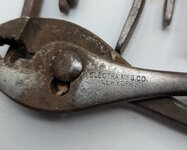
I think I have a couple Hudson Forge. But some random ones here Palmer Bros welloct and Electra?Hudson Forge Co. Parrots-Head Combination Plier
Alloy Artifacts says, “We added this entry as a place to display tools bearing the "Hudson Forge" marking, but have suspected for some time that the "Hudson Forge Co" was a brand rather than an actual tool company.
This suspicion was recently (2021) confirmed with the discovery of trademark #230,183, which displays the text "Hudson Forge Co" in a circular logo. The trademark was issued to the W.T. Grant Company in 1927.” http://alloy-artifacts.org/other-makers-p3.html
They add that this Parrot-Head’s Handle pattern “closely resembles the checkered pattern used by J.P. Danielson” A Parrot-Head identical to this one appears in their discussion.
I have some of those around somewhere. Trying to sort through them all currently.Dunno anything about Electra.
I regrettably passed up a Palmer Bros Signal Corps linesmans pliers once, but I do have a Bonney slipjoint manufactured by them.
The Welloct patent is a pivot pin design.

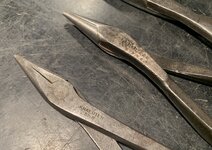
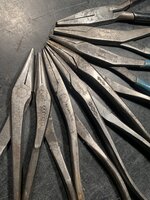


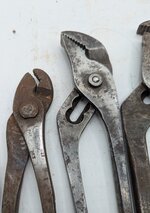
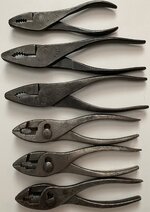
One of my favorite pliers to use, they just balance so nice on my hand. Good group.I recently found the Kraeuter 51-8 pliers and it inspierd me to snap these photos of the rest of the bunch, which includes a pair of Palmer 768 pliers. Plus, PROTO 228, UTICA (no. 31 & 82), CHANNELOCK (no. 378 & 3078) and CRAFTSMAN.
I reshaped the tips of the PROTO pair because one of the tips was broken off. I will clean up the pair of UTICA no. 82 pliers too, since someone's already done a crude job of it.
Just got this pair of Witherby pliers, Made in Germany. Model 1517. Tried to match the handle pattern with others and did find one, a Fulton, but still don't know who made it. 7 1/4" long. Inside both handles is Germany Drop Forged. The handle pattern is a flat diamond shaped with rounded ends. I have other pliers with a similar pattern but with only one end rounded and the other squared off.Well, well! Thank you, @Oregon Dave
I didn’t even notice the grip pattern on Don’s new heavy duty dikes. Now I do see the central diamond. And a quick dip elsewhere on the web does reveal several pliers with both the “Witherby England” and the chevron/diamond grips, though many Witherby pliers have smooth grips. One linesmans says only “Witherby” but forged in Germany, and two slipjoints say “Witherby” but forged in Japan.
So, Witherby-branded pliers made in England sometimes have that grip pattern, and some Witherby pliers were sourced outside England.
I compared my own chevron/diamond pliers’ model numbers (where visible) to similar models online, with no exact matches, but there may be a digit substitution pattern that would match them. I want more information about Witherby, and more examples of these pliers.
Here is a post on Progress is Fine that comes to a similar “maybe, but” conclusion.




 )
)

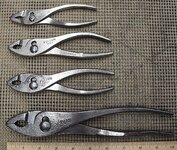



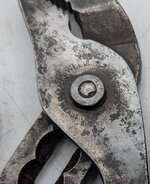
If I had to do it over again, I would have left these behind.
They came out of the evaporust yesterday and I hit them pretty hard with the wire wheel!
They turned out to be Williams USA marked.
-Don
Sometimes you just gotta say no, Don!
(I wonder if I opened a guest wing of the Lugzsonian if I could make a go of it in retirement as a sort of retreat house for recovering tool addicts. Ya know, like AA for toolhounds. Or Est for a more positive spin on it. I'd need to grow a yogi beard.
On the other hand, if it's any consolation, I can see why you may have been interested. The only slip-joints I more selectively bring home are a brand/marking I don't already have, a different length to a brand/marking I already have, or something truly unusual. Those are actually an unusual combination with the ****- or linesman-like side-cutters at the back of the jaws like that with a flush pivot. Frankly, of the dozens of combination slip-joints I have, I don't think I have any quite like that.
Williams didn't make their own pliers. I don't know anything about that era Williams with that marking, though. Those might be Diamond. Or Utica. The grip patterns are similar.
EDIT: After looking at a few catalogs, I am thinking Diamond.
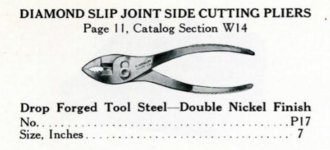
Here's a Diamond...
And here's a Utica...


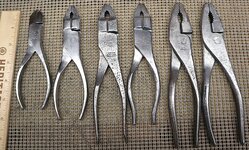
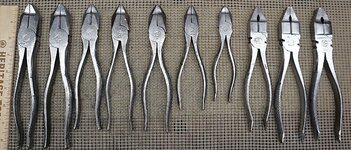
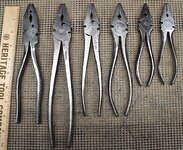
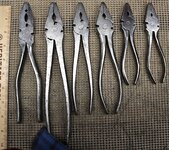
 Top three are Bonney-branded Utica-mfd. Then two Bonney branded, Danielson-mfd, and a “UTEE-CO” Danielson-mfd at bottom.

“UTEE-CO” Danielson-mfd at bottom.
“UTEE-Co,”which I’ve tried to rationalize as a collaboration between JP Danielson and Utica Tool Co or the Utica Cutlery Co to go head-to-head with Crescent’s “CEE TEE Co.”There’s a pair of Danielson-mfd diamonds-grip pattern slipjoints on eBay that very cleary say “UTEE-CO / UTICA, N.Y.” with S91 code on one handle.
I think that’s X92 and V13 for alphanumeric codes.
EDIT - found catalog evidence that Danielson did mess around with cute brands. Dan-Co Jim
They remain a mystery to me, but both of Danielson’s grip patterns are represented.Isn't “UTEE-CO” Utica? (leveraging "Cee-Tee...) or am I misremembering?
Agreed, and I was prepared to conclude it's perhaps the reason why they are so uncommon, i.e., low demand, low production, low numbers in the hands of collectors, but I was surprised to see you've found so many. I never see them. Or maybe I subconsciously ignore them. Thanks for the inventory effort, by the way.If I had to cut something thick enough to need the wider jaw position, I’d prefer a bigger tool with longer handles for the leverage.


I say that I don’t collect Kraeuter - I don’t! I really don’t! - but then I find these in a box while looking for those Craftsman. And they weren’t alone.