The Copilot
Well-known member
- Joined
- Apr 24, 2012
- Messages
- 107
removed
Last edited:

Strange.So they were sold that way you think?
We all know that wouldn't have flown if there was a Garage Journal back then to complain about chrome defects.
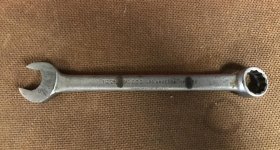
 I think just about every Proto LA wrench I have has marks on it just like that.
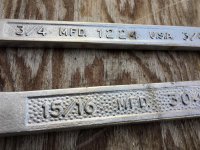
Plated pebble wrenches exist without these marks, so Plomb may have been using another plating method before (or after) this rack to get chrome on their tools. I'm not sure if factory fresh bare steel pebble wrenches exist or if what appear to be bare steel examples were just plated wrenches where the plating has worn off with handling. "Burn Mark" wrenches aren't exactly rare, but they seem to be somewhat uncommon, so perhaps this plating rack wasn't in use very long or Plomb figured out a way to use the rack but avoid the "burn marks" on the tools.
Interesting. When I worked for New Britian in the early 70s they used aluminum paint to touch up chrome defects in the non polished areas.
I just picked up a set of Plomb pebble combo wrenches, and in cleaning them, the finish on one of them started rubbing off--it was gray paint! I've had a couple of other pebbles on which the finish came off in little flecks, which I assumed was just bad chrome.
My understanding is that the pebble wrenches were never painted by Plomb at the factory, so was this something that an owner did, maybe to a plain steel wrench?
removed
Interesting find. I have a couple pebble finish wrenches but hadn't noticed those marks, now I'll have to take a second look at them.
The patent was filed 12/22/47, and according to Alloy Artifacts the pebble finish tools were made from 1945 - 1948, so maybe it's a way to tell if the wrenches were built before or after they started using the plating racks.

If that electroplating rack is indeed the cause of those particular marks on Pebbled Plomb DOE, DBE, and combo wrenches, none of the 'MADE IN U.S.A.' wrenches would have them. According to the Plomb timeline on the Tools Archive, Plomb switched from 'MADE IN U.S.A.' to 'MFD. U.S.A.' in January 1947, and that electroplating rack patent wasn't filed until December 1947.I wonder if some wrenches with these marks were the Made In USA pebbles with marks or mostly only the Mfd in USA pebbles.
Agreed, Ed. In fact, they may have actually not only tested it but used it for some time before applying for the patent, but that would be conjecture; the patent filing date is the earliest definitive date we have.I suppose as long as Plombs new electroplating rack wasn't tried out for a while before applying for the patent that cut off date looks solid.
Have you read the patent?....it does seem likely that firm contact on the wrench beam with any rack could leave thin spots in the plating.
Have you read the patent?
I remember reading this thread originally and being a little skeptical of the idea of the marks being areas of thinner plating appearing later.
Speaking of the spring-loaded clips....
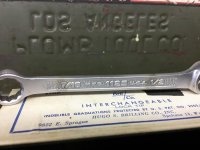
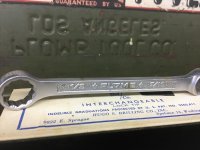
Do your wrenches have a third mark on the flip side? Anyone else want to check? It should show up in between the other two marks, but on the other side of the wrench.
While you're considering that, Ed, your question - about the number of 'MADE' Pebble Plomb wrenches with the purported plating rack marks vs the number of 'MFD.' Pebble Plomb with the same marks - got me to thinking about 'MADE' vs 'MFD' Pebble Plomb production numbers in general.
The 'MADE' Pebble Plomb production period was about 10 months long, from March 1946 (earliest known ads featuring pebbled DOEs, DBEs and combos) to December 1946.
The 'MFD.' Pebble Plomb production period was longer, from January 1947 to whenever they switched to the size-only pebble fields style, which are first shown in Catalog No. 4820, (c) 1948, which is the first Plomb-Proto catalog. Per AA, that's March 1948, when Plomb TM'd the Proto name. Per TA, that's December 1948, when Time magazine and Duke University business journal articles on the subject of the Plumb suit both say Plomb introduced the dual branding.
Either way (15 months, or 25 months), the 'MFD." period was longer.
And that seems to be consistent with examples found.
You can see the single verticle burn line on the DOE wrench and just a hint of rust (possibly a light burn mark) on the 3/4" combo. I didn't look at all having found evidence of a single burn mark on the backside right away.
 How about that?! Perfect! I am glad you revived this thread, and I am glad I decided to read the whole patent in more detail this time around. Not that there was much doubt before, with the two marks being spaced like that, but the third mark on the flip side pretty much confirms that the wrenches were plated on this kind of rack. And I do believe they are caused by the flow being concentrated through those places on the conductive rack to the wrench. Nice work. And thanks for checking.
Thanks. I don't know about talent, but it's definitely a part of the hobby I enjoy as much if not more than the actual collecting. In this case, as in so many of late, the "facts" are only very recently established by research (by twertsy and me) and often at odds with AA, so it's good to get them out there as discussions dictate.You have a real talent for summarizing historical facts.
I agree with Ed and also want to say great job on all the research that you, Twertsy and others have done. Secondly, until now I didn't know any specifics on the "Made" vs "Mfg" pebble timeline. In fact, I don't guess I have ever paid a tremendous amount of attention to my pebble tools for which way they were identified. After a quick review of what I could put my hands on easily, I found that I have more wrenches with the "Mfg" mark and more ratchets (plus the only 3/8" pebble breaker bar I have) with the "Made" mark.While you're considering that, Ed, your question - about the number of 'MADE' Pebble Plomb wrenches with the purported plating rack marks vs the number of 'MFD.' Pebble Plomb with the same marks - got me to thinking about 'MADE' vs 'MFD' Pebble Plomb production numbers in general.
The 'MADE' Pebble Plomb production period was about 10 months long, from March 1946 (earliest known ads featuring pebbled DOEs, DBEs and combos) to December 1946.
The 'MFD.' Pebble Plomb production period was longer, from January 1947 to whenever they switched to the size-only pebble fields style, which are first shown in Catalog No. 4820, (c) 1948, which is the first Plomb-Proto catalog. Per AA, that's March 1948, when Plomb TM'd the Proto name. Per TA, that's December 1948, when Time magazine and Duke University business journal articles on the subject of the Plumb suit both say Plomb introduced the dual branding.
Either way (15 months, or 25 months), the 'MFD." period was longer.
And that seems to be consistent with examples found.
While anecdotal, that is consistent with our research and analysis.After a quick review of what I could put my hands on easily, I found that I have more wrenches with the "Mfg" mark and more ratchets (plus the only 3/8" pebble breaker bar I have) with the "Made" mark.
 I guess they were using the same racks for drive tools.