To avoid these ads, REGISTER NOW!

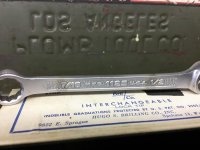
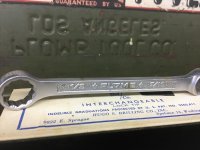
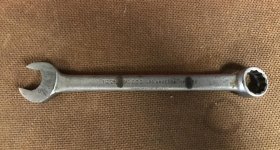
Plomb Electroplating "Burn Marks"

To avoid these ads, REGISTER NOW!

Stuart in MN

Well-known member
Joined
Sep 8, 2005
Messages
23,030
Location
Minneapolis
Interesting find. I have a couple pebble finish wrenches but hadn't noticed those marks, now I'll have to take a second look at them.

The patent was filed 12/22/47, and according to Alloy Artifacts the pebble finish tools were made from 1945 - 1948, so maybe it's a way to tell if the wrenches were built before or after they started using the plating racks.
 

montanafordman

Well-known member
Joined
Feb 10, 2013
Messages
621
Location
Meridian, ID
Actually I have witnessed this on several proto wrenches as well so it was in place much longer than just the later plomb years. I have those marks on some of my proto wrenches that are from the mid 50's to mid 60's (post Los Angeles without the trademark symbol). I might post some pictures later.
 

twertsy

Well-known member
Joined
Jan 5, 2014
Messages
6,726
Location
Reedville, VA
Strange.So they were sold that way you think?
We all know that wouldn't have flown if there was a Garage Journal back then to complain about chrome defects.

I don't think they were sold that way. The plating simply wears faster in those areas because the plating is thinner due to the support arms of the plating mechanism. Probably wouldn't notice anything at all on a brand new example.
 

SCscoutguy

Well-known member
Joined
Feb 23, 2010
Messages
2,229
Location
South Carolina
It has come up before but it was in reference to Proto wrenches not Plomb. Your post gives the most thorough description of why they look that way though. :thumbup: I think just about every Proto LA wrench I have has marks on it just like that.
 

Carla

MEMBER EMERITUS
Joined
Nov 27, 2010
Messages
672
Plated pebble wrenches exist without these marks, so Plomb may have been using another plating method before (or after) this rack to get chrome on their tools. I'm not sure if factory fresh bare steel pebble wrenches exist or if what appear to be bare steel examples were just plated wrenches where the plating has worn off with handling. "Burn Mark" wrenches aren't exactly rare, but they seem to be somewhat uncommon, so perhaps this plating rack wasn't in use very long or Plomb figured out a way to use the rack but avoid the "burn marks" on the tools.

For whatever its worth.......Yes, bare steel or original black oxide finish pebble pattern Plomb wrenches do turn up.....but in years of flea market scrounging, I've found only a very few.

(edited.....it could be likely that the uncommon 'bare steel' pebble pattern wrenches may well have been 'lunch box surplus' for workers at the Plomb works)

This is purely a guess, to be sure, but it could be plausible that some large-scale purchasers of small tools, such as the aircraft plants or public utilities, might have specified 'unplated' as a cost-saving detail in tool purchases.

I have seen sets of 'early Proto marked' wrenches and some other 'Proto' marked tools, which were black oxide finish, as military surplus. At one of the military vehicle club swap-meets, we got a full set of 'early style marking' Proto combination wrenches in its green cloth roll, still 'new in the cosmolene'.

I've had a few of the Navy-spec Plomb and Proto wrenches with a thick copper plating, but have never seen any copper plated 'pebble pattern' wrenches. Presumably, the heavily copper-plated wrenches were meant to be 'non-sparking', for use on fuel piping, or in compartments which could have explosive vapours present.

cheers

Carla
 
Last edited:

zeet

Well-known member
Joined
Jun 13, 2013
Messages
196
Location
Southern California
I have several wrenches that show these marks that I picked up from places throughout the country, and have wondered about those marks... Great post!
 

MShaw

Well-known member
Joined
Mar 2, 2015
Messages
1,013
Location
York, Pa.
Interesting. When I worked for New Britian in the early 70s they used aluminum paint to touch up chrome defects in the non polished areas.
 

Ratchet.

Well-known member
Joined
Jul 30, 2011
Messages
521
Location
Northwich England
Very interesting, I've noticed on older Hazet wrenches (600 series in particular) that they all have a similar mark on one end, always assumed it was during the chroming process, guess they used a similar set up to Plomb.
 

tym

Well-known member
Joined
Mar 5, 2016
Messages
2,429
Location
MA
I just picked up a set of Plomb pebble combo wrenches, and in cleaning them, the finish on one of them started rubbing off--it was gray paint! I've had a couple of other pebbles on which the finish came off in little flecks, which I assumed was just bad chrome.

My understanding is that the pebble wrenches were never painted by Plomb at the factory, so was this something that an owner did, maybe to a plain steel wrench?
 

SilverDeck

Well-known member
Joined
Jun 7, 2016
Messages
481
I just picked up a set of Plomb pebble combo wrenches, and in cleaning them, the finish on one of them started rubbing off--it was gray paint! I've had a couple of other pebbles on which the finish came off in little flecks, which I assumed was just bad chrome.

My understanding is that the pebble wrenches were never painted by Plomb at the factory, so was this something that an owner did, maybe to a plain steel wrench?

Same things happened to me when I was putting together my set of Plomb pebble combos. Bought one online and it looked great in the photos, but when I got it I discovered that it was spray painted silver to cover up condition issues. Totally dishonest, but this stuff goes one. Plomb never finished their pebbles with paint. They were either bare steel or chromed. Your gray paint wasn't a factory finish.
 

Oregon rock crusher

Well-known member
Joined
Jun 28, 2016
Messages
1,903
Location
West of Salem
The OP's pics aren't showing up but I have seen quite a few relatively pristine wrenches with a couple dark spots about 3"-4" apart on one side that look a lot like they could be from the chroming process. Ed.
 

Attachments

  • plomb combo wrench set not mine.jpg
    plomb combo wrench set not mine.jpg
    139.1 KB · Views: 109

FrankLee

Well-known member
Joined
Sep 13, 2010
Messages
3,561
Location
seMI, 48317

Interesting find. I have a couple pebble finish wrenches but hadn't noticed those marks, now I'll have to take a second look at them.

The patent was filed 12/22/47, and according to Alloy Artifacts the pebble finish tools were made from 1945 - 1948, so maybe it's a way to tell if the wrenches were built before or after they started using the plating racks.

Copilot removed his post, but according to Stuart's post (#2), this patent drawing must have been in the OP and likely explains those marks.

BTW, this is a Plomb Tool Company patent; one of several.
https://patents.google.com/?assignee=The+Plomb+Tool+Company

11292199436_581b642f71_b.jpg
 
Last edited:

3baygarage

Well-known member
Joined
Sep 1, 2013
Messages
11,932
Location
SW Florida/from Buffalo,NY
There’s a similar occurrence on JH Williams 3/4 drive Superratchets. It’s very common on them. A big wear loop through the chrome around the handle. Probably where they were hanging from during plating.
 

davethorik

Well-known member
Joined
Sep 14, 2013
Messages
4,992
Location
Norka, Ohio
I've seen some older Wright wrenches with similar marks.

In my limited knowledge of how chrome plating works, there always has to be a small unplated spot on a piece of metal receiving the chrome. With sockets, usually the inside is unplated (and some mfrs apply the "silver paint" to cover the bare steel).

I always wondered what the solution for wrenches was.
 
To avoid these ads, REGISTER NOW!

Oregon rock crusher

Well-known member
Joined
Jun 28, 2016
Messages
1,903
Location
West of Salem
Thanks for putting that patent drawing up Frank as well as the interesting perspective on dating tools using plating rack marks. I wonder if some wrenches with these marks were the Made In USA pebbles with marks or mostly only the Mfd in USA pebbles. Ed.
 

Private Lugnutz

Well-known member
Joined
Mar 30, 2012
Messages
30,486
Location
The Authentic Jersey Shore
I wonder if some wrenches with these marks were the Made In USA pebbles with marks or mostly only the Mfd in USA pebbles.
If that electroplating rack is indeed the cause of those particular marks on Pebbled Plomb DOE, DBE, and combo wrenches, none of the 'MADE IN U.S.A.' wrenches would have them. According to the Plomb timeline on the Tools Archive, Plomb switched from 'MADE IN U.S.A.' to 'MFD. U.S.A.' in January 1947, and that electroplating rack patent wasn't filed until December 1947.
 

Oregon rock crusher

Well-known member
Joined
Jun 28, 2016
Messages
1,903
Location
West of Salem
Good info as always Lugz. I suppose as long as Plombs new electroplating rack wasn't tried out for a while before applying for the patent that cut off date looks solid. As to whether the rack caused the marks...it does seem likely that firm contact on the wrench beam with any rack could leave thin spots in the plating. It does seem doubtful that the marks showed up right away though or surely they would have scraped it and come up with a better method. Ed.
 

Private Lugnutz

Well-known member
Joined
Mar 30, 2012
Messages
30,486
Location
The Authentic Jersey Shore
I suppose as long as Plombs new electroplating rack wasn't tried out for a while before applying for the patent that cut off date looks solid.
Agreed, Ed. In fact, they may have actually not only tested it but used it for some time before applying for the patent, but that would be conjecture; the patent filing date is the earliest definitive date we have.

....it does seem likely that firm contact on the wrench beam with any rack could leave thin spots in the plating.
Have you read the patent?

I remember reading this thread originally and being a little skeptical of the idea of the marks being areas of thinner plating appearing later. The original plating would have to be very thin to begin with, and considerably thinner to the naked eye in the darker areas for those darker areas to be bare steel showing through. By naked eye I mean you shouldn't need a surface gage to see a sizable and noticeable dip in the plating there when looking across the surface of the wrench transversely. I can't see any other reason for thinner plating to be darker plating. I don't own any of these wrenches. Is that what it looks like to you?

There are actually two designs in the patent. The design shown in the post on page 1 of this thread in Figures 1, 2, 3, 4, 5, and 6. And a second design shown in Figures 7, 8, 9, 10 and 11. The full patent can be seen at the USPTO site, linked here.

The rails in the rack are copper, and, it may not look like it, but those notches - where the wrench sits, are called "knife edge shoulders" in the first design, "to assure that substantial areas of the tool surfaces will not be mashed by the engagement with the rack, thus minimizing or almost substantially eliminating defects in the plating owing to this cause, and which otherwise must be retouched."

While no dimensions are provided, notches described and drawn as "knife edges" would imply a surface engagement area much thinner (knife-edge thin) than the width of the residual marks on the wrenches shown as examples. Implying to me that the cause of the marks is not physical (the notches not blotting out the plating from occurring where they touch the wrench).

Let's think about how electroplating works. It's not like paint. It doesn't appear immediately on contact with the solution in the plating vat when it's dipped into the plating vat. The entire rack is actually insulated except for the "knife edge shoulders" of the copper rails and that bent clip part of the spring-loaded mechanisms you can see between the rails, also made of copper, which hold the wrenches firmly against the knife-edge notches. That way, the flow of the electrical current in the vat is directed only to the uninsulated areas - the knife edge notches and the spring-loaded clip - that are in contact with the wrenches. In other words, those parts aren't just holding the wrenches in the rack - they are actually the means of directing the chromium plating onto the wrench from the solution in the vat.

Speaking of the spring-loaded clips....

Do your wrenches have a third mark on the flip side? Anyone else want to check? It should show up in between the other two marks, but on the other side of the wrench.

If the knife-edge notches in the rack rails caused the two marks we see on the brand side of surviving pebbled Plomb wrenches plated in this rack, it would seem to follow logically that surely the spring-loaded clip touching the wrenches on the other side would also cause the same mark.

In the second design, the engagement areas of the notches and the clip are even further minimized.

I actually thought the OP's term was apt. I'm inclined to think that the wrenches were in essence "burned" in the areas where the current actually flowed from the conductive rack to the wrench. If I had to guess, I'd say it was touched up, and the touch-up is what wore off.
 
Last edited:

Private Lugnutz

Well-known member
Joined
Mar 30, 2012
Messages
30,486
Location
The Authentic Jersey Shore
While you're considering that, Ed, your question - about the number of 'MADE' Pebble Plomb wrenches with the purported plating rack marks vs the number of 'MFD.' Pebble Plomb with the same marks - got me to thinking about 'MADE' vs 'MFD' Pebble Plomb production numbers in general.

The 'MADE' Pebble Plomb production period was about 10 months long, from March 1946 (earliest known ads featuring pebbled DOEs, DBEs and combos) to December 1946.

The 'MFD.' Pebble Plomb production period was longer, from January 1947 to whenever they switched to the size-only pebble fields style, which are first shown in Catalog No. 4820, (c) 1948, which is the first Plomb-Proto catalog. Per AA, that's March 1948, when Plomb TM'd the Proto name. Per TA, that's December 1948, when Time magazine and Duke University business journal articles on the subject of the Plumb suit both say Plomb introduced the dual branding.

Either way (15 months, or 25 months), the 'MFD." period was longer.

And that seems to be consistent with examples found.
 

Oregon rock crusher

Well-known member
Joined
Jun 28, 2016
Messages
1,903
Location
West of Salem
Have you read the patent?

I remember reading this thread originally and being a little skeptical of the idea of the marks being areas of thinner plating appearing later.

Speaking of the spring-loaded clips....

Do your wrenches have a third mark on the flip side? Anyone else want to check? It should show up in between the other two marks, but on the other side of the wrench.

Thanks for the information Lugz. I need to look at some wrenches closer but do not recall seeing a single burn mark on the side opposite the obvious dual burned side. I have not read the patent and admittedly commented on the marks based soley on conjecture and the apparent similarity of the marks on the wrenches and the width of the rack frame. Electroplating is not even remotely in my area of expertise but I did copy this article on plating burns and found it interesting so will paste it here. Pure speculation on my part as to whether this article explains the science behind the marks. Ed.


What Is “Burning” from a Plating Bath?
We’ve all seen it. That crispy, flaky, nodular, usually dark deposit on the high current density extremes (edges, etc.). Usually, turning down the current is the reaction done immediately to try and remedy the problem. But exactly why does burning occur? An understanding of the mechanisms involved with the formation of a burn can better help a plater to avoid this nasty problem.
Going back to high school chemistry (if you can remember that far back), you may have seen demonstrated the two electrodes from a battery, generator, or rectifier placed in a beaker of water. You will see gassing at both electrodes. If you collect the bubbles, separate for the anode (positive) and cathode (negative), you will note that twice as much volume of gas comes off the cathode. This is hydrogen gas. The gas collected from the anode is oxygen. These are, of course, the constituents of water is H2O.
Well that little experiment illustrates what I’d like to call as the ground state of electrolysis in an aqueous solution. This is what such a solution “wants” to do. Now in a plating bath, you’re wanting to overcome this tendency by supplying the metal ions that you which to plate from that bath. We will use nickel (Ni) as an example. At the cathode (the part being plated), reduction is occurring. Hydrogen ions (H+) are reduced to hydrogen gas by the incoming electrons from the cathode. You want enough nickel ions (Ni+2) to “step in” to the cathode film to take the place of the hydrogen ions to gas generation and therefore be reduced on to the part as nickel metal.
If there is not enough supply of nickel ions to replace the nickel that has already been reduced in the cathode film, the electrolytic “pressure” will start reducing the hydrogen ions to hydrogen gas. Due to the rapid depletion of hydrogen ions in the cathode film, the pH will rise sharply in that film. Remember, pH is a measure of the hydrogen ion concentration. You will also have an increase of hydroxide ions (OH) in the immediate vicinity. The pH will rise to the point, in the vicinity, that precipitation will occur of nickel hydroxide (and some iron if in the area) and this is what a burn basically is. So, obviously, the better you can facilitate the entry of the Ni ions into the cathode film, the less chance of burning. These include:
 Better solution agitation, especially near the plated work.
 Higher temperature.
 Higher nickel ion concentration.
Also, proper buffering of the bath with the boric acid helps in that it supplies extra hydrogen ions into the cathode film to keep pH there from going up too high to where the nickel starts precipitating in the cathode film causing the burn.
 

Oregon rock crusher

Well-known member
Joined
Jun 28, 2016
Messages
1,903
Location
West of Salem
While you're considering that, Ed, your question - about the number of 'MADE' Pebble Plomb wrenches with the purported plating rack marks vs the number of 'MFD.' Pebble Plomb with the same marks - got me to thinking about 'MADE' vs 'MFD' Pebble Plomb production numbers in general.

The 'MADE' Pebble Plomb production period was about 10 months long, from March 1946 (earliest known ads featuring pebbled DOEs, DBEs and combos) to December 1946.

The 'MFD.' Pebble Plomb production period was longer, from January 1947 to whenever they switched to the size-only pebble fields style, which are first shown in Catalog No. 4820, (c) 1948, which is the first Plomb-Proto catalog. Per AA, that's March 1948, when Plomb TM'd the Proto name. Per TA, that's December 1948, when Time magazine and Duke University business journal articles on the subject of the Plumb suit both say Plomb introduced the dual branding.

Either way (15 months, or 25 months), the 'MFD." period was longer.

And that seems to be consistent with examples found.

Thanks for that break down on the time period for those two variants of the pebble wrenches Lugz. You have a real talent for summarizing historical facts. On the other subject I just ran out to check a couple burn marked wrenches on the back side. These are two pretty pristine and lightly used examples. You can see the single verticle burn line on the DOE wrench and just a hint of rust (possibly a light burn mark) on the 3/4" combo. I didn't look at all having found evidence of a single burn mark on the backside right away. Ed.
 

Attachments

  • IMG_0186.jpg
    IMG_0186.jpg
    153 KB · Views: 50

Private Lugnutz

Well-known member
Joined
Mar 30, 2012
Messages
30,486
Location
The Authentic Jersey Shore
You can see the single verticle burn line on the DOE wrench and just a hint of rust (possibly a light burn mark) on the 3/4" combo. I didn't look at all having found evidence of a single burn mark on the backside right away.
:) How about that?! Perfect! I am glad you revived this thread, and I am glad I decided to read the whole patent in more detail this time around. Not that there was much doubt before, with the two marks being spaced like that, but the third mark on the flip side pretty much confirms that the wrenches were plated on this kind of rack. And I do believe they are caused by the flow being concentrated through those places on the conductive rack to the wrench. Nice work. And thanks for checking.

EDIT: In looking back, I see that it was tym who revived it.
 
Last edited:

Oregon rock crusher

Well-known member
Joined
Jun 28, 2016
Messages
1,903
Location
West of Salem
A couple more pics of burn marks including both sides of a small 1125 dbe. The marks are not always centered on the wrench beams nor strictly limited to the beam faces. All of these I have that show burn marks are MFD In USA wrenches. Ed.
 

Attachments

  • IMG_0188.jpg
    IMG_0188.jpg
    146.5 KB · Views: 47
  • IMG_0191.jpg
    IMG_0191.jpg
    113.9 KB · Views: 50
  • IMG_0192.jpg
    IMG_0192.jpg
    123.3 KB · Views: 40

Private Lugnutz

Well-known member
Joined
Mar 30, 2012
Messages
30,486
Location
The Authentic Jersey Shore
Thanks for the extra pics, Ed.

On this...
You have a real talent for summarizing historical facts.
Thanks. I don't know about talent, but it's definitely a part of the hobby I enjoy as much if not more than the actual collecting. In this case, as in so many of late, the "facts" are only very recently established by research (by twertsy and me) and often at odds with AA, so it's good to get them out there as discussions dictate.
 

Oregon rock crusher

Well-known member
Joined
Jun 28, 2016
Messages
1,903
Location
West of Salem
Well, regardless of whether you call it talent, due diligence, research, or just work, compiling scraps of information into an accurate historical timeline is appreciated. You, Twertsy, and many other individual contributors to this site help keep it relevant to those of us who enjoy our tools and want to know more about our collections. Ed.
 

RubiconJK

Well-known member
Joined
May 15, 2016
Messages
1,380
Location
"I'm bad, I'm Nationwide"
While you're considering that, Ed, your question - about the number of 'MADE' Pebble Plomb wrenches with the purported plating rack marks vs the number of 'MFD.' Pebble Plomb with the same marks - got me to thinking about 'MADE' vs 'MFD' Pebble Plomb production numbers in general.

The 'MADE' Pebble Plomb production period was about 10 months long, from March 1946 (earliest known ads featuring pebbled DOEs, DBEs and combos) to December 1946.

The 'MFD.' Pebble Plomb production period was longer, from January 1947 to whenever they switched to the size-only pebble fields style, which are first shown in Catalog No. 4820, (c) 1948, which is the first Plomb-Proto catalog. Per AA, that's March 1948, when Plomb TM'd the Proto name. Per TA, that's December 1948, when Time magazine and Duke University business journal articles on the subject of the Plumb suit both say Plomb introduced the dual branding.

Either way (15 months, or 25 months), the 'MFD." period was longer.

And that seems to be consistent with examples found.
I agree with Ed and also want to say great job on all the research that you, Twertsy and others have done. Secondly, until now I didn't know any specifics on the "Made" vs "Mfg" pebble timeline. In fact, I don't guess I have ever paid a tremendous amount of attention to my pebble tools for which way they were identified. After a quick review of what I could put my hands on easily, I found that I have more wrenches with the "Mfg" mark and more ratchets (plus the only 3/8" pebble breaker bar I have) with the "Made" mark.
 

Private Lugnutz

Well-known member
Joined
Mar 30, 2012
Messages
30,486
Location
The Authentic Jersey Shore
After a quick review of what I could put my hands on easily, I found that I have more wrenches with the "Mfg" mark and more ratchets (plus the only 3/8" pebble breaker bar I have) with the "Made" mark.
While anecdotal, that is consistent with our research and analysis.

You won't see this on the Van Natta Brothers Plomb site or on AA, where Plomb Pebble tools are lumped together as a monolithic category and identified as post-war, but Plomb Pebble tools were produced in stages by type, beginning during the war, in 1944, as we show on the Tool Archives timeline.

The first tools that were pebbled were ratchets, hinge handles, and flare nut wrenches only. Todd has found Plomb ads for pebbled ratchets, hinge handles, and flare nut wrenches as early as November 1944, and only those tools are shown pebbled in Catalog 19-R REPRINT, which I have dated from no earlier than February 1944 to no later than October 1946 based on War Production Board (WPB) Limitation Order L-216 markups (notices, strike-throughs, etc) and OEM identification (Utica).

Todd has found ads for pebbled DOE, DBE, and combo wrenches no earlier than March 1946 and those tools are not shown in a catalog until Catalog 19-R FOURTH PRINTING, which I have dated to no earlier than November 1946 to at least March 1948 based on WPB L-216 markups and OEM identification (J.P. Danielson).

If you're interested in seeing the details of my catalog dating research and analysis, which was the impetus for Todd's ad searches, see this GJ thread linked here.
 
Last edited:

Username already in use

Well-known member
Joined
Sep 4, 2015
Messages
2,177
Location
Ohio
I found this little Plomb ignition wrench today at the flea and immediately thought of this thread. I guess these 'burn' marks show up on even the smallest tools. Consistent with the other tools shown in this thread.

attachment.php
 

Attachments

  • Plomb burn marks.jpg
    Plomb burn marks.jpg
    58.5 KB · Views: 210

d42jeep

Well-known member
Joined
Oct 22, 2014
Messages
16,500
Location
Northern California
Here is a Proto LA combo wrench with pretty clear marks.
-Don
 

Attachments

  • 1CC0273F-FEEC-4359-9B87-619CA5B78ABF.jpg
    1CC0273F-FEEC-4359-9B87-619CA5B78ABF.jpg
    160 KB · Views: 30
  • 35A2238F-7E80-4512-AF68-ECCFF5C2CB59.jpg
    35A2238F-7E80-4512-AF68-ECCFF5C2CB59.jpg
    159.5 KB · Views: 22

Private Lugnutz

Well-known member
Joined
Mar 30, 2012
Messages
30,486
Location
The Authentic Jersey Shore
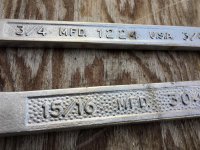
Okay guys, here is something new and quite different on this topic - the exact same electroplating rack burn marks on a 1/2-inch drive PENENS No. 1666 extension! :wtf: I guess they were using the same racks for drive tools.
 

Attachments

  • 20180919_165956.jpg
    20180919_165956.jpg
    58.1 KB · Views: 20
  • 20180919_170006.jpg
    20180919_170006.jpg
    51.6 KB · Views: 25

ssdave

Banned
Joined
Apr 11, 2015
Messages
2,913
Location
Eastern Oregon
Interesting. I've had numerous proto tools that have the burn marks. I thought that they had come in sets that had a rack that held them in, and caused rust staining to start.

Makes a lot more sense that it was the electroplating rack. I've seen it on extensions also, some it looked more like they had rubbed on something, and worn the plating off. I presumed they had been used in a deep hole or such and rubbed the sides.
 
To avoid these ads, REGISTER NOW!
Top Bottom