drivesitfar
Well-known member
Twertsy: that ?? went over my head. are you saying that the catalog pages are already on this thread? or on your website?
or are you just CONFUSED this SUNDAY?
or are you just CONFUSED this SUNDAY?

They're all in my site.....Twertsy: that ?? went over my head. are you saying that the catalog pages are already on this thread? or on your website?
or are you just CONFUSED this SUNDAY?
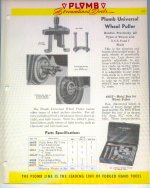
Here is a Plomb ad from 1944 that may be of interest.
-Don


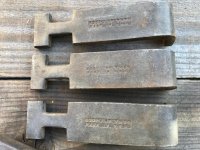
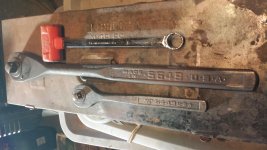
Reduced smoke from the Sonoma fires allowed me to get started cleaning these up today.
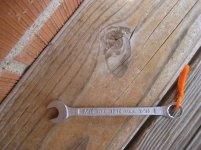
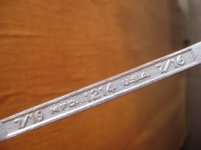
I think it's from wear, RagTop. I also have a few of with very little pebbling remaining. Although it could also be attributed to an imperfect die or set up or forge job during a run or two.whats the deal with the Pebble wrenches that really dont have the pebble on the background... ? I found a DBE yest at the flea that way/ Ill post pic of it after work .
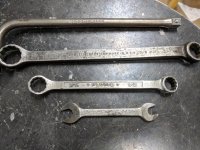
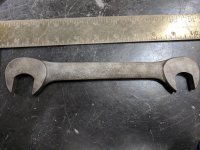
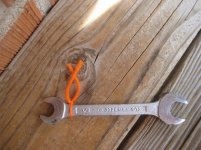
Also, I found this obstruction wrench with only some lettering on it.. military I'm guessing.... seems like someone else found one like this a week or two ago but can't find it in the Gsale thread.
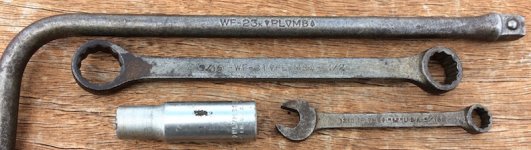
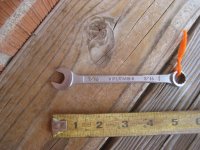
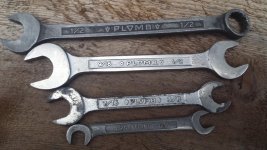
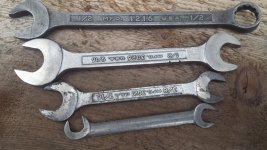
Not long ago I found a Plomb pebble-style wrench with no pebbles. The condition was good enough that it couldn't be attributed to wear. A close examination under magnification indicates the wrench was indeed made this way, and intentionally. Though not documented in other places like AA, I have little doubt that they are a legitimate variation. Because the overall design is otherwise virtually identical, they must have been made during the same time period as the pebble wrenches. They are apparently much more uncommon than the pebbled variety.Heres the few Plomb items I found at the flea Sunday. the Pebble wrench has no Pebbles... Anyone else see these around? Only one I have out of all my wrenches. there are two others with pebble backgrounds on both sides of the one I found without. Also, I found this obstruction wrench with only some lettering on it.. military I'm guessing.... seems like someone else found one like this a week or two ago but can't find it in the Gsale thread.
Not long ago I found a Plomb pebble-style wrench with no pebbles. The condition was good enough that it couldn't be attributed to wear. A close examination under magnification indicates the wrench was indeed made this way, and intentionally. Though not documented in other places like AA, I have little doubt that they are a legitimate variation. Because the overall design is otherwise virtually identical, they must have been made during the same time period as the pebble wrenches. They are apparently much more uncommon than the pebbled variety.
Since its manufacture seems intentional, I would suspect the non-pebbled variety may have been made at the very beginning or the very end of the pebble-style production unless it was used as an as-yet-undetermined distinguishing mark of some kind.
I may still have this oddball wrench somewhere and I'll try to dig it up for a photo. But I can indeed confirm that they do exist.
I would like to know what it came out of if and when you have time to mess with it.
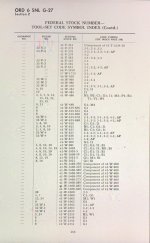
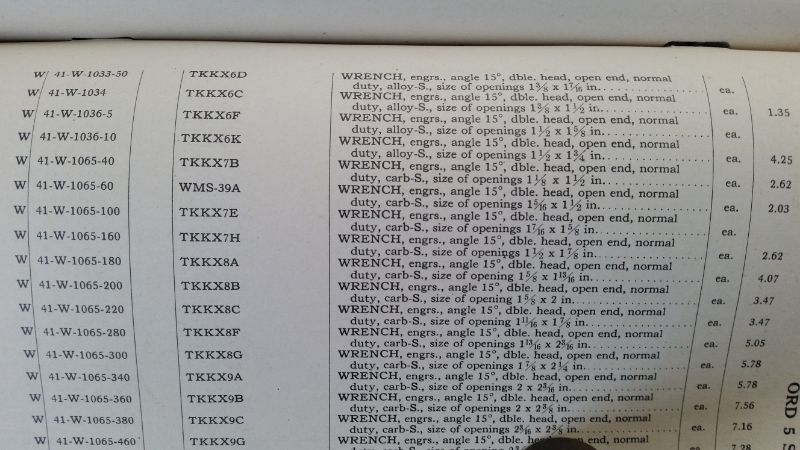
I haven't been able to find that FSN anywhere. There is a 41-W-642-*** series of tools in the March 1945 ORD 5 SNL J-4 (see the page scan in the thumbnail image below), all related to brake service. And, by a stroke of sheer coincidence, they were all supplied by Plomb!Lugz,
It doesn't appear in the July '45 ORD 6 so hopefully it will show up elsewhere.
Yes, the one I found was like that. It wasn't a case of a filled forging die, the field was uniform and showed no evidence of the usual pebbling. Might be awhile before I can dig it out though....I'm in Vintage Christmas Items for Sale mode until probably mid-January.thanks Id like it see it. I am going to go through my pebbles and see if there are any others I may have not noticed. This one is almost as smooth as the rest of the wrench... almost looks odd with out the pebbles.
I fully agree that the pebbling would have to be part of the complete forging die for the recess in the handle including all the figures. However, I'm not sure about variations in the placement or pressure/degree of striking depth could cause the effect of no evidence of pebbling whatsoever. If you imagine the die striking the steel, the first engraved figures that would be filled with metal will be the shallowest, followed sequentially by the deeper engravings. So even if the wrench was struck so lightly that the font figures would be only partially struck--say as extreme as only 1/2 their normal depth--the pebble engravings would already be filled with metal and will transfer the image to the wrench. This would be a function of mechanical physics (even fluid dynamics).On the other recent topic, how do you guys think the pebbled field was made on pebbled Plomb tools?
I'll stick my neck out and say I have my doubts about it being part of a first or second die that was initially forging and then finishing a basic tool out of a hot billet in a forge press, which would require a field of very tiny dimples in the basic shape (DOE, DBE, or flare nut wrench, or socket drive handle) dies. I think the tool would be too hot to maintain such a slight impression, let alone hundreds of tiny slight impressions.
I think the pebble field would be part of the same stamping forge or press making the brand, model number, COO, and size markings, after the wrench was cooled, but before the wrench was fully cooled, either before or after it was bent and broached. In that scenario, it wouldn't take much deviation in a machine's jig or set-up to cause a field of heavy pebble, light pebble, or no pebble, without affecting the rest of the figures formed on the wrench from the same die in the same motion, which would be the ridged box outline that surrounded every pebble field and the brand, model, COO and size markings inside the outline. And note that no pebbled Plomb tool I am aware of has any markings anywhere on the tool outside that ridged outline.
In short, while I think a transition period is an interesting and logical theory, I am skeptical of the examples with little to no pebbling being by design. I still lean toward random. If you look at AA or TA or a good number of your own tools, of all types (DOE, DBE, and flare nut wrenches, socket drive handles), I bet you find a wide variance in the grain of the pebbling, from heavy to light to hardly recognizable, and, apparently, looking at Rag's example above, to none.
In fact, I invite you guys to check out the following examples:
AA, Plomb page 4, Fig. 208B (No. 240 Water Pump pliers) - very light pebbling
AA, Plomb page 4, Fig. 244 (No. 3712 3/8" Flare Nut Wrench) - very light to no pebbling
Then, go to Catalog 19-R REPRINT, and look at the figures. (Yes, I know these are illustrations, but they are rendered from photographs of actual tools.) See especially:
pg 28, cub handles - light to no pebbling
pg 32, 1/2-inch handles - light to no pebbling
pg 35, 3/4 ratchet - no pebbling
pg 38, 1-inch ratchet - no pebbling
pg 52, flare nut wrench - very strong pebbling
EDIT: Same figures appear on different pages in Catalog 19-R FOURTH PRINTING if you have easier access to that one.
But I'm not falling on my sword on this one. I could be way wrong, and I'm eager to hear what others think.
You're right. I had to sketch it out in Sketchup to see it. It would have to be different dies, not machine or human deviations.So even if the wrench was struck so lightly that the font figures would be only partially struck--say as extreme as only 1/2 their normal depth--the pebble engravings would already be filled with metal and will transfer the image to the wrench.

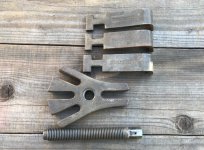
I finally got a chance to take some pictures of the Plomb puller I got last Thursday. It looks like it's seen plenty of use but still works fine. I think it's a keeper.
-Don
Looks great, Don. I'll keep an eye out for an empty box for it for you. Long shot, but you never know. I have the bad habit of picking up puller bodies and screws without legs thinking I'll run into the legs eventually. I have an OTC and a Herbrand.
I fully agree that the pebbling would have to be part of the complete forging die for the recess in the handle including all the figures. However, I'm not sure about variations in the placement or pressure/degree of striking depth could cause the effect of no evidence of pebbling whatsoever. If you imagine the die striking the steel, the first engraved figures that would be filled with metal will be the shallowest, followed sequentially by the deeper engravings. So even if the wrench was struck so lightly that the font figures would be only partially struck--say as extreme as only 1/2 their normal depth--the pebble engravings would already be filled with metal and will transfer the image to the wrench. This would be a function of mechanical physics (even fluid dynamics).
In my mind, the only way that this effect could occur is a variation in the die itself. While one may argue that the pebble engraving could have gotten filled in with residue (a well-known 'mint error' in coins), it would be very unlikely to obscure the entire field to such a uniform extent that no evidence of any pebbling in the entire field whatsoever, which is what the particular wrench I found looked like (not as if they were barely visible, but no evidence of them at all). It would also be highly improbable that such filler debris would not also get into the deeper letter engravings and affect their striking as well.
So to me, the answer lies in the dies themselves and how each was engraved. Variations within those wrenches showing pebbles indicates that the dies for each were engraved differently, perhaps by different engravers. I say 'intentional' because the dies striking no pebbles at all must have been engraved without pebbles. In this instance, it would indeed be 'by design'....BUT it could have also been at random as well. The conclusion would then be not one of a series variation, but of die variations within a single series. Still, it's hard to imagine how Plomb, having established a distinct design with pebbled field as the standard configuration for that series, might have had engravers who were obviously familiar with the intent of the overall design neglect to engrave them, and that at random, unless it was sanctioned to forego the extra engraving work in cases of emergencies where broken dies needed to be replaced quickly to meet a run deadline.
You're right. I had to sketch it out in Sketchup to see it. It would have to be different dies, not a machine or human deviations.


Catfish: with a name like that you probably live in the south?.