PEBBLE WRENCH VARIATION
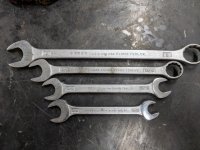
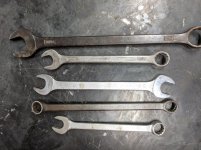
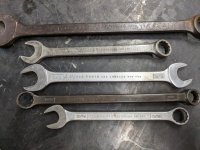
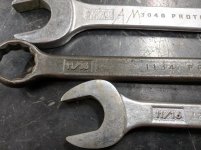
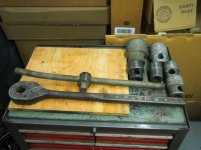
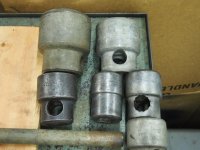
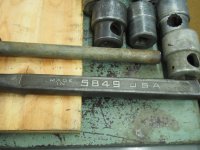
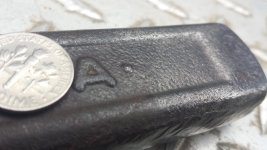
I think it's great that we're getting so many photos of pebble field examples. So far, there appears to be three major variations with some minor variations within these:
Heavy Pebbling
Light Pebbling
No Pebbling (the field varying from very smooth to lightly textured)
I don't believe these variations have been 'officially' documented before, if we're going to hold sites like AA and TA as 'official' keepers of the tool lexicon, just as Field and Stream magazine was for a long time the unofficial 'official' keeper of fishing world records until it was 'officially' taken over by the International Game Fish Association (IGFA).
Just with the examples offered in this thread alone, there seems to be little doubt that these three main variations exist, thereby dispelling the former precept that this style wrench was standard with a pebbled field.
The question then follows whether these were in fact variations within the production span of a single design, or if they actually represent a progression of designs from one to the next.
The only clue I can find is in the next design, which is called by AA the 'transitional'. It bears both the Proto and Plomb names, and has small pebble fields behind the size numbers only. Apparently, these are uncommon as AA indicates they were made for only about a year. I've only seen one in person, and just a few photos of these online. In every case, the size fields are distinctly pebbled.
The task would then be to find as many examples of these transitional wrenches and see what the size fields look like. If by some chance we find all of them to be pebbled, then that would argue against a random scenario for the variations in the previous design, otherwise we'd expect to see the same three random variations in the transitional as well (no-, light- and heavy-pebbling). But if all transitional examples are pebbled, it might just be that they are closer chronologically to the pebble field wrenches, since they would be the natural continuation of the previous pebbled variety. The logical sequence would then be from the earliest to the latest:
No Pebbling
Light Pebbling
Heavy Pebbling
Pebbled Size Fields
If we find no evidence of any transitionals with a non-pebbled size field, I believe this is our strongest hypothesis.
Perhaps this needs its own thread?
I think it's great that we're getting so many photos of pebble field examples. So far, there appears to be three major variations with some minor variations within these:
Heavy Pebbling
Light Pebbling
No Pebbling (the field varying from very smooth to lightly textured)
I don't believe these variations have been 'officially' documented before, if we're going to hold sites like AA and TA as 'official' keepers of the tool lexicon, just as Field and Stream magazine was for a long time the unofficial 'official' keeper of fishing world records until it was 'officially' taken over by the International Game Fish Association (IGFA).
Just with the examples offered in this thread alone, there seems to be little doubt that these three main variations exist, thereby dispelling the former precept that this style wrench was standard with a pebbled field.
The question then follows whether these were in fact variations within the production span of a single design, or if they actually represent a progression of designs from one to the next.
The only clue I can find is in the next design, which is called by AA the 'transitional'. It bears both the Proto and Plomb names, and has small pebble fields behind the size numbers only. Apparently, these are uncommon as AA indicates they were made for only about a year. I've only seen one in person, and just a few photos of these online. In every case, the size fields are distinctly pebbled.
The task would then be to find as many examples of these transitional wrenches and see what the size fields look like. If by some chance we find all of them to be pebbled, then that would argue against a random scenario for the variations in the previous design, otherwise we'd expect to see the same three random variations in the transitional as well (no-, light- and heavy-pebbling). But if all transitional examples are pebbled, it might just be that they are closer chronologically to the pebble field wrenches, since they would be the natural continuation of the previous pebbled variety. The logical sequence would then be from the earliest to the latest:
No Pebbling
Light Pebbling
Heavy Pebbling
Pebbled Size Fields
If we find no evidence of any transitionals with a non-pebbled size field, I believe this is our strongest hypothesis.
Perhaps this needs its own thread?
Last edited: