To avoid these ads, REGISTER NOW!

Plomb tool picture thread - show your stuff!

DadsTools

Well-known member
Joined
Jul 27, 2017
Messages
1,852
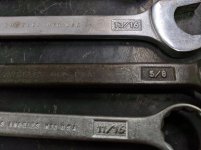
PEBBLE WRENCH VARIATION

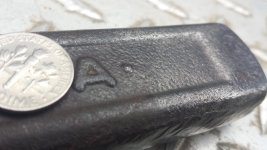
I think it's great that we're getting so many photos of pebble field examples. So far, there appears to be three major variations with some minor variations within these:

Heavy Pebbling
Light Pebbling
No Pebbling (the field varying from very smooth to lightly textured)

I don't believe these variations have been 'officially' documented before, if we're going to hold sites like AA and TA as 'official' keepers of the tool lexicon, just as Field and Stream magazine was for a long time the unofficial 'official' keeper of fishing world records until it was 'officially' taken over by the International Game Fish Association (IGFA).

Just with the examples offered in this thread alone, there seems to be little doubt that these three main variations exist, thereby dispelling the former precept that this style wrench was standard with a pebbled field.

The question then follows whether these were in fact variations within the production span of a single design, or if they actually represent a progression of designs from one to the next.

The only clue I can find is in the next design, which is called by AA the 'transitional'. It bears both the Proto and Plomb names, and has small pebble fields behind the size numbers only. Apparently, these are uncommon as AA indicates they were made for only about a year. I've only seen one in person, and just a few photos of these online. In every case, the size fields are distinctly pebbled.

The task would then be to find as many examples of these transitional wrenches and see what the size fields look like. If by some chance we find all of them to be pebbled, then that would argue against a random scenario for the variations in the previous design, otherwise we'd expect to see the same three random variations in the transitional as well (no-, light- and heavy-pebbling). But if all transitional examples are pebbled, it might just be that they are closer chronologically to the pebble field wrenches, since they would be the natural continuation of the previous pebbled variety. The logical sequence would then be from the earliest to the latest:

No Pebbling
Light Pebbling
Heavy Pebbling
Pebbled Size Fields

If we find no evidence of any transitionals with a non-pebbled size field, I believe this is our strongest hypothesis.

Perhaps this needs its own thread?
 
Last edited:
To avoid these ads, REGISTER NOW!

RagTopTA

Well-known member
Joined
Feb 26, 2015
Messages
1,892
Location
Wichita Falls , Texas
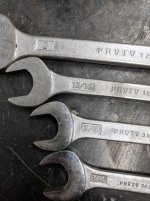
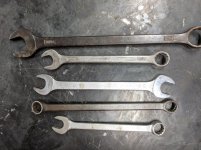
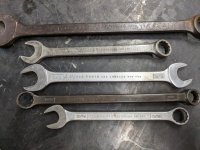
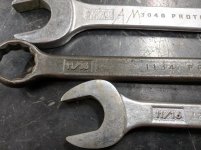
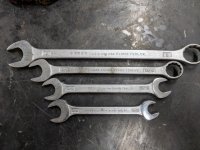
This is going to get interesting! And I happen to have a few wrenches to add for examples. I took these pics of the few I grabbed off the top of my pile of Plombs not in the big box. I prob have a few others. ill look for more on my days off. I have some Transitional wrenches with the pebble fields very easily visible. I also have PROTO LA wrenches... BUT... they are different! Two have the pebbled fields on the front with the Makers marks and sizes, with smooth backs. The other two have then pebbled fields on the BACK! so.. here are my examples...
 

Attachments

  • IMG_20171028_233305.jpg
    IMG_20171028_233305.jpg
    146.7 KB · Views: 29
  • IMG_20171028_233312.jpg
    IMG_20171028_233312.jpg
    147.4 KB · Views: 22
  • IMG_20171028_233322.jpg
    IMG_20171028_233322.jpg
    147.6 KB · Views: 20
  • IMG_20171028_233434.jpg
    IMG_20171028_233434.jpg
    147 KB · Views: 24
  • IMG_20171028_233504.jpg
    IMG_20171028_233504.jpg
    147 KB · Views: 19
  • IMG_20171028_233512.jpg
    IMG_20171028_233512.jpg
    145.5 KB · Views: 17
  • IMG_20171028_233519.jpg
    IMG_20171028_233519.jpg
    142.1 KB · Views: 18

DadsTools

Well-known member
Joined
Jul 27, 2017
Messages
1,852
This is going to get interesting! And I happen to have a few wrenches to add for examples. I took these pics of the few I grabbed off the top of my pile of Plombs not in the big box. I prob have a few others. ill look for more on my days off. I have some Transitional wrenches with the pebble fields very easily visible. I also have PROTO LA wrenches... BUT... they are different! Two have the pebbled fields on the front with the Makers marks and sizes, with smooth backs. The other two have then pebbled fields on the BACK! so.. here are my examples...
It's already quite interesting! Just in the short time I've been a member here, I've already seen some history added to the tool lexicon and a few previously held ideas adjusted.

According to the AA site, the transitionals are those with the small pebble size fields and having both the Plomb and Proto name, while the 'next' generation with the pebble size fields are marked Proto only. Your photos show both iterations. All these have distinct pebbling in the size field.

Hope more folks reading this can post photos of their own examples of transitionals.
 

RagTopTA

Well-known member
Joined
Feb 26, 2015
Messages
1,892
Location
Wichita Falls , Texas
Think I may have a couple of other Transitional tools also.. Sockets and a breaker bar....maybe some other stuff..... I'll look after work tomorrow. I am wondering when they went to PROTO LA... why did they do the pebble fields on the back by themselves and on the front with the wrenchinfo.. strange. I'll check in tomorrow.
 

Ole Slewfoot

Well-known member
Joined
Feb 22, 2016
Messages
5,098
Location
Freedom, CA
I don't have much of the trans style. There is also another pebble variation that has intrigued me. After the die is struck, some pebbles are done, others take a pass on the grinder so the letters and 'frame' around the pebble field are machined. I think the extra work looks nice on the ratchets, but makes the edges of the end wrench too sharp for comfort.
this pic showed both styles.

attachment.php
 

d42jeep

Well-known member
Joined
Oct 22, 2014
Messages
16,500
Location
Northern California
Just to get away from the pebbled path this thread has taken for a moment, here are a couple of tappet wrenches that I picked up on Friday. Now back to the pebbled programming. ;)
-Don
 

Attachments

  • IMG_6411.jpg
    IMG_6411.jpg
    149.7 KB · Views: 22

Private Lugnutz

Well-known member
Joined
Mar 30, 2012
Messages
30,477
Location
The Authentic Jersey Shore
Just in the short time I've been a member here, I've already seen some history added to the tool lexicon and a few previously held ideas adjusted.
It is a major constant purpose of the vintage forum.

The Non Pebbled seem to all be MFD BY style wrenches so far.
If that's true, and if that holds, it eliminates the early transition period theory. Pebbled handles with a natural steel finish were being made in the MADE era in mid 1944.

Perhaps this needs its own thread?
Feel free to tack on to the end of this thread as an excursion if you want. The purpose was to prove that they started much earlier than anyone (Van Natta, AA, etc) previously thought. You guys may now be onto something interesting and new about their tail end.
 

RagTopTA

Well-known member
Joined
Feb 26, 2015
Messages
1,892
Location
Wichita Falls , Texas
I'm wondering, if the MFG wrenches were the first ones made with the in field, that later held pebble background, what if they made a few runs when they came up with this new design, and someone decided, Hey!! We need something in the background, these look too plain. then here came the Pebble back ground idea... and it went on from there as a part of all the wrenches...
 

DadsTools

Well-known member
Joined
Jul 27, 2017
Messages
1,852
I'm wondering, if the MFG wrenches were the first ones made with the in field, that later held pebble background, what if they made a few runs when they came up with this new design, and someone decided, Hey!! We need something in the background, these look too plain. then here came the Pebble back ground idea... and it went on from there as a part of all the wrenches...
I've seen evidence before of design changes in products for similar reasons. At this point, any reasonable hypothesis that can fit the witnesses' testimonies (the artifacts and period literature themselves) is worthy of consideration.
 

DadsTools

Well-known member
Joined
Jul 27, 2017
Messages
1,852
LUGZ:

I did some reading on the other thread you mentioned regarding the actual starting date for the pebble design. I have so much to say that I'm probably not going to fit this into one post, or that I even have the time today to do so.

First, I'd like to say that your attention to detail and your refusal to deviate from sound Euclidean logic is remarkable. You have my deepest of admiration for it. Were you versed in theoretical cosmology, we could have one paradigm-changing discussion!

Changing the public mythos about a collectible (or anything for that matter) established by prior 'authorities' can be a herculean task. Once the 'authority' proclaims the conclusion, everyone just follows along as it becomes an integral part of the lexicon. I ran into similar with a certain collectible fishing lure on the subject. Based on a reference to a 1950 biology article mentioned on the back of the package, the mythology was established that the lure was produced in 1950. Just as you expressed your surprise at how so many ignored pertinent details in period catalogs, I too was amazed that no one seemed to pay any attention to the fact that the date referred to an article, not the lure itself. It didn't help that the inventor fabricated colorful tales about how the lure was discovered, which is common in fishing lore, but still arises in other fields as well. Fortunately, I not only had access to the mfr's archives, but was able to interview one of the principles in the lure's development, a man of advanced age in a nursing home (he's probably passed on by now). I was able to confirm that the actual dating was years later, and presented the evidence in my collectors reference book on that particular class of artifacts. I'm glad to say that after monitoring eBay auctions for the item over time, the 1950 reference gradually faded from use. So it can be done.

I also know from this experience that it can take only one solitary artifact to turn an established timeline on its head.

Based on taking all this information in, and in light of the current conversation about pebble wrench variations (which has so far centered around chromed post-war wrenches), I think the next logical question would be: Do we see such variations in what appears to be the wartime drive handles of this design? I noticed in the drawings of this recessed handle design in the referenced wartime catalogs plus a period ad showing the design in a photo do not clearly show any pebbling detail. But I also see in that thread and elsewhere examples of what appear to be plain-steel-finish wrenches that collectively also show variations of no-pebbling and pebbling.

We know from a recent discussion on the odd Penens C-10 rat I discovered that Plomb made a plethora of variations in their basic design involving brand names and number markings. It seems almost that their corporate reasoning could turn on a dime with regard to product details. It almost seems schizophrenic at times. So it seems to be also with the no- vs light- vs heavy-pebbling.

And yet, I can't help suspecting that there must be some logical explanation accompanied by a reasonable chronology for the introduction of these variations beyond spontaneous and random whimsy of the die engravers.

And can we be certain that apparent plain-steel finished wrenches having distinct pebbling are not a result of finish wear? I know that with the later chromed pebble-style combo or DOE wrenches, the plating seems ridiculously thin so that the slightest wear has removed it leaving no perceivable demarcation ridge between the worn-off and intact chrome areas.

Anyway, those are my thoughts at the moment.
 

RagTopTA

Well-known member
Joined
Feb 26, 2015
Messages
1,892
Location
Wichita Falls , Texas
Teres an older man at the flea market every week end that hangs around the tool guys bunch. We have talked a few times. He worked at the Proto plant here in town for ten years making wrenches. Hes very knowledgeable. Ill take the pebble/ no pebble samples and show him and pick his brain about it. Also he may be able to give me some info on how to dig deeper into he Plomb era of the company. Contacts, info , ect....
 

Private Lugnutz

Well-known member
Joined
Mar 30, 2012
Messages
30,477
Location
The Authentic Jersey Shore
I'm wondering, if the MFG wrenches were the first ones made with the in field, that later held pebble background, what if they made a few runs when they came up with this new design, and someone decided, Hey!! We need something in the background, these look too plain. then here came the Pebble back ground idea... and it went on from there as a part of all the wrenches...
Now you're confusing me.

Didn't you just say that all the examples you have seen of a Plomb Pebble tool with no actual pebbling so far were marked 'MFD IN USA', not 'MADE IN USA'?

If that's the case, a theoretical transition period (if these are arbitrary, not random) would have to be at the end of the Pebble period, not the beginning. And the lightbulb would've been more like, "I kind of like the idea of this same style, but you know those lightly pebbled dies we used last quarter, let's see what it looks like without any pebbling..."
 

DadsTools

Well-known member
Joined
Jul 27, 2017
Messages
1,852
Teres an older man at the flea market every week end that hangs around the tool guys bunch. We have talked a few times. He worked at the Proto plant here in town for ten years making wrenches. Hes very knowledgeable. Ill take the pebble/ no pebble samples and show him and pick his brain about it. Also he may be able to give me some info on how to dig deeper into he Plomb era of the company. Contacts, info , ect....
That sounds like a great idea. There's definitely some substance here that needs to be sorted out if we can. What makes it more challenging is that much of what goes on in a manufacturing plant, especially in the older traditional venues, is 'tribal knowledge'. I remember an incident back in the early 1990s in the office furniture business where Oxford bought out the Philadelphia steel furniture manufacturer Metalstand and moved its manufacturing to another state (think it was NY). Low and behold, even though they adhered to the engineering drawings and blueprints, none of the files worked correctly. Seems that the folks on the old Phila assembly line made them according to the tribal knowledge on the floor, not to the design specs, which didn't work right. Oops. I know of another factory making rescue vehicles where the same thing was happening--the product was not being made to the official specs, but according to what the workers knew would actually work. Engineering and fabrication never reconciled because of the logistical challenges, egos, and the inter-department battling that would have resulted. The folks on the floor just made them so they would work and perform as intended.

Catalogs are not the end-all either. I personally know of several instances (particularly in the pre-computerized pre-photoshop era) where old art was still being used in catalogs long after the actual product being sold had been changed.

The tribal knowledge is the best source available. Of course, the further back in the past, the fewer are still with us, even if you could identify these nameless individuals track them down.

Hope this fellow has some good inside skinny for you.
 

DadsTools

Well-known member
Joined
Jul 27, 2017
Messages
1,852
Now you're confusing me.

Didn't you just say that all the examples you have seen of a Plomb Pebble tool with no actual pebbling so far were marked 'MFD IN USA', not 'MADE IN USA'?

If that's the case, a theoretical transition period (if these are arbitrary, not random) would have to be at the end of the Pebble period, not the beginning. And the lightbulb would've been more like, "I kind of like the idea of this same style, but you know those lightly pebbled dies we used last quarter, let's see what it looks like without any pebbling..."
The MFD and MADE variations were a detail I wasn't familiar with until now, so I wasn't instantly familiar with details of RagTopTA's point.

Your particular 'light bulb' idea is also reasonable and could line up with the physical evidence we have.

All I can see so far is that with regard to the flat recessed panel design, we unquestioningly have three distinct background patterns:

No Pebbling
Light Pebbling
Heavy Pebbling

This is without a doubt.

The only thing I have beyond that is a compelling suspicion that these variations are not a result of random happenstance--I believe there must be some justification for these brought on by intent with an as-yet-discovered line of reasoning.

Someone thoroughly versed in Plomb product from that era might have a sense of what I call a company 'fingerprint' if you will--an M.O. that characterizes that company's philosophy and production. If we see a lot of evidence that Plomb production and designs were well thought-out and that the actual products reflected that philosophy, then the argument for purposeful intent becomes stronger than that of random happenstance. Even if the solution is the grinding off of damaged/worn pebbling to eliminate the inconsistent resulting product while saving the money to mfr new dies, that would be both reasonable and purposeful intent. But that would make any attempt to organize these in a chronological order fruitless.
 

DadsTools

Well-known member
Joined
Jul 27, 2017
Messages
1,852
The idea that pebbles could have been ground off the extend the life of a worn die may provide an answer. It's certainly reasonable. I still believe the key to this might be finding more examples of plain-steel finish recessed handles. If Lugz conclusion is correct that these are indeed later wartime production, AND if we find the same kinds of pebbling variations in these wrenches, I think the cleaning up of dies by grinding the pebbles off seems the best answer. Depending on the degree of grinding, it may also explain the light-pebbling variety. There would then be no chronology to trace. The viewing of complete sets, say 9-11 piece combo wrenches, that can be verified as being purchased as such and not pieced together later might be important data. I think it unlikely that, given the premise they were grinding pebbles off to extend the life of a particular die, we would not think that the entire set would have matching fields since each wrench would have its own die, and so wear and tear on each would be inconsistent.

Do we know of any such complete period sets showing evidence of no-pebbling?
 

twertsy

Well-known member
Joined
Jan 5, 2014
Messages
6,726
Location
Reedville, VA
The idea that pebbles could have been ground off the extend the life of a worn die may provide an answer. It's certainly reasonable. I still believe the key to this might be finding more examples of plain-steel finish recessed handles. If Lugz conclusion is correct that these are indeed later wartime production, AND if we find the same kinds of pebbling variations in these wrenches, I think the cleaning up of dies by grinding the pebbles off seems the best answer. Depending on the degree of grinding, it may also explain the light-pebbling variety. There would then be no chronology to trace. The viewing of complete sets, say 9-11 piece combo wrenches, that can be verified as being purchased as such and not pieced together later might be important data. I think it unlikely that, given the premise they were grinding pebbles off to extend the life of a particular die, we would not think that the entire set would have matching fields since each wrench would have its own die, and so wear and tear on each would be inconsistent.

Do we know of any such complete period sets showing evidence of no-pebbling?
I'm not convinced any grinding would be needed. I'm certainly no expert in metallurgy but it seems to me the pebble pattern is very shallow in the does and it can't take that many hammers to wear it down.

Sent from my VS990 using Tapatalk
 

RagTopTA

Well-known member
Joined
Feb 26, 2015
Messages
1,892
Location
Wichita Falls , Texas
Now you're confusing me.

Didn't you just say that all the examples you have seen of a Plomb Pebble tool with no actual pebbling so far were marked 'MFD IN USA', not 'MADE IN USA'?

If that's the case, a theoretical transition period (if these are arbitrary, not random) would have to be at the end of the Pebble period, not the beginning. And the lightbulb would've been more like, "I kind of like the idea of this same style, but you know those lightly pebbled dies we used last quarter, let's see what it looks like without any pebbling..."

I was under the impression the MFG version of the Pebbled wrenches were the earlier versions, and the Made in the USA were the later. I dunno why but always thought I read tht on a post when I first started messing with this Plomb addiction business.
 
To avoid these ads, REGISTER NOW!

DadsTools

Well-known member
Joined
Jul 27, 2017
Messages
1,852
I'm not convinced any grinding would be needed. I'm certainly no expert in metallurgy but it seems to me the pebble pattern is very shallow in the does and it can't take that many hammers to wear it down.

Sent from my VS990 using Tapatalk
The trouble with this is that we are looking at a relatively long field in question. Simple wear would show up as inconsistencies along the surface where you'd still see evidence of partial pebbling here and there. An argument might be made for this were we to find 'partially-pebbled' varieties. What we see instead is a consistency in the surface throughout the recess in any of these variations. Also keep in mind that the inside edges of the recesses appear relatively well-defined in these wrenches--such extensive wear should also result in a rounding or 'blurring' of these edges as well as a similar blurring at the bases of the other characters.
 

twertsy

Well-known member
Joined
Jan 5, 2014
Messages
6,726
Location
Reedville, VA
The trouble with this is that we are looking at a relatively long field in question. Simple wear would show up as inconsistencies along the surface where you'd still see evidence of partial pebbling here and there. An argument might be made for this were we to find 'partially-pebbled' varieties. What we see instead is a consistency in the surface throughout the recess in any of these variations. Also keep in mind that the inside edges of the recesses appear relatively well-defined in these wrenches-such extensive wear should also result in a rounding of these edges as well as a similar rounding at the bases of the other characters.
That does make sense, but until I see a set, in a roll that likely all came together, that all consistently have no pebbles, I just don't think there's anything to it.

Sent from my VS990 using Tapatalk
 

Private Lugnutz

Well-known member
Joined
Mar 30, 2012
Messages
30,477
Location
The Authentic Jersey Shore
I was under the impression the MFG version of the Pebbled wrenches were the earlier versions, and the Made in the USA were the later. I dunno why but always thought I read tht on a post when I first started messing with this Plomb addiction business.
No problem, RagTop. But I can assure you it's the other way around. The MFD USA marking is post-war.
 

DadsTools

Well-known member
Joined
Jul 27, 2017
Messages
1,852
That does make sense, but until I see a set, in a roll that likely all came together, that all consistently have no pebbles, I just don't think there's anything to it.

Sent from my VS990 using Tapatalk
I agree that a complete verifiable set of end wrenches would be very useful.

Years ago when I was engaged in coin collecting, I studied extensively regarding what's known as 'mint errors' in that field. The knowledge was absolutely essential for identifying , classifying and valuing these coins. Most of them have to do with irregularities in the dies and the striking. I've found that this kind of knowledge is almost never addressed in any detail in tool collecting simply because striking errors or die variations in this field appear to have no effect on identifying, grading and valuing an artifact. In coin collecting, the difference between a normally struck coin and, say a double struck coin, could be the difference between $10 and several thousands or more. In tools, this appears to play no role whatsoever in identification, grading or value.

I suppose my numismatic experience makes me more sensitive to these kinds of variations in tools. I recently sold an early SK-Wayne adjustable that commanded a premium from an astute buyer because a break in the die helped identify it as one of the earliest Wayne changeover specimens. But this kind of distinction has not taken hold in tool collecting. I have a couple of 1930s wrenches I find interesting because they show double-strikes and re-cut dies. To tool collecting, these are meh, and may even make them less desirable depending on the severity.

Yet, the process of striking metal coins is more or less the same as striking metal tools, and so the same kinds of effects are created by the very same kinds of processes.

One thing is for sure--these variations, including no-pebbling, do in fact exist. There can be no reasonable debate about that based on the physical evidence. Further, the characteristics of the artifacts and knowledge of metal-striking effects indicate the dies that struck them were indeed made in a way to produce the effects we're observing. I can understand why a tool collector could justify a 'nothing to it' position because that's a standard perspective toward die variations in the tool collecting field. But I think this is a little different. When you have an entire class of collectible that's defined by the very pebbling feature from which its name is derived, and yet find bona-fide examples lacking this most fundamental distinguishing characteristic, and furthermore there is every indication that they were intentionally struck this way, then I feel that a dedicated tool historian must at least try to address it in some meaningful way.

But in the end, this IS tool collecting, not numismatics. And I am ready to accept that concession when it comes to the body collective of this field. But privately, I will still consider die variations as legitimate objects of collection and study.
 

twertsy

Well-known member
Joined
Jan 5, 2014
Messages
6,726
Location
Reedville, VA
I agree that a complete verifiable set of end wrenches would be very useful.

Years ago when I was engaged in coin collecting, I studied extensively regarding what's known as 'mint errors' in that field. The knowledge was absolutely essential for identifying , classifying and valuing these coins. Most of them have to do with irregularities in the dies and the striking. I've found that this kind of knowledge is almost never addressed in any detail in tool collecting simply because striking errors or die variations in this field appear to have no effect on identifying, grading and valuing an artifact. In coin collecting, the difference between a normally struck coin and, say a double struck coin, could be the difference between $10 and several thousands or more. In tools, this appears to play no role whatsoever in identification, grading or value.

I suppose my numismatic experience makes me more sensitive to these kinds of variations in tools. I recently sold an early SK-Wayne adjustable that commanded a premium from an astute buyer because a break in the die helped identify it as one of the earliest Wayne changeover specimens. But this kind of distinction has not taken hold in tool collecting. I have a couple of 1930s wrenches I find interesting because they show double-strikes and re-cut dies. To tool collecting, these are meh, and may even make them less desirable depending on the severity.

Yet, the process of striking metal coins is more or less the same as striking metal tools, and so the same kinds of effects are created by the very same kinds of processes.

One thing is for sure--these variations, including no-pebbling, do in fact exist. There can be no reasonable debate about that based on the physical evidence. Further, the characteristics of the artifacts and knowledge of metal-striking effects indicate the dies that struck them were indeed made in a way to produce the effects we're observing. I can understand why a tool collector could justify a 'nothing to it' position because that's a standard perspective toward die variations in the tool collecting field. But I think this is a little different. When you have an entire class of collectible that's defined by the very pebbling feature from which its name is derived, and yet find bona-fide examples lacking this most fundamental distinguishing characteristic, and furthermore there is every indication that they were intentionally struck this way, then I feel that a dedicated tool historian must at least try to address it in some meaningful way.

But in the end, this IS tool collecting, not numismatics. And I am ready to accept that concession when it comes to the body collective of this field. But privately, I will still consider die variations as legitimate objects of collection and study.
Oh make no mistake, I certainly think it's a deviation worth monitoring. But onesy-twosies do not a pattern make. It's all conjecture until we 1. speak to someone who was there or 2. find a set of unpebbled wrenches, or socket set where all drive handles are unpebbled.


Sent from my VS990 using Tapatalk
 

Ole Slewfoot

Well-known member
Joined
Feb 22, 2016
Messages
5,098
Location
Freedom, CA
Based on taking all this information in, and in light of the current conversation about pebble wrench variations (which has so far centered around chromed post-war wrenches), I think the next logical question would be: Do we see such variations in what appears to be the wartime drive handles of this design? I noticed in the drawings of this recessed handle design in the referenced wartime catalogs plus a period ad showing the design in a photo do not clearly show any pebbling detail. But I also see in that thread and elsewhere examples of what appear to be plain-steel-finish wrenches that collectively also show variations of no-pebbling and pebbling.

And can we be certain that apparent plain-steel finished wrenches having distinct pebbling are not a result of finish wear? I know that with the later chromed pebble-style combo or DOE wrenches, the plating seems ridiculously thin so that the slightest wear has removed it leaving no perceivable demarcation ridge between the worn-off and intact chrome areas.

Anyway, those are my thoughts at the moment.
Its nearly impossible to get the chrome out from between the pebbles, more on that later.
Ill go with no on the above, as Plomb/Proto always have and probably always will sell unchromed industrial tools for less. Transitional pebble field wrenches posted above prove this, and its in the price lists.

Or that the dies were getting worn, so they ground off the pebbles to get a little more life from them.
I don't think so,the texture of the background is too much the same as the rest of the handle.

I agree that a complete verifiable set of end wrenches would be very useful.

Years ago when I was engaged in coin collecting, I studied extensively regarding what's known as 'mint errors' in that fieldthe striking.
.

Have you perused the 'show your factory flaw tools' thread?


All I can see so far is that with regard to the flat recessed panel design, we unquestioningly have three distinct background patterns:

No Pebbling
Light Pebbling
Heavy Pebbling

This is without a doubt.

The only thing I have beyond that is a compelling suspicion that these variations are not a result of random happenstance--I believe there must be some justification for these brought on by intent with an as-yet-discovered line of reasoning.

Someone thoroughly versed in Plomb product from that era might have a sense of what I call a company 'fingerprint' if you will--an M.O. that characterizes that company's philosophy and production. If we see a lot of evidence that Plomb production and designs were well thought-out and that the actual products reflected that philosophy, then the argument for purposeful intent becomes stronger than that of random happenstance. Even if the solution is the grinding off of damaged/worn pebbling to eliminate the inconsistent resulting product while saving the money to mfr new dies, that would be both reasonable and purposeful intent. But that would make any attempt to organize these in a chronological order fruitless.
Im a little confused about the 'intelligent design' thory of pebbles.

They were producing the WF style ratchets which are light simple and strong.
Then out come these pebbles which are really hard to clean, and are much weaker where the head and neck come together. Thats the only place the housings fail on the pear heads, but I have not ever seen it on an H beam wrench.
 

DadsTools

Well-known member
Joined
Jul 27, 2017
Messages
1,852
Its nearly impossible to get the chrome out from between the pebbles, more on that later.
Ill go with no on the above, as Plomb/Proto always have and probably always will sell unchromed industrial tools for less. Transitional pebble field wrenches posted above prove this, and its in the price lists.

I tend to agree. There would be at least some evidence of residual chrome.


I don't think so,the texture of the background is too much the same as the rest of the handle.

I agree with this too. These were struck that way by intentionally engraved dies. However, I thought I should be somewhat liberal with my thinking to avoid any possible disputes, and since I wasn't there at the factory so didn't know for sure. They do not appear to me to be the result of re-ground dies.


Have you perused the 'show your factory flaw tools' thread?

I haven't. But the idea that folks see mfg flaws in tools has little to do with the point I was making. Just because there's a thread displaying factory flaws does not in my experience enter into any reckoning with regard to identifying, categorizing, determining scarcity or valuing of collectible tools. Die errors simply don't enter into the scheme of things when it comes to these criteria. In other words, die varieties and errors may be seen as a curiosity, but is given little or no consideration beyond that, and certainly not with regard to appraising vintage tools. That was my point.


Im a little confused about the 'intelligent design' thory of pebbles.

They were producing the WF style ratchets which are light simple and strong.
Then out come these pebbles which are really hard to clean, and are much weaker where the head and neck come together. Thats the only place the housings fail on the pear heads, but I have not ever seen it on an H beam wrench.

Here again, this was not my point. I voiced no opinion as to whether the pebble design was 'intelligent' or useful or practical or superior/inferior in any way, and am not sure how this facet of consideration even enters into trying to establish an historical context for these wrenches. My point was only that the manufacturing of it and all its variations were intentional and not random happenstance.
 

RagTopTA

Well-known member
Joined
Feb 26, 2015
Messages
1,892
Location
Wichita Falls , Texas
Maybe they weren't flaws at all but a lower priced wrench made for the company store to sell employees at some point ? I have yet to see anything but wrenches though with smooth back grounds.
 

DadsTools

Well-known member
Joined
Jul 27, 2017
Messages
1,852
The variations exist. It's our job to place them correctly into historical context if we can.
 

Ole Slewfoot

Well-known member
Joined
Feb 22, 2016
Messages
5,098
Location
Freedom, CA
Here again, this was not my point. I voiced no opinion as to whether the pebble design was 'intelligent' or useful or practical or superior/inferior in any way, and am not sure how this facet of consideration even enters into trying to establish an historical context for these wrenches. My point was only that the manufacturing of it and all its variations were intentional and not random happenstance.
No you didn't, that's just my observation.

Its been said that employee buy tools were ground so as not to be warranted/resold, but were had at a good discount.
 

RagTopTA

Well-known member
Joined
Feb 26, 2015
Messages
1,892
Location
Wichita Falls , Texas
I work in a huge factory doing production work. When I made something thats not perfect.. even if its 10 thousand pieces, I throw it away in the trash... maybe they were take homes.
 

DadsTools

Well-known member
Joined
Jul 27, 2017
Messages
1,852
Its been said that employee buy tools were ground so as not to be warranted/resold, but were had at a good discount.

Perhaps so, but this does not explain the variations at the surface of the recessed field where they would not have been ground, or at least had they done so would be so blatantly obvious that this conversation would not even be occurring.
 

Rileysan

Well-known member
Joined
Sep 11, 2015
Messages
4,298
Location
Milwaukie, Oregon
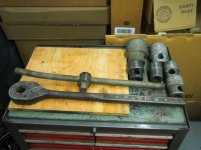
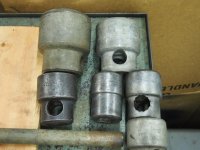
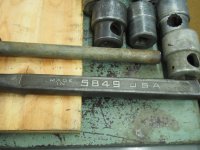
I acquired this Plomb "Big Bertha" 1" drive ratchet and 6 sockets a couple weeks ago from another Plomb collector. He has more sockets but needs to dig them out. All I need to complete my pebble ratchet collection is a 1/4" drive ratchet.

- Plomb 5849 1" drive ratchet
- Plomb 5884 1" drive T-bar. Someone must have used one hell of a big pipe in order to bend it that bad!
- Plomb 5788 2 3/4" socket
- Plomb 5776 2 3/8" socket
- Plomb 5764 2" socket
- Plomb 5760 1 7/8" socket
- Plomb (unreadable) 1 5/8" socket
- Plomb 8071785 socket with 12-pt holes through the side. There is no size stamped on it but someone used a paint pen to write 1 7/8".

Brian
 

Attachments

  • PA292544.jpg
    PA292544.jpg
    140.7 KB · Views: 21
  • PA292546.jpg
    PA292546.jpg
    141.8 KB · Views: 17
  • PA292547.jpg
    PA292547.jpg
    138.7 KB · Views: 12
  • PA292548.jpg
    PA292548.jpg
    143 KB · Views: 19

Ole Slewfoot

Well-known member
Joined
Feb 22, 2016
Messages
5,098
Location
Freedom, CA
Heres a close up of my ratchet
attachment.php


Nice Rileysan, is that a 26" box they are on?
 

Attachments

  • 20171029_165633.jpg
    20171029_165633.jpg
    142 KB · Views: 98
Last edited:

DadsTools

Well-known member
Joined
Jul 27, 2017
Messages
1,852
I work in a huge factory doing production work. When I made something thats not perfect.. even if its 10 thousand pieces, I throw it away in the trash... maybe they were take homes.
I understand the reasoning, but we'd be getting into the realm of pure speculation. We not only lack any evidence to show that this was done at this factory at this time, but also have no evidence that these no-pebble variety wrenches were mistakes in any way so that employees might take them home as rejects. The physical evidence indicates that they were made as intended with dies that were intentionally engraved to produce the precise results we see in the artifacts.

We simply need to see many more examples, especially verifiable complete sets of end wrenches, or at least examples we can pin down as to when they were originally purchased.

We may ultimately arrive at the conclusion that, while we may establish these are genuine varieties intentionally made as such, too much time has elapsed for us to ever be able to precisely place them in the historical record.

It has at the least opened up another avenue of collecting these pebbles, as we now know there are several kinds to look for.
 

DadsTools

Well-known member
Joined
Jul 27, 2017
Messages
1,852
Heres a close up of my ratchet
attachment.php


Nice Rileysan, is that a 26" box they are on?
No pebbles here, just an almost faux leather type texturing in the recess. It appears that the high reliefs have been pitted with oxidation, so it's difficult to determine if the pattern extends beyond the recess on this one, but I've seen examples posted in this thread of similar texturing that clearly extended to the higher surfaces.
 

Rileysan

Well-known member
Joined
Sep 11, 2015
Messages
4,298
Location
Milwaukie, Oregon
The variations exist. It's our job to place them correctly into historical context if we can.

In the world of manufacturing, dies in heavy machinery wear out over time. Entire runs of widgets can be made before small and/or insignificant flaws are noticed. For all we know, the quality control department was hung over from a big party the night before. That easily explains shallow or imperfect pebble designs, so there's no historical context to explain. It just is.

As for the designs without pebbles, there are some interesting theories by members here, most of which are plausible. However, without proof - either written or oral - they remain theories, and you can't put things in context without some sort of proof. Your best bet is to find a former employee to tell us why some wrenches came without pebbles.

My money is on modified tooling at, or near the end of life of the pebble wrenches, and most likely just a few sizes.

Brian
 
Last edited:

Ole Slewfoot

Well-known member
Joined
Feb 22, 2016
Messages
5,098
Location
Freedom, CA
Perhaps so, but this does not explain the variations at the surface of the recessed field where they would not have been ground, or at least had they done so would be so blatantly obvious that this conversation would not even be occurring.
Blatantly obvious like this?

attachment.php
 

Attachments

  • 20171029_171437.jpg
    20171029_171437.jpg
    141 KB · Views: 168

DadsTools

Well-known member
Joined
Jul 27, 2017
Messages
1,852
Blatantly obvious like this?

attachment.php
Absolutely! So blatant you could pick it out across the room. But please keep in mind we have been speaking of the variations in the patterns on the recessed surface of various Plomb pebble wrenches. This kind of grinding is not a factor in the examples we've been considering. Such grinding would not have occurred merely down into a recessed handle that would have erased all the pebbles and left everything else intact. The kind of grinding shown in your photo is very typical (or at least it was) on tools that did not meet quality control and were deemed as seconds. We're considering examples where the wrench was obviously die-struck with an intentional pattern
 
To avoid these ads, REGISTER NOW!
Top Bottom