To avoid these ads, REGISTER NOW!

Post-filter after Electronic Air Cleaner

mm08822

Well-known member
Joined
Jan 13, 2012
Messages
5,909
Location
NJ
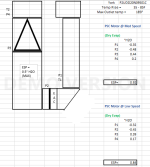
I will be replacing my old forced hot air up-flow furnace shortly with a new furnace that I have waiting in the wings. New furnace will sit on 4" concrete blocks which creates some ductwork adjustments in the return. New plenum is already made.

In reviewing my existing EAC against new units, I see today's models have post-filters as an option. My existing unit at the time made no mention of such. My unit had typical provisions for locating the pre-filters left or right of cells depending on air flow.
The new units mention an ionized surface filter to collect the finer particles that make their way thru the EAC and use the un-used pre-filter position. This style of post filter seems more like a revenue stream than a practical approach for manageable filtration.

Without putting an offset into the return duct, I don't have room to add a new media filter between EAC and furnace. I do however have a 4" wide spacer between furnace and EAC now.

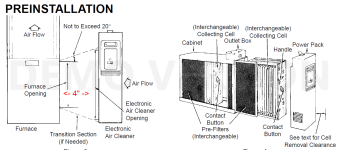
Instead of dealing with more sheet metal work, I was thinking I could use the 4" space between the furnace and EAC to insert a 2" thick MERV 11 or 13 filter. I could support it on both sides with 4 removable rods on either side of the MERV filter. MERV filter replacement access would require removing the EAC cells. Not a problem as I should be cleaning the cells and this would get me moving on it.

I plan to put a delta P sensor on both sides of the EAC and on both sides of the MERV filter so I get an alarm when either is blocked. I will adjust the fan speed during furnace install. (The original media filter that was replaced with the EAC was for 1200 CFM and the current EAC is rated for 1600 - 2000 CFH. This size was chosen to nicely fit the ductwork size. The MERV filter would be 20" x 25" x 2".)

Thoughts? Pros/cons? Should I do the return duct offset instead to install a 4" thick MERV instead?
1766509424446.png
 
To avoid these ads, REGISTER NOW!

danski0224

Well-known member
Joined
Jan 29, 2005
Messages
13,410
Location
Near Naperville, IL
The max side opening size on a typical residential furnace is 14" tall x 22" wide, and the width may be less on some models.

The fan on residential equipment can't handle the narrow pleated filters, there isn't enough media for lower restriction unless you get the fanfold 6" thick style (NOT the 4" thick style sold at the box stores).

Vertical filter, slammed to the cabinet on one side and slammed to the drop on the other side is pretty much the worst you can do for airflow, but it's easy and no skill is required.
 
OP
M

mm08822

Well-known member
Joined
Jan 13, 2012
Messages
5,909
Location
NJ
The max side opening size on a typical residential furnace is 14" tall x 22" wide, and the width may be less on some models.

The fan on residential equipment can't handle the narrow pleated filters, there isn't enough media for lower restriction unless you get the fanfold 6" thick style (NOT the 4" thick style sold at the box stores).

Vertical filter, slammed to the cabinet on one side and slammed to the drop on the other side is pretty much the worst you can do for airflow, but it's easy and no skill is required.
You stated the fans on residential units can't handle dirty filters. In my case, I'm planning to continue running at ~1200CFM through a filter used for 2000 CFM systems. Shouldn't a 4" deep filter with only 60% of the rated air flow through it provide some relief to the concern you mention?

What is the pressure drop across filter media that starts heating/cooling performance problems in your experience?
1766539341795.png
I see 14 x 22 is clearly dimpled out on the sides of the new furnace.
The ductwork opening into the EAC is very close to 21"h x 22"w as it 90's into the EAC. I previously added turning vanes inside the 90 as well.

I failed to mention, my 4" wide spacer that I previously made, included tapering from the EAC opening dimensions down to 14ish x 22ish on the furnace - or what ever the original hole size is in the furnace.

If I'm following you, it seems like I would need to do the downward return duct offset to provide room for a media housing to accommodate a 4 or 6" deep media filter AND possibly remake the current 4" wide transition section wider to not exceed the 20 degree (1:3) taper. ~18.5h x 23.25w ---> 14h x 22w.

Who makes 6" media/media housing ?
What other methods are used post EAC?
 

danski0224

Well-known member
Joined
Jan 29, 2005
Messages
13,410
Location
Near Naperville, IL
In that picture above, it states to replace the filter when the pressure drop reaches 0.5" WC.

The typical residential fan in a furnace is rated at 0.5" WC TESP, which is Total External Static Pressure. That's EVERYTHING before and after the fan, not just the filter.

Residential furnace fans can't handle the disposable pleated filters. No matter what the 3M marketing says. A 2" filter rack would be uncommon.

What is the TESP of your system now? Then you will know how much headroom is left for a filter (if any). You can look at the furnace fan charts and see the airflow drop as TESP goes up. If the equipment has a variable speed ECM motor, it can usually maintain the set airflow, but motor amperage goes up.

General Aire has a deep media filter, AC22 or AC24.

I do not recommend electronic air cleaners, nor would I recommend any pleated filter, except for a General Aire setup, or an Aprilaire 5000.
 

mike93lx

ALLIANCE MEMBER
Joined
Dec 9, 2013
Messages
37,507
Location
Richmond, VA
I have aprilaire 1310's on two of my systems (4") and the 5000 is also available.

The media is expensive, but it's Made in America (Virginia).

I believe General Aire's filters are made in north America
 

bonneyman

Well-known member
Joined
Apr 22, 2010
Messages
8,792
Location
Desert SW
In that picture above, it states to replace the filter when the pressure drop reaches 0.5" WC.

The typical residential fan in a furnace is rated at 0.5" WC TESP, which is Total External Static Pressure. That's EVERYTHING before and after the fan, not just the filter.

Residential furnace fans can't handle the disposable pleated filters. No matter what the 3M marketing says. A 2" filter rack would be uncommon.

What is the TESP of your system now? Then you will know how much headroom is left for a filter (if any). You can look at the furnace fan charts and see the airflow drop as TESP goes up. If the equipment has a variable speed ECM motor, it can usually maintain the set airflow, but motor amperage goes up.

General Aire has a deep media filter, AC22 or AC24.

I do not recommend electronic air cleaners, nor would I recommend any pleated filter, except for a General Aire setup, or an Aprilaire 5000.
I agree that I don't like electronic air cleaners much at all. Over the years I've deleted bad EAC's because the cost of repair or replacement was something my customers didn't want to do. I pulled out the bad cells, and adapted the cell rails to properly hold a 4" pleated filter. That's if they could replace the filters themselves. Most people wouldn't want to pay for a service agreement for me to come out every quarter to change filters.
AprilAire's were nice, and Carrier used to have SpaceGuard filters. A bit of a pain to replace the media but had good filtration with those.
Then again that was all older PSC motor units. The newer ECM systems seem to be very finicky with airflow issues.
 
Last edited:

danski0224

Well-known member
Joined
Jan 29, 2005
Messages
13,410
Location
Near Naperville, IL
Over the years I've deleted bad EAC's because the cost of repair or replacement was something my customers didn't want to do.
I haven't installed many, but had 1 electronic part of an Aprilaire 5000 go bad, and the part (basically the door assembly) was more money than a whole new housing.

I haven't really recommended that style for a long time, but they work.

And the replacement media is hovering around $100.00.

I would NOT install one without a manometer to dictate filter replacement.

Aprilaire 5000 would meet OP's requirements for electronic + post filter.
 
Last edited:

danski0224

Well-known member
Joined
Jan 29, 2005
Messages
13,410
Location
Near Naperville, IL
The newer ECM systems seem to be very finicky with airflow issues.
I disagree.

Bad airflow was masked by plain old split capacitor motors. The airflow went down as static pressure goes up.

HVAC people don't check, customers don't care.

The variable speed motor can overcome bad ductwork or a bad install, to a point.

Customer experiences more noise and shorter motor life.
 
OP
M

mm08822

Well-known member
Joined
Jan 13, 2012
Messages
5,909
Location
NJ
Checking back, the age of my existing EAC is up there and I should just replace it or eliminate it altogether while doing the new furnace. New furnace is rated at 0.5"wc.

I will measure the existing return pressure before EAC and also after evap coil for a ductwork system baseline.

The Aprilaire 5000 would do both as a single unit but still has the space concerns and worse yet, blinding over as mentioned causing a high static pressure won't go away.

Whatever my final system is, it will include a magnahelic across the filtering system to provide in my face motivation for maintenance 🙄. Much harder to make excuses.

Without any constraints, what would you install today to really minimize airborne particulate? (Dogs, carpets, random construction dust, system used 10 mos/year.)
 

pcmeiners

Well-known member
Joined
Aug 13, 2009
Messages
7,900
Location
In the only town in Pennsylvania, Bloomsburg.
After a decent electrostatic/HEPA filter there are microns to filter, mostly odor. A very large charcoal filter would be the only filter which would improve the air quality and the average homeowner could not afford one. Small charcoal filter are useless beyond a days use, great for profit selling them but basically a scam .
 
Last edited:
OP
M

mm08822

Well-known member
Joined
Jan 13, 2012
Messages
5,909
Location
NJ
After a decent electrostatic/HEPA filter there are microns to filter, mostly odor. A very large charcoal filter would be the only filter which would improve the air quality and the average homeowner could not afford.
I should be satisfied with -MERV 11/13 air quality. Carbon filters exist in the MERV11 (IIRC) already.
Im not looking for clean room quality/performance.
 

pcmeiners

Well-known member
Joined
Aug 13, 2009
Messages
7,900
Location
In the only town in Pennsylvania, Bloomsburg.
Any charcoal filter the average home owner can afford will not work. I constructed a large filter with a hundred pounds of activated charcoal, removed odors for a couple weeks but 100 lbs is not enough. Basically the best you can do is a decent HEPA filter which will not get rid of odors.
 
OP
M

mm08822

Well-known member
Joined
Jan 13, 2012
Messages
5,909
Location
NJ
Any charcoal filter the average home owner can afford will not work. I constructed a large filter with a hundred pounds of activated charcoal, removed odors for a couple weeks but 100 lbs is not enough. Basically the best you can do is a decent HEPA filter which will not get rid of odors.
That's the problem with all of these systems, they need frequent maintenence/monitoring. Some is simple labor but most require replacement media in some form which is an ongoing wallet drain.
 

fitter30

Well-known member
Joined
Jun 23, 2019
Messages
2,973
Location
Peace Valley,mo
Have a electonic don't need a post filter. Are you going to be running the furnace blower 24/7? Furnace filter is no different than a vacuum cleaner it will ownly picks up what it sees. Dust settles because its heavier than the air can support.
 
OP
M

mm08822

Well-known member
Joined
Jan 13, 2012
Messages
5,909
Location
NJ
Have a electonic don't need a post filter. Are you going to be running the furnace blower 24/7? Furnace filter is no different than a vacuum cleaner it will ownly picks up what it sees. Dust settles because its heavier than the air can support.
The furnace/ductwork could also be seen as the victim of what's happening in the space.

Protecting the equipment is one thing and not having it continually spread a dusting over everything is another.
One feeds the other.

Eliminating the dust entering the conditioned space first off, is probably more beneficial but life gets in the way.

No, the blower would not run 24/7. Without constant turbulence in the space, as you stated, most will precipitate out and the blower running would be a waste.
 

brewchief

Well-known member
Joined
Sep 20, 2008
Messages
2,370
Location
Michigan
If i felt my filter needed a filter after it I would throw it in the garbage, personally thats where i feel all EACs belong. In nearly 30 of replacing furnaces I have never seen one with an EAC that the blower compartment is clean like it it with a properly installed media filter. The only exception being the Aprilaire 5000 but that's really a media filter with a bit of extra help from the electronic side.
The original Spacegard filters were great, I feel some filter area and thus filter life was given up when they went to the current 2410/2210 style but it gained a lot in being more user friendly for filter replacement.

Personally I would delete the current EAC and install a 2210 in it's place, depending on thickness of the current EAC it may be very close swap. FWIW a 2210 is 7 inches thick.
 

BurtEggley

Well-known member
Joined
Oct 8, 2024
Messages
864
to add a filter system beyond the factory 1" filter designed to "stop a cat from entering the HVAC", one must test the system to see what the external static pressure is. IF ONE READS the fine print from the manufacturer, it often reads ".5 maximum external static pressure. .1 may be added if the INTERNAL factory filter is removed." This is from a Carrier manual for my system. That means .6" pressure is allowed from the inlet to the outlet of the HVAC system. In my case, with a 20 x 25 x 1" 3M Merv 13 1900 filter, and a 14 x 24" filter with the huge number of pleats, my tesp is .59" which is within spec. 3M does not make a 2" filter in that series, I wish they did. But after reviewing many 2" high merv filters, there are ones out there that have a slightly better spec than the 3M 1" but not by much. My total tesp with a 2" pleated Merv 13 filter is .58. That is when the AC is running, which is the highest speed. The heater, uses lower speeds so the tesp is even lower. There are many factors in the equation. Something as simple as closing bedroom doors will raise the static pressure because even with a large door undercut the pressure in the system increases. A LOT goes into keeping a system below the engineered pressure. The ONLY 3m filter that has a reasonable back pressure is the 1900 at least 20 x 25, and maybe even 2 of them. The lower Merv ones are much more restrictive because the surface area of the pleats is much less.
 

fitter30

Well-known member
Joined
Jun 23, 2019
Messages
2,973
Location
Peace Valley,mo
The furnace/ductwork could also be seen as the victim of what's happening in the space.

Protecting the equipment is one thing and not having it continually spread a dusting over everything is another.
One feeds the other.

Eliminating the dust entering the conditioned space first off, is probably more beneficial but life gets in the way.

No, the blower would not run 24/7. Without constant turbulence in the space, as you stated, most will precipitate out and the blower running would be a waste.
Most people install electronic air filters for allergens. For that they run the blower 24/7.
 
To avoid these ads, REGISTER NOW!

danski0224

Well-known member
Joined
Jan 29, 2005
Messages
13,410
Location
Near Naperville, IL
I will measure the existing return pressure before EAC and also after evap coil for a ductwork system baseline.
That is not correct.

TESP is everything before and after the fan*.

This means before the evaporator and after the filter.

*: at least for a piece of equipment that has an external evap coil and filter, which has been true for every furnace that I have seen so far. An air handler, with an internal evap and air filter rating may include those parts.
 

danski0224

Well-known member
Joined
Jan 29, 2005
Messages
13,410
Location
Near Naperville, IL
a magnahelic across the filtering system
This is useless in a residential application. You do not know what the allowable pressure drop spec is (unless you measure properly and figure it out).

The gauge needs to measure TESP, and you change the filter when the value hits the predetermined ceiling.

In my experience, it is quite difficult to take an existing system and get it to operate *near* manufacturer allowable specs, much less *below* those specs, without SIGNIFICANT ductwork renovations. If something can be brought to 0.6" or 0.65" WC, that's a win in my book.

Then you look at the fan charts and see where the airflow starts to drop out of range, and change the filter then. Or, if the motor can maintain airflow until 1.0" wc, pick a point well before that.

TESP will change when the evap coil is wet, and it will change in multi stage systems.

This is why it is important to correctly size HVAC equipment, because it can reduce airflow issues, because smaller equipment needs less air.

You will not be able to fix your return side airflow or filter issues without significant work. Slapping a filter between the drop and the furnace cabinet is not the way to go.
 

bonneyman

Well-known member
Joined
Apr 22, 2010
Messages
8,792
Location
Desert SW
I disagree.

Bad airflow was masked by plain old split capacitor motors. The airflow went down as static pressure goes up.

HVAC people don't check, customers don't care.

The variable speed motor can overcome bad ductwork or a bad install, to a point.

Customer experiences more noise and shorter motor life.
I've been busy with other threads, so haven't had a chance to comment on this.
You claim "customers don't care", but then say they'll have noise and longevity complaints? :unsure:

My point was - and is - that taking say a 40 year old house and slapping a new hi-efficiency ECM system into it doesn't always work. (Mostly in my experience.) Homes back then were designed for - and installed with - the equipment of the day. And they don't operate the same with todays ECM units.
When I get to a job I'm typically dealing with a customer who had someone sell them a new high-efficiency unit that would "save them money". After a year of back and forth with the contractor (and multiple service calls) they're told the warranty's expired and cut loose. I get called because they're desperate and I have to explain to them what is really going on. The newer units were designed for different specs than what their older home was built to. And I can't fix their problems in a one hour service call. Lots of unhappy customers, and contractors doing the typical song and dance. I do what I can for them with what they've got. And that usually means ignoring the ductwork modifications (which is what they really need) because they can't or won't pay for that.

In my experience, it is quite difficult to take an existing system and get it to operate *near* manufacturer allowable specs, much less *below* those specs, without SIGNIFICANT ductwork renovations. If something can be brought to 0.6" or 0.65" WC, that's a win in my book.
Exactly! Since most customers can't do this I do what I can to alleviate the extreme issues. Installing 2" or 4" pleated filters, setting them up on a service contract to come out and replace those filters regularly, installing insulating baffles in returns to reduce noise, or adding an additional return for more airflow. No one is entirely happy, but most all of those customers admit to me later that the noise is less, temperature differentials throughout the home are minimized, and there's less dust and contaminants inside. And I can live with that.
 

danski0224

Well-known member
Joined
Jan 29, 2005
Messages
13,410
Location
Near Naperville, IL
You claim "customers don't care", but then say they'll have noise and longevity complaints? :unsure:

And that usually means ignoring the ductwork modifications (which is what they really need) because they can't or won't pay for that.
They "don't care" because they don't want to pay* to fix it.

It's a problem, until the repair path is outlined... and I get it that there's a number of people out there that claim that they can fix it, but can't. And the customers that will not listen to anything because the "stuff worked fine for years, why is it a problem now?".

*: at least they do not want to pay more than an equivalent of around $20 an hour.
 

bonneyman

Well-known member
Joined
Apr 22, 2010
Messages
8,792
Location
Desert SW
They "don't care" because they don't want to pay* to fix it.

It's a problem, until the repair path is outlined... and I get it that there's a number of people out there that claim that they can fix it, but can't. And the customers that will not listen to anything because the "stuff worked fine for years, why is it a problem now?".

*: at least they do not want to pay more than an equivalent of around $20 an hour.
I can't make people spend their money. All I can do is tell them what I think is happening and how I would go about fixing it. It's their equipment, in the end. If they choose not to do anything, I annotate it on the service form and have them sign it. If they come back within the callback period complaining, I'm covered.

*: at least they do not want to pay more than an equivalent of around $20 an hour.

But with filters I gave people a smoking deal. If they could change them, I'd sell them a dozen for a discount. Tell them change it once a month when the electric bill comes in. No need to remember, and never gonna forget! If it was a rooftop unit, I'd sell them a PM for cost +10%. Didn't make much money on those jobs, but it got me touching their unit regularly and maybe I could get the repair work when something did break. And if I could get say 4 or 5 PM's the same month I could set aside one day to do all of them in a circular route. Load the van with the first customers filters in the back, and work my way forward. Shave the time to a minimum. Then I could compound the minor profits and make the day halfway decent. As it turned out I probably only made $15-20 an hour those days. :)
 

Aileron

Well-known member
Joined
Apr 15, 2019
Messages
461
Location
outside
The evaporator coil usually works as the final filter. Had neighbor that swore up and down you didn't need a filter with a EAC until I had to pull his evap coil out on a hot July day and clean it.
He was a engineer, came over when I had a friend that owned one of the largest commercial concrete firms pouring a new driveway during their down time and explained how they weren't doing it right.
 

dscheidt

Well-known member
Joined
Apr 26, 2017
Messages
2,892
The evaporator coil usually works as the final filter. Had neighbor that swore up and down you didn't need a filter with a EAC until I had to pull his evap coil out on a hot July day and clean it.
He was an engineer, came over when I had a friend that owned one of the largest commercial concrete firms pouring a new driveway during their down time and explained how they weren't doing it right.
Well, were they? I see lots of concrete work that’s not done right. Some of it even looks good after.
 
OP
M

mm08822

Well-known member
Joined
Jan 13, 2012
Messages
5,909
Location
NJ
I measured my existing system’s ESP, fuel consumption, temp rise, and calculated current CFM.
  • ESP =0.85
  • Delta T = 65F
  • Fuel = 103 CFH (maybe 5% high)
  • Air Flow = 1515 CFM
There has always been a noticeable air stream flowing from 1st floor into basement under the basement door when blower running.

I SWAG’d the air flow to each of the supply registers based on floor sq ft the register served. Some were increased to cover hallway, stairway, foyer, etc.

I am even mapping out the actual ductwork, cross-sections, lengths, etc. Hoping to eventually reach total equivalent lengths for each register. Maybe even get to doing heat losses.

My new furnace spec requires two 16 x 25 filter inlets (either side of furnace) or a bottom filter of 20 x 25, which I can’t use.
New furnace has a 0.5” ESP for heating and up to 0.8” during cooling. AC is 3 Ton. So' I'll be at 1200CFM at least.

If I were to add a 2nd 16 x 25 side filter as part of the new furnace installation, I could easily move 3 returns off of the existing trunk that now collectively are ~325 CFM.

This would lower the existing return CFM to ~1200 CFM.

How will this balance out between the 2 returns if I am only providing a new trunk, filter inlet to the furnace and just extending 3 returns runs ~5’ each to the new trunk?
I’m assuming the only way to know the impact for sure is to do it on paper, both “as is” and "proposed" and compare. Any gut feelings on this modification?

I’m trying to keep all of the modification work in the basement. It will not become an entire ductwork system replacement project!
 

brewchief

Well-known member
Joined
Sep 20, 2008
Messages
2,370
Location
Michigan
What are you installing for a furnace? Most manufacturers will allow a base to be used under the furnace that raises it and allows a 20" tall air cleaner, the bottom of the furnace is removed and the base allows airflow to come in both the side and bottom of the furnace. Carrier/Bryant sells them in a 4" tall version for 17 and 21" wide furnaces and 8" tall for the 24" wide. Lennox had them in like a 7" tall, I have seen a goodman/amana version as well and some supply houses have a universal model.
 
OP
M

mm08822

Well-known member
Joined
Jan 13, 2012
Messages
5,909
Location
NJ
Residential returns 90% are short of air flow and with all the flex duct doesn't help.
I am trying to reduce ESP and there is minimal flex duct...maybe 2 lengths in the attic but those come off of exterior wall stacks. Otherwise, everything else is metal duct.

If I am getting significant air flow under the basement door from the 1st floor. Doesn't that indicate undersized/too few returns? It seems to me that I am excessively positive pressurizing the house from the supply registers and needlessly forcing conditioned air outside through every single crack b/c of return duct under sizing.
 
OP
M

mm08822

Well-known member
Joined
Jan 13, 2012
Messages
5,909
Location
NJ
What are you installing for a furnace? Most manufacturers will allow a base to be used under the furnace that raises it and allows a 20" tall air cleaner, the bottom of the furnace is removed and the base allows airflow to come in both the side and bottom of the furnace. Carrier/Bryant sells them in a 4" tall version for 17 and 21" wide furnaces and 8" tall for the 24" wide. Lennox had them in like a 7" tall, I have seen a goodman/amana version as well and some supply houses have a universal model.
Goodman GMVM971005CN.
1767836620253.png

I plan to raise the furnace onto 4" block and have already built the plenum taking that height into account. There is an A coil on top of furnace also.
Is my P1 pressure too high or reasonable? This is from the existing set-up.
1767836908629.png
 

fitter30

Well-known member
Joined
Jun 23, 2019
Messages
2,973
Location
Peace Valley,mo
I am trying to reduce ESP and there is minimal flex duct...maybe 2 lengths in the attic but those come off of exterior wall stacks. Otherwise, everything else is metal duct.

If I am getting significant air flow under the basement door from the 1st floor. Doesn't that indicate undersized/too few returns? It seems to me that I am excessively positive pressurizing the house from the supply registers and needlessly forcing conditioned air outside through every single crack b/c of return duct under sizing.
Your electric company might offer a energy audit that includes a blower door test. That test tell how much infiltration in coming in. Energy audit is usually priced very reasonable with mine do certain things they have rebates for them.
If the air is to forcefull there should be dampers at main trunk line. The air going under the door is forcefull the gap at the bottom of the door is probably to small. Crack the door a little just to see if your happy. Might need a transfer duct for the return from bedroom to hall or to the furnace.
 
OP
M

mm08822

Well-known member
Joined
Jan 13, 2012
Messages
5,909
Location
NJ
Your electric company might offer a energy audit that includes a blower door test. That test tell how much infiltration in coming in. Energy audit is usually priced very reasonable with mine do certain things they have rebates for them.
If the air is to forcefull there should be dampers at main trunk line. The air going under the door is forcefull the gap at the bottom of the door is probably to small. Crack the door a little just to see if your happy. Might need a transfer duct for the return from bedroom to hall or to the furnace.
Wouldn't dampers in the supply trunk just raise ESP and increase energy consumption b/c of blower motor working harder?

The basement technically has no returns (nor supply registers) so should it not technically have zero flow into it? (Yes I know everything leaks in the real world.) If the basement door is few inches ajar, it will shut "on its own".

I will have to check if there is air flow under each bedroom door when closed, but the air flow under the basement door occurs all of the time....bedroom doors opened or closed.

ETA: Bedrooms are on second floor. 2nd floor stairway/hallway is open to 1st floor.
 
Last edited:

fitter30

Well-known member
Joined
Jun 23, 2019
Messages
2,973
Location
Peace Valley,mo
Wouldn't dampers in the supply trunk just raise ESP and increase energy consumption b/c of blower motor working harder?

The basement technically has no returns (nor supply registers) so should it not technically have zero flow into it? (Yes I know everything leaks in the real world.) If the basement door is few inches ajar, it will shut "on its own".

I will have to check if there is air flow under each bedroom door when closed, but the air flow under the basement door occurs all of the time....bedroom doors opened or closed.
Trunk dampers are for balancing. Adjusting one forces more air out of the other runs. If the rooms are comfortable then theres return problem in your bed room. ESP shouldn't change much. Most houses returns are short (to small) or the return is a stamped steel and blocks the more air than a better grill.
 
OP
M

mm08822

Well-known member
Joined
Jan 13, 2012
Messages
5,909
Location
NJ
Trunk dampers are for balancing. Adjusting one forces more air out of the other runs. If the rooms are comfortable then theres return problem in your bed room. ESP shouldn't change much. Most houses returns are short (to small) or the return is a stamped steel and blocks the more air than a better grill.
I'm thinking if the bedrooms are comfortable with doors shut, then there is enough supply cfm and return cfm occurring through each bedroom's individual return duct - whether or not the designed amounts are being delivered is another story. (Also, the Space Nazi, doesn't care about blocking supplies or returns. :scared: )

I think the first floor is where the worst of the supply/return imbalance occurs. As a test, I could block the basement door gap and check if the first floor becomes uncomfortable due to lower/slower air movement.

The opportunities for running ducts in this house design really ***** from day 1. The architect cut off so many potential duct routes that I can't blame the HVAC guy.

So, not having enough returns could be the root cause but adding more into the existing sized return trunk I think would just move me to make a current problem bigger - undersized return duct and filter back the to furnace. This is why I am asking about off-loading 3 return ducts from the existing main return trunk and creating a 2nd return main duct & filter setup on the other side of the furnace.
 
To avoid these ads, REGISTER NOW!
Top Bottom