To avoid these ads, REGISTER NOW!

Power to new garage

sparky 1971

Well-known member
Joined
Oct 9, 2018
Messages
8,028
Location
Central Iowa
I'd put money that the panel is probably in the basement right below that meter main combo. If i was doing this job id just add a breaker in the main panel and from the basement stub out into a box then down underground with an expansion fitting into the garage. I'd use a panel with a main.. and dont forget the uffer ground or ground rod or rods ... otherwise you would need to add a splice box next to the existing meter main and run from the load side of that exterior main breaker into the box and then down to the main panel and use the tap rule to tap and add fused disco or a small 2/4 3r panel with the appropriate breaker size within 10' of the tap. Sounds easier to just run the work from inside!
I'm not betting on it but it sure looks like a modular home with a crawl space to me. If I'm right, the panel is more than likely going to be a PITA. The few I've dealt with were ridiculous, the last one being a 200 amp 16 space Siemens completely full of twins and quads from the factory and no place to add another breaker. On top of that, every effing cable enters through the bottom and there are no knockouts left to bring anything in if there is a space.
 
To avoid these ads, REGISTER NOW!

Snap-on_rich

Active member
Joined
Dec 12, 2025
Messages
44
Location
NJ
the main panel is the one outside and cannot take any more breakers. the panel inside is a subpanel.

you could make the tap right inside the meter main, then feed it into a disco next to it....

and im not gonna assume where the inside panel is located....
I really wouldn't call the meter/main a panel.

It would be considered the service disconnect/emergency disconnect where I'm located... Bonding is done at that point. And yes inside, you separate grounded conductors and your grounds...

And I'm not sure if there is ample room to tap those conductors in there with insulation piercing taps.. Id be more comfortable re doing it.. Maybe this time with listed conductors...
 

Snap-on_rich

Active member
Joined
Dec 12, 2025
Messages
44
Location
NJ
I'm not betting on it but it sure looks like a modular home with a crawl space to me. If I'm right, the panel is more than likely going to be a PITA. The few I've dealt with were ridiculous, the last one being a 200 amp 16 space Siemens completely full of twins and quads from the factory and no place to add another breaker. On top of that, every effing cable enters through the bottom and there are no knockouts left to bring anything in if there is a space.
If it is a crawlspace situation on a trailer thats tricky. I've done them before where I was able to fish up some SER.. But it *****...
 

sparky 1971

Well-known member
Joined
Oct 9, 2018
Messages
8,028
Location
Central Iowa
If it is a crawlspace situation on a trailer thats tricky. I've done them before where I was able to fish up some SER.. But it *****...
There appears to be a skirt below the siding. I would think that if it were a basement we would see an LB right below where the siding stops.
 

Snap-on_rich

Active member
Joined
Dec 12, 2025
Messages
44
Location
NJ
There appears to be a skirt below the siding. I would think that if it were a basement we would see an LB right below where the siding stops.
Yep its an odd one. Ones i worked on there was an lb right where the skirting started since the conduit was mounted to the underside of the floor joists... Maybe OP can clarify
 

PhantomEB

Well-known member
Joined
Feb 6, 2006
Messages
6,841
Location
Medicine Hat, AB, Canuckistan
If you got to ask, I would hire someone or actually talk to an electrician.

my shop has 2 3/4“ conduits as well a 1/2“. I wish we had 200 but I not paying to upgrade that. My last shop had 60 amp power so I will be doing the same. Electricians at work told me I can put 8/3 wire in the 3/4” one to get 50 or 60 amps again.
 

mm08822

Well-known member
Joined
Jan 13, 2012
Messages
6,061
Location
NJ
8/3 typically means cable of some sort. It can't be NM-B and UF would be miserable. Neither would make sense trying to pull thru 3/4"

You want individual xhhw conductors to pull. It needs to be a 4-wire feeder.
 

PCustoms

Well-known member
Joined
Jul 23, 2011
Messages
23,572
Location
VT
8/3 typically means cable of some sort. It can't be NM-B and UF would be miserable. Neither would make sense trying to pull thru 3/4"

You want individual xhhw conductors to pull. It needs to be a 4-wire feeder.
That, and how's he going to get 60A out of #8?
 

Snap-on_rich

Active member
Joined
Dec 12, 2025
Messages
44
Location
NJ
If you got to ask, I would hire someone or actually talk to an electrician.

my shop has 2 3/4“ conduits as well a 1/2“. I wish we had 200 but I not paying to upgrade that. My last shop had 60 amp power so I will be doing the same. Electricians at work told me I can put 8/3 wire in the 3/4” one to get 50 or 60 amps again.
if you want 50 amps. Go with #8 thhn single conductors in the 3/4" conduit. That would work
 

mm08822

Well-known member
Joined
Jan 13, 2012
Messages
6,061
Location
NJ
That, and how's he going to get 60A out of #8?
He's not. But the workers' solution would only have given him 40.

Assuming he's got the pocketbook stuffing for copper (based on the worker's recommendation), #8 xhhw or thhn/thwn is good for 55a. He could put that on a 60A cb or 50a cb depending on calculated load (which he says is trivial).

OP earlier stated only wanted 50a.
 

Snap-on_rich

Active member
Joined
Dec 12, 2025
Messages
44
Location
NJ
240.4(b)(2) comes to mind... Refer to 240.6(a) for standard size overcurrent devices. It jumps from 50 to 60 Amps. So if you have #8 feeders rated at 55 amps your allowed to use next largest OCD.
 
To avoid these ads, REGISTER NOW!

Snap-on_rich

Active member
Joined
Dec 12, 2025
Messages
44
Location
NJ
Only if your load is not in excess of 50a (or is it 55?)
if you read 240.4 it states:

240.4(B) Overcurrent Devices Rated 800 Amperes or Less. The next higher standard overcurrent device rating (above the ampacity of the conductors being protected) shall be permitted to be used, provided all of the following conditions are met:

(1) The conductors being protected are not part of a branch circuit supplying more than one receptacle for cord-and-plug-connected portable loads. (y) WE ARE LOOKING AT A FEEDER NOT A BRANCH CIRCUIT

(2) The ampacity of the conductors does not correspond with the standard ampere rating of a fuse or a circuit breaker without overload trip adjustments above its rating (but that shall be permitted to have other trip or rating adjustments).

(y) WE ARE SUGGESTING #8 XHHW OR THWN-2 WHICH IS RATED AT 55 AMPS IN THE 70C COLUMN. THIS DOES NOT CORRESPOND WITH A STANDARD AMPERE RATING.

(3) The next higher standard rating selected does not exceed 800 amperes.
(y) WE IN COMPLIANCE WITH THIS.

240.6(A) Fuses and Fixed-Trip Circuit Breakers. The standard ampere ratings for fuses and inverse time circuit breakers shall be considered.... ( 15, 20, 25, 30, 35, 40, 45, 50, 60, 70, ETC........)

NEXT HIGHEST SIZE IS 60.
 

mike93lx

ALLIANCE MEMBER
Joined
Dec 9, 2013
Messages
37,962
Location
Richmond, VA
if you read 240.4 it states:

240.4(B) Overcurrent Devices Rated 800 Amperes or Less. The next higher standard overcurrent device rating (above the ampacity of the conductors being protected) shall be permitted to be used, provided all of the following conditions are met:

(1) The conductors being protected are not part of a branch circuit supplying more than one receptacle for cord-and-plug-connected portable loads. (y) WE ARE LOOKING AT A FEEDER NOT A BRANCH CIRCUIT

(2) The ampacity of the conductors does not correspond with the standard ampere rating of a fuse or a circuit breaker without overload trip adjustments above its rating (but that shall be permitted to have other trip or rating adjustments).

(y) WE ARE SUGGESTING #8 XHHW OR THWN-2 WHICH IS RATED AT 55 AMPS IN THE 70C COLUMN. THIS DOES NOT CORRESPOND WITH A STANDARD AMPERE RATING.

(3) The next higher standard rating selected does not exceed 800 amperes.
(y) WE IN COMPLIANCE WITH THIS.

240.6(A) Fuses and Fixed-Trip Circuit Breakers. The standard ampere ratings for fuses and inverse time circuit breakers shall be considered.... ( 15, 20, 25, 30, 35, 40, 45, 50, 60, 70, ETC........)

NEXT HIGHEST SIZE IS 60.
I know that.

Your calculated load cannot exceed the current carrying capacity of the conductors (except in special cases like welders and HVAC)

So if his calculated load was 60, this would not be ok
 

mm08822

Well-known member
Joined
Jan 13, 2012
Messages
6,061
Location
NJ
I know that.

Your calculated load cannot exceed the current carrying capacity of the conductors (except in special cases like welders and HVAC)

So if his calculated load was 60, this would not be ok
And he should then be planning for a bigger feeder to start with, IMO.
 

Snap-on_rich

Active member
Joined
Dec 12, 2025
Messages
44
Location
NJ
I know that.

Your calculated load cannot exceed the current carrying capacity of the conductors (except in special cases like welders and HVAC)

So if his calculated load was 60, this would not be ok
yep, thats 310.12? Over 100 amps you can Derate to 83% of the calculated load, so in this case he's stuck at the cable rating...

Unless he has electric heat im thinking he's within 55 amps.. Not to many continuous loads in a workshop. But... Only OP knows!!
 

mike93lx

ALLIANCE MEMBER
Joined
Dec 9, 2013
Messages
37,962
Location
Richmond, VA
yep, thats 310.12? Over 100 amps you can Derate to 83% of the calculated load, so in this case he's stuck at the cable rating...

Unless he has electric heat im thinking he's within 55 amps.. Not to many continuous loads in a workshop. But... Only OP knows!!
I don't think this is a problem for him either.

Just clarifying something that your comment omitted
 

Snap-on_rich

Active member
Joined
Dec 12, 2025
Messages
44
Location
NJ
it is indeed the main service panel.

calling a subpanel/load center the main panel just adds confusion.
I can agree it is indeed the main. But what should it be labeled per the nec....?

ill continue calling it what the nec does.. a service disconnect/Emergency disconnect which the nec specifically states and needs it to be labeled as. 220.85 You cant argue that...

if it cant accept any breakers like a panelboard does Its a disconnect to me.. everyone is welcome to there interpretation. Inside would be a sub panelboard of course.

Im not arguing btw I enjoy code talk and interpretation.
 
Last edited:

mm08822

Well-known member
Joined
Jan 13, 2012
Messages
6,061
Location
NJ
which NEC article would you use to calculate load for a feeder?
Article 215 for Feeders...and more specifically 215.4 Minimum Rating and Size. Basically 125% of continuous loads + 100% of the non-continuous.
However, I would ask myself what could be a worst combination of non-continuous loads likely to simultaneously occur especially when single-person shops can't run every tool simultaneously. In addition to that, 5 recepts or 105 recepts installed, don't imply a change in connected load either.

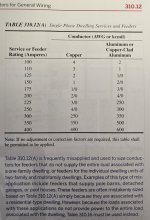
215.4 does not imply the use of 310.12 which is only for SE conductors.
The blue text below is NEC author commentary on exactly this mis-use of Table 310.12(A):
1766368572324.jpeg
 

Snap-on_rich

Active member
Joined
Dec 12, 2025
Messages
44
Location
NJ
Article 215 for Feeders...and more specifically 215.4 Minimum Rating and Size. Basically 125% of continuous loads + 100% of the non-continuous.
However, I would ask myself what could be a worst combination of non-continuous loads likely to simultaneously occur especially when single-person shops can't run every tool simultaneously. In addition to that, 5 recepts or 105 recepts installed, don't imply a change in connected load either.

215.4 does not imply the use of 310.12 which is only for SE conductors.
The blue text below is NEC author commentary on exactly this mis-use of Table 310.12(A):
1766368572324.jpeg
Excellent explanation. I got fooled by 310.12 when I read dwelling services and feeders.. thats what skewed my thinking and I didn't even think about 215. This is what happens when I dont get off the couch to open my code book which is stting just 20 feet away in my office.. thanks for the correction and wisdom!
 
To avoid these ads, REGISTER NOW!
Top Bottom