To avoid these ads, REGISTER NOW!

"Pre-Block" Grinders--Where's the Love?

AtlasRearden

Well-known member
Joined
Feb 8, 2021
Messages
63
Location
Southern California
I believe it started with the flat tops but then included all of the aluminum frame grinders since the internals are about the same. Pre blocks are the cast iron version.

So if that's the case, and all-cast iron construction is what defines "Pre-Block," then 1963 and earlier are "Pre-Block" and 1964 and later are "Block?"
 
To avoid these ads, REGISTER NOW!
OP
E

exmaxima1

Well-known member
Joined
Jun 25, 2011
Messages
6,339
Location
Midwest
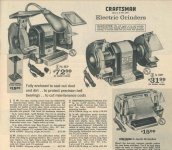
As I've been looking at these, a few things have stood out in identifying the years.

1963
  • Last year the power switches were on the horizontal surface of the base.
  • Last year the horizontal rods for the tool rests extended from the quench tray of the 1/2 hp model
  • Must be the last year of the 1/2 hp all-cast-iron model (85 lbs!)
  • No 3/4 hp model
1963Grinders.jpg

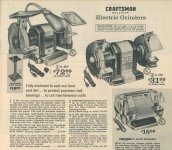
1964
  • Power switch moves to the vertical surface of the base.
  • 1/2 hp model design is changed (most noticeably, no horizontal bars for the tool rests attached to quench tray).
  • No 3/4 hp model
1964Grinders.jpg


But I still can't say I'm really clear on when "Pre-Block" ended, and "Block" began.

Fron your catalog pages it would appear the change happened after 1963. I currently own 1/3hp versions of both Block and Pre-block and enjoyed seeing the weights: the Pre-block weighs almost exactly TWICE as much!
 

torqueman2002

Well-known member
Joined
Jun 3, 2009
Messages
6,138
Location
SE Michigan
I'm pretty sure this has to be a line from Mad Max: Thunderdome...

Ladies and gentlemen, boys and girls... Grinding time's here.

I will seek out this Torqueman.
Some one call?

I'm behind in my reading, sorry for not responding sooner.

I can't help on the Mad Max quote; but, if you check the following link, it might clear up what is/is not a Block, ....

What is a Block grinder?
https://www.garagejournal.com/forum/showthread.php?t=249539

BTW - I spotted a pre-Block in the 'wild', or at least on YouTube.


AtlasRearden

Well-known member
Joined
Feb 8, 2021
Messages
63
Location
Southern California
...if you check the following link, it might clear up what is/is not a Block, ....

What is a Block grinder?
https://www.garagejournal.com/forum/showthread.php?t=249539

Thanks for weighing in Torqueman. Now that I see that link, I actually did read that post, but still wasn't quite sure what year marked the progression from "Pre-Block" to "Block."

This section made me think that some of the models from the late 60's might still be considered "Pre-Block":
What is a Block grinder?
Important Update: March 24, 2020
<< I thought the other places refer to the block grinder as the ones with center band and end bells that look like a cube.
The prior aluminum ones have end bells shaped like a tombstone, or mailbox as you've mentioned. These should not be confused with "block grinder".
The aluminum tombstone/mailbox shaped grinders were patterned from the earlier 6" and 7" cast iron machines.

They didn't start using aluminum until 1964, so I'm assuming the quote above is referencing later models that "should not be confused with block grinders."
 

macgee

Well-known member
Joined
Jan 11, 2014
Messages
2,834
Location
Sepulveda Pass, CA
I'll be the one to say it.

To keep it simple for the children (me and maybe for others), can someone use less words and just post pictures in one post really good examples of what is a 1: Pre-block, 2: Block 3: Post block is suppose to be????

I have had at least 12-14 of these in my time and I'm now more confused more than ever of which one is which.
 

Old Radar

Well-known member
Joined
Apr 17, 2019
Messages
2,754
Location
San Antonio, TX
I'll be the one to say it.

To keep it simple for the children (me and maybe for others), can someone use less words and just post pictures in one post really good examples of what is a 1: Pre-block, 2: Block 3: Post block is suppose to be????

I have had at least 12-14 of these in my time and I'm now more confused more than ever of which one is which.

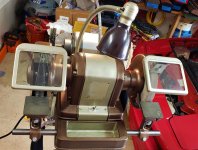
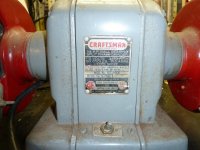
Here is my 1/2hp 115.7575 "Pre-Block" dated - 1-59 (still hoping mattblast is someday able to print on aluminum so I can get a label)
Cast Iron body. Horizontal on-off toggle. Sits on a removable cast iron platform with integrated tool rests and quench tray. Eye shields are two layers of glass bonded together with metal rims.


CM PreBlock 1-59.jpg

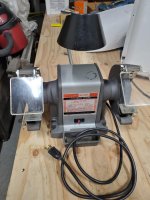
This is my 1/2hp 397.19591 "Mailbox" Block dated Oct 16 1972
Aluminum body. Vertical on-off toggle. Aluminum quench tray that fits in a slot on the grinder body. Not shown are the Princess Leia wheel covers and the formed plastic eye shields


CM Mailbox Block 16Oct1972.jpg


I don't have an actual 1974+ Block grinder, but I think everyone is familiar with that shape and is the least of anyone's concern. I got this from the Block thread.

CM Block.jpg
 

AtlasRearden

Well-known member
Joined
Feb 8, 2021
Messages
63
Location
Southern California
So based on this, it seems pretty well established that anything prior to 1960 is "Pre-Block," and anything after 1970 is probably "Block." The fuzzy part for me is exactly when during the groovy 60's did the "Block" begin.

Maybe to make it easier, what would one call these models from 1964?
1964Grinders.jpg
Are these "Block" or "Pre-Block?"

I had assumed these were "Pre-Block" based on this guidance:
The prior aluminum ones have end bells shaped like a tombstone, or mailbox as you've mentioned. These should not be confused with "block grinder".
The aluminum tombstone/mailbox shaped grinders were patterned from the earlier 6" and 7" cast iron machines.
 

macgee

Well-known member
Joined
Jan 11, 2014
Messages
2,834
Location
Sepulveda Pass, CA
Thank You Old Radar and Wrench,

Could saying this: Any Craftsman end bell that is magnetic is a Pre-Block? Of course the early round ones are exempt from the block party.

All the Block (not Pre-Block) and later square tops have aluminum end bells and would fail the magnet test?

It also looks like Blocks have cutout holes to accommodate front mounting bolts and the Pre-Blocks do not?

Sorry if my questions sound so elementary school level.
 

LesserSon

Well-known member
Joined
Feb 7, 2016
Messages
5,047
Location
PA USA
Torqueman is quoting Brian Kachadurian in that purple prose.
I do not know what he means by “important update.” Brian’s definition of a true “block grinder” - AKA “block motor grinder” - seems to correspond only to the Craftsman benchgrinders Torqueman consistently describes as “flat top.” Whether Torqueman intends to ammend his own terminology to match Brian’s, I do not know.
Does it really matter? We should not expect there to be consistency or logic to nicknames, and that is all “block,” “pre-block,” “round, top,” and “flat top” are - nicknames. Did the manufacturers call them that? Did Sears? We might as well call them Larry, Moe, Curly, and Curly Joe. Is there a difference between Curly and Curly Joe? Where does Shemp fit in? Should questions like that keep you awake at night? Is arguing about it worth your time?
There are a LOT of subtle differences among the different models, making it a fun game to identify them from the usually out-of-focus, poorly-lit photos on FBM, CL, etc. But it is just a game. Iif you see one in person, picking it up with your eyes closed tells you whether the bells-Bells-BELLS! (apologies to EAP) are cast from aluminum or iron. Open your eyes and you can read the horsepower.
Buy one, and a new game of researching authentic color schemes from black-and-white catalog illustrations unfolds, and intensifies when no such colors await you at HD, Lowes, WalMart, etc.
If you want to collect every model, go ahead. If you want to fix one up, go ahead. If you want to use one, go ahead. If you want to make up new nicknames for them, go ahead. We are blessed to live in a country where you can do that.
 

Old Radar

Well-known member
Joined
Apr 17, 2019
Messages
2,754
Location
San Antonio, TX
Torqueman is quoting Brian Kachadurian in that purple prose.
I do not know what he means by “important update.” Brian’s definition of a true “block grinder” - AKA “block motor grinder” - seems to correspond only to the Craftsman benchgrinders Torqueman consistently describes as “flat top.” Whether Torqueman intends to ammend his own terminology to match Brian’s, I do not know.
Does it really matter? We should not expect there to be consistency or logic to nicknames, and that is all “block,” “pre-block,” “round, top,” and “flat top” are - nicknames. Did the manufacturers call them that? Did Sears? We might as well call them Larry, Moe, Curly, and Curly Joe. Is there a difference between Curly and Curly Joe? Where does Shemp fit in? Should questions like that keep you awake at night? Is arguing about it worth your time?
There are a LOT of subtle differences among the different models, making it a fun game to identify them from the usually out-of-focus, poorly-lit photos on FBM, CL, etc. But it is just a game. Iif you see one in person, picking it up with your eyes closed tells you whether the bells-Bells-BELLS! (apologies to EAP) are cast from aluminum or iron. Open your eyes and you can read the horsepower.
Buy one, and a new game of researching authentic color schemes from black-and-white catalog illustrations unfolds, and intensifies when no such colors await you at HD, Lowes, WalMart, etc.
If you want to collect every model, go ahead. If you want to fix one up, go ahead. If you want to use one, go ahead. If you want to make up new nicknames for them, go ahead. We are blessed to live in a country where you can do that.


LS--You're always the voice of reason. Thank you.
Let's put this :deadhorse in the ground.
 

macgee

Well-known member
Joined
Jan 11, 2014
Messages
2,834
Location
Sepulveda Pass, CA
Well that was constructive.

Should we just combine the preblock thread and block thread together and call it a party as it doesn't matter and we can keep the ambiguity going strong?
 

AtlasRearden

Well-known member
Joined
Feb 8, 2021
Messages
63
Location
Southern California
Does it really matter?

Not really. The only reason I asked was because I posted something about what I thought was a Pre-Block grinder and someone said "That's not a pre-block." So I just thought I'd ask what that is, so I can use the same terminology as all the cool kids. Certainly was not arguing, as I have no idea what I'm talking about on this subject. Was just curious.
 

macgee

Well-known member
Joined
Jan 11, 2014
Messages
2,834
Location
Sepulveda Pass, CA
Atlas,

You're good and it was a valid question despite what some may think, as this has been happening regularly for years in the threads for Craftsman grinders with many owners not sure which one they have and obviously could use some clearing up.
 
OP
E

exmaxima1

Well-known member
Joined
Jun 25, 2011
Messages
6,339
Location
Midwest
Well that was constructive.

Should we just combine the preblock thread and block thread together and call it a party as it doesn't matter and we can keep the ambiguity going strong?

I started the "Pre-Block" thread because there were too many differences between the older cast iron grinders and the later alloy models. In particular, the alloy versions moved to current sensing relays (in lieu of centrifugal switches), much smaller stators and rotors, and of course the much lighter weight. The differences among the various alloy Blocks are mainly cosmetic and their internals can in many cases be interchanged---no way you can use internals from a Pre-Block in a Block grinder.
 
To avoid these ads, REGISTER NOW!

Old Radar

Well-known member
Joined
Apr 17, 2019
Messages
2,754
Location
San Antonio, TX
Okay, I'll take one more whack at this horse.

As LesserSon rightfully notes, we're talking about a nickname that neither the grinder's manufacturer, nor the mighty arm of Sears' marketing department ever used. Who came up with the term? I don't know but I like the idea of Lucy Van Pelt--and I think Torqueman might, also. Whoever it was had a keen eye for the obvious when referring to the cubic housing of the later models of Craftsman grinders.

I'm willing to bet most of us here are a bunch of Type-A personalities (reference this entire discussion and all its iterations over the years!), so, of course, immediately following that short but uncomfortable few minutes after Block Grinders became a "thing", we had to designate the style of Craftsman grinder that preceded the "Block" as the "Pre-Block".

That made perfect sense and all was right with the world--for about 45 minutes. Then people began pointing out some subtle and some not-so-subtle design differences in the "Pre-Block" models and the Type-As began to fidget and tremble (Two minutes to Wapner!!!) with the need to pin down exactly where the magical dividing line between the two could be found.

Or, wait! Some of those not-so-subtle differences might deserve a designation unto themselves!! Maybe. No! Don't muddy the Wapner--I mean water! KISS! Keep It Simple, Stupid! Where is the One Line??? One Line to rule them--no!--that's something else.

And so the discussion has devolved to where we are today. Plenty of desire for clarification, but still no answers. Maybe if someone took it upon themselves to do a Type Study like some have done for Stanley Planes, noting each difference in all the components they may find that magic line... Until then, keep looking for these grinders, keep refurbishing them, keep maintaining them and keep using them--no matter what you call them.
 

drivesitfar

Well-known member
Joined
Oct 23, 2013
Messages
35,997
Location
Pacific Northwest
I do like this conversation and personally I like the older Pre blocks better cause I like heavy cast, but they all seem to work great.

I know Doc (Tourqueman) has more than a few excel sheets with model #'s and dates on his and other blocks and maybe pre blocks so would like to know what he says if he's got a few minutes.

I think I quit liking Craftsman grinders when they went to plastic housing or maybe they just looked like plastic.
 

AtlasRearden

Well-known member
Joined
Feb 8, 2021
Messages
63
Location
Southern California
Okay, I'll take one more whack at this horse.

As LesserSon rightfully notes, we're talking about a nickname that neither the grinder's manufacturer, nor the mighty arm of Sears' marketing department ever used. Who came up with the term? I don't know but I like the idea of Lucy Van Pelt--and I think Torqueman might, also. Whoever it was had a keen eye for the obvious when referring to the cubic housing of the later models of Craftsman grinders.

I'm willing to bet most of us here are a bunch of Type-A personalities (reference this entire discussion and all its iterations over the years!), so, of course, immediately following that short but uncomfortable few minutes after Block Grinders became a "thing", we had to designate the style of Craftsman grinder that preceded the "Block" as the "Pre-Block".

That made perfect sense and all was right with the world--for about 45 minutes. Then people began pointing out some subtle and some not-so-subtle design differences in the "Pre-Block" models and the Type-As began to fidget and tremble (Two minutes to Wapner!!!) with the need to pin down exactly where the magical dividing line between the two could be found.

Or, wait! Some of those not-so-subtle differences might deserve a designation unto themselves!! Maybe. No! Don't muddy the Wapner--I mean water! KISS! Keep It Simple, Stupid! Where is the One Line??? One Line to rule them--no!--that's something else.

And so the discussion has devolved to where we are today. Plenty of desire for clarification, but still no answers. Maybe if someone took it upon themselves to do a Type Study like some have done for Stanley Planes, noting each difference in all the components they may find that magic line... Until then, keep looking for these grinders, keep refurbishing them, keep maintaining them and keep using them--no matter what you call them.

Heh.. This makes sense to me. To be clear, I was not trying to force a debate over a topic that has no answer. Rather, as a newcomer to this vintage tool, I naively thought there was probably a clear-cut dividing line that was simply unknown to me. Hence my attempt to seek out the answer. What if I acquired a 1964 model with sweet mailbox styling and cast aluminum bells almost indistinguishable from the year prior (at least until you lift it), and in the jubilee of such an acquisition, head over to the "Pre-Block" thread for a little discussion only to be tarred, feathered and ran right out of the forum for not knowing my Pre-Blocks from my Blocks, like an incompetent ****. I was just trying to head this fate off with a little legwork.

But if the definition is a little fuzzy, I totally get it.

Perhaps I could propose a new label for the 1964-1969 Craftsman Grinders: The "Transition Block" - they share many characteristics with the "Pre-Block," but are starting to move into the world of aluminum. You could call them "****** Blocks" for short... heh.
 

Old Radar

Well-known member
Joined
Apr 17, 2019
Messages
2,754
Location
San Antonio, TX
To be clear, I was not trying to force a debate over a topic that has no answer. No one thought that.

I naively thought there was probably a clear-cut dividing line that was simply unknown to me. You're not the first (I wasn't, either) and you won't be the last.

...for not knowing my Pre-Blocks from my Blocks... Now you know there's a lot of confusion out there...

I was just trying to head this fate off with a little legwork. EVERYONE appreciates those who do a little legwork--so thank you!

But if the definition is a little fuzzy, I totally get it. That's what makes the discussion worthwhile.

Perhaps I could propose a new label for the 1964-1969 Craftsman Grinders: The "Transition Block" - they share many characteristics with the "Pre-Block," but are starting to move into the world of aluminum. Not the first, won't be the last--tongue-in-cheek or not.

Now back to our regularly scheduled program...
 

lafester

Well-known member
Joined
Mar 1, 2017
Messages
2,191
Location
Northern CO
It's actually pretty simple. The people over at owwm only consider the flat tops as blocks, while over here the round top aluminum frame grinders are included since they share very similar internals.

To me it really should be flat top, round top and early round top for the three machine types, but really call them what you like. I would like to know why they moved away from the iconic round top look that everyone knew and loved.
 

jimmyin3D

Banned
Joined
Apr 15, 2016
Messages
587
Location
southbay, CA
Just picked up my first pre block grinder. It’s the 115.7575 and under the white paint it is in excellent condition, even the glass eye shields are scratch/crack free. The gold color is very cool, I didn’t realize it would be this heavy though haha.

Also does anyone know if this is one of the highest amp rating craftsman grinders out there besides the 1HP 7.6A ?

And these seem to be the most common pre-block grinders, I see them all the time, is that true?
 

Attachments

  • 6CF840AA-05B2-472E-8F39-3C7B3AC0539D.jpg
    6CF840AA-05B2-472E-8F39-3C7B3AC0539D.jpg
    148.6 KB · Views: 76
  • 754C7094-F410-474A-9550-925A7318F0E4.jpg
    754C7094-F410-474A-9550-925A7318F0E4.jpg
    155.2 KB · Views: 71
OP
E

exmaxima1

Well-known member
Joined
Jun 25, 2011
Messages
6,339
Location
Midwest
And these seem to be the most common pre-block grinders, I see them all the time, is that true?

I rarely see a 1/2hp model with the deluxe base. More common are the 1/3hp and 1/4hp versions, especially the latter with its lack of end covers.
 

lucasd2002

Well-known member
Joined
Jan 29, 2008
Messages
67
Location
ATL-ish
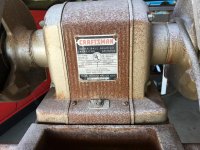
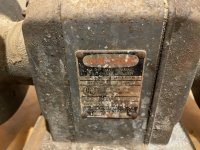
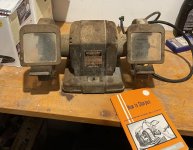
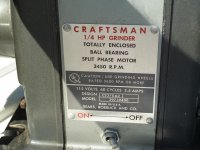
Picked up my first vintage Craftsman Grinder yesterday for $45. It's the basic 1/4 HP model 115.7561 (listed as "4.5 AMPS"). The power switch is the horizontal toggle style.

label.jpg

It is dated "3.54" so March 1954.

IMG_5038.jpg

It's dirty but doesn't seem too rusty. This is my first USA made grinder after owning some imports. The motor is amazingly quiet.

I think the only missing parts are the housing endcaps.

I think it will clean up well.

As a bonus, it came with a Craftsman "How to Sharpen" manual that looks like it could have been printed yesterday.

IMG_5037.jpg
 

Attachments

  • IMG_5037.jpg
    IMG_5037.jpg
    150.9 KB · Views: 40
  • IMG_5038.jpg
    IMG_5038.jpg
    156.6 KB · Views: 37
  • label.jpg
    label.jpg
    152.6 KB · Views: 46
OP
E

exmaxima1

Well-known member
Joined
Jun 25, 2011
Messages
6,339
Location
Midwest
Picked up my first vintage Craftsman Grinder yesterday for $45. It's the basic 1/4 HP model 115.7561 (listed as "4.5 AMPS"). The power switch is the horizontal toggle style.

I think the only missing parts are the housing endcaps.

I have never seen a 1/4hp model with end caps, even in catalogs. I doubt you will find them as well.
 

torqueman2002

Well-known member
Joined
Jun 3, 2009
Messages
6,138
Location
SE Michigan
I have never seen a 1/4hp model with end caps, even in catalogs. I doubt you will find them as well.
I agree.

The 1/4-HP wheel guards have the same bolt bosses as the 1/3-hp - but they are not tapped for the cover screws.

It's feasible that the 1/4-Wheel Guards could be drilled & tapped, IF covers can be obtained. :thumbup:

attachment.php


OK, I stand corrected. There are 1/4-HP pre-Blocks with wheel guard covers. Model 397.19400.
attachment.php


attachment.php
 

Attachments

  • P1070943.jpg
    P1070943.jpg
    149.3 KB · Views: 80
  • P1070942.jpg
    P1070942.jpg
    146.9 KB · Views: 207
  • P1000338.jpg
    P1000338.jpg
    147.2 KB · Views: 629
  • P1000336.jpg
    P1000336.jpg
    152.5 KB · Views: 623
Last edited:

WMichelsen

Well-known member
Joined
Nov 24, 2012
Messages
64
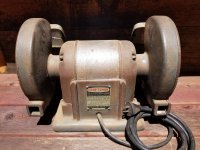
Some time ago I picked up one of the old art-deco cast iron Craftsman grinders 115.6965. I believe it is all original, mostly complete, and in very good condition considering it's age and amount of use.

It's clearly had some grinding hours put on it:
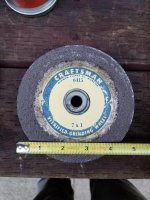
The 7x1 course stone is ground down to 5x1
The fine stone had been replaced by a wire wheel. Took a bunch of time for a wire wheel to grind the tool rest away like that.

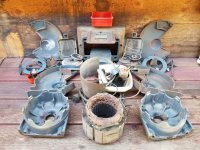
Now, I'm doing a complete tear-down and restore.
 

Attachments

  • 20210502_123248.jpg
    20210502_123248.jpg
    148 KB · Views: 30
  • 20210502_123612.jpg
    20210502_123612.jpg
    149.3 KB · Views: 28
  • 20210502_183011.jpg
    20210502_183011.jpg
    118.8 KB · Views: 25
  • 20210505_153513.jpg
    20210505_153513.jpg
    120.2 KB · Views: 23
  • 20210502_162628.jpg
    20210502_162628.jpg
    154.3 KB · Views: 31

WMichelsen

Well-known member
Joined
Nov 24, 2012
Messages
64
I have a couple issues to pass by you all:

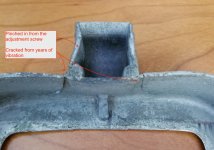
1. The eye shield frames have cracks and bent near the mount point. The part is not well engineered for the vibration and loads here. Seems to be made of pot-metal. Any ideas how to repair the cracks and unbend the mount without breaking?

2. After cleaning the ID plates (not sure I can get them any better), do you add a clear coat to them? Or leave them bare?

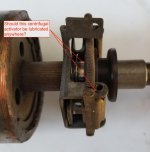
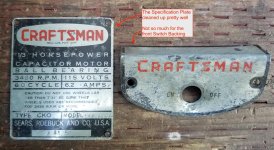
3. Should I apply any kind of lubricant to the centrifugal switch components on the rotor?

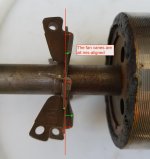
4. The fan fins are longitudinally kinda non-aligned. I don't think the case has ever been opened, so this must be original. Would you straighten them out?

5. I like the way Frank replaced the bulb socket wiring. I think I'll do the same.

6. Polling question: Original paint color or not? This grinder needs new paint. I understand it's my machine and my choice. Here's my problem: I'm trying to do a pretty detailed restoration, where possible back to original. But, I've never liked the WWII era "Craftsman Gray" (grayish-blue) paint. So, repaint to original color? Or, don't worry and move on?

7. BTW, what's the difference between 115.6965 and 115.7397 ?
 

Attachments

  • 20210505_154020.jpg
    20210505_154020.jpg
    77.5 KB · Views: 31
  • 20210505_184017.jpg
    20210505_184017.jpg
    156.2 KB · Views: 29
  • 20210503_115127.jpg
    20210503_115127.jpg
    148.8 KB · Views: 29
  • 20210505_154012.jpg
    20210505_154012.jpg
    69.1 KB · Views: 34

WMichelsen

Well-known member
Joined
Nov 24, 2012
Messages
64
BTW, I have read lots of the posts looking for information and past approaches. I may have missed stuff, but I'm not just tossing questions out there for lack of research. I try to be a good forum participant. :)
 

Old Radar

Well-known member
Joined
Apr 17, 2019
Messages
2,754
Location
San Antonio, TX
I have a couple issues to pass by you all:

1. The eye shield frames have cracks and bent near the mount point. The part is not well engineered for the vibration and loads here. Seems to be made of pot-metal. Any ideas how to repair the cracks and unbend the mount without breaking?

2. After cleaning the ID plates (not sure I can get them any better), do you add a clear coat to them? Or leave them bare?

3. Should I apply any kind of lubricant to the centrifugal switch components on the rotor?

4. The fan fins are longitudinally kinda non-aligned. I don't think the case has ever been opened, so this must be original. Would you straighten them out?

5. I like the way Frank replaced the bulb socket wiring. I think I'll do the same.

6. Polling question: Original paint color or not? This grinder needs new paint. I understand it's my machine and my choice. Here's my problem: I'm trying to do a pretty detailed restoration, where possible back to original. But, I've never liked the WWII era "Craftsman Gray" (grayish-blue) paint. So, repaint to original color? Or, don't worry and move on?

7. BTW, what's the difference between 115.6965 and 115.7397 ?

Nice old grinder!

Here are my opinions and suggestions—don’t take any as gospel.

1. I don’t know of any good way to repair pot metal—is it aluminum? You may be able to stabilize the cracks with JB Weld. If there is room in the area that has been pinched I would suggest inserting a firm rubber washer against each wall to reduce vibration and hopefully, further deformation. To reduce vibration further I would seriously recommend installing rubber feet.

2. Since the Spec plate is out of the line of fire, I would lean toward not clear coating it. The On-Off switch plate shows the results of being in the direct line of fire so I would clear coat that one.

3. I’m no help on lubes.

4. If the blades show no evidence of intentional or accidental bending, i.e., they were designed that way, I wouldn’t try to “improve” them.

6. Although I’m normally a fan of original color, I’m not a fan of Gray. Since this grinder is not museum-bound, if it were mine, I’d paint it a color that actually appealed to me.

7. Here’s the spec sheet for the 115.7397 I found on Vintage Machinery—including a parts list. Maybe you can find the differences between the two by looking at this.
http://vintagemachinery.org/pubs/detail.aspx?id=4472

Good Luck with the restoration!
 

WMichelsen

Well-known member
Joined
Nov 24, 2012
Messages
64
Thanks for your suggestions.
JB Weld is probably an option. I don't know how to tell if it's aluminum or pot-metal or what. I just know it's not ferrous.
 

lucasd2002

Well-known member
Joined
Jan 29, 2008
Messages
67
Location
ATL-ish
What is the correct method for removing the "wheel spacers" (4 in the drawing below)?

parts_exploded1of2.jpg

I have already removed the wheel guards (7, 41) but the wheel spacers (4) are preventing removal of the end caps (12). Each wheel spacer will spin on the shaft and move a short distance along the shaft but it seems like there is a groove in the shaft for holding the spacers in position. I tried to search for similar problems, but most of the posts I found were about bearing removal.
 

Attachments

  • parts_exploded1of2.jpg
    parts_exploded1of2.jpg
    113.6 KB · Views: 39
  • parts_exploded2of2.jpg
    parts_exploded2of2.jpg
    142.1 KB · Views: 42

torqueman2002

Well-known member
Joined
Jun 3, 2009
Messages
6,138
Location
SE Michigan
See my comments in RED.
...

3. Should I apply any kind of lubricant to the centrifugal switch components on the rotor? ....
The centrifugal switches I have seen did not have lubrication. If it operates smoothly, I'd leave it as is, if it is 'sticky' a light burnishing with emery cloth is what I would try.

What is the correct method for removing the "wheel spacers" (4 in the drawing below)? ....
I have encountered this. Try lightly smoothing the arbor shaft from the point where the spacers become stuck. There is likely a small ridge from years of use, you just want to lightly remove it. Of course, don't force it.
:thumbup:
 

Bro-Dozer

Well-known member
Joined
Aug 27, 2016
Messages
50
So why not bring this zombie thread back to life?

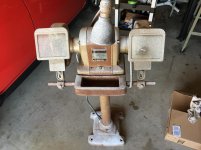
What do you think of this January 1954 build pre-block? How about for $20? :)
 

Attachments

  • first.jpg
    first.jpg
    102.2 KB · Views: 30

bcschief

Well-known member
Joined
Oct 29, 2014
Messages
498
Location
Crescent City Florida
I have a couple issues to pass by you all:

1. The eye shield frames have cracks and bent near the mount point. The part is not well engineered for the vibration and loads here. Seems to be made of pot-metal. Any ideas how to repair the cracks and unbend the mount without breaking?

2. After cleaning the ID plates (not sure I can get them any better), do you add a clear coat to them? Or leave them bare?

3. Should I apply any kind of lubricant to the centrifugal switch components on the rotor?

4. The fan fins are longitudinally kinda non-aligned. I don't think the case has ever been opened, so this must be original. Would you straighten them out?

5. I like the way Frank replaced the bulb socket wiring. I think I'll do the same.

6. Polling question: Original paint color or not? This grinder needs new paint. I understand it's my machine and my choice. Here's my problem: I'm trying to do a pretty detailed restoration, where possible back to original. But, I've never liked the WWII era "Craftsman Gray" (grayish-blue) paint. So, repaint to original color? Or, don't worry and move on?

7. BTW, what's the difference between 115.6965 and 115.7397 ?
How about this to repair your cracked parts https://www.alumaloy.com/
 
To avoid these ads, REGISTER NOW!
Top Bottom