OP
canuck coupe
Member
You shouldn't be lifting / jacking from the bottom of the pinch welds. They're not designed for that and can crush.
You're right. Pinch welds are not designed for lifting without adapters.
But this is not my first rodeo.
I own 4 floor jacks, 6 bottle jacks, and the Quickjack.
I've been lifting on pinch welds for decades. Sometimes with a piece of wood, sometimes with nothing.
The rubber lifting blocks from Quickjack deform readily and, compared to the other things I've used (or not used) to "protect" the welds, they are the least likely to be a problem.
The only reason to be concerned about crushing the pinch welds is that the OEM scissor jack might not fit. The last time I needed to use one of those was 40 years and about 400,000 miles ago. I'll take my chances.

As the jack goes up it moves forward at all points so does the car move forward to compensate for a difference? Is the car free to roll as the jack comes up? Maybe that is the problem with a pinch weld. If the weld stays at one point and the jack moves forward past that point something has to give.
Yes, the Quickjack lifts in an arc. By the time it has achieved full lift, the car will have moved about 10 inches. But once the blocks make contact with the pinch welds, they stay there. It takes a bit of guesswork to position the blocks on the jack prior to lifting since the lift moves up and forward (or back if you are working from the front of the car. I work from the back). You have to lift the jack until the blocks make first contact, then go around to check that all four blocks are on the designated lifting points on the pinch welds.
I have had a Quickjack for a few years now and used it quite a bit. The car on it most of the time is a unibody with pinch welds that are made for lifting. I use both the regular blocks and the pinch weld blocks. There is really no difference between them in my application - neither is safer than the other and honestly, the regular block does a better job at ensuring the full force is on the pinch weld and not up higher on the body. Don't let anyone tell you not to use the pinch welds, they likely just don't have the experience with a car that was designed that way.
I agree. I think the only advantage of blocks with grooves for the pinch welds is that they ensure the block is centered on the pinch weld.
Keep in mind that the blocks DO NOT need to be parallel to the car.
I agree again. Until a day or two ago, I had thought that the issue was a block that was toed out. I'm now thinking that it's not having the block at an angle that matters, it's having the block not centered on the weld that matters. If the weight of the car compresses the block on one side (in my case, the inside), a small lateral force would be induced. Normally, it wouldn't matter, but combined with slippery floors, it's an issue.
As some of the others mentioned I think it's an issue with the frames not being parallel. One other outside chance... is there any way that you accidentally had one frame facing one way and the other facing the opposite way?
The jacks were parallel. I center the blocks in the trays on the jack, then center the entire apparatus on the pinch welds.
It's impossible to have one jack lifting one way and the other jack lifting the other way, because there isn't enough hydraulic hose to reach.
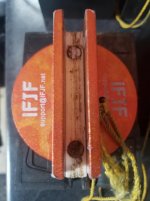
Looking at the photos of the blocks I think there may be an interesting clue. There should be ONE indentation in the block from the pinch weld. But instead we're seeing multiple. This could just be multiple layers of metal that make up your pinch weld.
It took me while to figure that out. There are indeed three layers at the lifting points: two layers of body sheet metal plus a thicker reinforcing layer. They are not spread as far apart as the indentations on the block. The actual layers are separated by a millimeter or so. On the block, it looks like 3 times that. I think that's due to the compression. The indentations were made at full compression. As the block decompressed, the lines spread apart like letters on an expanding balloon.
A combination of two things caused this....... A "slick" Race Deck floor and Blocks NOT "centered" properly on the lift pushing down on the lift and creating a lateral force on the inside load point that most likely created lifting on the outside of the QJ on the slick floor therefore pushing the entire assembly from out of the car.
Thank You OP for posting this problem and hopefully everyone with a QJ reads it and takes the time to TRIPLE check everything before they get under their car.
Yes! The incident was a combination of 1) a block not being centered and 2) slippery garage tiles.
Meanwhile, I did some tests to see how much force is required to move a Quickjack across my garage tiles unmodified and with rubber feet.
With no weight on the jack: 11 lbs unmodified and 21 lbs with rubber feet.
With 200 lbs on the jack: 42 lbs unmodified and 88 lbs with rubber feet.
With 400 lbs: 73 lbs unmodified and beyond the limit of my measuring device (100 lbs) with rubber.
Story and pics here:
https://www.myg37.com/forums/g37-sedan/298456-quickjack-cautionary-tale.html
What do these numbers tell us? I'm not sure yet.
 I intend to apply my rudimentary mathematics skills in an attempt to prove my theory about how this could happen.
I'll get back to you.
Last edited: