To avoid these ads, REGISTER NOW!

Radiant Hydronic Tuning Tips...?

Holeshot

Active member
Joined
Aug 6, 2007
Messages
30
Location
Eaton County, MI
Here's a few tidbits about the garage:
Attached, stick-built structure 32'x40'x13.5'
4" slab
6 loops of 1/2" oxygen barrier PEX (~1200' total)...probably should have done 4 loops...
PEX was Malco stapled to 2" 25 PSI EPS insulation under the slab
There is also 2" EPS around the perimeter of the slab where it meets the foundation/frost walls.
R15 fiberglass in the walls and I will be blowing 12-18" of celluose in the attic very soon.
Columbia County, WI - it's chilly in the winter to say the least.

Heat source:
Takagi T-H3M-DV-P
15k-120k modulating, condensing and rated for space heating

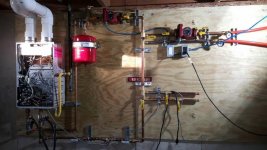
Primary/secondary loop:
Two Grundfos 15-58FC circulators
Type-L copper throughout
Webstone primary/secondary purge valves
Webstone flange valves
3/4" Spirovent
Amtrol RX-15
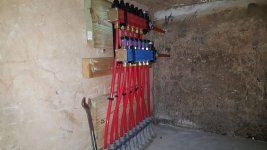
Embassy manifolds (bought these way back in 2008 on a friend's recommendation)

Very rough heat loss calcs were between 45-75k BTU.
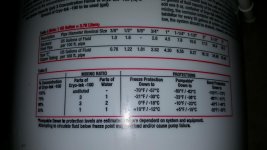
I have 60% Cryo-Tek -100 glycol in the system because I travel for work fairly regularly and can't risk letting it freeze/burst if we lose power or system malfunctions.

I first fired it about a week ago and let it run for a while with the Takagi set to temps between 100-115°F. As expected, it took forever and a day (4-6 hours?) to bring the return temps from ~40°F to 70°F.

With the Webstone purge tee/valve open, I had a hard time getting the supply temp to 80°F. With it closed (as seen in the picture), the supply to the loops is very close to the output temp of the Takagi.

Second Webstone purge tee was added for future use, but with the return temp of the floor overwhelming the primary loop, I'm not sure how viable this will be.

I've tried running both 15-58FC's on all 3 speeds...the maximum flow with both on 'High' as reported on the Takagi's readout is ~2.4 GPM. With the Webstone purge tee/valve open, it drops to about 1.8 GPM. I'm not sure how accurate this flow meter is, nor am I familiar with what kind of flow I should be seeing in the primary loop.

What am I doing wrong? :eek:
What do you guys typically run for supply temp?
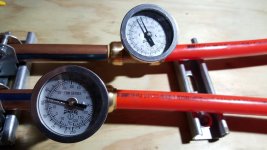
I'm getting fairly consistent ΔT of ~20°F

The slab will get very slightly warm to the touch after running many hours...perhaps I just need to let it run longer...?

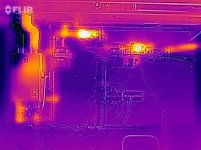
Note: thermal image was taken not long after system was fired off and with the Takagi set to 100°F...it was modulated very low...draft inducer speed and burner changes instantly on demand.

Many thanks in advance for your assistance!

Beers,

Matt
 

Attachments
  • RadiantPanel.jpg
    RadiantPanel.jpg
    57.1 KB · Views: 195
  • EmbassyManifolds.jpg
    EmbassyManifolds.jpg
    78.1 KB · Views: 170
  • FLIR00841.jpg
    FLIR00841.jpg
    41.7 KB · Views: 146
Last edited:
To avoid these ads, REGISTER NOW!

Rookie2

Well-known member
Joined
Feb 27, 2013
Messages
1,925
Location
Western Pa.
I'm not familiar with the Webstone purge tee/valve, but i would start by closing the valve 1/2 way. I have a 180k boiler with a primary loop that I control the temperature in , then the floor pump extracts and returns 12" down stream (those look 3-4" apart. I try to control the return flow to keep around a 40 deg differential . It takes 1-2 days to bring 2500 sq ft. of 5" concrete up to 55 deg if I wait till It's cold outside. The boilers I've helped install all had short primary loops with a homemade (Webstone purge tee/valve) type transition 12" or less.
IT appears to be acting as a single loop.


Someone else will be of more help I'm sure.
 

kj_mustang

Well-known member
Joined
Feb 9, 2011
Messages
1,213
Location
Harrisonburg, VA
My pole barn is similar setup to yours, 32' x 52' about 1500' of pex, same pump. I have more insulation in the walls and ceiling so my calc was only 22,000 btu. Loop cad designed my system for a 2 gpm flow with 105° supply and 20° delta. At start up, I ran the pump on high for several hours to bring the water up to temperature.
 

pstnbly

Well-known member
Joined
Jul 20, 2010
Messages
766
Location
So. Vermont
My shop floor is 1700' of 6" slab. Calculations put it as 167,000btus per 1 degree of heat rise. Just to put things in perspective.
 

kabinenroller

Well-known member
Joined
Sep 14, 2013
Messages
897
Location
S.E. Wisconsin USA
First off the floor should not feel warm to the touch except near the heat source where the supply tubes exit the manifold. Your hand is at body temp. (98.6) the floor would have to be hotter for you to feel it warm.
Also, your GPM is too low. My system pushes about 4.7 GPM, have you cleaned the micro filter on the "Y" fitting on the heater outlet?
My heater is set at 110 degrees, and has no problem heating my 1600 sq.ft. Shop with 1,800' of PEX in 6 even loops.
 

UpstateNY

Well-known member
Joined
Jan 2, 2012
Messages
662
My pole barn is similar setup to yours, 32' x 52' about 1500' of pex, same pump. I have more insulation in the walls and ceiling so my calc was only 22,000 btu. Loop cad designed my system for a 2 gpm flow with 105° supply and 20° delta. At start up, I ran the pump on high for several hours to bring the water up to temperature.

18K BTU, 3' of cellulose in the ceiling, 6" bats in walls, 90° supply and 20° delta, 3 GPM. I use a dedicated 40 gallon water heater for heat source, 95 % efficiency. It's a VERY efficient system. All of my research told me to stay away from on-demand heaters due to their lousy efficiency. 50K BTU's for an hour per 1.2 degree of rise. My $.02.
 
Last edited:

Rookie2

Well-known member
Joined
Feb 27, 2013
Messages
1,925
Location
Western Pa.
It takes awhile to get all the air out of the system, make sure you top off the fluid seeral times .
 

Mr onetwo

Well-known member
Joined
Apr 6, 2011
Messages
2,005
Location
Coastal Maine
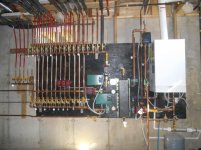
Just my opinion after 30 years in the business....use on-demand heaters for DHW and use boilers for in-floor heating. When using primary/secondary pumping you don't regulate the primary loop...you want as much flow as possible.Did you run the glycol straight (no water) or did you add additional water to thin it out.I am not sure what the 60% description meant. Pumping glycol is very difficult and really hurts pump and system efficiency.You should not care about "freeze" rating....only "burst" or "slush" rating.I think you may have a problem moving the glycol thru the tiny passages in the Takagi.I would start by re-piping your primary loop with a Viessmann low loss header and a high head pump. Then maybe try thinning your glycol mix.I also think your primary loop pipe size is too small....should be a minimum of 1", but 1 1/4" would be ideal.
 

Attachments

  • 8124_400_400.jpg
    8124_400_400.jpg
    103.1 KB · Views: 77
  • Appleton Boiler-final 005.jpg
    Appleton Boiler-final 005.jpg
    141 KB · Views: 130
Last edited:
OP
H

Holeshot

Active member
Joined
Aug 6, 2007
Messages
30
Location
Eaton County, MI
Excellent info, guys - thank you!

I'm seeing some conflicting information.
Some are setting the heat source to a lower temp and having good results, while others have it set higher.

After I started this thread, I ran the system for several hours with the purge tee closed and the heat source set to 140. The supply temp went up to about 135 (supply temp to the manifold closely matching the heat source, which it never does with the purge valve open...) and I had a return temp of 74. This was a huge delta-T...much different than the 20-25 degres when I had the purge tee open and heat source set lower.

For those with primary/secondary loops:
If your heat source is set to say 140, what is your supply temp to the floor? What is your return temp from the floor?

Despite our nominal body temperature of 98.6 (mine is routinely 96), the sense of touch is able to discern the difference between 40 degrees and 70. 70 feels 'warm' when compared to 40. Sorry for any confusion.

I could have sworn that I read somewhere that folks are seeing slab surface temps of around 80...so that is what I expected after running the system for 6 hours or so...but after reading replies to this thread, it could take a day or two for the slab to feel 'warm'.

While I'm no expert, the Takagi (92% AFUE) seems to be quite efficient. There is almost zero steam exiting the flue at any firing rate and the flue temp is quite low. It makes gallons of condensate. It's putting the heat into the loop, otherwise it would be going out the flue or the cabinet it's housed in would be hot as hell. Right?

I have a mix of 10 gallons of Cryo-Tek 100 glycol and 7 gallons of water in the system...that includes the 3 gallons remaining in the bucket I used to fill/purge. I have seen overnight ambient temps of -25 (without the windchill) for a few weeks every winter since I moved to WI, so that is why I set the glycol concentration for a burst protection of -40.

For fill/purge, I started out with a drill pump and quickly abandoned it...now I have a 1/2 HP Wayne PC4...which may be overkill. I completed two purge sessions with the PC4, each time it ran for 45-60 minutes. I started out with a lot of bubbles and foam and ended with clear, turbulent circulation in the bucket.

With regard to purging, I hear a slight swishing sound when the circulators first fire off, but once they're running...its damn near silent. My only prior hydronic experience is from growing up in MA with baseboads and oil burner fired boilers...once that burner fires, you can't hear much of anything...so I'm not sure if what I'm hearing with this system is normal or abnormal. I have heard a system with air in it before...mine does not sound like that.

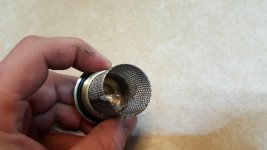
I will check the screens. The Takagi has one at the inlet and I also installed one in the primary loop. Perhaps there is solder, copper filings or other debris in there.

If I have to abandon the primary/secondary setup and run it with the purge tee closed, I won't be terribly upset...but it will bother me.

With the purge tee closed, it acts like one big loop instead of two...is it OK for one Grundfos 15-58 to pump into another?

Thanks again for your insight, guys!

My apologies for not responding directly and quoting previous replies...I'm thumbing this reply on my cell phone.

Beers,

Matt

Sent from my SM-N920P using Tapatalk
 

Jackfre

Well-known member
Joined
Dec 26, 2010
Messages
4,406
Location
N CA
On commissioning any system it is a good idea to clean the loops, meaning pump the hell out of them with a system cleaner. Noble Noburst Hydronic System Cleaner, Fernox F3 or Rhomar Hydro-Solv 9100. Isolate the Takagi when cleaning. You don't want to pump that mix through your water heater.

I think you are way over on your mix of anti-freeze. You are trying to pump glue. You have chosen the option of "no possibility of freezing" vs buying some time to get some repairs made. With a warm slab you do have time to get help. Get a wireless stat that you can see the temp in the place while you are traveling.

Firing rates on all tankless water heaters, which is what you have, are based upon GPM x Delta T X 500= BTU. Push the numbers around a bit and you will see you are, once the system is up to temp running at very low firing rates.

I would recommend a Caleffi low loss header.
 
OP
H

Holeshot

Active member
Joined
Aug 6, 2007
Messages
30
Location
Eaton County, MI
Good note on the system cleaner.

There may be periods of time when I'm gone for upwards of 3 weeks. If the system had a failure, Murphy's Law dictates that it would occur in the dead of a cold snap while I'm away. Power outages are also a possibility out here...and with reduced population density, we are surely not a priority in a big outage.

I would have much rather filled with water and saved $170...but for burst protection below any anticipated worst case ambient temp, 60% is needed. The original Cryo-Tek (blue stuff) would have required an even higher concentration.

I took a few pics showing the debris I found in the Takagi strainer as well as the additional strainer I plumbed into the primary loop just before the 'cold' inlet...I will add them later.

Thanks again for the input!

Beers,

Matt

...sent via mobile device (Tapatalk).
 
OP
H

Holeshot

Active member
Joined
Aug 6, 2007
Messages
30
Location
Eaton County, MI
With both circulators set on high, the flow through the tankless is now 2.2 - 2.4 GPM with the purge tee closed.

The debris in the tankless inlet screen was not helping matters. There wasn't much in the brass strainer I plumbed in.

...sent via mobile device (Tapatalk).
 

JCByrd24

Well-known member
Joined
Jul 21, 2005
Messages
493
Location
Bath, ME
You didn't mention any under slab insulation did you? If you don't have it you're pumping a bunch of heat right into the ground, especially on start up.
 

finn

Well-known member
Joined
Mar 27, 2005
Messages
16,203
Location
The UP, God's country
Your high antifreeze concentration is aggravating two things: first, the high viscosity is reducing flow through the system, especially critical in your case since the heater has small passages and low flow itself.

Second, antifreeze has poor heat transfer capacity compared to water.

It's sort of a double whammy in your system as you describe it, although in your case the high delta T indicates very low flown, or the slab simply has very high mass and needs a bigger boiler, more flow, or more time to reach equilibrium.

Your location in south central Wisconsin is unlikely to ever see sustained temperatures of -40. Even-20 temperatures rarely last more than a couple of days, and remember, that slab is starting at, say 50 degrees and the earth beneath your slab is warm too. I'd target slush initiation at somewhere around -15 or -20.


Also, buy a good insurance policy.
 
OP
H

Holeshot

Active member
Joined
Aug 6, 2007
Messages
30
Location
Eaton County, MI
I have 2" of 25 PSI EPS (Owens Corning Foamular 250) under the 4" slab and around the entire perimeter where it meets the frost walls / foundation. 1/2" oxygen barrier PEX is stapled to the EPS.

I can definitely reduce the glycol concentration...that's fairly easy to do. I agree that we rarely see -40 and the extreme cold temps (where it struggles to reach -5 during the day...without the windchill) only last a few weeks to a month.

I do indeed have good homeowners insurance, but I sort of thought the glycol would be my insurance for the system. :) I'd like to avoid making a claim. Afterall, the install was all done by me and the first reaction of any insurance claim is to avoid full payout for any number of reasons.

I haven't had a definitive need for heat in the garage for years (garage was built in 2008), but I'm trying to keep the water in my new CNC plasma table from freezing. It too has a thermostatically controlled submersible heater in the water tank...I like to cover my **** whenever possible.

2.x GPM doesn't sound like anywhere near enough when you consider that the heat loss calcs call for a little over 6 GPM.

Should I be seeing 6 GPM at the water heater?

Thanks again, guys!

Beers,

Matt

...sent via mobile device (Tapatalk).
 
To avoid these ads, REGISTER NOW!

Jackfre

Well-known member
Joined
Dec 26, 2010
Messages
4,406
Location
N CA
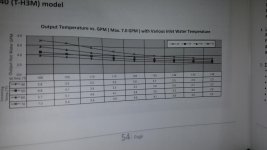
The flow chart is typical of tankless manuf. At 2.3 gpm x say a 20* delta T x500 =23,000 btu input. That is it. You may get a higher DT on a cold slab, but you need to get your flow rate up to get any more btu input into the slab.
 
OP
H

Holeshot

Active member
Joined
Aug 6, 2007
Messages
30
Location
Eaton County, MI
That makes sense.

After I cleaned the screens and filled/purged the system, I fired it up. Return temp was about 42...now it's 70...after 6 hours with the purge tee closed and heat source set to 110.

Both 15-58FC's are on high...2.0 GPM as indicated by the Takagi.

I just measured the surface of the slab with an IR thermometer. There is a big range in temp...from 50 to 73...the highest near where the PEX exits/enters the slab.

Man, this glycol is really hurting me WAY more than I expected.

...sent via mobile device (Tapatalk).
 

Attachments

  • uploadfromtaptalk1449456980198.jpg
    uploadfromtaptalk1449456980198.jpg
    136.3 KB · Views: 42

UpstateNY

Well-known member
Joined
Jan 2, 2012
Messages
662
The flow chart is typical of tankless manuf. At 2.3 gpm x say a 20* delta T x500 =23,000 btu input. That is it. You may get a higher DT on a cold slab, but you need to get your flow rate up to get any more btu input into the slab.

Jackfre,


In this equation: At 2.3 gpm x say a 20* delta T x500 =23,000 btu input. Where does the 500 value come from ?
 

UpstateNY

Well-known member
Joined
Jan 2, 2012
Messages
662
Holeshot,

Why do you have Two Grundfos 15-58FC circulators ? I understand the pre/sec loop thing, but you could've done the design with 1 pump. Is it for redundancy ? But if it's for redundancy, I assume if 1 pump fails i.e. the motor burns out, the other pump could still turn the impeller of the other pump, that is you could still flow water thru the system ? If a failure scenario occurs in a given pump wherein the impeller won't turn, you're screwed. 2 pumps in parallel for redundancy I get, but in series, I don't get it.
 
OP
H

Holeshot

Active member
Joined
Aug 6, 2007
Messages
30
Location
Eaton County, MI
I modeled my system based on a few primary/secondary loop systems...including one that is commercially available as a pre-made panel.

I've never seen a primary/secondary loop setup with only one pump...

...sent via mobile device (Tapatalk).
 

UpstateNY

Well-known member
Joined
Jan 2, 2012
Messages
662
I modeled my system based on a few primary/secondary loop systems...including one that is commercially available as a pre-made panel.

I've never seen a primary/secondary loop setup with only one pump...

...sent via mobile device (Tapatalk).

I phrased my question incorrectly perhaps. What is the purpose of a pri/sec loop system using 2 pumps ?

I have the same setup as you, with 1 pump, and it does all I need it to do: it heats the floor, can run the system in primary mode closing valves, can purge air out of the system, can add fluid to the system. It all depends how you connects the pump, pipes and valves. Like you, I just copied a system, I'm no expert, but mine only uses 1 pump, 2 in parallel if I wanted redundancy and/or more flow. It seems to me the setup you copied just adds another point of failure. I just don't see where your set up has any advantage over a single pump system. I fully realize you're not going to change it now, my question is more academic. No reply necessary, just my $.02.
 
OP
H

Holeshot

Active member
Joined
Aug 6, 2007
Messages
30
Location
Eaton County, MI
My two pump system (in theory) allows for a second future zone that feeds from and flows into the primary loop without the use of motorized zone valves or mixing valves.

The 15-58FC'S are $89 and then there's probably $50 total in Webstone flanges with ball valves involved per pump. The purge tees were about $40 a pop.

I could have saved some time and money, but wanted to plan for future use. In theory, this system is capable of easy expansion... :)

Beers,

Matt

...sent via mobile device (Tapatalk).
 
OP
H

Holeshot

Active member
Joined
Aug 6, 2007
Messages
30
Location
Eaton County, MI
Well...I drained 10 gallons of the glycol/water mix (60% glycol) and added 10 gallons of straight water.

With the purge valve closed and both pumps set on high I'm now seeing 2.6 GPM at the Takagi.

The added water and reduced glycol concentration provided about 0.3 GPM gain.

I don't have a way to graph or accurately record the delta-T over time, but it seems like the return temp from the floor is raising faster than before.

...sent via mobile device (Tapatalk).
 

Radix2

Well-known member
Joined
May 28, 2014
Messages
1,853
Location
the thumb!, MI
I phrased my question incorrectly perhaps. What is the purpose of a pri/sec loop system using 2 pumps ?

I have the same setup as you, with 1 pump, and it does all I need it to do: it heats the floor, can run the system in primary mode closing valves, can purge air out of the system, can add fluid to the system. It all depends how you connects the pump, pipes and valves. Like you, I just copied a system, I'm no expert, but mine only uses 1 pump, 2 in parallel if I wanted redundancy and/or more flow. It seems to me the setup you copied just adds another point of failure. I just don't see where your set up has any advantage over a single pump system. I fully realize you're not going to change it now, my question is more academic. No reply necessary, just my $.02.

You are missing the purposes of primary-secondary piping system design.

The primary loop allows decoupling of the flow rates and to some extent the delta t that the heating loops and the boiler see. As is the case here, some boilers have small passages inside them which causes a lot of pressure drop - so much so that it is simply impractical to pump all of the water in the system through the boiler in a series flow. The primary loop allows a small low restriction loop to get the flow required (to get the BTUs required - realize that flow x delta T x a constant is BTUs out) . The secondary loops can then be designed independently for flow and pressure drop to properly serve the radiation (floor loops).

Part of the issue here is that on-demand water heaters are designed to move a fairly small amount of water at a high delta T - cold ground water in, 50-70 degree delt T out - and pushed by a 40-60 PSi water source - so the flow characteristics are poor for a direct floor heating loop - which wants a low pressure drop, low delta T and a high flow rate to move the BTUs. The primary-secondary loop is away to achieve this.
 

Radix2

Well-known member
Joined
May 28, 2014
Messages
1,853
Location
the thumb!, MI
Well...I drained 10 gallons of the glycol/water mix (60% glycol) and added 10 gallons of straight water.

With the purge valve closed and both pumps set on high I'm now seeing 2.6 GPM at the Takagi.

The added water and reduced glycol concentration provided about 0.3 GPM gain.

I don't have a way to graph or accurately record the delta-T over time, but it seems like the return temp from the floor is raising faster than before.

...sent via mobile device (Tapatalk).

It is simple math that the BTU output of your heater is the flow times the delta T - so the more you can move through the more heat you will get. What is the size of your primary piping ? If you want the full output of your heater, you really need to be able to move the required water in the primary loop. You are stuck with the restriction in the heater (getting any crud out was essential), so the only levers you have are pump size and your primary loop pipe restrictions. Once you get that right, then you can juice the loop flows to get the delta T that you want. If the primary loop doesn't have the BTUs there is nowhere for the floor loops to get them.
 
OP
H

Holeshot

Active member
Joined
Aug 6, 2007
Messages
30
Location
Eaton County, MI
I purged the heck out of the system using two different locations for feed/return.

I also cleaned the screen in the Takagi...again...now I'm seeing 3.5 GPM.

Progress!

...sent via mobile device (Tapatalk).
 
OP
H

Holeshot

Active member
Joined
Aug 6, 2007
Messages
30
Location
Eaton County, MI
System is now filled with 100% water.

I did not like the cloudy appearance of the glycol/water mix at the lower concentration, so I filled and purged until the water ran clear and then ran another 15 gallons through.

3.5 GPM with purge tee closed, 2.9 with it open.

In: 60°F
Out: 110°F
Delta-T: 50°F

3.5 x 50 x 500 = 87,500 BTU

Thanks again, guys...I think I'm making headway.

Beers,

Matt

...sent via mobile device (Tapatalk).
 

tdkkart

Well-known member
Joined
Jun 17, 2006
Messages
6,887
Location
Eastern Iowa
Now, turn your T-stat down. Unless you got some whining woman working in there you're never gonna need 70*, if you're working you'll be in short sleeves with it set to 60*.
At 60* ambient you'll typically need a floor surface temp of only 62-65* to maintain your set temp.
In the kind of weather we're having right now, with a 60* T-stat at nose level, my floor is 52* and my 12ft ceiling is 58*.

There's a lot of hockus-pockus going on in the hydronic heating world and most of it is BS. One guy says this, the other says that, one says 80*, the other says 100, one says 2 gallons/min, the other says 3. What it all comes down to is making btus of heat in one place and sending it to another where it's used up.

Look at it like a balloon full of air. The heat source blows it up, you send it to the floor where it shrinks down, it goes back to the source and gets blown back up again.
The guy that figures out how to do that in the most efficient way(the the least variance in the size of the balloon), wins.
 
OP
H

Holeshot

Active member
Joined
Aug 6, 2007
Messages
30
Location
Eaton County, MI
Now that is some great real world info right there...thank you! I've been wondering what I should be seeing for slab surface temps in relation to room ambient. Excellent info!

I was working out there this weekend hammering away on some steel and at 56°F (heat wasn't running), I was in short sleeves. Plenty comfy.

I still don't have a zone controller or a t-stat yet...I'm controlling my circulators with a wall switch for now since I'm still in the testing phase.

What do you like for a temperature setting on your heat source?

Some say 140°, but I could have sworn I read here on the forum that it's not good to send that sort of temp out to the floor.

(I'm sending 106°F and returning 72°F as I type this...Takagi set to and outputting 110°F and showing 3.4 GPM.)

Thanks again!

Beers,

Matt
Now, turn your T-stat down. Unless you got some whining woman working in there you're never gonna need 70*, if you're working you'll be in short sleeves with it set to 60*.
At 60* ambient you'll typically need a floor surface temp of only 62-65* to maintain your set temp.
In the kind of weather we're having right now, with a 60* T-stat at nose level, my floor is 52* and my 12ft ceiling is 58*.

There's a lot of hockus-pockus going on in the hydronic heating world and most of it is BS. One guy says this, the other says that, one says 80*, the other says 100, one says 2 gallons/min, the other says 3. What it all comes down to is making btus of heat in one place and sending it to another where it's used up.

Look at it like a balloon full of air. The heat source blows it up, you send it to the floor where it shrinks down, it goes back to the source and gets blown back up again.
The guy that figures out how to do that in the most efficient way(the the least variance in the size of the balloon), wins.


...sent via mobile device (Tapatalk).
 

rburke65

Well-known member
Joined
Nov 10, 2007
Messages
12,349
Location
Canfield, Ohio
I have my pex tubing installed in my shop but as of now, no heat source. I read and read and I am by no means, know what I'm doing, but to the average guy on here....aka me.....this sure seems like rocket science. There are more opinions on here than there are members! Between all the opinions and the horror stories on the attempts of installing epoxy flooring and radiant heat, I'm almost content with my raw, cold floors here in Ohio.
 
Last edited:
OP
H

Holeshot

Active member
Joined
Aug 6, 2007
Messages
30
Location
Eaton County, MI
Between all the opinions and the horror stories on the attempts of installing epoxy flooring and radiant heat, I'm almost content with my raw, cold floors here in Ohio.

There are indeed a lot of opinions and facts. It takes a lot of reading to arrive at a solution...and even then, things change or it doesn't perform like you had hoped.

I read the warnings about not using anything but a real bone fide boiler, but then I started seeing how many folks are not using them and are happy as can be.

I must have been ignorant to all the warnings about glycol...but there are also folks without any issues running it. Everyone's situation is different enough that it can be hard to apply everything verbatim to your project.

Hell, I started out thinking I had to put 5/8" drywall everywhere in my garage. So I started burying Romex in the walls...luckily I didn't get very far.

Now I have corrugated steel on the ceiling and will do the same for the walls. ...and all of my electrical (I'm using 6x6 raceway) and compressed air will be surface mounted.

I appreciate the clean/hidden look, but I like the industrial look in a shop more...and upgrades or changes will be simple.

I also ran 5/8" OSB for the first 8' up the walls so I can sink a screw just about anywhere and hang whatever I want, wherever I want.

Since I was young, I've always been interested in and fascinated by HVAC...so this project, though time consuming and frustrating at times, is actually enjoyable for me in the end.

I sure could have hung a radiant tube or forced air unit and heated the space, but the warm floors are just awesome to walk around on. I've actually been wearing my usual wool/leather slippers and been quite comfortable.

There's also the reduced noise, no dust blowing around everywhere, energy savings (when installed and operating properly), etc.

To each his own, but I'll go hydronic whenever possible...and I'll be more than willing to help others in their efforts.

Supply: 106°F
Return: 75°F
Flow: 3.4 GPM
Floor surface: 52-60°F
Ambient: 56°F
Outdoor ambient: 36°F

Beers,

Matt

...sent via mobile device (Tapatalk).
 

tdkkart

Well-known member
Joined
Jun 17, 2006
Messages
6,887
Location
Eastern Iowa
What do you like for a temperature setting on your heat source?

Some say 140°, but I could have sworn I read here on the forum that it's not good to send that sort of temp out to the floor.


I send approx. 100* to the floor. I see no reason to send any warmer water to the floor when I only need a 60-64* floor

BTW, go to Dubuque, then 40 miles west, 20 miles south to my house.
 
OP
H

Holeshot

Active member
Joined
Aug 6, 2007
Messages
30
Location
Eaton County, MI
I send approx. 100* to the floor. I see no reason to send any warmer water to the floor when I only need a 60-64* floor

BTW, go to Dubuque, then 40 miles west, 20 miles south to my house.
Awesome info!
So far 110°F at the heat source and sending 106°F seems to be working well. The flexibility of being able to change this is nice...I'll likely mess with this more.

Small world. I know the area fairly well - I used to work at JD in Waterloo for a short while...lots of guys lived South of town.

...sent via mobile device (Tapatalk).
 

UpstateNY

Well-known member
Joined
Jan 2, 2012
Messages
662
You are missing the purposes of primary-secondary piping system design.

The primary loop allows decoupling of the flow rates and to some extent the delta t that the heating loops and the boiler see. As is the case here, some boilers have small passages inside them which causes a lot of pressure drop - so much so that it is simply impractical to pump all of the water in the system through the boiler in a series flow. The primary loop allows a small low restriction loop to get the flow required (to get the BTUs required - realize that flow x delta T x a constant is BTUs out) . The secondary loops can then be designed independently for flow and pressure drop to properly serve the radiation (floor loops).

Part of the issue here is that on-demand water heaters are designed to move a fairly small amount of water at a high delta T - cold ground water in, 50-70 degree delt T out - and pushed by a 40-60 PSi water source - so the flow characteristics are poor for a direct floor heating loop - which wants a low pressure drop, low delta T and a high flow rate to move the BTUs. The primary-secondary loop is away to achieve this.

Radix,

Thanks. Since I use a 40 gallon dedicated nat. gas water heater with glycol in my shop's radiant system, there are (virtually) no flow restrictions to my 5 loops. Hence, I'm able to use a single pump and get as much flow as the 3-speed pump will deliver.
 
To avoid these ads, REGISTER NOW!
Top Bottom