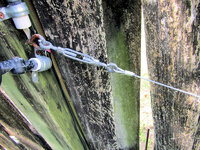
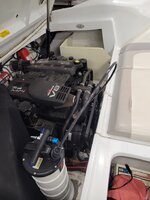
Justin if the loctite doesn’t cut it I’d suggest using nordloc washers. I think we talked about these before but regardless these are perfect for connections that get subject to high heat and stretch then relax. It keeps the darn bolt or nut in place.

www.northwestfastener.com
Thanks Cam, I don't think you shared those here. In this case the fasteners are flat head torx.
The one big downside to a custom setup...common repair parts.
You know...a big cube LS stroker swap would solve A LOT of these issues

...hell a GM 6L80E would bolt right up to a 454 or 8.1L based engine

...you Ford guys got it tough, but still better than the MOPAR camp!
Hard to argue but the Ford 7.3 godzilla is already stroked and bolts to my trans... It was not quite available or affordable when I started my 460 build.
The Holley injectors are 'LS' type but with different sized o-rings.
^^^Marc, THAT was the exact point I was trying to make in my thread earlier today about why my son chose to go with a stock remanned engine. Repairability as well as reliability are paramount on something that is driven long distances, especially to small out of the way places. I think somewhere in my son's 32 years now he was paying attention to my rants about such things when people would bring their broken toys to me to repair with very bespoke parts. There is nothing wrong with building custom one-off parts for race vehicles or toys that will be heavily inspected before and after various races and or trips. But add those parts to a daily driver or worse, a tow rig, and you have a recipe for walking.
I think I've told the story in my thread about how I learned my lesson back in the mid-80's when I had built up my first truck using many hi-performance parts and accessories. I had a Mallory distributor coupled with an MSD ignition box and during a wheeling trip to Moab with my buddy and his brother I developed a miss that ultimately ended up in a failed ignition system. After unsuccessfully locating the required parts in the big metropolis of Moab (keep in mind this is also mid-80's and not recent), I ended up buying a remanned HEI GM ignition and switching everything back over to OE setup to finish out the trip and eventually drive the 250 miles back home.
That learning opportunity, as stressful as it was, forged my way of thinking even to this day about such parts, when to use them and more importantly, when NOT to use them.
I been thinking along these lines recently. The particular group on last event all drive late model Toyotas. Can't argue with the dependability of those platforms. Lower power, small tires. You get there, maybe slower or stack more rocks, but get there and back home.
But for me that is just too boring I guess. I want something that cannot be bought. Big power, big tires, unique.
Although I have left my boat and 2014 F250 completely stock. So I'm kind of growing up.
I have been re-assessing what I want to do with the truck. The original intent wasn't to drive hundreds of miles to wheeling areas. More local places, home depot, drive to work. For that is checks all the boxes, it is my DD. But now I want to do the typical bucket list trails (Moab, Rubicon, Glamis ect) and all are long drives, and not trailer it. For this the old Ford is not ideal.
Most industries call it "MTBF" (Mean Time Before Failure) and they have run studies and done experiments to know what the average service life of their parts is. I am convinced that very few in the hot-rod parts industry even have an understanding of this.
A big thrust in my projects is to make the wear parts unmodified, common parts. It's the bits connecting them together that can be custom.
I failed at this with my recent rear disc brake conversion using Expedition parts as I had to modify the rotors to make them work at all. So I made 3 of them.
Yes the aftermarket auto industry doesn't have the quality standards or requirement that the OEM have. A single point failure is different than MTBF, it is like it sounds in that one part can bring down the whole system. In Nuclear safety world this is unacceptable and redundancy is required.
The chip company I work for sells to the big auto manufacturer suppliers (like Bosch, Mahle). We have MTBF reports and others for our chips. The suppliers all have a zero defect policy. Build a million, but if one fails for any reason, the root cause must be found and corrected. They send us the failed part or board and we have to figure out root cause and update test programs to prevent future problems. Expensive process.