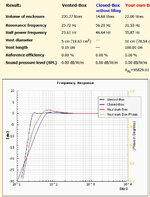
Started on a sub box. Audio gear is heavy, so goal is to minimize weight. One sub instead of two, with more than too much power. The sub is a Rockford Fosgate punch P3 shallow. They have been the same for a long time, more than 10 years. Low freq output is proportional to box size/weight, unfortunately. With only one driver I want to get the most output with a reasonable box size, a balance. Manufacture recommended box is 0.5 sealed or a 1.0 vented. I used this calc
www.micka.de
and picked a vented design that has more output where I want in a smaller box than they recommend.
0.77 cu ft. Port is 4" diameter and 39" long for resonant of 32 Hz.
Typically the port is inside the box, but that requires the box to be that much larger and heaver. Also, the shape effects the amount of material needed to construct the enclosure. A sphere is best, a cube next, and long skinny objects the worst. A behind the seat single cab box is shallow, long & skinny, and exacerbates the issue further. So an external port is good here, and it doesn't matter how long it is, as it doesn't effect weight. So I can somewhat cheat by using a really long port to get low frequency boost in a smaller box.
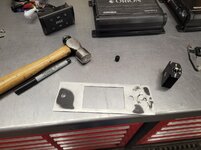
Shallow mount speakers somewhat cheat in that they push part of the speaker to the front side of the baffle, to make the depth less. This older P3 doesn't really do this but it does have surround over the top of the mount ring (instead of attached to) like all P3s making essentially a larger cone. The 10 still fits in standard hole 9-1/8" but is an 11" overall (instead of 10-1/8). The trim ring is 1" tall so I made the box an inch shallower than the nominal space available. I wanted to mount the amps on the box, mainly for old school style. They are 2" tall so I made the amp area recessed a board thickness to more match the speaker height.

I cheated and used brad nails in conjunction with glue and clamps to speed construction along. I chose to make the box short and put the port on the top. I sleeved the 4" drain pipe's bell end with ABS to make the end look thick like the 18" contraption in my shop. Then I attempted to cut the end off flush and it exploded in the chop saw. I had bought a 10' stick no knowing if I had enough, but my cheapness and stubbornness wanted to use the piece I started with. So I cut off the damage and came up with this:

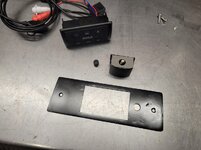
I drilled pilot holes for all the equipment and did a test fit. I made a spacer/clamp bracket to support the end of the port. I stacked up some steel flat stock like jinga and smashed it in the press to make the bends in the piece of aluminum.


 .. also i agree with the clamps as well