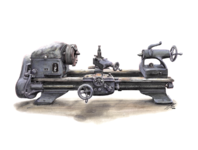
I'm getting the 10" Logan 200 lathe set up. It's in pretty decent cosmetic shape. The PO used a graphite-impregnated grease on the gears, so that's pretty messy, but it's OK. I use bicycle chain lube on my Logan 400.
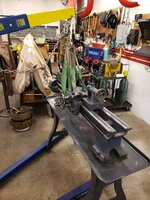


It's not up against the wall since I'm installing a DRO.
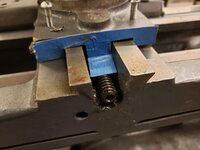
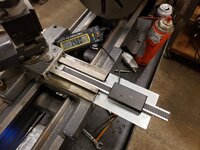
Here's my template for the glass scale for the cross slide. The scale will ride above and parallel to the lead screw and I'll fabricate an extended cover for it.

There is some minor damage to the spindle threads; no idea how that happened. That should repair easily with a file. The spindle threads are the same as on my 9" Logan 400, so all chucks and faceplates will interchange between the two lathes.

It's missing a carriage lock. The one I purchased from eBay has arrived and I'll get it installed.
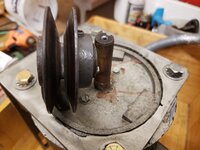
As has a dual sheave pulley for the motor to restore the full 12 speeds. The PO had used only a single sheave pulley. I ordered a double-sheave pulley from the Logan Lathe company. That motor is new-ish.

It's a 1945 model with change gears, no quick-change box. No change gears came with the lathe other than what are installed, but it uses the same gears as my Logan 400, so I'm good for now. Future plans involve an electronic lead screw for this machine, so change gears will not only be unnecessary, but Imperial/metric threading will then be available as well and a wide range of feed speeds.
The lathe came with some tooling including a faceplate and AXA QCTP (same as my 400) and two tool holders as well as a new-ish SHARS 3-jaw chuck that is sized better for my 9" model 400; I can put the larger Buck 3-jaw on the Logan 200. I already have a 4-jaw chuck and a 3AT collet system as well as a Palmgren milling attachment that all interchange (I may need a longer drawbar for the 200). I just acquired a follow rest and steady rest for the 400; they are not interchangeable, but are difficult to find. Follow and steady rests for the 200 are more plentiful and I'll be on the lookout.


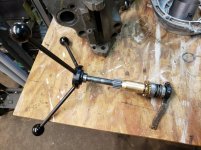
This is the tailstock wrench provided by the PO. It's actually a Snap-On hydraulic fitting wrench but, of course, it works just fine -- it's a wrench after all.
I'll install the DROs while it's away from the wall, then level the lathe, check the tailstock alignment and lubricate the machine, then make some chips.
I need to get back on the restoration of the Bridgeport mill and . . . I'll be in the market for a new shop location since I've sold this one!