DocsMachine
Well-known member
- Joined
- Sep 16, 2006
- Messages
- 1,930
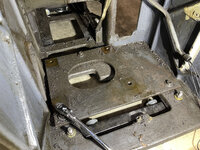
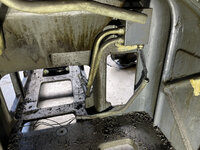
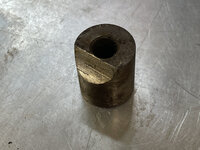
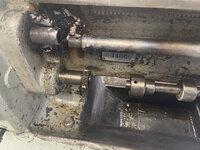
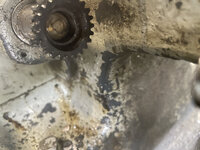
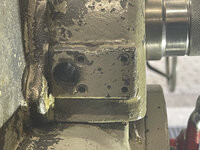
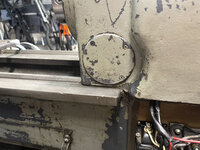
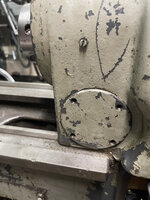
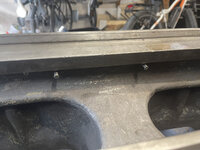
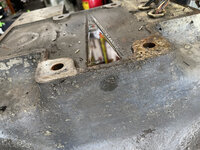
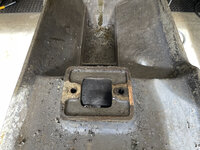
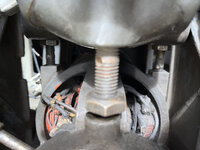
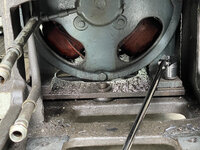
Working on the tail stock, does anyone have a tip for removing this stud?
-It's almost certainly threaded in. Put two nuts on it, tighten them together, spin it out.
Doc.


Working on the tail stock, does anyone have a tip for removing this stud?




Yea, and if it's not big enough to turn a propeller shaft for an aircraft carrier to a ten thousandth of an inch, they will sneer at you , and call it a toy and a piece of junk.I don’t post on practical machinist. Too many grumpy guys on there it seems like, especially towards new comers. For the Bridgeport I used a drop bed trailer. May do that again this time but would prefer not too if I can swing it.













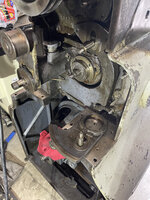
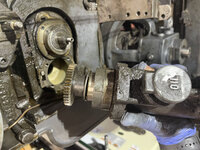

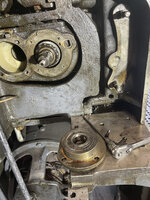


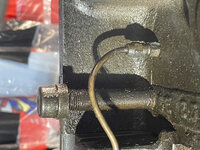






Thanks. It's nice having the brains of Garage Journal to help out too.Fantastic work - love seeing this kind of thing!
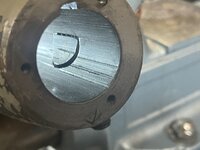
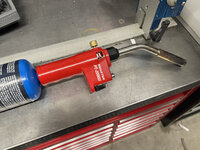
I do have a slide hammer, but there is no good way to attached it to the plug. I ended up resorting to heat and it worked great. It's also amazing how long after to heat it, that the cast iron retains its heat. I guess thats why it's also so good for cooking.Grant,
Regarding that stud, do you have a slide hammer? Two things you could do, first heat the body of the tailstock too warm to touch 250~275, either a slide hammer or use a nut and spacers to pull the stud loose.
Steve
Thanks. I have been fortunate to have had a lot of covers of ski media over the years but a NatGeo cover is a bit special. Evidently I have a bunch of images in the book as well, but I have yet to get my hands on a copy of it, as its only available for pre-sale on Amazon until the end of October.Congratulations on the book cover!
Thanks. I am really hoping it all turns out good when its finished. Its nice having tools that not only perform well, but look good too. I've found that having an appreciation for the quality of the machine, forces you to slow down and think out your process when using it more. That ultimate ends up in a better quality end result.... or at least seems to hold true for me.Grant - you are doing very nice work on that machine. I had one for a time about 20 years ago and it was almost a work of art in the shop and it looks like yours will be the same. I really did not see a lot of closeups of the ways - how are they? When you pull the carriage (a bear of a job in itself) be sure to flush out all of the oil lines and passages and just go ahead and replace the oilers with the correct new ones (pricey but it will be good for another 50 years). For manual machine way oil I have switched my machines over to Conoco Hydro-clear from the old Vactra - it is much cleaner and does not end up with the sulphur settling out and clogging everything up over the years.
The replacements that I got looked the same as the old ones but they were not corroded or clogged like the old ones - they just worked like they should. Some of the old ones were totally stopped up and at least another just drooled oil out so I ended up with very uneven oiling. When I got the machine it had been in storage for at least ten years but had been nicely repainted some time in the past. Just had a lot of problems from sitting for too long. The drives in the older round dial machines are basically scaled down elevator drives and are pretty reliable but when you get a lot of oxidation and humidity in the windings you can get a lot of arcs under load. I cleaned the motor contacts and changed the brushes and put an old school worklight in the motor compartment to warm everything up for a month or two and it behaved much better. My dad used to be an industrial electrician in the 50s and 60s and that was his suggestion - get everything warm, dry, and clean and it will be happier. Went through several cans of CRC contact and electrical winding cleaner doing that.Thanks. I am really hoping it all turns out good when its finished. Its nice having tools that not only perform well, but look good too. I've found that having an appreciation for the quality of the machine, forces you to slow down and think out your process when using it more. That ultimate ends up in a better quality end result.... or at least seems to hold true for me.
I was un-aware (but not surprised) that they changed the design of the oilers. I haven't gotten it torn down enough yet, to know what the factory ones look like. Do you have any info on the new design or a product link?
I have been using the Vacrta for the Bridgeport, but will need a bigger bottle of the lathe, so I'll have to try the Hydro-clear for it. Thanks for the info!


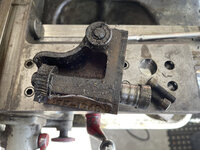


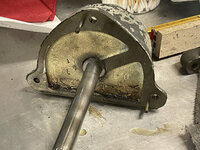
 So I removed the two dog point set screws in the bottom of the apron. I also removed both oil drain plugs and got a minuscule amount of oil out of them.


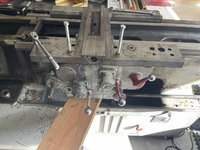
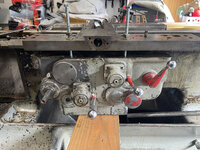


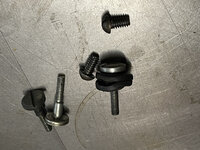

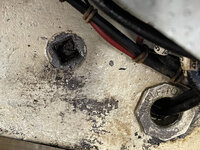


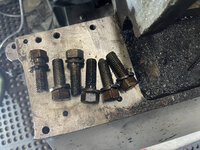


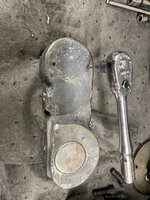


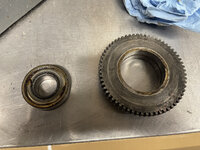


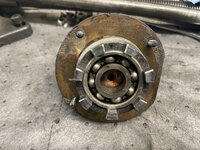

Look up Accurate Bearing onlineI have been trying various heat cycles on trying to get the rack pins out. While they are soaking again in Kroil, I decided to work on cleaning up some of the parts on the work bench.
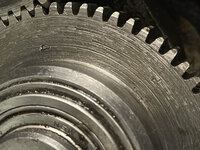
First I needed to press the bearings out of the end gears I pulled, so that I can put the gears into the Ultrasonic cleaner.
Step 1 is to remove the locking rings on both sides of the gears. These gears use two New Departure C487505V bearings with snap rings on each side. I ended up using the new Proto / Wilde snap ring pliers I just got as my craftsman ones had too much deflection to get the rings off. Here is a link to the thread where I was trying to decide what snap ring pliers to buy and why I went with these.
Next the center bushing needs to get pressed out. I used a brass drift and my arbor press for this.
There bearings can then be pressed out. I used a large socket as a drift as I didn't have any drifts the correct size.
One bearing on each gear, still felt like it had some life left in it, but one on each was completely toast.
Remember the bearing on the tumbler shaft assembly separated when I removed it from the lathe. So I was faced with a challenge of how to get the inner race off.
What I ended up doing was to hold the bearing by the jaws of my vice. I then used a piece of black Iron pipe that fit one of the shafts steps perfectly and then taped it out.
That went a hell of a lot easier than I had expected. Inside of the tumbler shaft cup, is another bearing thats fully pressed in.
There is no way to press it out, and no room to get a blind bearing puller behind it. Luckily the engineers at Monrach where thinking ahead, and they had drilled two access holes for inserting a pin punch to tap the bearing out.
Most of the original bearings for the end gear on my 10EE are shot, and since I have it all apart now is the best time to replace all of them.
I know New Departure is long out of business, and I suspect that modern bearing technology has only surpassed what was used in the lathe back in 1944. So trying to figure out modern replacements.
I am no expert in bearing nomenclature and most of what I typically work on is pretty standard off the shelf bearings for high-end mountian bikes.
The bearing numbers I am looking at replacing are:
New Departure C487505V. No idea what the C is, but the V is SNAP RING LOCATED ON OPPOSITE SIDE FROM STANDARD
New Departure NM0205B. No Idea what NM stands for. the B is DIMENSIONAL AND/OR INTERNAL DEVIATION WHEN SUFFIXED TO STANDARD BEARING NUMBER
New Departure C8505. No idea what the C is
Am I correct in thinking that all 3 of the above bearings are ABEC 5 rated?
The last bearing is made by SKF
2202 HC LW02. No Idea what HC or LW02 stand for.
So if anyone has any insight to what bearings to replace these with I would love to have some feed back and at least a rough idea of what to ask about before I head into the local industrial bearing supply shop.
Thanks!
Thanks. I'm going to see if the local bearing shop has suitable replacements in stock in the am.The C means that it has a metal shield and V indicates the snap ring to retain it (OD is probably a thou or two under a press fit bearing). If you google the bearing numbers you can usually find a suitable replacement. BTY, you are doing a heck of a job and really make me happy that my Hardinges are in good shape.


I agree with you on the bearing. All of the ones they used where top quality...like everything else on the lathe it was built without regard to costs. These lathes new cost several orders of magnitude more than the average house at the time. For the decorative steel pieces, I am thinking it would be nice to polish them up and then send them out to be chromed. I have never had any metal plating done, so not sure where to start with looking for a chrome shop and what prep needs to be done on my end. There is none local to me that I know of.I suspect that during the war they used what they could get so that notch in the bearing might be for something totally different. From looking at the pictures of yours, it looks like it has the steel decorative bars on the cast door on the front of the base - non-wartime machines had polished aluminum ones that really looked nice but aluminum was too valuable to use for decorations then. I would just clean and grease the bearing and I am sure that it will last longer than you will.






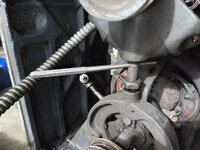

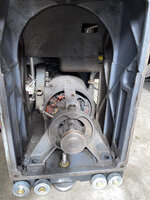

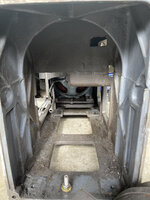

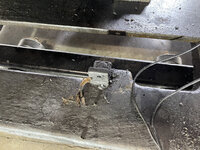
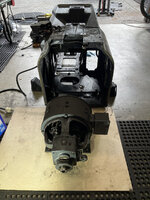

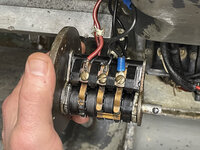
I think I found a Chrome shop about 45 minutes a way. Next time I am down that way, I'll stop in and see what kind of prep I need to do and see if I can get a cost estimate. It will just be a bunch of small parts, so hopefully not too expensive. I'm going to head into the local motor shop to get all new brushes for the motors, and see what the cost would be for them to re-dipp / check out the windings etc. Depending on the costs, ill have them do that. I think I will end up serving the bearings my self, but we will see.Call your local Harley Davidson shop because bikers love chrome and they should be able to point you in the right direction. Are you going to get the motors re-dipped while you have them out? If you have a good local motor shop tell them what you have and they might be able to give them a long overdue PM.


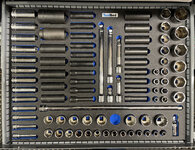

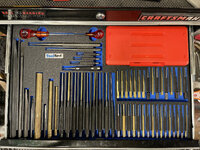
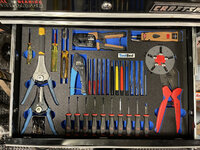
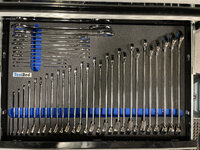
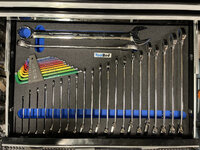
Thanks! Maybe I will do one, once the rest of the drawers are done. Trinyg to decide if I can do Tool Bed for those, or just use Kaizen foam as their as a lot of specialty tools in their thats nots in their system.I've been enjoying following along on the Monarch project and love your detailed writeups and pictures...that tool organization deserves its own writeup!
Thanks! I am very fortunate that I get to do it for my day job.X2 On the book cover, i miss skiing.
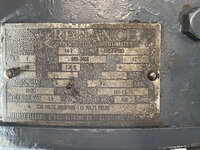
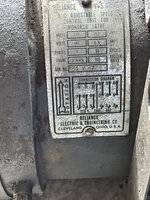
I'll have to reach out to Monarch on Monday. My gut tells me that these motors etc where used in more than just these machines, so I would think if it was possible to find the part number those brushes would be fairly available via a brush supplier.Supposedly Monarch still has brushes for these (https://monarchlathe.com/services/parts) so that would be the first place that I would try. I have a British spec Hardinge HLV-BK (the older narrow bed version) that the previous owner converted to VFD drive from the old reeves drive setup (220 volt VFD to a step up transformer) and the machine runs nicely and is very smooth. Only downside is you lose a lot of the low speed torque unless you step up the motor size. I did see a 10EE that was nicely converted with a Baldor super efficient 10HP motor and a 10HP VFD that was wired up through the original controls. Unless you can find a good deal on the motor and vfd, expect to spend at least $2500 on the conversion but it should match the torque at low speed of the original and be scary strong at higher speeds (you will probably need to detune it through the VFD PLC interface).