To avoid these ads, REGISTER NOW!

Rebuilding a monarch 10ee lathe

OP
G

Grant Gunderson

Well-known member
Joined
May 17, 2013
Messages
2,320
Location
Bellingham, WA
I took my son down to see Thomas the Train at the Northwest rail museum in Snoqualmie.... he's 5 now but still loves his trains!
IMG_6806.jpeg
The museum is pretty cool, and they have lots of stuff for kids. Hopefully they can raise enough money to build the round house they have plans for. I'd love to see the machine shop they use for the restorations.

Speaking of which, after I got done buying Stian a few more toy trails, I told my wife I had purchased the large Yates bandsaw they had outside.
IMG_6813.jpeg
She wasn't amused... That thing is in pretty good shape considering its sat at least the last year outside, as it was there last time we where down there. I'm pretty sure if I had bought it, I'd be looking for a divorce attorney!

Back home, after I finished sanding the guide coat and the little Bondo I had to rework down to 320 grit, I sprayed it all again with primer.
IMG_6847.jpeg
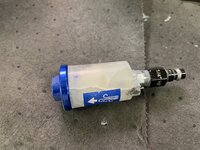
After the primer dried, I wet sanded it all to 600 grit, and mixed up the black Sealer paint. I was then all set to spray, or so I thought. Soon as I plugged the gun into the air, I noticed I had a major air leak.
IMG_6844.jpeg
The gun end water trap cracked! With the seal coat already mixed, I just sprayed it without a water trap. While the sealer coat was drying, I ran down to the paint supply store and picked up some of the disposable water traps.
IMG_6846.jpeg
Back in business. I then sprayed a second coat of the Sealer.
IMG_6851.jpeg
Lumabase states the Sealer coat doesn't need to be sanded if you spray the base coat with in 12 hours. I had a few dust nibs, so I wet sanded it to 1000 grit. Since I am painting in a tent outside, some dust nibs are unavoidable. Once I start the color coat, I cant stop until the final clear is on, and you can't really sand the metallic color coat, so now was the best time to deal with the dust nibs that had formed to this point.
IMG_6854.jpeg
I then sprayed 4 coats of the metallic blue color coat, to ensure I had a good even coverage. As soon as those coats flashed, I then sprayed another 4 coats of the Lumabase 4:1 2K poly clear coat.
IMG_6855.jpeg
That was a long day of spraying in 85F 65% humidity and I felt like I had been working in a sauna all day wearing a non breathable paint suit!
IMG_6857.jpeg
IMG_6858.jpeg
It was worth it. The finish came out pretty good. I feel like I am starting to get a bit better with the gun, and while the orange peel on the lathe body wasn't bad when I painted it last fall, I had way less this go around. I did have some dust nibs that got into the color / clear coats. So I need to address those. I'm going to let it cure all day today before pulling the rest of the tape. I think I'm going to wait a couple of weeks before I attempt to address those issues until the Poly is fully cured unless someone has a better solution.
 
To avoid these ads, REGISTER NOW!

DocsMachine

Well-known member
Joined
Sep 16, 2006
Messages
1,864
Speaking as a regular lathe user, while I love the quality of the finish, I'd have recommended against painting the tops of the "wings" of the saddle like that. That's the "first available flat surface" where an operator is always setting tools and wrenches- as well as having hot chips piling up on it, etc.

I'd have suggested keeping the top faces bare, and just buffed to a reasonable finish.

Apart from that, love the progress!

Doc.
 
OP
G

Grant Gunderson

Well-known member
Joined
May 17, 2013
Messages
2,320
Location
Bellingham, WA
Speaking as a regular lathe user, while I love the quality of the finish, I'd have recommended against painting the tops of the "wings" of the saddle like that. That's the "first available flat surface" where an operator is always setting tools and wrenches- as well as having hot chips piling up on it, etc.

I'd have suggested keeping the top faces bare, and just buffed to a reasonable finish.

Apart from that, love the progress!

Doc.
Thanks Doc. I actually debated quite a bit about wether or not to paint the tops of the wings. They where pretty beat up from 80 years of abuse just as you mentioned above. so even after a bunch of work they’d still stick out like a sore thumb against the rest of the lathe. So in the end I decided to do some body work on them and paint them. Most likely I’ll fab up some covers for them. Additionally do to the limited space in the shop I’ll be custom making some cabinets to go over the lathe with the idea of the bottom shelf being dedicated to lathe work. Worse case I can always strip the paint on them latter, but that would take a lot of motivation
 

dutchgray

Well-known member
Joined
Sep 28, 2014
Messages
6,468
Location
Dorset. England.
Those flat saddle tops are also extremely useful for magnetic indicator stands to be attached too, I would not want covers on them for that reason alone.
Thats quite a deep blue for a machine tool, its going to be a very striking lathe when its all painted.
 
OP
G

Grant Gunderson

Well-known member
Joined
May 17, 2013
Messages
2,320
Location
Bellingham, WA
After the paint cured for 48 hours, I peeled the tape.
IMG_6875.jpeg
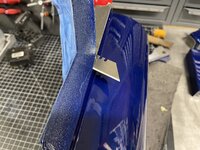
I slid a razoe blade under the tape, to help break the edge, to prevent any chance from the tape wanting to pull the pain from the parts.
IMG_6886.jpeg
Ok, time to get some of these parts back on the lathe, to give me some much needed work bench space back.

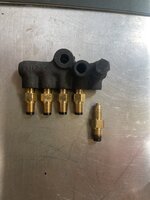
The first thing that needs to go on is the saddle, so I stated by getting the Bijur lubrication manifold prepped. I had cleaned it with my until sonic cleaner when I removed, it so all I needed to do was to blue it and then install the new meter units.


IMG_6891.jpeg
The lathe original used, 4 MJC-00 metering valves. These are for 3/32 tubes and the new replacement is a FJC-00. It also uses one MJB-00 which is for the 5/32 tube and the new replacement is FJB-00. Since these are compression fittings, no plumbers tape is needed. The Bijur torque spec states 2-3 turns past finger tight. I guess thats just shy of torquing it till it snaps, then backing off half a turn :lol:
IMG_6893.jpeg
There isn't a lot of room between the units, so I used a ⅜ mid length socket to install the meter units.
IMG_6895.jpeg
When I took the metering manifold apart, I had flushed all of the lines to ensure they where clear. Before reinstalling I used a small pick to make sure the ends where opened up. Ideally, I'd install new compression nuts / olives, but these where not coming off unless I cut the lines, and I was worried about having enough length left, so I left them in tack. While the tubing ends, look far from being a clean cut (they must have been in a big rush that day) the olives and nuts where in good shape, so I think they will be ok.
IMG_6896.jpeg
Due to the limited space, I found it was easier to install each line working out from the center. A ⅜ flare nut wrench would be ideal for this, buy I only own those in metric, so just used my Snapon ⅜ spanner.

I then cleaned up the tape residue form all of the matting surfaces using some denatured alcohol.
IMG_6509.jpeg
I've been switching my spray bottles out with these aluminum ones. You fill them with your content of choice, then they get charged with up to 200PSI from your air compressor using a schrader valve. The large one in front can be adjusted anywhere from a fine mist to a concentrated powerful stream. I use the taller sprayer for Denatured Alcohol as it just has a very powerful concentrated stream. It's perfect for flushing cavities out, etc.
IMG_6899.jpeg
All cleaned up and you can still see some of the original scraping.
IMG_6907.jpeg
The Front V-way has some wear, but there is only minimal ridging along the edge. I coated the ways with some way oil and placed the saddle back on the lathe.
 

Attachments

  • IMG_6890.jpeg
    IMG_6890.jpeg
    267.3 KB · Views: 6
Last edited:
OP
G

Grant Gunderson

Well-known member
Joined
May 17, 2013
Messages
2,320
Location
Bellingham, WA
I then turned my attention to the roller blocks that keep the saddle from lifting off.
IMG_6889.jpeg
I cleaned the paint overspray from the shaft hole with a reamer.
IMG_6915.jpeg
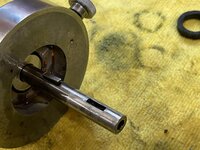
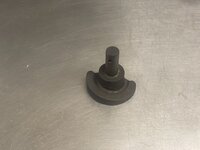
I lubed up the eccentric shaft with some super lube and installed it.
IMG_6917.jpeg
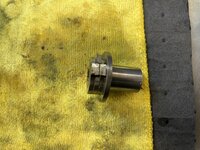
A spacer goes on next, then a *** 629-C-2HRS-L038 bearing goes on.
IMG_6919.jpeg
Followed by a thin washer and then a retaining ring.
IMG_5284.jpeg
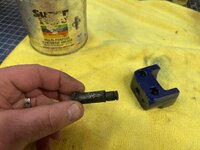
Despite having damn near every retaining ring plier possible, none of the ones in this drawer fit rings this small.
IMG_6921.jpeg
So I just pressed it on using a Snapon 10mm impact socket.
IMG_6920.jpeg
I then used a couterbore to clean up the recess for the socket cap screws.
IMG_6927.jpeg
This is where I noticed something interesting... the standard 5/16-18 counterbore doesn't fit. I seem to remember reading that the standard for socket head screws has changed over the years, and apparently this lathe is old enough it used the old narrower heads. Well ****, I had just purchased a bunch of new stainless steel hardware.
IMG_6923.jpeg
So I chucked the screws into the Bridgeport using a collet, and then filed the heads down with a corse file, then a fine file. Oh, btw my phone is on its last legs after a bike crash, and is apparently having a damn hard time focusing now.
IMG_6928.jpeg
That worked, but it will get really old, really quick if I have to do that for all of the hardware I am replacing on the lathe. I need to do some research and figure out what exactly I need to order that will have the narrower heads.
 
OP
G

Grant Gunderson

Well-known member
Joined
May 17, 2013
Messages
2,320
Location
Bellingham, WA
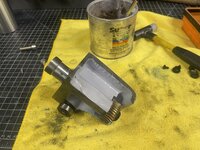
The thread dial bracket also has one of the anti lift roller brackets built into it.
IMG_6929.jpeg
So I assembled the thread dial. once again using super lube. The brass gear will only fit on one direction given the way the key was cut.
IMG_6930.jpeg
All assembled.
IMG_6931.jpeg
I then cleaned all of the threads using a thread chaser.
IMG_6936.jpeg
Now that the roller brackets are bolted back on, I dont have to worry about the saddle tipping off of the lathe.
IMG_6937.jpeg
I then slid the saddle all the way to the tail end, and adjusted the rollers on the tail end until they where just barely making contact. Its easy to feel with the eccentric shaft, and then added the lock ring and screw. I then repeated that with the head stock end.
IMG_6932.jpeg
I then checked the height of the saddle using my Starrett feeler gauges. At the tail end I have .002" on the front way and .0015 on the back way.
IMG_6913.jpeg
In the middle I have .0015" on both front and back way.
IMG_6935.jpeg
IMG_6934.jpeg
At the full forward position I have .003 on the front way and .002 on the back.


So thats:
Tail .002 F / .0015R
Center .0015F / .0015R
Head .003 F / .002 R

With the saddle only being a total of .0015 out on a 80 year old machine I am pretty happy. Then again it might just be a sign it’s relatively evenly worn in. The lathe has not been leveled yet, so we will see what happens once thats done. I think the real test will be the head to tail stock alignment.
 
Last edited:
OP
G

Grant Gunderson

Well-known member
Joined
May 17, 2013
Messages
2,320
Location
Bellingham, WA
@Grant Gunderson you want 1936 series socket head cap screws, they have smaller diameter heads, and are likely what monarch used when originally building these machines.
Thanks.

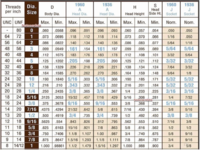
I did some quick research and it seems the differences are not always consistent in 1936 series being smaller, as there a handful of sizes that are the same. I found the chart bellow and apparently the 5/16 are in fact different, but the ⅜ bolts are supposed to be the same, but on the lathe those also had smaller counter bores than a standard ⅜.

Screen Shot 2022-07-28 at 10.29.14 AM.png
 

alex71

Well-known member
Joined
Jan 19, 2009
Messages
2,819
Location
SE Florida
There are no other standards for SHCS that i'm aware of...if the 1936 part fits your C/B, you're in luck. If not, it will likely take less time to turn the head OD down on commercially available parts than to find whatever non-standard stuff that was used on your machine.
 

DocsMachine

Well-known member
Joined
Sep 16, 2006
Messages
1,864
So I chucked the screws into the Bridgeport using a collet, and then filed the heads down with a corse file, then a fine file.

-You know, that's a lot easier to do in a lathe...

[runs]

:D

Doc.
 
OP
G

Grant Gunderson

Well-known member
Joined
May 17, 2013
Messages
2,320
Location
Bellingham, WA
-You know, that's a lot easier to do in a lathe...

[runs]

:D

Doc.
The irony is not lost on me!

I ended up tacking the saddle and compound installation today. First order of business was to clean up some of the parts.
IMG_6942.jpeg
For polishing parts, I typically like to hit them with some Mirka Abrasive first, depending on how thrashed they are I till start with 500, and then do 1000, 2000, 3000 and then 4000 grit. This saves a lot of time with the buffing.
IMG_6943.jpeg
For polishing I have a Baldor buffer. This thing is stupid powerful, to the point it can be a bit scary if you are not careful with it. It also makes one hell of a mess. It currently lives where the lathe is going to go. Once the lathe gets finished, my tentative plan is to build a long shed along the side of the garage where the previous owner had a dog run. I'll put power out there, and ideally installer a larger air compressor, a dust collector and then move the grinder and buffer out there as they are the messiest tools in the shop. For now, I gotta live with cleaning up after myself.
IMG_6941.jpeg
I keep the various abrasives and airways for the buffer in a large systainer, along with the cleaning rake and the various polishing compounds. To keep track of it all I have numbered the center of each airway with its order along with the color of compound it gets used with. The pre sanding usually allows me to start with either a white or red polish before moving along to the blue.
IMG_6945.jpeg
For smaller parts I am more comfortable buffing them if I attached them to some scrap wood, so I have more control.
IMG_6946.jpeg
The backlash for the crossed is adjusted by this pin putting pressure on to the bronze nut. It gets installed loosely first.
IMG_6948.jpeg
I then bolted the bronze nut into position. It will only fit one direction.
IMG_6950.jpeg
The dust plate gets a thin coating of way oil and is slid into its dovetailed slot with the small tab on the end pointing up into the cross slide.
IMG_6958.jpeg
The saddle then gets a coating of way oil, as well as the cross feed.
IMG_6962.jpeg
The crossed / compound assembly gets slid on from the rear of the lathe.
IMG_6963.jpeg
At least, I wont have to worry about making the first apprentice marks on it.
 
Last edited:
OP
G

Grant Gunderson

Well-known member
Joined
May 17, 2013
Messages
2,320
Location
Bellingham, WA
For the cross feed screw I need to make a felt oil wiper.
IMG_7026.jpeg
Based upon the original felt, I figured it was a ¾ inner by 1" outer. For this I used my Mayhem hole punch kit. This kit is really nice as it allows you to stack the cutters for creating rings just like this.
IMG_6975.jpeg
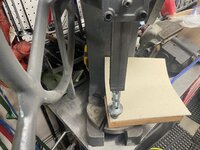
I have found they cut best, when you put some scrap wood under the felt (in this case ¼" F1) and then use the arbor press to make the cut with the dies.
IMG_6977.jpeg
All set.
IMG_7025.jpeg
IMG_6980.jpeg
The felt wiper gets sandwiched between two flat washers, and then a retaining ring holds it all in place. I found that for these kinds of rings, depending on the size, my Knipex Special circles pliers, or my Proto lock ring horseshoe pliers work best. FYI, those are made by Wilde tools, they are the OEM for Stanley-Proto as well as Snapon for this model, they are all identical except for the brand label and the Proto was the cheapest of the bunch when I bought them.
IMG_6983.jpeg
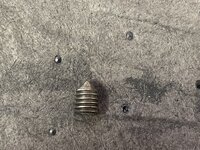
The stop screw has a shoulder machined into it, that gets retained by a small 4-40 dog point setscrew
IMG_6985.jpeg
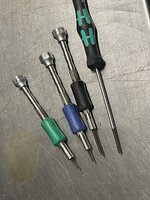
I used one of my small Vessel drivers for this. I like these for precision drivers, way better than the Wera set I have as well as better than the Wiha set I used to use for camera repair. They are also way cheaper than the rest too!
IMG_6987.jpeg
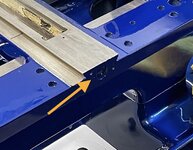
Note, on the cross feed bushing there is an oil port on it here.
10ABF496-BC93-416D-B0F8-62278AC03AE8.jpeg
It aligns with this port on the saddle as noted by the arrow above. Prior to cleaning I had no idea it was there.
 
OP
G

Grant Gunderson

Well-known member
Joined
May 17, 2013
Messages
2,320
Location
Bellingham, WA
IMG_6993.jpeg
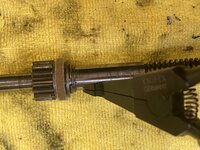
The first thrust bearing stack goes on the shaft between the gear and the cross feed bushing.
IMG_6994.jpeg

The second thrust bearing stack gets slid on to the other side of the bushing.
IMG_6996.jpeg
It gets retained by the first woodruff key.
IMG_6997.jpeg
The loose and lock collar stack then gets assembled. Note the orientation of the key ways into the two loose collars.
IMG_7001.jpeg
Here the stack is properly lubed with way oil and installed on the micrometer dial bushing.
IMG_7002.jpeg
The stack is installed and then followed by the second woodruff key being installed.
IMG_7003.jpeg
Followed by the micrometer dial.
IMG_7004.jpeg
The micrometer dial lock collar has a small brass plug that goes under the lock plunger.
IMG_7006.jpeg
The lock collar goes on, then the handle and its finally secured by the spanner screw using a shop made tool.
 
Last edited:

F-22

Well-known member
Joined
Jan 23, 2022
Messages
1,830
I have a more modern lathe, and it uses an interesting simple solution to eliminate most of the play on the nut on the compound slide and cross slide. It basically has the same length of nut, but it's split in two pieces at an angle, with a wedge in between. A set screw pushes in the wedge and forces the slack out.
 
OP
G

Grant Gunderson

Well-known member
Joined
May 17, 2013
Messages
2,320
Location
Bellingham, WA
With the cross feed screw fully assembled, I then installed the Gib from the front of the machine.
IMG_7007.jpeg
I then installed the Gib retaining screw from the rear of the lathe.
IMG_7009.jpeg
And then adjusted the Gib using the retaining screw on the front.
IMG_7008.jpeg
There are two spring load retaining pins that get installed on the back of the cross feed.
IMG_7010.jpeg
IMG_7011.jpeg
They are retained by a small set screw on each side. The dust cover for the screw then gets held on by these.
IMG_7019.jpeg
I then installed the over travel limiting bracket for the cross slide.
IMG_7018.jpeg
Finally the crossed screw assembly gets installed. It is left hand threaded.
IMG_7015.jpeg
And gets retained by two stainless hex bolts. I wanted to use button head screws for this as they would look cleaner, but there is no room to access them.
IMG_7032.jpeg
I then setup a Noga clamp with my Starrett indicator on the cross feed to measure how much backlash I have in the screw when adjusting the the pin that puts pressure onto the bronze nut. The best I could do was 55 thousands of backlash on the dial before it register movement on the indicator. I'm going to see if I can source a replacement brass nut. In my experience those seem to wear faster than the screw threads (or at least thats what I found on the Bridgeport rebuild). So hopefully that tightens it up a bit. Regardless, at the end of the day, I will most likely set the lathe up with a DRO, so it wont be that big of an issue.

Out of curiosity I also used the same setup on the compound and only got 4 thousands of backlash on it.
 
Last edited:
OP
G

Grant Gunderson

Well-known member
Joined
May 17, 2013
Messages
2,320
Location
Bellingham, WA
I have a more modern lathe, and it uses an interesting simple solution to eliminate most of the play on the nut on the compound slide and cross slide. It basically has the same length of nut, but it's split in two pieces at an angle, with a wedge in between. A set screw pushes in the wedge and forces the slack out.
My Bridgeport uses a split nut, and when you tighten the adjustment screw it forces the split together to adjust of the backlash. The monarch basically uses a pin, to cam the nut slightly out of alignment to adjust for it.
 

MBfreak

MEMBER EMERITUS
Joined
Dec 10, 2010
Messages
2,301
Location
Linkoping , Sweden
F22 said : I have a more modern lathe, and it uses an interesting simple solution to eliminate most of the play on the nut on the compound slide and cross slide. It basically has the same length of nut, but it's split in two pieces at an angle, with a wedge in between. A set screw pushes in the wedge and forces the slack out.

I had a soviet made 1972 Profila 1K62 lathe, heavy duty industrial with wonderful design all over. Weighed about 2200 kg, An the slides were totally playfree. Two large brass nuts that could be adjusted. Once the slide screw is worn, you had to adjust with some play. But the cross slide screw was a M26 standard edison thread, and easy to buy and replace.
Never had a better lathe. Feed rate for every thread ever invented . And going from 0,02 mm/turn to 157 mm/turn. Great for making drillbit blanks.
Sorry, lost all pics in a hard disk crash.

Ola
 

F-22

Well-known member
Joined
Jan 23, 2022
Messages
1,830
My cousin has a similar lathe "class" machine made by Potisje, but I think it's a license from the Italian Morando.

IMG_20210511_193153.jpg

Wonderful machine, very massive (can handle a couple tons, many models had the spindle high above the ways ...). It can also do countless thread pitches without swapping any sprockets. Also really nice and simple gearbox.
 
To avoid these ads, REGISTER NOW!

dutchgray

Well-known member
Joined
Sep 28, 2014
Messages
6,468
Location
Dorset. England.
My DSG lathe has two separate nuts on the cross slide screw with a steel shim between them that you grind on the surface grinder to adjust for wear, its a bit of a pain but you don't have to dismantle anything more than one cover to get the shim out, the compound has no adjustment for screw wear.

I have found that anytime you have to dismantle your lathe for repairs you need to go buy another to make parts on to fix the first.

I have recently sold a small lathe, so am down to just two, one that needs work before it is operational.

However in the week the opportunity came up to buy a good and well tooled Colchester Master 2500, an ok step pulley Bridgeport and a power hacksaw, plus all the MT drills, reamers, files, etc in the garage, for 3K

Impossible to say no really.
 
OP
G

Grant Gunderson

Well-known member
Joined
May 17, 2013
Messages
2,320
Location
Bellingham, WA
Ok, I should have stopped while I was ahead last night. I resisted adjusting the cross feed screw and ended up getting.

Near operator .021
center of travel .021
Far end of travel .005

So thats better.

I decided to tackle the tail stock today.

First step was to install the eccentric shaft assembly for the bed lock
IMG_7040.jpeg
It gets assembled in this order.
IMG_7036.jpeg
Everything gets lubed with way oil, then the bronze bushing gets pushed on to the shaft, and oriented so the recessed hole in it aligns with the set screw threads in the base casting. Then the eyebolt gets slid on to the eccentric part of the shaft then the retaining ring gets slid on, with the bevel side towards the eye bolt.
IMG_7042.jpeg
The bronze bushing gets retained with a high hold, conical set screw.
IMG_7044.jpeg
The retaining ring uses a dog point set screw.
IMG_7047.jpeg
I then chased the thread holes for the clamp guide pins.
IMG_7048.jpeg
Next I used the old oil reservoir felt as a template
IMG_7049.jpeg
I cut the new one out of ¼" F1 Felt and soaked it in way oil, along with coating the matting surfaces.
IMG_7055.jpeg
The base then gets placed onto the bottom of the tail stock, and I installed the clamp guid pins, lubed them with way oil, and slid the springs over them.
IMG_7058.jpeg
The clamp bracket gets installed in this order.
IMG_7059.jpeg
It is important that the half shafts get pressed in just shy of the opening for the Eye bolt. All 3 shafts get retained with dog point set screws on the flats machined into them.
 
OP
G

Grant Gunderson

Well-known member
Joined
May 17, 2013
Messages
2,320
Location
Bellingham, WA
The clamp then gets screwed into the tail stock assembly.
IMG_7062.jpeg
It's important to note that the eyebolt nuts have one side that has been machined flat. These need to mate with the block of the clamp assembly, so one faces up the other down.
IMG_7063.jpeg
I adjusted mine so the bottom nut is flush with the shaft. This matched the image I had from taking it all apart
IMG_7073.jpeg
I then placed some tape on the lathes bed casting to protect the paint incase I had it set too low.
IMG_7077.jpeg
Turns out I had plenty of clearance. I am using a tapper punch to move the eccentric shaft as I still need to paint the handle. or get it chromed... more on that in a bit.
 
OP
G

Grant Gunderson

Well-known member
Joined
May 17, 2013
Messages
2,320
Location
Bellingham, WA
Next, I need to assemble the tail stock spindle. Here is everything laid out in order.
IMG_7083.jpeg
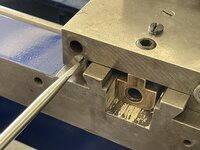
First the keyway for the spindle gets installed into the tail stock
IMG_7085.jpeg
It has this angled retaining pin that matches a hole in the bottom front of the tail stock
IMG_7100.jpeg
The spindle nut has a hole in the top of it for oil, it needs to align with the hole in the oil pathway machined into the top of the spindle.
IMG_7097.jpeg
I placed the spindle into the soft jaws of my size and tapped a new keyway in. It uses a .125 keyway stock, but I had to do some hand lapping with it to get it to fit just right.

IMG_7102.jpeg
The retaining nut then gets screwed in. I used a pin spanner wrench that I had left over from doing camera repair years ago. The nut doesn't need much torque.
IMG_7103.jpeg
As a set screw engages its threads locking it in place.
IMG_7124.jpeg
I lubed the spindle with plenty of way oil and slid it into the tail stock from the front.
IMG_7126.jpeg
The screw then gets threaded into the spindle from the tail end (its left hadn't thread) and a thrust bearing stack gets slid on it, and a woodwruff key gets tapped in to the shaft and another piece of ⅛ keyway stock gets placed into the key way at the end of the shaft. I had to lap it vertically to get a good fit.
IMG_7133.jpeg
The micrometer bushing then gets slid over the woodruff key and the key stock.
IMG_7140.jpeg
The tail stock bell end gets threaded into the tail stock, then the micrometer dial gets slid over.
 
OP
G

Grant Gunderson

Well-known member
Joined
May 17, 2013
Messages
2,320
Location
Bellingham, WA
IMG_7145.jpeg
The micrometer dial collar gets slid on
IMG_7148.jpeg
And finally the hand wheel gets installed and is secured by the locking screw using a shop made pin spanner.
IMG_7149.jpeg
A new spindle wiper felt is installed in its cover. It is ⅛ F1 felt.
IMG_7152.jpeg
And gets secured to the front using 3 stainless screws.
IMG_6878.jpeg
I chased the threads of the binder plug stud bolt. They where pretty gunked up and it was a real pain in the *** to get it out.
IMG_7155.jpeg
I lubed the threads with way oil and twisted it in 4 or 5 turns.
IMG_7153.jpeg
The binder plug was pretty stuck in the lathe when I got it and took a bunch of effort to get it out as 80 years of swarf where binding it, but it cleaned up really well. It also got a liberal coating of way oil.
IMG_7157.jpeg
And dropped into the shaft with the bevel side facing the spindle.
IMG_7162.jpeg
The locking lever then gets threaded on and the two set screws for the tang get installed flush into the sides of the spindle.
IMG_7166.jpeg
I am pretty damn happy with how the tail stock turned out. I have been debating if I want to get the bed locking lever and the hand wheel chromed. I am concerned that if I get them chromed, I will have some tolerance issues with the shaft holes and key ways in them. The shaft dia. would be easy to deal with, but I'd prefer to not have to try to grind the keyways back. The other option is to paint the center of the hand wheel and then just polish the rest of it. I am planning to get the oil dipper and way wipers chromed as well as some of the trim pieces. I need to take those down to a chrome shop and get an estimate, as no idea how painful its going to be. The tail stock was missing the oil plugs, so I am ordering these from McMAster, unless someone has a source for the style Monarch original used.
 

DocsMachine

Well-known member
Joined
Sep 16, 2006
Messages
1,864
... Something tells me you do a lot of skiing in your off time. :)

On the chroming, I was thinking of doing a few pieces on my big Springfield. They weren't chromed originally, as it was made in the middle of WW2, and of course chromium was a vital, strategic metal.

But, adding a little "bling" here and there, especially for all the time and money I've sunk into the damn thing so far, I think might be kind of interesting.

You might talk to the (or several) chrome shops and see if things like hub holes can't be masked. I seem to recall reading that some can, usually by using a silicone plug, or whatnot. Really, you could maybe make a snug-fit Delrin plug and provide it with the part. Delrin is pretty acid resistant, but it'd also be a one-use thing, so who cares if it gets eroded a bit.

Doc.
 
OP
G

Grant Gunderson

Well-known member
Joined
May 17, 2013
Messages
2,320
Location
Bellingham, WA
... Something tells me you do a lot of skiing in your off time. :)

On the chroming, I was thinking of doing a few pieces on my big Springfield. They weren't chromed originally, as it was made in the middle of WW2, and of course chromium was a vital, strategic metal.

But, adding a little "bling" here and there, especially for all the time and money I've sunk into the damn thing so far, I think might be kind of interesting.

You might talk to the (or several) chrome shops and see if things like hub holes can't be masked. I seem to recall reading that some can, usually by using a silicone plug, or whatnot. Really, you could maybe make a snug-fit Delrin plug and provide it with the part. Delrin is pretty acid resistant, but it'd also be a one-use thing, so who cares if it gets eroded a bit.

Doc.
Ha. Skiing IS my day job.

Thats my exact thoughts with the 10ee, I'm this deep into it, its probably worth it to bling up a few pieces... hopefully the cost isn't to insane. I pretty much now nothing about chrome. From my research it sounds like there is one shop and hour south and another just across the boarder to the north. So need to go pay them a visit and see what they have to say. Worst case it will be another learning experience.

The Delrin sounds like a great. Idea. Thanks! I'll see what the shop says about what kind of prep I need to do
 
OP
G

Grant Gunderson

Well-known member
Joined
May 17, 2013
Messages
2,320
Location
Bellingham, WA
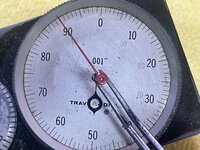
The 10EE Came with a TravAdial on it.
IMG_1956.jpeg
It had a bunch of swarf / grime on it. I cleaned up the exterior of the case when I got it, and it worked.... well sort of. The needled didnt move that smoothly. Some of this could be calibration on the machine, but removed it from the machine and moving the wheel that engages with the bed of the lathe still resulted in jumpy needle movement. I am willing to bet its full of swarf, from who knows how many years its been on the lathe.

My plan is to put a DRO on the lathe once its finished.... so that would make the TravAdial obsolete, but sometimes analog gauges are nice to have in addition to digital.... especially when trying to creep up on a number. I've never seen one of these units in person before, so I am a bit curious as to how it works. Maybe the heat was getting to me today, but it seemed like a good idea to take it apart.

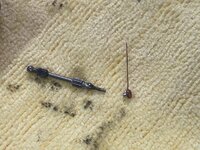
First, I lifted the plastic gauge cover off. It just snaps on. I then used my favorite (and, well worn), Knipex tweezers to lift off the needle.
IMG_7184.jpeg
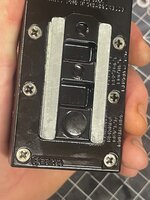
Turning my attention to the back of the case, there is 6 Phillips screws that hold it together.
IMG_7173.jpeg
A #1 Philips driver took them out easily.
IMG_7175.jpeg
All of the screws are the same size. Into the Ultrasonic cleaner they go.
IMG_7176.jpeg
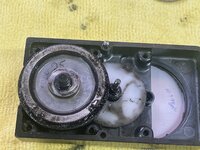
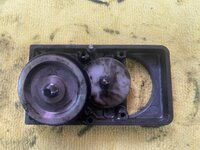
ugh.... thats a lot of swarf in there. The bottom of the case is swamped in oil and swarf and looking at the main gear on the right its caked in it. I am willing to bet this just needs a good cleaning... hopefully there is no broken teeth. Looks like someone last worked on it 10-7-96 So thats what 26 years of swarf and grime built up?
IMG_7178.jpeg
I used a few Q-tips to wipe out the lower case to see what I was dealing with. Looks like 3 sets of ball bearings that are pressed into some sort of cup that has two wave washers behind each. Typically I'd expect some sort of clip to be holding the wave washers down, but I couldn't find any. Plus I dont own any blind bearing pullers THAT small. So into the Ultrasonic it goes. I dont like putting bearings into the ultrasonic but these are packed full of ****.
IMG_7181.jpeg
Looking at the top half of the case, it appears the center plastic gear is what holds in the Needle axel and the main metal gear on left.
IMG_7183.jpeg
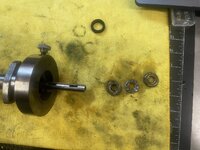
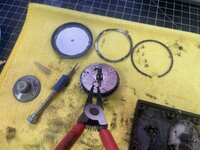
whipping the **** away from it, it appears its held in by a tiny (I'm guessing a .125) External retaining ring with 3 shims / washers bellow it.
IMG_5284.jpeg
I own a pretty complete set of retaining ring / circlip pliers all the way down to a J0
IMG_7188.jpeg
That easily removed it and allowed for enough play for the needle's axel to slide out.
 
Last edited:
OP
G

Grant Gunderson

Well-known member
Joined
May 17, 2013
Messages
2,320
Location
Bellingham, WA
IMG_7187.jpeg
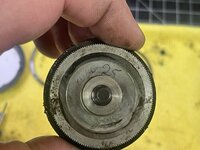
Here is the back side of the top plastic gear. There is a small gear on the bottom (top side in case) of it
IMG_7190.jpeg
Thats quite a bit of swarf. It looks to be either brass or bronze... thats in line with most of what I found cleaning out the machine.
Into the Ultrasonic the gear goes.
IMG_7192.jpeg
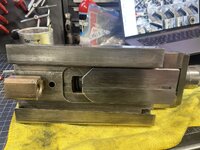
So that leaves us with the large gear on the left side of the case and another plastic gear under it. The larger gear appears to be pressed into the same shaft the knob is on. Looks like the knob is what is holding it in at this point. Let's turn our attention to the top of the case.
IMG_7193.jpeg
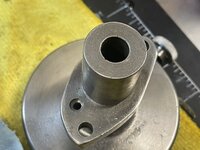
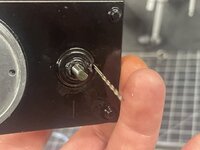
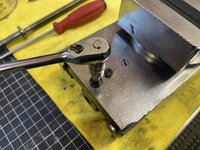
There are two holes in the side of the bezel one at the 25 mark and the other at 0. I assumed these where for set screws.
IMG_7228.jpeg
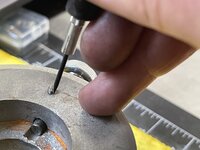
I couldn't find the head of a set screw at the 0 position even with my smallest flat driver. For reference the Wera on the right has a 0.3x1.8mm tip. So these guys are tiny! Ok, so guessing it must have disappeared over the years, but the bezel is still on solid, which seems odd for one that would have two set screws retaining it. So I then tried the 25 mark portion hole and felt something click... ok thats interesting. Anyways the dial slipped right off after that.
IMG_7195.jpeg
There is a wave washer under the that.
IMG_7197.jpeg
And then look at that its another retaining ring. This one is very loose and can easily be removed with your fingers. Turns out, the back of the bezel has a bevel on its leading edge and directly bellow that is a small grove. So the design is the bezel just gets pressed on to the case with the wave washer behind it and is retained by that ring. Smart, and pretty clever way to make it less labor intensive to assemble.
IMG_7199.jpeg
The knob has what appears to be a hole to access a set screw. However its not lined up at all for that. I tried holding the back of the metal gear it shares a shaft with an rotating the knob, but no luck. Portion doesn't change. So I used a small brass drift and was able to tap it off wich freed the large gear on the back thats pressed on to the shaft. I set the knob aside, and will come back to it in a bit. Now lets turn our attention to the back side off the case.
IMG_7200.jpeg
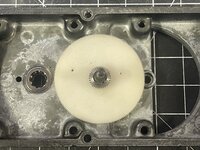
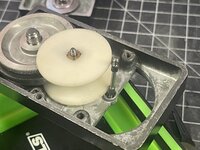
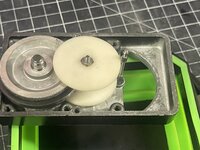
I can now lift the large metal gear on the left out, complete with its shaft, leaving the second plastic gear on the right in the case with its shaft.
IMG_7204.jpeg
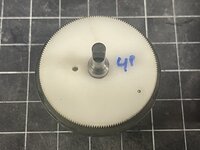
Here is the metal gear out of the case complete with its shaft assembly. Note it has 1000 and 25 written on it in pencil.
 
OP
G

Grant Gunderson

Well-known member
Joined
May 17, 2013
Messages
2,320
Location
Bellingham, WA
IMG_7205.jpeg
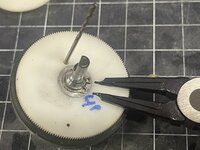
Flipping the metal gear over, there is a plastic gear on its backside (top in case) it is held on by an external snap
IMG_7207.jpeg
The snapping easily came off with my J0 size external retaining ring pliers. Note this ring is quite a bit larger than the one that was on the shaft of the center set of gears.
IMG_7209.jpeg
I then used a carbide scribe to make a small witness mark to indicate the gear goes back on with this side facing up towards me. Note, just to the left of the scribe's tip is a hole that the tip of a spring is inserted into.
IMG_7212.jpeg
I then just lifted the gear off. The shim stack is sitting on top of it. Also the tip of the screw driver is pointing at the tip of the spring that inserts into it. Note, the hole in the plastic and metal gear near the shaft. These correspond to another hole in the top case. I am fairly confident these are alignment holes for setting the proper spring tension when it goes back together. Align all 3 holes and you will have the proper spring tension of the main gear to properly tack the bed of the lathe, so it is critical. That will make assembly fun. At least they provided the alignment holes for us!
IMG_7214.jpeg
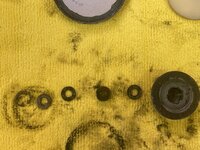
Here are the four shims. They both resided on the top side of the plastic gear, so I need to resist the temptation to sandwich the gear between them on assembly.
IMG_7216.jpeg
All thats left in the case is the center gear with it's shaft pressed into it. It simply lifts out.
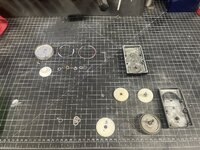
IMG_7172.jpeg
Everything but the dial and its needle gets tossed into the ultrasonic for a good cleaning. When doing small parts like these, I like to put them into a smaller tray inside of the tanks basket to keep them from disappearing.
IMG_7217.jpeg
Ok, back to the knob. It has what appears to be a thin layer of cork gasket material on it. there is then an internal retaining ring that holds its guts in.
IMG_7219.jpeg
Out it comes.
IMG_7221.jpeg
So there is a retaining ring, a washer, a wave washer, then the brass collar with the set screw I was trying to access earlier and then another washer in that order inside of the knob.
 
Last edited:
OP
G

Grant Gunderson

Well-known member
Joined
May 17, 2013
Messages
2,320
Location
Bellingham, WA
IMG_7223.jpeg
Did you know cotton swabs come in multiple sizes? The standard Q-tip size is on the right, I like these smaller ones of the left for cleaning small parts and I have even some Jumbo sized ones that work great on cleaning the inside of larger shafts etc.
IMG_7225.jpeg
A little bit of alcohol on a cotton swab makes quick work of cleaning the grime off of the dial. Look at how faded that red is!
IMG_7233.jpeg
And thats everything laid out in order. I'll see if I can get the case and knob painted tomorrow.
 

Mgdoug3

Well-known member
Joined
Mar 2, 2018
Messages
1,391
Location
KY
Nice work! If you do decide to make a new crossfeed nut don't use brass. Bearing bronze is what you want to use. Brass will wear quick. I just made a new crossfeed screw and nut for my Leblond lathe. I converted it to Acme threads and bought a LH 3/4-8 tap, precision 3/4-8 all thread and 954 bronze from McMaster Carr. Made everything for less than $400 and Leblond quoted me over $2600.
 
OP
G

Grant Gunderson

Well-known member
Joined
May 17, 2013
Messages
2,320
Location
Bellingham, WA
This morning I sanded the TravAdial casing and knob with 500 grit paper, cleaned it with isopropyl and then masked it for paint.
IMG_7236.jpeg
I dint have any hole plugs on hand, so I some of those press in automotive panel fasteners to plug the hole for the knob to protect the bearing from paint. This then reminded me to place an order for Silicone painters plugs. I'll surely need them on the rest of the project.
IMG_7237.jpeg
For the TravAdial I am just going to rattle can it. I have found the Hardhat series by Rustoleum is actually quite durable as far as ratelcans go, so thats what I will use, followed by a top coat of the clear.

While waiting between coats on the TravAdial, I stated stripping the lathes access panels.
IMG_7239.jpeg
My tentative plan is to have the Art Deco strips and all of the knobs Chromed. I need to go meet with a chrome shop next week and see how realistic, and painful to the wallet thats going to be, but at least thats the intent.
IMG_7238.jpeg
All of the deco strips unscrewed really easy, which was surprising given that all of the fasteners had been painted over.
IMG_7241.jpeg
As with many parts of the lathe, the knobs are secured using taper pins.
IMG_2451.jpeg
I have a pretty full set of punches. Everything from Drifts to pin punches, Starter punches and even brass roll pin punches. They all have a specific use. Most of mine are Mayhew, Starrett and Grace. I really like the Starrett ones, with the exception of their brass ones being a bit too soft.
IMG_7242.jpeg
To get the tapper pins out, I start by using a starter punch (left in the photo above) These have a tapered tip making them stronger. More importantly they have a concave tip that keeps them from drifting around when trying to break a pin loose. Once the pin starts moving, I switch to the pin punch on right to push it the rest of the way through.
IMG_7252.jpeg
Thankfully all but one set where quite easy to free. Once free, I used a carbide scribe to mark the panel and if its a left or right knob. Since these taper pin holes where most likely hand drilled, it wont work if you mix up the combination. So ideally this will save time on reassembly. I still dont know how ill keep the knobs straight if they get chromed, but hey, at least I am starting with the intent to keep them identified.
IMG_7256.jpeg
I have found with other tapered pins on the lathe, if they are difficult to remove, its most likely because the small lend of the pin somehow got peened over a bit. So for these I tap the large head to try to get the small head to be slightly proud. I then knock down the small head with a file to remove the peened over edge, and then usually they tap right out from the small side like normal.
IMG_7261.jpeg
The knobs are then press fit onto the shafts that have the cams that lock the panels in place. To remove these, I slide an automotive clip tool under them and this gives me the leverage needed to pull them right off. It's interesting the tail end cover panel doesn't have the Art Deco strips. I dont know if this is normal, or just do to this being a war machine... maybe I'll make some strips for it latter. We will see.
 
OP
G

Grant Gunderson

Well-known member
Joined
May 17, 2013
Messages
2,320
Location
Bellingham, WA
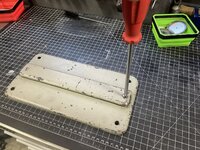
I got the paint shipped off of the access panel today.
IMG_7263.jpeg
So they are ready to be sanded for the Epoxy primer.
IMG_7265.jpeg
The knobs where still pretty filthy after soaking in lacquer thinner all afternoon. Note all of the dings in them.
IMG_7270.jpeg
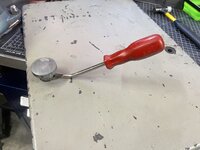
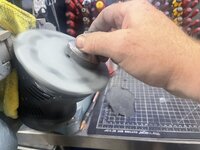
It would be really nice to have a disk or belt sander, but I have neither, so I clamped my Festool Rotex 150 into my vice and used it as a disk sander. Don't mind me.... I'm just over here polishing my knob. HA!
IMG_7266.jpeg
Knobs after 400 grit
IMG_7280.jpeg
Knobs after 500 girt
IMG_7283.jpeg
Knobs after 4000 grit
IMG_7285.jpeg
I then hit them with my Baldor buffer, first with Red compound then with Blue. They turned out pretty damn nice!
 
OP
G

Grant Gunderson

Well-known member
Joined
May 17, 2013
Messages
2,320
Location
Bellingham, WA
Time to put the TravAdial back together.
IMG_7287.jpeg
The black paint with the clear coat turned out pretty well.. the white not so much.... I think that can had been sitting around way too long. I am also getting spoiled with the finish I am getting out of the IWATA gun.
IMG_7288.jpeg
First step is to lube the bearing and gears. I was going to use my ARRI cineflex camera oil for for this. That stuff was insanely good for camera gears, but somehow the cap for the vile cracked and apparently it all spilt out on the shelf. Thankfully I keep all of my oil / lubricants sitting on top of pig mats, so no major mess. So instead I used some really light dupoont grease with teflon in it.
IMG_7289.jpeg
On assembly, I find it really helps if you can lay everything out in order, as it forces you to think about the sequence ahead of time.
IMG_7291.jpeg
The case alignment pins go back in the case first.
IMG_7292.jpeg
Next I assembled the travel wheel / main metal gear with the friction spring and the plastic gear that goes bellow it.
IMG_7294.jpeg
I then signed up the spring tension alignment holes and inserted a 1/64th drill bit to hold it in place.
IMG_7296.jpeg
The 4 shim washers go on next, followed by the external snap ring. With snap rings, I always like to try to rotate them in their groove after installation to ensure they are fully seated.
IMG_7297.jpeg
The lower center plastic gear goes into the case first.
IMG_7298.jpeg
The the travel wheel / main gear combo gets inserted. Note the drill bit I used to hold the alignment holes for the spring tension goes through the alignment hole in the case. Dont remove the drill bit until the case is fully assembled.
IMG_7299.jpeg
The upper center gear goes on next, with the brass gear facing down.
 
OP
G

Grant Gunderson

Well-known member
Joined
May 17, 2013
Messages
2,320
Location
Bellingham, WA
IMG_7300.jpeg
The shaft for the dial needle gets inserted next.
IMG_7301.jpeg
The shim stack goes on the center gear followed by its small external snap ring.
IMG_7302.jpeg
Everything is now back in the case.
IMG_7306.jpeg
The two half of the case get matted and all 6 #1 Phillips screws get screwed down.
IMG_7307.jpeg
The drill bit holding the alignment holes in place can now be removed.
IMG_7309.jpeg
The large retaining ring goes on the dial base.
IMG_7311.jpeg
The wave washer drops into the back of the dial..I put the service and my initials in.... curious to see when it needs service again.
IMG_7314.jpeg
Dial gets pressed on, until the retaining ring snaps in place. The Needle gets pressed on to the shaft followed by the lens getting pressed on.
IMG_7315.jpeg
The guts get put back into the knob in this order.
IMG_7316.jpeg
Make sure the set screw is actually aligned with the access hole.
 
OP
G

Grant Gunderson

Well-known member
Joined
May 17, 2013
Messages
2,320
Location
Bellingham, WA
IMG_7317.jpeg
Finally put in the internal snapring.
IMG_7318.jpeg
I used a lacquer stick to fill in the indicator mark for the knob, as well as for the knob markings.
IMG_7345.jpeg
I then clear coated the knob and thats where I ran into problems. The l white paint reacted with the clear, despite the white paint being from the same paint system. I found you can order replacement knobs / dial here. If the knob / faded dial ends up annoying me enough I'll probably order new ones. I still need to paint the bracket for it before I can install it.
 
OP
G

Grant Gunderson

Well-known member
Joined
May 17, 2013
Messages
2,320
Location
Bellingham, WA
IMG_7320.jpeg
The Art Deco accent bars for the access panel of my lathe where made of cast iron, since its a war machine... hell I'm surprised they even bothered with the accents during the war.
IMG_7322.jpeg
After stripping the paint form them, I hit them with some 40 grit sandpaper to see what I am actually dealing with. The castings are extremely rough, pitted and none of the edges are true or level. There is no way I will be able to sand and polish these in there given state and not have them come out super wavy / inconsistent. So there is only really two options forward, either machine new ones out of ½" AL bar or machine the rough castings. At this point it was 4:30, the only metal supply shop in town closes at 5 and I dont have any suitable bar in this size on hand. So not wanting to be that guy that shows up right at closing, I decide to move forward with machining the castings. I've never machined cast iron before, and knowing what I know now, next time I'd just make new ones! I'm not a fan at all of machining cast iron as it leaves fine dust that seems to get everywhere!
IMG_7321.jpeg
The bars have rounded edges on all sides, and the mounting tabs on the back are also rounded. Note the factory was far from constant in drilling the mounting holes, so they will only properly fit back in the correct spot. The 3 bars for the front access panel are the same hole to hole dimension. The bar for the access panel under the start switch is longer hole to hole, despite all of the bars being the same overall length. Also, holes are not symmetrical to the ends on each end. Each set is drilled with one set of holes closer to one end. I also found that while the holes are are close to being centered they are all constantly off center by the same amount.

So I have two problems, how to clamp these to mill them, but also how do I do it more efficiently and make each set symmetrical.
IMG_7324.jpeg
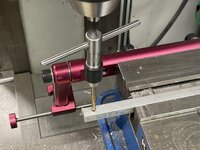
My solution was to cut a scarp piece of ½" bar to length.
IMG_7325.jpeg
I then drilled and tapped it on one end.
IMG_7326.jpeg
I then secured a bar from the first set on one end, and then used a transfer punch to mark the distance to the other hole. The mill took care of the centering.
IMG_7327.jpeg
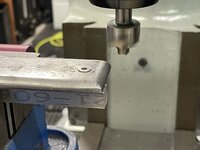
I know have a jig, so I can just swap the parts out for each cutting operation. First I need to clean up the sides. I am using a .250" radius cutter for this, and machined all of the right ends first.
IMG_7330.jpeg
Ok, thats way better. I now have straight ends with a constant curve. I'm not worried about the top edge yet, as that will get taken care of latter.
IMG_7337.jpeg
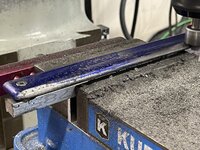
I used some dykem to mark the parts, so I could see what material I was actually removing. I then machined all of the front edges first. This pic is after the second pass on this part, you can see from the dykem how far out it is.
IMG_7343.jpeg
After I got the fronts cleaned up, I then took the same amount off of the back edges. Those ended up needing one more, pass, so I did a final pass on the fronts, before finishing with all of the left hand ends as oriented in the mill. all in all I took .060 off of each edge. I now have 4 constant and parraell sides with even radiuses. Tomorrow, I will do the bar for under the start switch, and then will finish milling these by machining all of the tops to the same thickness.

In hind site, if I was to do it over again, I would just make them from scratch out of aluminum. I think that might actually be faster. I had to take really light cuts in order to prevent chatter as they where only being supported from two points, relatively far apart... plus machining cast iron is damn messy compared to AL, Steel or Brass!
 
Last edited:
OP
G

Grant Gunderson

Well-known member
Joined
May 17, 2013
Messages
2,320
Location
Bellingham, WA
Turns out the factory drilled holes, are damn close to the correct hole size for a 6M tap (not exact, but close enough). So I tapped them to 6M.
IMG_7352.jpeg
This allowed me to mount them to the same AL bar as before, but from the backside, so that I could face them with a carbide insert mill.
IMG_7357.jpeg
I wedged a piece of wood between the plates and the AL bar to help reduce chatter in the middle. Far from ideal, but it worked.
IMG_7380.jpeg
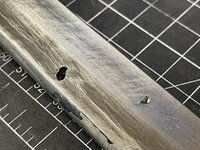
Here you can see, that the bars where far from having the same thickness top to bottom. So it took quite a few passes to get them even and flat.
IMG_7386.jpeg
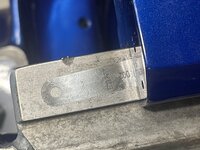
And then disaster strikes. I had to take so much off of the front to get them somewhat flat, I ended up milling open a few internal cavities in the casting. Well ****. I suppose those voids could get filled prior to chroming, but this point I was DONE with milling cast iron. In fact it would have to be a damn good reason to get me to do it again, as it resulted in a fine black dust on everything in my garage. Worse than wood dust. So I spent an entire day cleaning the mill, and the rest of the shop. I even dragged the rubber floor matts into the driveway to pressure wash to keep fro meh black powder getting dragged into the house (the wife would kill me if it got on the new carpet!).

Needing a break from working on the accent plates, I decide to start working on the access panels.
IMG_7402.jpeg
I wire brushed the cams that hold the panels on, then blued and oiled them.
IMG_7548.jpeg
I had previously used lacquer thinner to get most of the paint off the access panels. So all that was left was to hit them with a cupped brass wire brush in the grinder to get the rest of the paint remnants off.
IMG_7406.jpeg
That made quick work of it.
IMG_7407.jpeg
Several of the mounting pins where proud of the panel. My first attempt was to see if I could press them in flat with my arbor press. They wouldn't move. Ok Good. I dont want loose pins to ruin the paint latter.
IMG_7410.jpeg
They got ground flush using a flap disk. I also tried to knock down any of the more obvious high spots on the panels.
IMG_7411.jpeg
A company called high-temp sells these silicone painting plugs and caps. They are designed for use powder-coating, but they make it really easy to make sure you dont get paint into critical areas, and its easier and quicker than masking, Plus they are reusable.
 
OP
G

Grant Gunderson

Well-known member
Joined
May 17, 2013
Messages
2,320
Location
Bellingham, WA
IMG_7421.jpeg
With the temps being unseasonably hot here, the paint cured quite fast. My painting tent was like a sauna! Both sides of the panels got a coat of self etching epoxy primer. The backsides got the same single stage polyurethane paint that I used on the interior of the lathe. I really like that single stage primer, and for someone that doesn't want to do the additional steps I am doing with the exterior of the lathe, I think it would be a great option.
IMG_7433.jpeg
Silicone plugs and caps removed. That was easy. I then covered the inside of the panel with painters tape, and put the first coat of Bondo on the exterior side. It was so hot and humid, I could barely get a panel done before it kicked. I'll have to wait to do the second coat of Bondo until the temps get better.

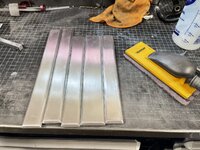
Back to accent plates. I decide to make new ones using AL bars, and for a cleaner look I am going to use blind holes to mount them, so no front fasteners. I started by facing all of the bars with the mill.
IMG_7431.jpeg
I was getting a ton of chatter on the ends where the bars stuck out from the sides of the vise. So I ran down to Grizzly and picked up two sets of machinist jacks.
IMG_7430.jpeg
I put one on each end, using a thin piece of cork between it and the bar stock and then made them finger tight. Not sure if there is a better way of setting this up, if so I am all ears. I did notice doing this, I get a bit of deflection the area above the jacks is very slightly higher than the section in the vise. Not critical for these parts, but I bet there is a more accurate way of setting this up.
IMG_7437.jpeg
Regardless, it took care of the chatter issue and you can see a big difference in the surface finish here.
IMG_7493.jpeg
All of the bars then got drilled with a ⅜" deep hole and bottom tapped. Using the vise stop made quick work of this.
IMG_7501.jpeg
Once again using the vise stop I rough milled the ends of the backsides of each piece and then milled the sides. The nice thing is once you set it up for each width, you can do all of the sides without moving. I aunt too concerned with surface finish here as you will never see this side on the lathe.

IMG_7504.jpeg
I then bolted each accent bar to some scrap stock, to allow me to clamp the pieces into the vise and then used a rounding mill with a ¼" radius to do all of the side profiles.
IMG_7533.jpeg
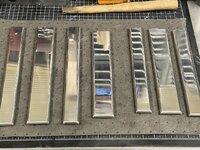
I used my Mirka hand sander to sand all of the pieces with 320, 400 and then 600 grit.
IMG_7545.jpeg
I then used some of the RED compound on the Baldor buffer and gave them all a quick polish. It turned out pretty good, so I didn't bother moving onto the blue compound. We will see what the chrome shop says when I make it down there. Hopefully week after next as I have another summer bike shoot next week in Vegas I gotta do first.
 
To avoid these ads, REGISTER NOW!
Top Bottom